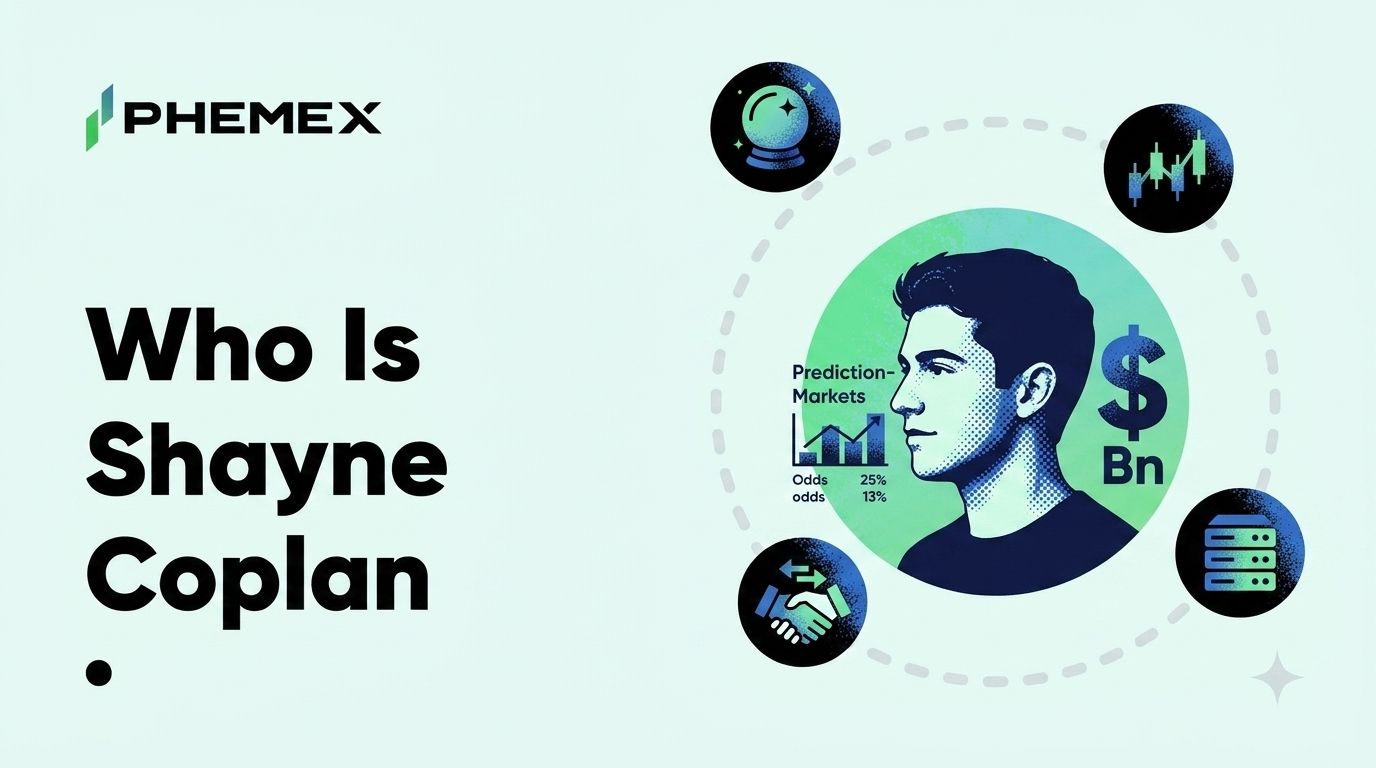
Shayne Coplan is the founder and CEO of Polymarket, the blockchain-based prediction market where people bet on the outcome of real-world events. On June 25, 2026, Polymarket closed a funding round of roughly $200 million at a valuation of about $1 billion, and that single line item turned the 27-year-old Coplan into a billionaire on paper. He owns a large slice of the company he started in 2020, and the new raise put a price tag on it.
The number is the headline, but the more interesting question is how a college dropout built one of the largest prediction markets in crypto, survived a federal settlement that nearly ended it, and walked it back into the United States. Here is who Shayne Coplan is, how prediction markets actually work, and what this raise signals about where the category goes next.
Who Shayne Coplan Is and How He Got Here
Coplan is a New York native who got into crypto early, buying Ethereum during its 2014 presale as a teenager. He briefly attended New York University and studied computer science before dropping out to work in the crypto industry full time. By his early twenties he had cycled through several blockchain projects and developed a clear thesis. Information markets, where the price of a contract reflects the crowd's real-time probability of an outcome, were underbuilt and undervalued.
That thesis became Polymarket. He founded the company in 2020 at the age of 21, betting that people would pay to express an opinion on an event and that the resulting prices would be more honest than any pundit's forecast. Most observers wrote it off as a niche curiosity. The 2024 US election cycle proved them wrong, when Polymarket's oddsbecame a reference point quoted by major media outlets and traders alike.
What stands out about Coplan is how young the whole arc is. He is 27 today, which means he has run Polymarket since he was 21 and is now a paper billionaire before most people finish paying off student loans. The wealth is concentrated and illiquid, tied to equity in a private company rather than cash in a bank account, but the valuation is real and so is the company behind it.
What Polymarket Is and How Prediction Markets Work
Polymarket is a prediction market built on blockchain rails. Instead of trading tokens or stocks, users buy and sell shares in the outcome of a specific question. Will a given candidate win an election? Will Bitcoin close above a price on a certain date? Will a sports team take the title? Each outcome trades as a share priced between zero and one dollar, and that price reads directly as a probability. A contract trading at 65 cents means the market collectively assigns a 65% chance to that outcome.
When the event resolves, winning shares pay out one dollar each and losing shares go to zero. The mechanism is elegant because the price is the forecast. There is no analyst spinning a narrative, just real money taking a position, and money tends to be more disciplined than opinion.
Polymarket settles trades in USDC, a dollar-pegged stablecoin, and runs on a low-cost blockchain so fees stay small. That is the DeFi part of the story. The order matching and the user experience feel like a normal app, but the settlement layer is on-chain and transparent, which means anyone can audit the contracts and the payouts. This combination of a familiar interface and a verifiable backend is a big reason the platform scaled past its rivals.
Why Polymarket Became One of the Largest Prediction Markets
Prediction markets are not new. Academics have studied them for decades, and earlier attempts existed long before Polymarket. What Coplan got right was timing and execution. He launched on cheap, fast blockchain infrastructure at a moment when crypto-native users were comfortable funding a wallet with stablecoins, and he focused relentlessly on the questions people actually wanted to bet on.
The 2024 election turned the platform into a phenomenon. As polling and punditry drew skepticism, Polymarket's prices offered a market-based alternative that updated by the second. Volume on the election questions ran into the billions of dollars, and the odds were cited everywhere from financial desks to cable news. That visibility pulled in a flood of new users who stayed to trade other markets, from macroeconomic data prints to sports and entertainment.
The platform's edge compounds the same way a deep order book does. More traders mean tighter spreads and more accurate prices, which attracts still more traders who trust the numbers. By 2026 Polymarket had built a liquidity moat that smaller prediction venues could not easily cross. The category is broader than one company, with regulated competitors like Kalshi operating in the US under a different legal framework, but Polymarket became the name most people associate with crypto-native prediction markets.
The Regulatory Battles Polymarket Has Faced
The path was not smooth. In January 2022, Polymarket settled with the US Commodity Futures Trading Commission, paying a $1.4 million penalty for offering event-based binary options contracts without the proper registration. As part of that settlement, the company agreed to block users in the United States from trading on the platform. For a product built around American political events, locking out American users was a serious blow.
Polymarket spent the following years operating outside the US while building volume internationally and through the 2024 election cycle, when much of its trading came from non-US participants and the platform's odds still dominated the conversation. The regulatory cloud never fully lifted during that stretch, and the company faced ongoing scrutiny from authorities watching the prediction-market space closely.
The turning point came as the US regulatory mood shifted toward clearer rules for digital assets. Polymarket pursued a compliant route back to American users, and by 2026 it had re-established a presence in the US market through a regulated structure. The detail that matters for the new valuation is that the largest single audience for political and macro betting, the US, is back in play. A prediction market without American users is a fraction of the business it could be, and reopening that door reset the company's growth ceiling.
The $1 Billion Raise and What It Signals
The roughly $200 million raise on June 25, 2026 at a roughly $1 billion valuation is the clearest signal yet that serious capital views prediction markets as a real category rather than a crypto sideshow. Investors are paying for three things at once. A proven product with genuine usage, a liquidity moat that is hard to replicate, and a clearer regulatory runway in the US than the company has had since 2022.
For Coplan, the math is straightforward. A founder who retained a meaningful equity stake in a company now valued near a billion dollars is a billionaire on paper, even if very little of that is liquid. The figure reflects investor conviction, not a bank balance, and private valuations can move sharply in either direction. Still, crossing the billion-dollar line at 27 puts him in rare company among crypto founders.
The bigger read is what it means for the sector. A well-funded, US-accessible Polymarket can build out new market types, deepen liquidity, and compete for mainstream attention against traditional polling and forecasting. It also draws a sharper line under the idea that on-chain settlement and stablecoin rails can power a consumer product at scale. The raise is a bet that prediction markets are early, not late, and that the company defining the category is worth backing now.
Frequently Asked Questions
Who is Shayne Coplan?
Shayne Coplan is the founder and CEO of Polymarket, the blockchain-based prediction market he started in 2020 at age 21. He is a New York native and NYU dropout who got into crypto as a teenager, and the June 2026 funding round made him a paper billionaire at 27.
What is Polymarket?
Polymarket is a prediction market where users buy and sell shares in the outcome of real-world events, from elections to macro data to sports. Each share is priced between zero and one dollar, settled in the USDC stablecoin on a blockchain, and the price reads directly as the market's probability of that outcome.
Is Polymarket legal in the US?
Polymarket settled with the CFTC in 2022 and agreed to block US users at that time, then operated internationally for several years. As the US regulatory environment clarified, it pursued a compliant path back, and by 2026 it had re-established access for American users through a regulated structure.
How did Shayne Coplan become a billionaire?
His wealth comes from his equity stake in Polymarket, not from cash. The roughly $200 million raise on June 25, 2026 valued the company at about $1 billion, and his retained ownership of a private company at that valuation put his paper net worth above the billion-dollar mark.
Bottom Line
Shayne Coplan built Polymarket from a contrarian thesis about information markets into one of the largest prediction platforms in crypto, and the roughly $1 billion valuation set on June 25, 2026 is the market pricing that work. The number to watch now is not his paper net worth but Polymarket's US user growth, because the regulatory reopening is what unlocks the next leg. If American volume returns at anything close to its prior scale, the billion-dollar tag looks like a floor rather than a ceiling. If regulatory winds shift again, that valuation gets tested fast. Either way, a 27-year-old founder just put prediction markets squarely on the map for serious capital.
This article is for informational purposes only and does not constitute financial or investment advice. Cryptocurrency trading involves substantial risk. Always conduct your own research before making trading decisions.