


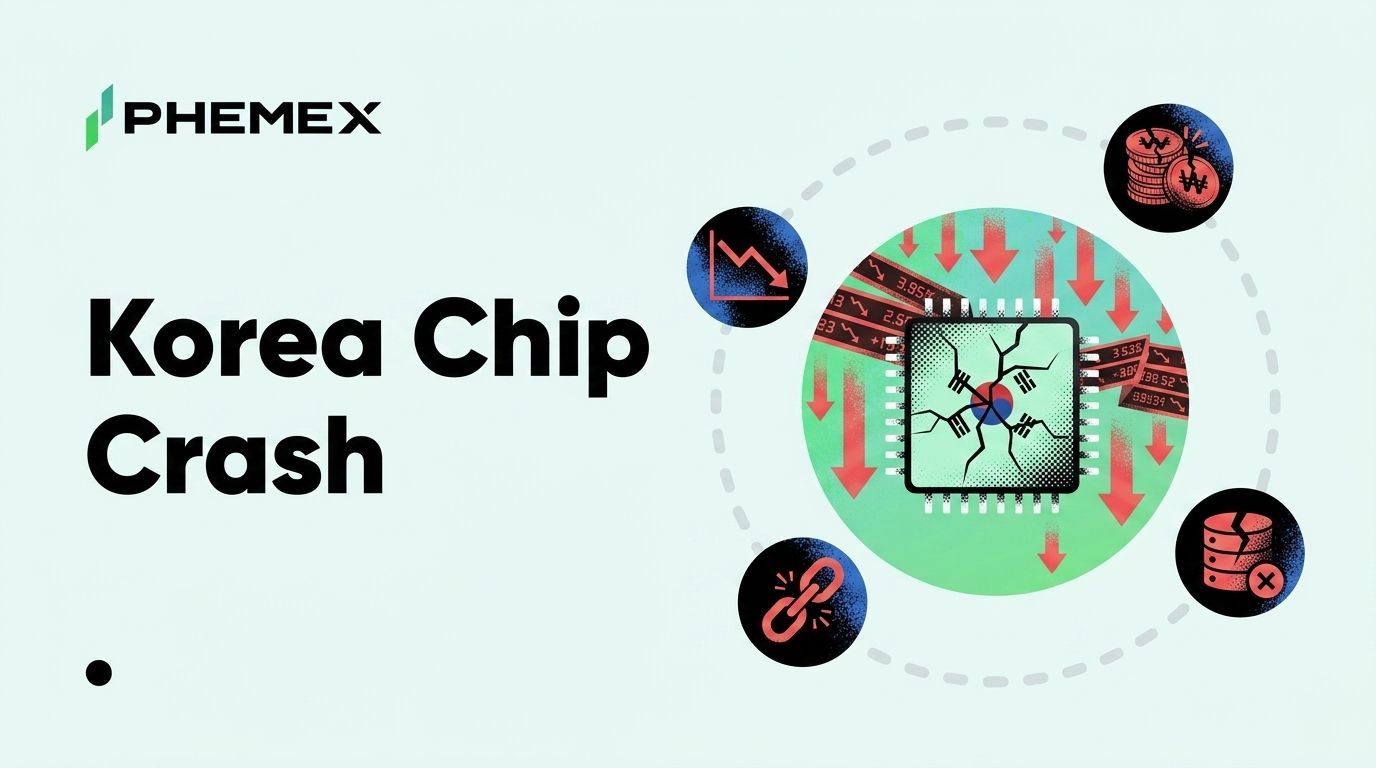
The KOSPI closed down ~10% on June 23, 2026 and triggered double circuit breakers in a single session, the kind of market halt South Korea reserves for the worst days on record. SK Hynix and Samsung both fell ~12%, Japan's Kioxia dropped ~15%, and the damage did not stay inside Asia. By the time US memory stocks opened, Micron traded at $1,051, down 7.25%, dragged into a fiscal Q3 earnings report it delivers tonight, June 24, 2026 after the US close.
The trigger was not a bad earnings print or a demand collapse. It was a forced unwind of 16 retail-heavy single-stock leverage ETFs built on Samsung and SK Hynix, products whose combined assets had ballooned to ~14 trillion won (about $9.1 billion), roughly 92% of it retail money, after launching only weeks earlier in late May. When the selling started, the leverage worked in reverse and the entire memory complex went with it. Here is how a Seoul ETF problem became a global semiconductor problem the day before the year's most-watched memory earnings.
What Actually Happened on the KOSPI on June 23, 2026
Source: Yahoo Finance
South Korea's benchmark does not trip a circuit breaker often. The exchange halts trading when the index falls 8% for a sustained period, and a second, deeper breaker fires at 15%. On June 23 both levels were hit in the same session, which is why traders are calling it a double circuit breaker day. The index ended down roughly 10% after the halts cleared and selling resumed.
The losses concentrated exactly where you would expect if the problem started with leveraged products. SK Hynix fell about 12% and Samsung Electronics fell about 12%, the two names those 16 leverage ETFs were built to amplify. The contagion then jumped the Korea Strait. Kioxia, the Japanese NAND maker, dropped about 15%, a sharper fall than either Korean giant because Kioxia is smaller, less liquid, and carries no index-fund cushion to absorb the selling.
What made the day frightening was the speed. A normal correction gives portfolio managers time to hedge. A forced ETF unwind does not. The funds had mechanical obligations to sell once their leverage thresholds broke, and those sell orders hit a market that had already gapped lower at the open. The Samsung stock trader positioning guide covers why these two names anchor so much of the region's index weight, which is part of what turned a product accident into a benchmark-wide event. The shape of June 23 will look familiar to anyone who has watched a reflexive selling loop in leveraged crypto markets. The mechanism is different, but the feedback math is the same.
How Single-Stock Leverage ETFs Forced the Unwind
A single-stock leverage ETF promises a fixed daily multiple of one stock's return, usually 2x. If SK Hynix rises 3% on the day, a 2x fund targets roughly 6%. To hold that multiple steady, the fund has to rebalance its derivatives exposure every single day. That daily rebalancing is the hidden engine, and on a falling day it turns the fund into a forced seller.
Here is the chain that played out across the 16 Samsung and SK Hynix products on June 23:
- The stocks opened lower on a routine AI-valuation wobble, nothing that would have caused a 10% index day on its own.
- The 2x funds breached their daily exposure targets, which obligated them to sell underlying exposure to bring leverage back to the mandated multiple before the close.
- ~92% retail ownership meant no patient holder to step in. Institutions hedge or hold through a dip. Retail money in leveraged products tends to panic-sell or get auto-liquidated by margin systems.
- The funds' selling pushed the stocks lower, which breached the exposure targets further, which forced more selling. A reflexive loop, exactly the failure mode regulators warn about.
- ~14 trillion won (about $9.1 billion) of concentrated assets unwinding into two stocks overwhelmed normal liquidity and dragged the whole index into circuit-breaker territory.
The political context made it worse. The governor of the Financial Supervisory Service had publicly regretted allowing these products to launch in late May 2026, a rare admission that a regulator misjudged a retail risk. That comment, surfacing again as the crash unfolded, removed any hope of an official backstop and told the market the funds were on their own. You can read the agency's own remit on the Financial Supervisory Service site, and the index mechanics on the Korea Exchange market page.
The Day's Chip-Stock Moves at a Glance
The selling did not respect borders. Here is how the memory and broader semiconductor complex moved as the unwind spread from Seoul outward.
|
Stock
|
Region
|
Move on June 23, 2026
|
Why it moved
|
|
SK Hynix
|
South Korea
|
~-12%
|
Core leverage-ETF underlying
|
|
Samsung Electronics
|
South Korea
|
~-12%
|
Core leverage-ETF underlying
|
|
Kioxia
|
Japan
|
~-15%
|
NAND read-across, thin liquidity
|
|
Micron (MU)
|
United States
|
-7.25% to $1,051
|
Memory contagion into earnings
|
|
NVIDIA (NVDA)
|
United States
|
held near $200.81
|
AI-valuation fear, less memory-direct
|
The split tells the story. The pure memory names took the worst of it, while NVIDIA held near $200.81 because the fear was specifically about memory pricing and a leveraged-product accident, not about AI compute demand broadly. That distinction matters for how a trader reads the next 24 hours. If this were a true demand-side AI selloff, NVDA would have led the way down. It did not.
The Contagion Path to Micron and Why MU Is the Next Domino
Micron is the only large US-listed pure-play memory maker, which makes it the natural read-across when Korean memory stocks crater. SK Hynix and Micron compete head-to-head in high-bandwidth memory (HBM), the chips that sit next to AI accelerators and carry the fattest margins in the entire memory market. When SK Hynix falls 12% on a structural-looking selloff, traders reprice Micron's HBM story in the same breath. The Micron trillion-club analysislays out why HBM is the swing factor for the stock.
That is how Micron slid 7.25% to $1,051 without any company-specific news. It was guilt by sector association, arriving on the worst possible day. Micron reports its fiscal Q3 2026 results tonight, June 24, 2026, after the US close(the quarter covering roughly March through May 2026). Walking into an earnings print already down 7% means the stock has no cushion if guidance disappoints, and an outsized reaction either way is now baked in.
The guidance line is the one that matters. Memory is a cyclical business where the forward outlook moves the stock more than the trailing quarter. If Micron guides HBM pricing and shipment volumes higher, it directly contradicts the panic that just hit Seoul and gives the whole memory complex a reason to bounce. If it guides cautiously, the June 23 selloff gets a fundamental justification it currently lacks. Micron's own numbers will be posted on the Micron investor relations site the moment they cross.
For context on how the AI-memory trade fits the broader semiconductor picture, the Samsung vs Broadcom AI semiconductor comparison, the NVIDIA 2026 outlook, and the Marvell AI outlook frame where memory sits relative to compute and custom silicon. Memory is the one corner of that picture priced almost entirely on spot pricing and inventory, which is exactly why a leveraged accident in Seoul transmits to it faster than to a design house like NVIDIA. That structural difference is the reason the day's losses fanned out so unevenly across the complex.
What a Trader Watches Now
The first question is simple. Was June 23 a contained accident, or the start of something larger. A leveraged-ETF unwind is, by nature, a one-time mechanical event. Once the 16 funds finish rebalancing, the forced selling stops, and the stocks can trade on fundamentals again. That argues for a sharp-but-brief shock rather than a prolonged bear leg, as long as no second wave of margin calls hits overnight.
The second question is the Micron print. Tonight's guidance is the cleanest fundamental signal the market will get on the real question. Did memory demand actually soften, or was June 23 purely a financial-plumbing failure. A trader watches the after-hours MU reaction the way a sailor watches the barometer. A strong guide that lifts MU in extended trading would tell you the Seoul crash was an isolated structural event, while a weak guide would confirm the bears.
The third thing to watch is NVIDIA holding $200.81. NVDA staying firm while memory names bleed is the tell that this is a memory-specific and leverage-specific event, not a broad AI-valuation unwind. If NVDA starts breaking lower in sympathy, the story changes from a contained Korean accident to a sector-wide repricing, and that is a very different trade.
Frequently Asked Questions
What caused the South Korea chip crash on June 23, 2026?
A forced unwind of 16 retail-heavy single-stock leverage ETFs tracking Samsung and SK Hynix, which together held about $9.1 billion in assets at roughly 92% retail ownership. Once the stocks opened lower, the 2x funds had to sell to rebalance, which pushed prices down further in a reflexive loop and tripped double circuit breakers on the KOSPI.
Why did Micron stock fall if the crash started in Korea?
Micron is the main US-listed pure-play memory maker and competes directly with SK Hynix in high-bandwidth memory, so traders reprice it whenever Korean memory stocks move sharply. The 7.25% drop to $1,051 was a sector read-across, not company-specific news, and it landed right before Micron's fiscal Q3 earnings.
When does Micron report earnings?
Micron reports fiscal Q3 2026 results tonight, June 24, 2026, after the US market close. That quarter covers roughly March through May 2026, and the HBM pricing guidance is the line most likely to move the stock.
Is a single-stock leverage ETF risky?
Yes, especially in a falling market. The daily rebalancing that keeps the leverage multiple constant forces the fund to sell into weakness, which can amplify a normal dip into a cascade when ownership is concentrated and retail-heavy, as it was with the Samsung and SK Hynix products.
Bottom Line
If the 16 leverage ETFs finish unwinding without a second margin wave and Micron guides HBM higher tonight, June 23 reads as a contained financial accident and the memory complex has room to bounce from oversold levels. If Micron guides cautiously and NVIDIA loses $200.81, the crash gets a fundamental justification and the selloff broadens from a Korean ETF problem into a sector-wide AI-memory repricing. Watch the after-hours MU reaction first, the overnight Seoul open second, and NVDA as the broad-AI barometer throughout. The cleanest signal arrives tonight, and the next 24 hours decide the verdict. Plumbing, or demand.
This article is for informational purposes only and does not constitute financial or investment advice. Cryptocurrency trading involves substantial risk. Always conduct your own research before making trading decisions.