Summary Box
Ticker Symbol: SYN
Current Price: Around $0.36–$0.41
Chain: Multi-chain, with canonical token deployments across Ethereum, Optimism, Arbitrum, Base, Avalanche, BNB Chain, Polygon, and others
Market Cap: Around $91.5 million
Circulating / Max Supply: Approximately 223 million circulating / roughly 255 million fully diluted implied supply
ATH / ATL Price: $4.92 / $0.027
All-Time ROI: Roughly +1,200% to +1,400% from the all-time low, depending on the live spot source
Availability on Phemex: Yes
What Is Synapse?
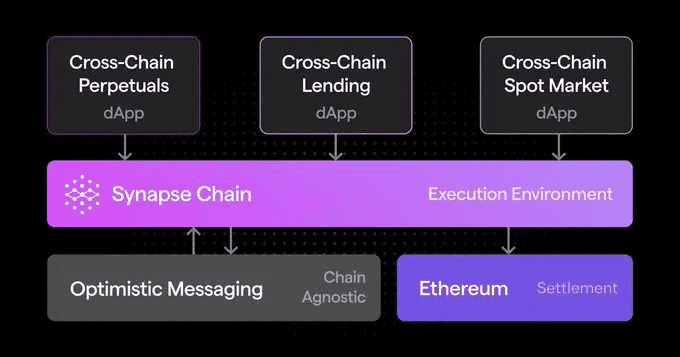
At its core, Synapse is a cross-chain interoperability protocol built to make blockchains feel less isolated. Crypto has spent years expanding into a maze of Layer 1s, Layer 2s, appchains, and specialized execution environments. That fragmentation has created opportunity, but it has also made liquidity harder to move, applications harder to scale, and users harder to retain. Synapse exists to reduce that friction.
Originally known mainly for its bridge, Synapse has evolved into something broader: a cross-chain communication network that supports asset transfers, messaging, swaps, and now more intent- and routing-based infrastructure. In plain English, it tries to make moving value and data between chains faster, cheaper, and more seamless. That matters because in a multichain world, the winning infrastructure is rarely the loudest token. It is the protocol that developers can depend on and users barely have to think about.
SYN is the governance token at the center of that ecosystem. Holders use it in DAO governance, and the protocol’s docs make clear that future emissions are governed by the DAO rather than locked into a permanently rigid schedule. The token’s tokenomics investment case therefore sits at the intersection of bridge activity, messaging adoption, and the market’s willingness to reward infrastructure tokens that solve real fragmentation problems.
Price History & Performance Overview
Synapse’s historical price action reflects both the promise and pain of crypto interoperability. During the earlier multichain boom, bridges were treated as essential infrastructure. Capital moved aggressively between Ethereum, alt-L1 ecosystems, and later the first waves of optimistic and zk rollups. Synapse benefited directly from that environment because it was not just another token chasing liquidity. It was part of the plumbing that allowed liquidity to move.
That tailwind helped push SYN to an all-time high of $4.92. At the time, the market was willing to pay rich multiples for protocols that looked like foundational pieces of the multichain future. The problem, as always, was that crypto infrastructure narratives often reprice faster than protocol cash flows mature. As the cycle turned, bridge risk became a bigger topic, risk capital rotated elsewhere, and investors grew much less generous toward tokens without obvious fee-to-market-cap support.
Since then, SYN has lived through a difficult repricing. The token’s all-time low sits around $0.027, which underscores just how violent the drawdown became. That collapse was not just about Synapse itself. It reflected a broader market shift away from speculative interoperability plays, lower enthusiasm for smaller governance tokens, and a much more skeptical view of how bridge activity should translate into token value.
Still, the protocol never fully disappeared. Synapse continued shipping. The bridge remained functional. New routing and RFQ-based infrastructure came online. Blog posts and product rollouts reframed the network as more than a static bridge. That is why the current phase is interesting. SYN is no longer priced as a market darling, but it still has enough infrastructure relevance that a proper recovery is not impossible.
Whale Activity & Smart Money Flows
Whale activity in Synapse is harder to read cleanly than it is for a simple one-chain token. SYN exists across multiple chains, and a large portion of the token’s real utility happens in routing, pools, bridges, and governance rather than passive spot holding. That means a single explorer view often captures only part of the story.
The Ethereum token contract page shows over 154,000 transactions on that deployment alone, which indicates the token is still actively used rather than completely dormant. The contract also reveals multichain visibility through Blockscan-linked addresses on Arbitrum, BNB Chain, Avalanche, and Polygon. That is important because it confirms what many traders miss: SYN’s flow pattern is fragmented by design. Large holders may not look like traditional “whale wallets” because activity can be split across chains, routed through bridge-related contracts, or repositioned between ecosystems.
From an investment perspective, that creates both opportunity and uncertainty. On the one hand, fragmented flow can reduce the optics of concentration. On the other hand, it makes whale monitoring less straightforward. In accessible public views, there is no easy proof of a clean, synchronized accumulation trend by obvious smart-money wallets. Instead, the better reading is that SYN behaves like an infrastructure token with diffuse usage rather than a meme asset with one or two hyper-visible whales pulling the market around.
On-Chain & Technical Analysis
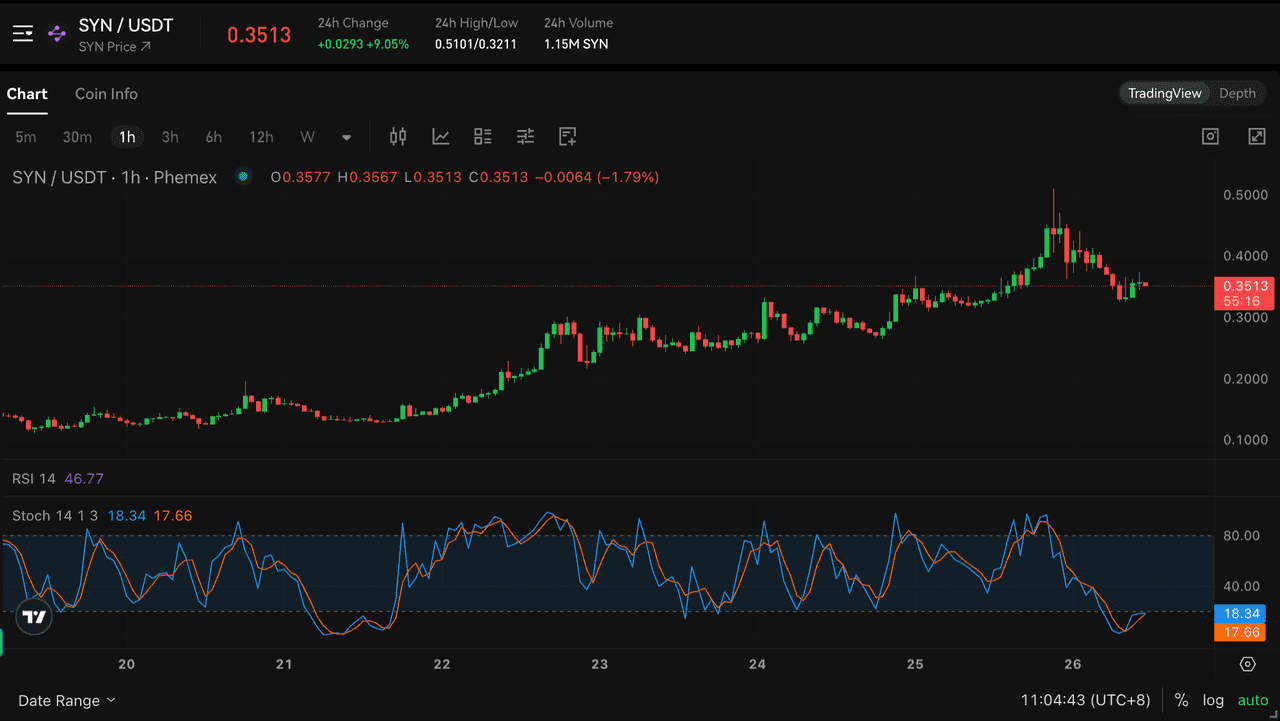
Technically, SYN is at an interesting but fragile point. The live market currently shows price in the high-$0.30s to low-$0.40s, which is still far below the $4.92 all-time high. That huge gap is important because it tells us the token is not in price discovery. It is in rehabilitation.
The nearest visible support zone sits around $0.32 to $0.36. That range matters because the live feed’s recent low sits just above $0.31, while a number of current tracker snapshots cluster in the upper-$0.30s and low-$0.40s. If SYN loses that band decisively, bears will likely target the psychologically important $0.27 to $0.30 zone next, which also sits closer to the weaker conditions implied by some contract-level token trackers.
Immediate resistance sits around $0.49 to $0.50, matching the recent intraday high and the first obvious breakout shelf. If SYN can convincingly reclaim and hold above that range, the next target likely shifts into the $0.60 to $0.75 zone, where the chart would begin to look less like a dead-cat bounce and more like a durable recovery. Beyond that, the $1.00 level becomes the next larger psychological marker.
A simple Fibonacci view of the recovery band from roughly $0.27 to $0.50 places the mid-retracement area near the high-$0.30s, which lines up well with current price action. That is useful because it suggests the present zone is not arbitrary. The market is already trading around a structurally meaningful level.
RSI and MACD should be interpreted with caution here because SYN’s liquidity profile and tracker dispersion can distort clean reads. Still, recent price acceleration suggests short-term momentum has improved from oversold conditions. The more important question is whether it can stay improved. If SYN holds above the upper-$0.30s, shorter moving averages will likely continue curling upward. If it drops back through them quickly, that would reinforce the view that the move was speculative relief rather than a durable trend reversal.
Short-Term Price Prediction (2025–2026)
For the rest of 2026, the short-term SYN price prediction comes down to execution versus relevance. The protocol still has working infrastructure, brand recognition in cross-chain transfer, and newer RFQ/interchain-network narratives. But it also has weak fee generation relative to market cap and a bridge sector that no longer gets the benefit of the doubt.
In the bull case, the market starts pricing SYN less as a leftover bridge token and more as a recovering interoperability infrastructure asset. For that to happen, bridge volume would need to improve meaningfully from current levels, messaging and RFQ adoption would need to keep growing, and the token would need to reclaim the $0.50 zone. Under that scenario, SYN could realistically trade in a $0.60 to $0.90 range before the end of 2026, with a stretch move toward $1.10 if the broader altcoin market becomes risk-on again.
In the neutral case, Synapse keeps shipping, usage remains real but unspectacular, and the market stays cautious because fees remain thin. Under that outcome, SYN likely ranges between $0.30 and $0.60. That would still leave room for tactical trades, but not necessarily a full structural rerating.
In the bear case, competition intensifies, bridge activity stays muted, and the market continues punishing tokens whose revenue does not justify their valuation. Then SYN could fade back toward $0.20 to $0.28. That would not necessarily mean the protocol is failing operationally, but it would mean the token market still sees better risk-reward elsewhere.
Long-Term Price Forecast (2027–2030)
The long-term Synapse price forecast is more about sector structure than weekly momentum. If the future of crypto really is multichain, interoperability will remain essential. The harder question is which protocols actually capture value from that future.
In a bullish 2027–2030 scenario, Synapse successfully extends beyond being thought of as “just another bridge,” and instead becomes a durable routing and communication layer that developers actually choose for cross-chain applications. If bridge usage and messaging volumes grow, and if token holders begin to believe the DAO can align emissions with real economic activity, then SYN could reasonably recover into a $1.20 to $2.50 range over the next cycle. That would still be below the most euphoric historical expectations, but it would represent a meaningful long-term recovery.
In a neutral scenario, Synapse remains useful but not dominant. It holds relevance, maintains integrations, and continues serving a slice of the cross-chain economy, but competitors absorb much of the growth. Under that outcome, a $0.50 to $1.20 range feels more realistic for 2027–2030.
In the bear scenario, interoperability becomes increasingly commoditized, and value accrual flows more to the applications or order-flow layers than to the token itself. If that happens, SYN may remain stuck in a lower range around $0.15 to $0.50, with occasional spikes but no durable rerating.
Fundamental Drivers of Growth
Synapse still has real growth drivers, and that is why the token deserves more than a superficial obituary. The first is obvious: cross-chain demand is not going away. As long as assets, users, and applications remain fragmented across multiple chains, there will be demand for fast, cheap interoperability.
The second is product improvement. Synapse’s own communication shows how much the protocol wants to shift the conversation away from old-school pool-based bridging toward RFQ-based routing and broader interchain infrastructure. Its blog claims median bridge time dropped from 20 minutes to 3 seconds and average quotes became materially cheaper after RFQ deployment. If those gains hold and scale, that is not a cosmetic upgrade. That is a product-level improvement that can matter commercially.
The third is ecosystem breadth. Synapse supports a wide range of chains, including major L1s and L2s, and its docs maintain canonical token deployments across many of them. That reach matters because interoperability protocols only stay relevant if they keep showing up where liquidity actually lives.
The fourth is governance flexibility. Because future emissions are DAO-governed, Synapse is not trapped in a completely inflexible token design. That does not guarantee strong value accrual, but it does mean the community has tools to respond.
Key Risks to Consider
The risks of investing in Synapse are just as real as the catalysts. First, current fee generation looks weak relative to token valuation. DefiLlama’s figures imply annualized fees that are tiny compared with market cap, and even the platform’s own prompt-like summary raises the question of whether the valuation multiple is too rich.
Second, competition in cross-chain transfers is fierce. The interoperability market is no longer a sleepy category with one or two players. Cheaper routing, better UX, and stronger liquidity can all pull users away quickly.
Third, bridge narratives carry security baggage. Even when Synapse itself is not suffering an incident, the bridge sector as a whole has been trained by past exploits to trade at a discount to perfect-case expectations.
Fourth, token-to-protocol value capture remains uncertain. A protocol can be useful without the token being dramatically underpriced. That distinction is crucial.
Analyst Sentiment & Community Insights
Community sentiment around SYN feels cautiously constructive rather than euphoric. The project still publishes product-focused updates, still talks about performance improvements, and still frames itself as building for the interchain future. That tone matters because it suggests the team is not simply relying on nostalgia from older bridge cycles.
From a market perspective, sentiment seems utility-driven rather than hype-driven. Traders watching SYN today are not generally buying it because it is the trendiest ticker on crypto social media. They are watching it because it looks cheap relative to where it once traded and because interoperability remains a real category. In other words, SYN’s community is more likely to reward tangible performance gains than vague branding alone. That is healthier in the long run, but it also means price recovery has to be earned.
Is Synapse a Good Investment?
The bullish thesis is that SYN offers exposure to a real infrastructure protocol trading far below its former highs, with working products, broad chain support, and a plausible path to rerating if interoperability returns to the center of the market narrative. The bearish thesis is that revenue remains weak, competition is intense, and the token may continue to lag even if the product remains useful. That makes SYN more appealing to speculative DeFi and infrastructure investors than to conservative buyers looking for low-risk compounders. It has asymmetry, but it also has baggage.
Not financial advice: Synapse still has a legitimate long-term use case in cross-chain communication and bridging, but the token’s upside depends on stronger value capture than the market sees today. The Synapse investment potential remains speculative but still promising heading into 2025–2030.
Why Trade Synapse on Phemex?
Phemex is a top-tier centralized exchange known for speed, security, and trader-focused tools, which is exactly the kind of environment that matters when dealing with a volatile mid-cap like SYN. Traders looking at interoperability tokens often need fast execution, deep order books, and straightforward risk controls because these assets can move quickly on sector news and broader altcoin rotations.
Phemex offers spot access across a broad range of crypto assets, along with futures, trading bots, and a wider suite of tools for more active market participants. Its platform design makes it easier for traders to manage volatile positions without relying entirely on on-chain execution or bridging into multiple ecosystems first. For Synapse specifically, Phemex is the natural centralized venue to monitor if you want clean market access, charting, and execution around a token that sits at the intersection of DeFi infrastructure and cross-chain growth.