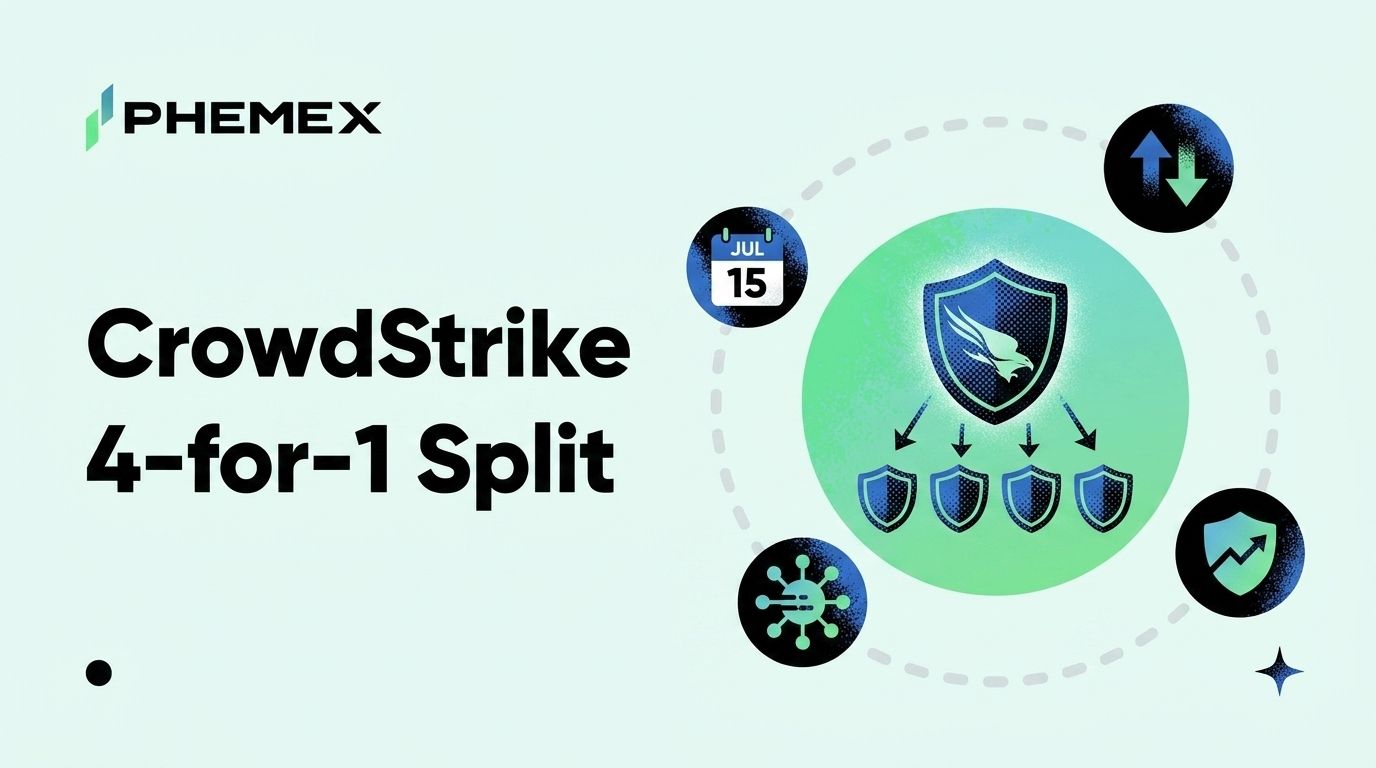
CrowdStrike closed near $748 after jumping roughly 7% on June 29, two trading days before its 4-for-1 stock split takes effect on July 2, 2026. The move came inside a broad cybersecurity bid that lifted Palo Alto Networks about 9% to near $332 and pushed Okta up around 5% in the same session. On the same day, Wells Fargo analyst Michael Turrin raised his CRWD price target from $500 to $900, an 80% jump that reframed how the desk is pricing the AI-security spending wave.
A split changes the share count and the per-share price. It does not change what the company is worth. The reason traders still care is what tends to happen around the date, and the fundamentals carrying CRWD into it.
CRWD price (June 29 close): ~$748
Recent move: +7% on June 29
YTD performance: ~+59%
Split ratio: 4-for-1
Split effective date: July 2, 2026
Here is what the split mechanically does, why it tends to amplify retail demand and short-term volatility, the rally and earnings powering CRWD, and the specific levels and dates a trader watches as July 2 approaches.
What a 4-for-1 Stock Split Actually Does to Your Position
A stock split multiplies your share count and divides the price by the same factor, leaving the total value untouched. After the 4-for-1 split, one share near $748 becomes four shares near $187, and a holder who owned 10 shares wakes up owning 40. Nothing about CrowdStrike's revenue, profit, or market capitalization moves because of this. The pie is cut into more slices, and each slice is smaller.
Here is the math laid out side by side, using the June 29 close as the reference.
|
Metric
|
Pre-split (June 29)
|
Post-split (July 2)
|
|
Price per share
|
~$748
|
~$187
|
|
Shares from a $7,480 stake
|
10
|
40
|
|
Total position value
|
~$7,480
|
~$7,480
|
|
Split ratio applied
|
1 share
|
4 shares
|
|
Market capitalization
|
Unchanged
|
Unchanged
|
The takeaway is that the split is cosmetic at the level of value. What it changes is accessibility and psychology, and that is where the trading interest actually comes from.
Why Splits Amplify Retail Demand and Short-Term Volatility
A lower nominal price lowers the barrier for retail buyers who think in whole shares rather than dollar amounts. A $187 share feels reachable in a way a $748 share does not, even though fractional trading has made that distinction less mechanical than it used to be. The effect is more behavioral than financial. Splits signal management confidence, they generate headlines, and they pull in buyers who were watching from the sidelines.
That fresh demand is also why splits tend to bring short-term volatility. Volume spikes around the effective date as new positions open and index funds and options market makers adjust. Option strikes get re-struck at the new price, and the contract multipliers reset, which can thin liquidity for a few sessions until the chain rebuilds. None of this tells you direction. It tells you to expect wider intraday ranges and faster moves in both directions for the first few days after July 2.
The honest read is that there is no durable edge in the split itself. Studies of post-split performance are mixed, and any pop tends to be sentiment-driven rather than fundamental. The split is a spotlight. What the spotlight lands on is the part that matters, and right now it is landing on a cybersecurity sector running hot.
The Cyber Rally Carrying CRWD Into the Split
The June 29 session was a sector move, not a single-stock story. CrowdStrike's 7% gain came alongside Palo Alto's roughly 9% pop and Okta's 5% rise, the kind of correlated strength that signals money rotating into software and cybersecurity names as a group. The driver is spending. As enterprises push AI agents and automated tooling into production, the attack surface expands, and security budgets are following.
The numbers behind the theme are large. UBS projects the cybersecurity market grows about 13% to roughly $240 billion in 2026, and security has become one of the few enterprise line items still expanding while other software budgets tighten. AI is both the threat and the product here. Attackers use it to scale phishing and intrusion, and vendors sell AI-driven detection to counter it, which keeps the spending loop turning.
Wells Fargo's Michael Turrin leaned directly into that setup when he lifted his CRWD target from $500 to $900. An 80% raise is not a routine tweak. It reflects a view that CrowdStrike's platform model, where customers adopt one module and expand into several, compounds as security budgets grow. You can track the broader market context through Phemex's coverage of AI agents in crypto, since the same AI-infrastructure wave drives demand on both the equity and token sides.
The Earnings and the 2024 Outage Behind the Recovery
CrowdStrike is splitting from a position of strength. In its fiscal Q1 2027 report, which covers the calendar quarter running roughly February through April 2026, the company posted revenue up about 26% year over year with total annual recurring revenue crossing roughly $4.6 billion. ARR is the metric that matters most for a subscription security business, because it measures the recurring base rather than one-time sales, and a $4.6 billion run rate at that growth pace is what justifies the premium multiple.
CrowdStrike's fiscal year runs ahead of the calendar, so its fiscal Q1 2027 is happening in the first half of calendar 2026. That labeling trips up readers who expect fiscal and calendar years to line up, and it is worth keeping straight when you compare quarters.
The recovery framing matters because of where this stock was two years ago. On July 19, 2024, a faulty CrowdStrike sensor update crashed millions of Windows machines worldwide, grounding flights and freezing hospitals and banks in one of the largest IT outages on record. The stock fell hard and the reputational damage looked severe. The bounce-back since then, with retention holding and ARR compounding to current levels, is a large part of why analysts are willing to underwrite a $900 target today. You can review the official numbers on the CrowdStrike investor relations page and pull the original filings from the SEC EDGAR page for CrowdStrike Holdings.
How the Cyber Names Stack Up Right Now
The rally is not uniform, and the leaders are pulling for different reasons. The table below frames the three names that moved together on June 29, alongside the catalyst attached to each.
|
Stock
|
June 29 move
|
Key catalyst
|
|
CrowdStrike (CRWD)
|
+7%, ~$748
|
4-for-1 split July 2, target raised to $900
|
|
Palo Alto Networks (PANW)
|
+9%, ~$332
|
Platform consolidation, AI-security demand
|
|
Okta (OKTA)
|
+5%
|
Identity security spending tailwind
|
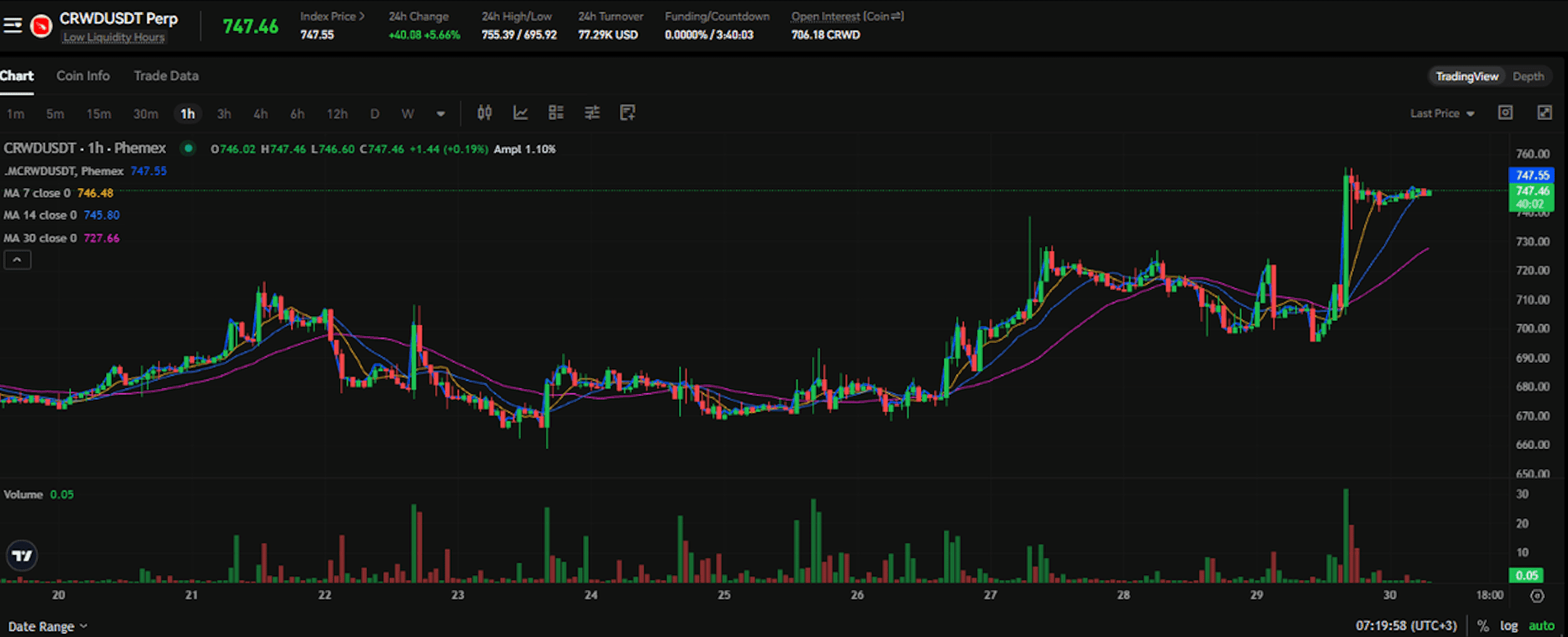
CrowdStrike sits at the center of this because it carries both the sector tailwind and a stock-specific event in the same week. PANW logged the biggest single-day percentage move, which tells you the bid is broad rather than CRWD-only. For traders who want exposure to the theme through crypto-correlated instruments, CRWD is the listed perpetual, and the same risk discipline that applies to leveraged crypto futures positions applies here. Volatility cuts both ways, and a 7% up day can reverse just as fast.
What a Trader Watches Around the Split Date
The first thing to watch is volume on July 2 and the sessions right after. A split that draws genuine retail demand shows up as sustained volume at the new $187 price, not a one-day spike that fades. The second is how the broader cyber bid behaves, because CRWD strength built on a sector rotation can unwind quickly if money rotates back out of security names. The third is the gap between price and the new $900 target, which implies roughly 20% of upside from the pre-split level and gives the rally a number to chase or fade.
Keep the split mechanics separate from the fundamentals in your head. The split itself is neutral on value, the AI-security spending wave is the real driver, and the post-split days are likely to be choppy regardless of direction. Trade the volatility with that framing rather than treating the split as a buy signal on its own.
Frequently Asked Questions
When is the CrowdStrike stock split?
The 4-for-1 split takes effect on July 2, 2026. Shares begin trading at the split-adjusted price, roughly $187 versus the pre-split level near $748, on that date.
Does a stock split make CrowdStrike cheaper to own?
No. The split lowers the per-share price but increases your share count by the same factor, so the total value of a position is unchanged. It can feel more accessible to retail buyers, which is a behavioral effect rather than a change in valuation.
Why is the cybersecurity sector rallying in 2026?
Enterprise security spending is one of the few software budgets still expanding, with UBS projecting roughly 13% growth to about $240 billion in 2026. The AI buildout drives it on both sides, since attackers use AI to scale threats and vendors sell AI-driven detection to defend against them.
What is CrowdStrike's price target after the rally?
Wells Fargo analyst Michael Turrin raised his CRWD target from $500 to $900 on June 29, an 80% increase. That target reflects expected expansion of CrowdStrike's platform as security budgets grow, not the split itself.
Bottom Line
CrowdStrike enters its July 2 split with a 7% tailwind, a fresh $900 target, and ARR crossing $4.6 billion on 26% growth, which is a strong setup that the split itself does nothing to change. The real test is the cyber rotation that lifted CRWD, PANW, and Okta together and how long it holds into Q3, because a sector-wide bid can fade as fast as it formed. Watch sustained volume at the new $187 price in the days after July 2, watch the broader security tape, and watch the roughly 20% gap to the new target as the level the market either chases or rejects. The split is the spotlight, and the AI-security spending wave is the thing standing in it.
This article is for informational purposes only and does not constitute financial or investment advice. Cryptocurrency trading involves substantial risk. Always conduct your own research before making trading decisions.