









Pi Network attracted over 60 million registered users with a simple pitch of mine crypto from your phone, no hardware required. The project launched its Open Mainnet in February 2025 and briefly touched $3.00 before collapsing more than 90% to trade around $0.14 in early February 2026. The token now sits in oversold territory with 1.2 billion PI tokens scheduled to unlock throughout 2026, putting constant pressure on an already fragile price.
This review covers what PI looks like from a technical and fundamental perspective, what the project has delivered so far, and what risks remain unresolved heading into the rest of 2026.
What Is Pi Network and How Does It Work?
Pi Network is a mobile-first blockchain founded by Stanford PhDs Nicolas Kokkalis and Chengdiao Fan. Users "mine" PI by tapping a button in the Pi app once every 24 hours. The network uses a modified version of the Stellar Consensus Protocol (SCP), where trust is established through user-created "security circles" rather than traditional mining or staking.
The total supply is capped at 100 billion PI tokens. Of that, 65% is allocated to community mining rewards, 20% to the core team, 10% to foundation reserves, and 5% to liquidity. As of early 2026, roughly 8.3 billion PI tokens are in circulation, and over 16 million users have migrated to the Mainnet.
What Do PI's Technical Indicators Show Right Now?
As of early February 2026, PI's chart structure is bearish on most timeframes.
Indicator | Reading (Feb 2026) | Signal |
Price | ~$0.14-$0.16 | Near 52-week lows |
RSI (14-day) | ~25-35 | Oversold territory |
MACD | Negative, below signal line | Bearish momentum intact |
50-day SMA | ~$0.17-$0.18 | Price below (resistance) |
200-day SMA | ~$0.25 | Price well below (bearish) |
Fear & Greed Sentiment | Extreme Fear | Market-wide risk aversion |
Daily Volume | ~$13-20M | Low conviction on either side |
The RSI has been hovering near oversold levels for weeks, but oversold does not mean a bounce is coming. In a sustained downtrend, RSI can stay compressed for extended periods. The MACD histogram remains negative with no bullish crossover in sight on the daily chart.
Price is trading below both the 50-day and 200-day moving averages. The 50-day SMA around $0.17 acts as the first layer of resistance. For any recovery to gain credibility, PI would need to reclaim $0.17 first, then break through $0.20, which was a psychological support level that turned into overhead resistance after January's breakdown.
Support sits around $0.14-$0.15. A close below $0.14 opens the path toward $0.10, which is the original listing price from February 2025.
Why Has PI Dropped Over 90% From Its Peak?
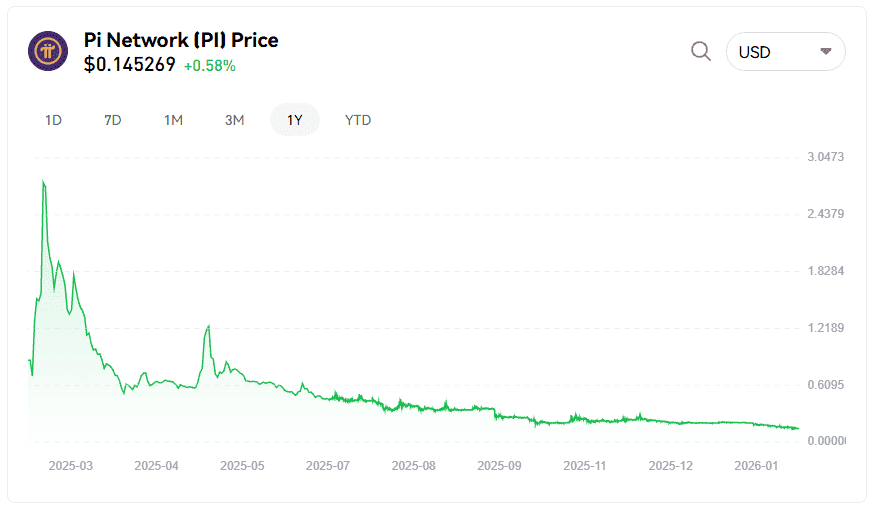
The decline was not caused by a single event. Multiple factors compounded:
Token unlocks have been relentless. January 2026 saw 134 million PI unlocked, fifteen times larger than December's 8.7 million release. February 2026 brings another estimated 130-189 million PI tokens into circulation. For all of 2026, roughly 1.2 billion PI tokens are expected to hit the market. Without matching demand on the buy side, each unlock adds selling pressure.
Limited exchange availability restricts liquidity. PI is not listed on Binance or Coinbase. The exchanges where it does trade have relatively thin order books, meaning sell pressure from unlocks has an outsized impact on price. Daily volume has hovered around $13-20 million, which is low for a token with an 8+ billion circulating supply.
The broader crypto market has been weak. Bitcoin dropped below $80,000 in late January 2026. The Crypto Fear & Greed Index hit 14, its lowest reading of the year. When BTC sells off, altcoins like PI tend to fall harder and recover slower.
Real-world utility remains thin. While over 215 apps were submitted through Pi's Hackathon program, most are experimental. There is no widely adopted DeFi protocol, no active DEX on mainnet, and peer-to-peer commerce using PI is still limited. The $100 million Pi Ventures ecosystem fund has made some investments (CiDi Games, OpenMind), but tangible results have not materialized in ways that drive token demand.
What Are the Biggest Risks Facing Pi Network?
Anyone considering buying PI should understand the structural risks that separate this project from more established cryptocurrencies.
Centralization is the elephant in the room. The Pi Foundation controls approximately 90% of the total 100 billion token supply. The network operates with only about 28 active nodes and 3 validators as of early 2026. For comparison, Ethereum has over 900,000 validators. This level of centralization contradicts the decentralized ethos that blockchain projects are built on, and it has been a primary reason Binance and Coinbase have avoided listing PI.
Governance is opaque. The core team has not delivered on its overdue Roadmap Version 2, originally planned for late 2023. Community members have repeatedly flagged vague timelines and limited accountability. Plans for decentralized governance (PiDAO) are mentioned in forward-looking documents, but nothing operational exists.
Tokenomics create ongoing dilution. With only ~8.3 billion tokens circulating out of a 100 billion max supply, the float will continue expanding for years. The declining issuance model helps slow the pace, but 1.2 billion tokens unlocking in 2026 alone represents roughly a 14% increase in circulating supply. That is a lot of new selling pressure for a token with limited organic demand.
KYC and data privacy concerns. Pi requires full KYC verification. The SEC has raised questions about Pi's centralized data storage and compliance model. For a project that promotes accessibility, the extensive personal data requirements have drawn criticism from privacy-focused users.
What Are the Bull Cases for PI?
Despite the long list of risks, there are arguments for why PI could recover.
The user base is massive. 60 million registered Pioneers and 17.5 million KYC-verified users represent one of the largest identity-verified communities in crypto. If even a fraction of those users become active transactors, the network effects could be significant.
Infrastructure is expanding, slowly. The 2025 Hackathon generated 215+ mainnet apps. Pi App Studio uses generative AI tools that lower the barrier for developers. Protocol v23 testing on Testnet includes AMM and DEX experiments. If DeFi functionality comes to Pi's mainnet, it could create organic demand for the token.
Mobile mining has a unique niche. No other major project has successfully built a mining model that works on smartphones without draining battery or data. If Pi can convert this accessibility into commercial utility, the long development cycle could pay off.
Price is heavily discounted from peak. At $0.14, PI trades at roughly 95% below its all-time high. For risk-tolerant buyers, this level represents either a value opportunity or a value trap, and the distinction depends entirely on whether the project executes over the next 12-18 months.
What Do Price Predictions Say for 2026?
Price predictions for PI vary wildly depending on the source, which tells you more about the uncertainty than the token itself.
Source | 2026 Range | Methodology |
$0.10 - $0.57 | Algorithm-driven, bearish short-term | |
$0.85 - $3.50 | Optimistic, adoption-dependent | |
Ventureburn | ~$0.28, up to $0.40 aggressive | Technical + AI models |
CoinCheckup | Bearish forecast, ~$0.15 near-term | Technical indicators only |
3Commas/TradingBeasts | $0.19 - $0.22 average | Statistical modeling |
The conservative models cluster around $0.15-$0.22, which reflects current technical conditions and ongoing unlock pressure. The bullish outliers ($0.85+) assume breakthroughs in exchange listings, ecosystem utility, and broader market recovery that have not happened yet.
The honest assessment: nobody has a reliable model for predicting PI because the token's price depends almost entirely on whether the core team delivers functional utility before the market loses patience.
How to Buy PI on Phemex
If you have reviewed the risks and decided PI fits your portfolio, Phemex supports PI purchases directly.
Step 1: Create a Phemex account and complete verification.
Step 2: Deposit funds via crypto transfer or fiat on-ramp.
Step 3: Navigate to Buy PI and select your purchase amount.
Step 4: Review the order and confirm.
Phemex provides real-time pricing, instant execution, and stores over 70% of user assets in offline cold wallets with Fireblocks institutional custody. All deposits are backed 1:1 through verifiable Proof of Reserves.
Frequently Asked Questions
Is Pi Network a scam?
Pi is not a scam in the traditional sense. It has a real team (Stanford PhDs), a functioning blockchain, and millions of verified users. The legitimate criticism is about execution speed, centralization, and whether the project can deliver meaningful utility before token unlocks drain value. It is a high-risk project with real infrastructure but unproven commercial outcomes.
Can PI reach $1 in 2026?
Reaching $1 would require roughly a 7x increase from current levels and a market cap exceeding $8 billion based on current circulating supply. That is possible in crypto, but it would need a major catalyst like Binance listing, a breakout DeFi application, or a broad altcoin rally. Most conservative models do not project $1 in 2026.
Why isn't PI listed on Binance?
Binance has not publicly explained its decision. Market observers point to PI's centralization (90% of supply controlled by the Foundation, 28 nodes), unclear tokenomics, and regulatory uncertainty as likely factors. A Binance listing would be a significant positive catalyst for price, which is exactly why the absence of one weighs on sentiment.
Should I sell my PI or hold?
That depends on your cost basis, risk tolerance, and belief in the team's ability to execute. If you mined PI for free and have no cost basis, the holding cost is minimal. If you bought at higher prices, the decision becomes whether you believe the project can recover before further unlocks dilute value. This is not a token where "just hold" is obvious advice.
How many PI tokens will be unlocked in 2026?
Approximately 1.2 billion PI tokens are scheduled to unlock throughout 2026. January already released 134 million, and February is expected to add another 130-189 million. These unlocks are the single biggest source of selling pressure on the token right now.
Bottom Line
Pi Network built something unusual: a mobile mining platform with 60 million users and a real, functioning blockchain. That community is an asset no other project has replicated.
But community is not enough on its own. The token has lost over 90% of its value since listing. Technical indicators are bearish. Token unlocks keep adding supply that the market is struggling to absorb. Centralization concerns remain unaddressed. And the DeFi ecosystem that could generate organic demand is still in testing.
For risk-tolerant buyers, the current price near $0.14 offers a speculative entry point with asymmetric upside if the team delivers. For everyone else, PI is a "watch and wait" until the project demonstrates that its infrastructure can match the scale of its community.
This article is for educational purposes only and does not constitute financial or investment advice. Cryptocurrency markets are volatile and past performance does not indicate future results. Pi Network carries specific risks including token dilution, centralization, and limited liquidity. Always conduct your own research before making investment decisions.
