

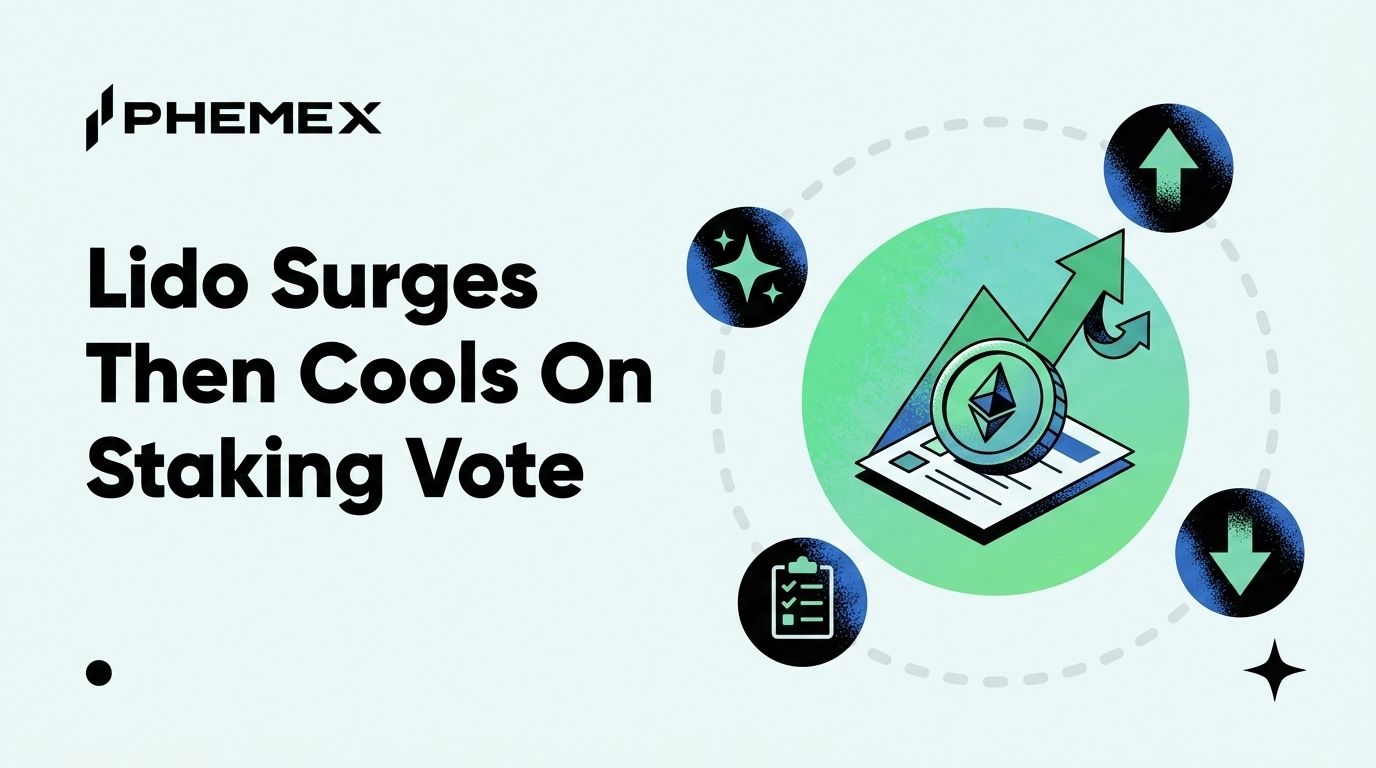
Lido's governance token LDO trades around $0.363 after a sharp run that has since lost its momentum. The token gained roughly 12% on July 16, 2026, with some feeds putting the move as high as 16%, and LDO futures open interest jumped about 32% in 24 hours to around $75.4 million. The catalyst was Lido's on-chain governance vote on Staking Router v3, which closed on July 17. The rally was real, and so is the cooling that followed, and the two deserve to be read as separate stories rather than one clean trend.
- LDO price: around $0.363, cooling after the catalyst pop
- Catalyst move: about +12% on July 16, 2026 (some feeds show up to 16%)
- Futures open interest: up roughly 32% in 24 hours to about $75.4 million
- The trigger: Staking Router v3 governance vote (LIP-35), voting window July 15 to 17
- Market backdrop: ETH $1,869 (+1.37%), BTC $64,811, Fear and Greed near 25 (Extreme Fear)
Here is what the vote actually changes, why the price ran, and why it has already given some of that move back.
What Sparked the LDO Rally
The move came directly off a governance event. Lido's on-chain vote on Staking Router v3, formally filed as LIP-35, ran from July 15 to July 17 and concluded on July 17 at 2pm UTC. The proposal bundles two pieces, the Curated Module v2 and the Community Staking Module v3, into a single upgrade to how the protocol routes staked ETH.
Traders started positioning as soon as the voting window opened, and the price action shows it. A governance vote with a fixed close date gives leverage a clear event to trade around, and the roughly 32% surge in LDO futures open interestover 24 hours is the signature of that positioning. Open interest rising alongside price means new money is opening leveraged longs rather than shorts closing out.
The vote itself was widely expected to pass, and it did. That matters for reading the chart, because the market was buying the anticipation of an approval that was never really in doubt. Once the outcome landed, the reason to hold the pre-event position started to fade, which is where the cooling begins.
What Staking Router v3 Actually Changes
Lido's Staking Router is the internal system that decides how the protocol spreads staked ETH across its different operator modules. Think of it as a dispatcher that routes deposits to the groups of validators actually running the stake. Version 3 expands that dispatcher and makes it more modular, so new types of operator sets can plug in without rewriting the core.
The piece that carries the weight is the Community Staking Module v3. It lets more independent, permissionless node operators run Lido validators with lower bonding requirements, meaning a smaller upfront capital commitment to participate. In plain terms, the pool of people who can actually operate Lido's validators gets wider, and it stops being limited to a hand-picked, curated set.
That direction addresses Lido's longest-standing criticism. Because Lido is the largest single home for staked Ethereum, a large share of the network's validators has historically run through one protocol using a curated operator list, and that concentration has been flagged for years as a centralization risk for Ethereum itself. More permissionless operators is a genuine, measurable improvement to that story, and it is the substance behind the headline.
What Lido Is and Why LDO Tracks Ethereum
Lido is the largest Ethereum liquid-staking protocol. You stake ETH with Lido and receive stETH in return, a liquid token that keeps earning staking rewards while staying usable across DeFi. That combination is the whole appeal, since holders keep yield on their ETH without locking it away and losing access to it.
The stETH you receive can be supplied as collateral in lending markets like Aave, used in liquidity pools, or held as a yield-bearing version of ETH, which is why liquid staking became one of the deepest corners of on-chain crypto lending and collateral activity. LDO is the separate governance token that votes on protocol decisions like the Staking Router upgrade, and it does not directly earn staking yield the way stETH does.
That split explains the token's behavior. LDO is a bet on the protocol's direction and adoption rather than a direct claim on staking rewards, so it tends to track ETH sentiment plus Lido's own protocol news. When ETH is weak, LDO usually leans weak, and a protocol catalyst like this vote is what pulls it out of step for a few days.
Separating the Upgrade From the Price Action
This is where a skeptical read earns its keep. A governance upgrade is a fundamentals event that plays out over months, as new operators actually onboard and the decentralization numbers slowly shift. The roughly 12% pop and the 32% jump in open interest happened in hours, which is a very different clock.
What that speed tells you is that the move was mostly traders front-running a known event and leverage piling into a token with a fixed catalyst date, not the market re-rating LDO's long-term value. Fundamentals do not re-price 12% in an afternoon on a vote everyone expected to pass. Leverage does. The subsequent cooling toward $0.363 is that same leverage unwinding once the event passed and the fast money took profit.
None of this means the upgrade is noise. Widening the operator set is a real answer to Lido's central criticism, and over time a more decentralized validator base strengthens the case for both the protocol and Ethereum's health. But the honest framing keeps those two things apart. The LDO price move was a short-term, leverage-driven reaction, while the protocol improvement is a slow-burn fundamentals story that a one-day candle cannot capture.
LDO Against a Weak Altcoin Tape
The rally also landed in a hostile market, which shaped how it played out. The broader altcoin market cap fell about $8.8 billion over the week, and the Fear and Greed reading sits near 25, deep in Extreme Fear. LDO ran higher against that weak tape on its own catalyst, then gave part of the move back as the wider market pulled it down again.
The anchor underneath all of it is ETH. With Bitcoin at $64,811 and ETH trading around $1,869, up 1.37% on the day, the staking-token complex has no strong updraft to lean on. Because Lido's entire business is built on staked ETH, LDO cannot decouple from Ethereum sentiment for long, and a soft ETH tape puts a ceiling on how far a protocol-specific catalyst can carry the token before gravity returns.
Frequently Asked Questions
What is Staking Router v3 in Lido?
It is an upgrade to the system that routes staked ETH across Lido's operator modules, bundling the Curated Module v2 and the Community Staking Module v3 under proposal LIP-35. Its main effect is letting more independent, permissionless node operators run validators with lower bonding requirements, which pushes Lido toward a more decentralized validator base.
Why did LDO price go up in July 2026?
LDO gained about 12% around July 16 as traders positioned ahead of the Staking Router v3 governance vote that closed on July 17. Futures open interest jumped roughly 32% in a day, which shows the move was driven by leveraged positioning into a known event rather than a lasting shift in the token's fundamentals.
Does the Staking Router v3 upgrade make LDO a buy?
The upgrade is a real positive for Lido's decentralization story, but that is a slow fundamentals process, not an instant price driver. The sharp pop and the equally sharp cooling suggest the near-term price is being set by leverage and by ETH sentiment, so treat the vote as a structural improvement rather than a short-term trade signal.
What is the difference between LDO and stETH?
stETH is the liquid token you receive when you stake ETH through Lido, and it earns staking rewards while remaining usable in DeFi. LDO is the separate governance token that votes on protocol decisions, so it tracks Lido's adoption and direction instead of paying staking yield directly.
The Bottom Line
LDO around $0.363 is a token that did its job on the catalyst and is now handing the move back to a weak market. The Staking Router v3 approval is the substance worth tracking, because a wider, more permissionless operator set is the real answer to the centralization critique that has followed Lido for years. That story plays out over quarters as operators onboard, not over the July candles.
Watch how LDO behaves once the leverage from the vote fully clears. If it holds up against a soft ETH tape and Extreme Fear sentiment, that is the sign real conviction is stepping in behind the upgrade. If it keeps bleeding with the broader altcoin market, the pop was exactly what the open interest said it was, a leverage event that already passed.
This article is for informational purposes only and does not constitute financial or investment advice. Cryptocurrency trading involves substantial risk. Always conduct your own research before making trading decisions.