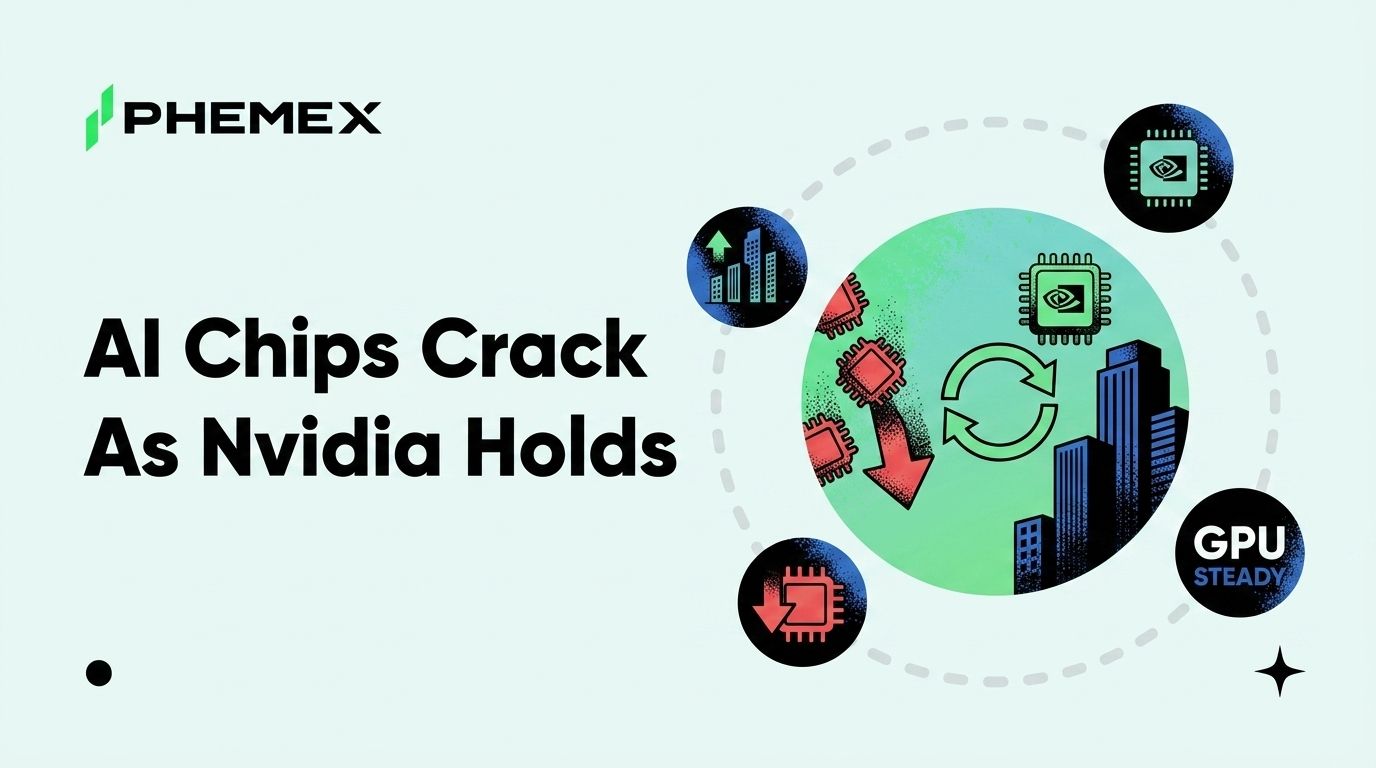
The AI chip trade is coming apart in slow motion, and the tape on July 16, 2026 shows exactly where the money is running from and where it is running to. Marvell dropped 8.72%, Intel fell 5.57%, AMD lost 4.19%, Micron gave back 3.49%, and CoreWeave slid 4.59%. In the same session, Nvidia barely moved at all, down 0.28%, while Alibaba jumped 5.17%, Apple gained 3.73%, Google rose 3.28%, and the rest of the megacap complex traded green.
That split is the whole story. One half of the semiconductor market is being sold hard while the single largest name in it holds firm and the companies that spend the AI money rally. When a group de-rates like this and the quality name refuses to break, it tells you something about what the market is actually worried about.
AI chip and megacap snapshot for July 16, 2026:
- Nvidia (NVDA) $211.72, down 0.28% and effectively flat while its peers cratered
- Marvell (MRVL) $206.02, down 8.72% and the worst mover in the entire complex
- Intel (INTC) $103.63, down 5.57% and Micron (MU) $904, down 3.49% on no company news
- AMD $530.50, down 4.19% and CoreWeave (CRWV) $77.12, down 4.59% on the same rotation
- Alibaba (BABA) $120.78, up 5.17% and Google (GOOGL) $372.33, up 3.28% as the money rotated in
- Bitcoin (BTC) $64,568 trading with the same risk-appetite signal driving the equity tape
The reason those green names are green and those red names are red comes down to one word that changed meaning today. Here is what actually broke the AI chip trade and why Nvidia was the last one standing.
What the AI Chip Tape Actually Did Today
Marvell led the decline, and there was a specific reason. Erste Group cut MRVL from Buy to Hold on July 15, 2026, and the downgrade named two problems that matter for the whole custom-silicon story. The first is margin. Marvell's revenue mix is shifting toward custom AI ASICs built for hyperscalers, and bespoke chips carry lower gross margins than the merchant parts Marvell sells to everyone. More of the hot growth line item is the lower-margin one. The second is competition in the 800G and 1.6T optical DSP market, where the pricing pressure is intensifying just as that segment was supposed to be a moat.
It was Marvell's fourth straight down session, and the stock now sits roughly 36% below its recent peak. There was no fresh scandal, no guidance cut from the company itself, nothing beyond that single analyst note. Most of an 8.72% move does not come from one downgrade. The rest of it is the sector rotation dragging the highest-beta name in the group down the fastest. When traders decide to reduce exposure to custom AI silicon, Marvell is the purest expression of that trade, so it takes the biggest hit. Intel, AMD, Micron, and CoreWeave all fell in sympathy for the same reason rather than on any news of their own. You can see the deeper read on the custom-silicon margin question in Marvell's AI outlook coverage.
Why ASML's Beat and Raise Became a Warning
This is the part that should not make sense at first, and it is the spine of the entire selloff. ASML, the company that builds the machines every advanced chip fab depends on, reported on July 15, 2026. It beat expectations and raised its full-year 2026 guidance to a range of 43 to 45 billion euros in net sales, up sharply from the prior 36 to 40 billion. ASML sits at the very base of the semiconductor supply chain, and a beat-and-raise from that position is normally the single most bullish signal the chip sector can get. The machines get ordered years before the chips ship, so ASML's order book is the closest thing the industry has to a crystal ball.
Chip stocks sold off anyway. The market looked at ASML's enormous multi-year equipment backlog and read it as evidence that capacity is being built and pulled forward faster than end demand can absorb it. That is the fear of overcapacity. If the fabs are ordering machines at a record clip, the AI infrastructure buildout may be running ahead of the revenue that is supposed to justify it, which sets up a capex digestion air pocket somewhere down the line.
The worry shifted from supply to demand in a single afternoon. For two years the anxiety centered on supply, on the industry's ability to physically make enough chips to feed the AI boom. Today the anxiety is about the sustainability of the spending on all those chips at this pace. Good news about supply became a question about demand, and that inversion is why a beat-and-raise from the most important company in the chain sent the whole group lower instead of higher. Traders are no longer asking if the chips get built. They are asking who keeps paying for them. That same capex-sustainability question is what makes AI-linked crypto tokens trade as a high-beta mirror of this exact debate.
Why Nvidia Held While the Group Cracked
Nvidia is the one name in the group with real pricing power and the clearest line of sight into its own demand, so in a rotation out of AI chips it is the last one anybody sells. Traders trim the names they are least sure about first. Marvell's margin story is now in question, Intel's turnaround is unproven, and CoreWeave is a leveraged bet on the buildout continuing. Nvidia has none of those specific doubts hanging over it, which is why it barely moved while everything around it fell 4 to 9 percent.
It also had its own support today. China cleared more firms to buy Nvidia's H200 chips, reopening a demand channel the market had partly written off, and KeyBanc raised its Nvidia price target to $330 from $310 on July 15, 2026. Being the quality name in a group that is de-rating is a strange kind of outperformance. Nvidia did not rally. It simply refused to break, and in a session this red, holding the line is its own signal. You can read the fuller case on the stock in Nvidia's 2026 stock breakdown. The lesson for anyone watching this tape is that relative strength in the leader during a group selloff usually marks where the smart money is willing to stay.
Where the Money Actually Went
Capital did not leave the AI theme today. It rotated inside it. The money came out of the capex-heavy, high-valuation chip suppliers and moved into the cash-generative megacaps and Chinese tech. Alibaba is now up roughly 17% off its late-June low, lifted by Chinese stimulus, the broader AI rally, and the same H200 buyer clearance that helped Nvidia. Google, Meta, Apple, Amazon, and Microsoft all traded higher because the market is starting to prefer the companies that spend the AI capex and monetize it over the suppliers whose earnings depend on that spending never slowing down.
Think of it as the difference between owning the toll road and owning the trucking company. When investors get nervous about how long the freight will keep flowing, they would rather hold the platform that collects revenue from AI than the vendor that only gets paid while the buildout accelerates. The megacaps generate enormous free cash flow today and can fund their own AI ambitions without needing anyone else's capex to hold up. That is the rotation in one sentence. Out of the picks-and-shovels names that need the spending to continue, into the balance sheets that can survive if it pauses.
The Fundamentals Are Still Strong
Here is the honest counterpoint, and it matters. TSMC reported record revenue today, up 36% year over year, and its CoWoS advanced-packaging capacity remains sold out. The actual demand data has not rolled over at all. The real chip orders are still there, the fabs are still full, and the customers are still paying. What sold off today was a valuation and positioning event layered on top of a fear about the pace of spending, not a signal that AI demand has weakened.
A trader has to separate the two things. The price action is a rotation and a de-risking move driven by sentiment. The fundamentals underneath are still strong, confirmed by Micron's memory demand and by TSMC's sold-out packaging lines. That tension is the entire point of the day. When the tape and the fundamentals disagree this loudly, the disagreement itself is the trade to watch.
The crypto read-through is tight but real. The highest-beta corners of crypto move with the AI-momentum complex, so when the chip trade wobbles on capex-sustainability fears, that is the same risk-appetite signal that pushes crypto beta around. Bitcoin at $64,568 is trading in that same risk weather. Nvidia is the cleanest tokenized AI proxy available on Phemex, and watching if it keeps holding the line is a useful tell for where the broader risk tape goes next.
Frequently Asked Questions
Why did chip stocks fall after ASML raised its guidance?
ASML beat and raised on July 15, 2026, but its record equipment backlog signaled that chip capacity is being built faster than end demand can absorb it. The market read that as an overcapacity and capex-sustainability warning rather than a bullish supply signal, so the group sold off on what would normally be good news.
Why did Nvidia hold up while Marvell and AMD dropped?
Nvidia has the strongest pricing power and the clearest demand visibility in the group, so it is the last name traders sell in a rotation. It also got fresh China H200 buyer clearance and a KeyBanc target hike to $330, which is why it stayed flat at $211.72 while peers fell 4 to 9 percent.
Is the AI chip selloff a sign that AI demand is over?
No, at least not based on today's data. TSMC posted record revenue up 36% year over year with CoWoS packaging sold out, so the underlying demand is intact. The selloff is a valuation, positioning, and pace-of-spending story, not evidence that end demand has broken.
What does the chip rotation mean for crypto traders?
The highest-beta parts of crypto trade alongside the AI-momentum complex, so wobbles in the chip trade often show up as the same risk-appetite shifts that move crypto. Watching if Nvidia keeps holding its line gives you a live read on broad risk appetite that tends to spill into Bitcoin and AI-linked tokens.
The Bottom Line
The divergence is the signal. As long as Nvidia holds near $211 while the rest of the group bleeds, the market is de-rating the AI capex trade without abandoning the leader, and that is an orderly rotation rather than a panic. Watch two things from here. If Nvidia loses its line and starts falling with the group, the sell-off has graduated from rotation into something broader that will drag risk assets including crypto beta with it. If TSMC-style demand data keeps printing records while the chip suppliers keep bleeding, the gap between price and fundamentals closes in the fundamentals' favor once positioning resets. The names that spend the AI money are winning today. The names that sell the picks and shovels have to prove the spending continues, and until they do, Nvidia holding the line is the tell that matters most.
This article is for informational purposes only and does not constitute financial or investment advice. Cryptocurrency trading involves substantial risk. Always conduct your own research before making trading decisions.