

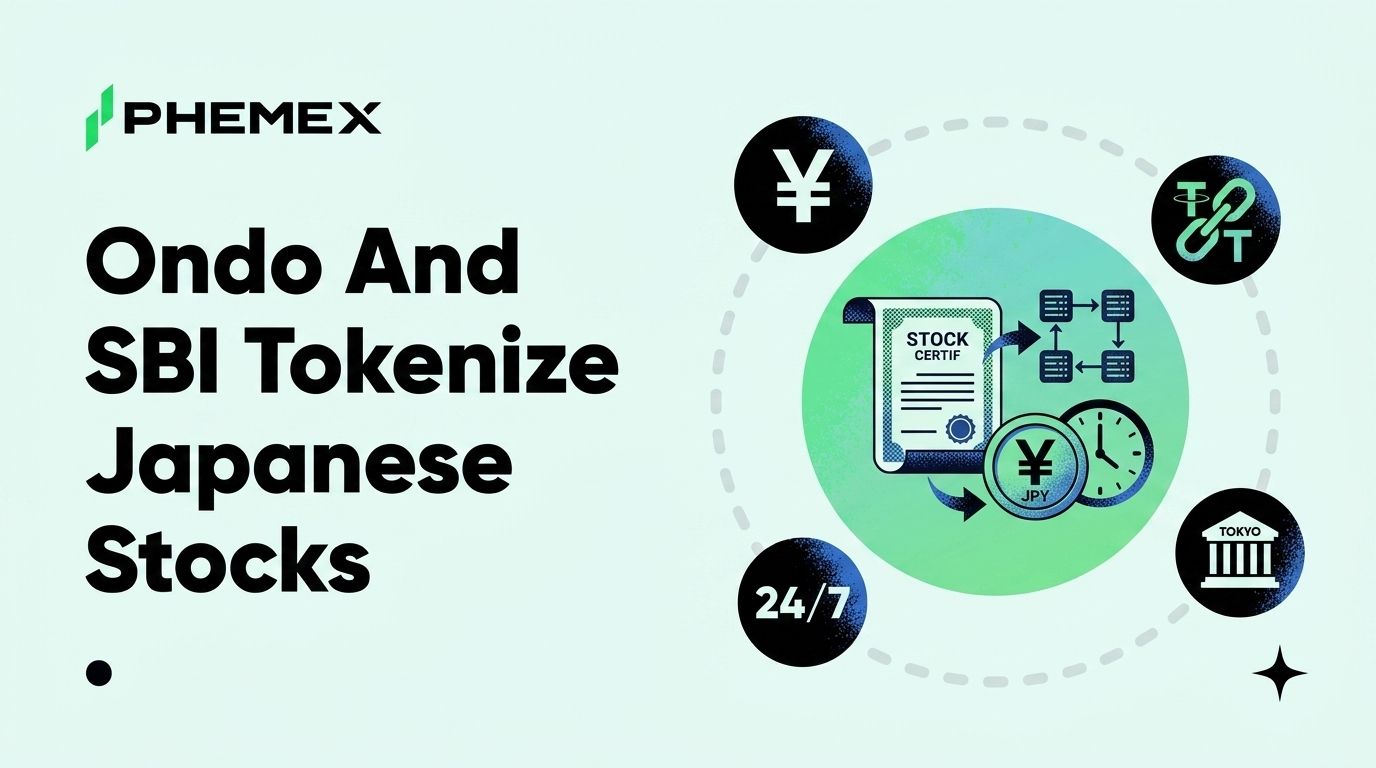
On July 16 and 17, 2026, Ondo Finance made two moves that push tokenized stocks past the demo stage. It partnered with SBI, one of Japan's largest financial groups, to tokenize Japanese assets and settle the trades in JPYSC, a yen stablecoin. In the same window it switched on 24/7 mint and redemption for ten more tokenized US stocks, including AMD and Intel, taking the always-available set to 16 assets that a trader can create or cash out at any hour.
Ondo is the leading real-world-asset tokenization platform, holding more than 70% of the tokenized-equity market with about $3.78 billion in total value locked. The ONDO token is not celebrating any of this. It trades near $0.345 and is pulling back today with the soft altcoin tape, on a quiet weekend where Bitcoin sits around $64,811 and ETH near $1,869. The deal is the story here, not the candle.
- ONDO price: around $0.345, retracing on the weekend
- Ondo tokenized-equity share: more than 70% of the market
- Ondo RWA total value locked: about $3.78 billion
- Always-on tokenized stocks: 16, up from six, now including AMD and Intel
- Market backdrop: BTC near $64,811, ETH near $1,869, altcoins under pressure
The two announcements look separate, but they attack the same problem from opposite ends. Here is what each one does and why they matter far more together than apart.
What Ondo and SBI Just Agreed To
The structure is the interesting part. Under the deal, Ondo Global Markets, a British Virgin Islands entity, issues the tokenized instruments, while SBI handles regulated distribution, custody, and settlement inside Japan. Ondo brings the on-chain issuance engine, and SBI brings the licensing, the local relationships, and the compliance rails that a crypto-native issuer cannot build alone.
That division of labor is the whole point. Japan is one of the largest and most tightly regulated financial markets on earth, and it does not let unlicensed foreign issuers sell securities to its residents. A crypto company can mint a token that represents a Japanese stock, but it cannot legally distribute that token to Japanese investors or custody it for them without a regulated partner. SBI is that partner, which is why this reads as market infrastructure rather than another press-release integration.
The settlement detail matters just as much. Trades clear in JPYSC, a yen-denominated stablecoin, which means both legs of the transaction move on-chain. The asset leg is the tokenized stock and the cash leg is the yen stablecoin, so the entire trade settles inside one on-chain system instead of bouncing between a blockchain and a traditional bank wire. That is the difference between a tokenized asset that still depends on legacy plumbing and one that actually lives natively on rails traders already use.
The 24/7 Mint and Redeem Switch, Explained
The second announcement is quieter but structurally larger. Ondo turned on around-the-clock mint and redemption for ten additional tokenized US equities, adding names like AMD and Intel to bring the always-available roster to 16. Ondo says this makes it the first platform offering true around-the-clock primary issuance and redemption of US equities on-chain.
Primary issuance is the phrase that carries the weight. Trading a token on a secondary market at 3 a.m. was already possible, because a blockchain never closes. Creating a brand-new tokenized share, or destroying one to pull out the underlying value, is a different action, and until now that action was gated to US exchange hours. Ondo issues these instruments on Ethereum, and the switch means the create-and-redeem window now stays open even while the New York Stock Exchange is dark.
Why Around-the-Clock Issuance Fixes the Biggest Flaw in Tokenized Stocks
Here is the flaw that has quietly capped this entire category. A tokenized stock is supposed to track the price of the real share, and the mechanism that forces that tracking is arbitrage. When the token drifts above the real stock, arbitrageurs redeem tokens for the underlying and pocket the gap. When it drifts below, they mint new tokens cheaply against the real share. That constant create-and-redeem pressure is what glues the token price to reality.
The problem was that the underlying stock market only trades during exchange hours, so the token could change hands 24/7 while the tool that keeps it honest could only run part-time. Off-hours, the arbitrage loop broke, and the tokenized price could wander away from the real stock with nothing pulling it back until New York reopened. It is the same create-and-redeem plumbing that keeps a Bitcoin ETF trading close to its net asset value, except tokenized stocks were running that plumbing on banker's hours.
Around-the-clock primary issuance is the fix. If arbitrageurs can mint and redeem at any hour, they can keep enforcing the price link even on a Saturday, which is exactly what lets a tokenized share track its real-world twin continuously instead of only nine-to-five. That is the unglamorous engineering that turns a novelty into a market.
The Bull Case and the Skeptical Case
Read together, both moves point the same direction. Tokenized equity is shifting from a one-sided demo into a two-sided, always-on market with regulated distribution attached. The dominant player is the one extending that lead, which is why the bulls see this as the category finally growing up.
The skeptics have real points too, and they deserve equal airtime.
|
Bull case
|
Skeptical case
|
|
Regulated distribution in Japan via a licensed partner
|
Tokenized-equity volume is still tiny next to the real stock market
|
|
Always-on primary issuance keeps prices honest
|
24/7 issuance raises hard questions about fair pricing when the underlying market is closed
|
|
On-chain cash leg through a yen stablecoin
|
A BVI issuer plus a local distributor is legally complex and jurisdiction-dependent
|
|
Market leader with roughly 70% share expanding its moat
|
Leadership in a small market is still leadership in a small market
|
None of the skeptical points are fatal, and none of the bull points are guaranteed. What is true is that both announcements move the category toward being usable, and that is a real change from a year ago when most of this was slideware. The honest read is that the infrastructure is arriving faster than the volume, and volume is what eventually decides if any of it sticks.
Why This Matters If You Trade Crypto
Real-world assets, and tokenized stocks in particular, are one of the fastest-growing corners of on-chain finance, and Ondo is the name at the front of it. For a trader, that is the reason to track this even on a weekend when the token itself is red. The narrative only becomes tradeable when two things happen. Regulated distribution has to show up so the assets can reach real buyers, and the structural limits have to come off so the markets actually function around the clock.
The SBI deal covers the first, and the 24/7 issuance switch covers the second, in the same 48 hours. That is bullish for the RWA category over a multi-quarter horizon, and it is why the leader in that category is worth watching even while ONDO drifts lower with the rest of the weekend altcoin tape. The token price and the business trajectory are telling two different stories right now, and traders who can hold both in their head at once tend to be the ones positioned early.
Frequently Asked Questions
What did Ondo and SBI announce?
Ondo Finance partnered with SBI, a major Japanese financial group, to tokenize Japanese assets and settle the trades in JPYSC, a yen stablecoin. Ondo Global Markets issues the tokenized instruments while SBI provides regulated distribution, custody, and settlement inside Japan. It pairs a crypto-native issuance engine with a licensed local partner, which is what makes it workable in a strict market.
What is JPYSC?
JPYSC is a yen-pegged stablecoin used as the cash leg for these tokenized trades. Because the settlement currency lives on-chain, both the asset and the money move inside the same system instead of routing the cash through a traditional bank. That keeps the full transaction native to the blockchain rails traders already use.
Can I create or redeem tokenized stocks when the US market is closed?
As of this update, Ondo now supports around-the-clock mint and redemption for 16 tokenized US equities, including AMD and Intel, which is new. The open question the skeptics raise is how these assets should be priced during hours when the underlying stock is not trading, since there is no live reference price off-hours. Continuous issuance narrows that gap, but it does not erase the pricing debate entirely.
Is the ONDO token going up on this news?
No. ONDO is trading near $0.345 and pulling back this weekend along with the broader altcoin market. The news is a structural positive for the real-world-asset category over time, but the token is retracing with weak sentiment rather than rallying on the headline.
The Bottom Line
The signal to track from here is not today's ONDO candle. It is SBI's regulated distribution going live and moving Japanese volume on-chain, plus the 24/7 issuance holding the tokenized US names to their real prices through this weekend. Those two proofs turn the narrative into a functioning market, and the leader with roughly 70% share is the cleanest way to watch it happen. For the token, sentiment is the near-term driver and the deal flow is the multi-quarter one, so a soft weekend print near $0.345 says nothing about the step the infrastructure just took. It took it. The volume is the only thing left to prove.
This article is for informational purposes only and does not constitute financial or investment advice. Cryptocurrency trading involves substantial risk. Always conduct your own research before making trading decisions.