










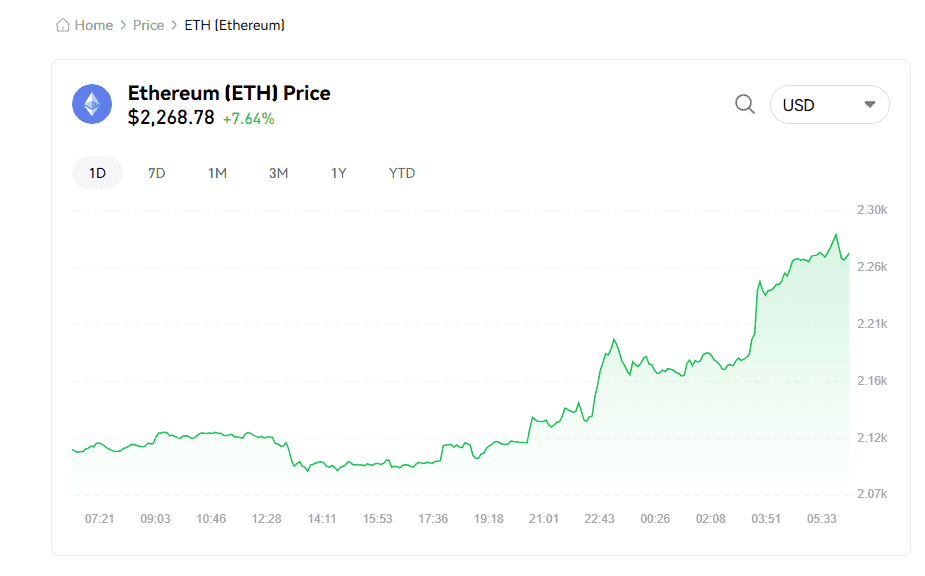
Ethereum is trading around $2,050 in March 2026, down more than 60% from its 2025 peak near $4,950. If you only looked at the price, you would think the project is in serious trouble. But in the same month that ETH hit these lows, BlackRock launched a staking ETF (ETHB) on Nasdaq that pays investors yield for holding Ethereum. JPMorgan is running tokenized money market funds on it. Goldman Sachs holds over $1 billion in ETH ETF exposure. And Larry Fink told Davos that tokenization on Ethereum is "necessary" to modernize a financial system still running on decades-old software.
The gap between ETH's price and its institutional adoption has never been wider. This article explains what Ethereum actually is, what makes it different from Bitcoin, why the largest financial institutions on earth keep building on it, and what the honest case for and against holding ETH looks like right now.
What Ethereum Is (and What It Does That Bitcoin Does Not)
Bitcoin is digital money. Ethereum is a decentralized computer that can run any application.
That one-sentence distinction explains why both exist and why they serve different purposes. Bitcoin was designed to be a store of value and a peer-to-peer payment system. Its blockchain records transactions and nothing else. Ethereum, launched in 2015 by Vitalik Buterin, was designed to run programs called smart contracts, which are self-executing agreements that automatically enforce their terms without any intermediary. A smart contract can hold funds, release them when conditions are met, and interact with other smart contracts to create complex financial systems that operate entirely on code rather than human gatekeepers.
This programmability is what makes Ethereum the foundation layer for most of what has been built in crypto over the past decade. DeFi (decentralized lending, borrowing, and trading without a bank), stablecoins (USDC is a smart contract on Ethereum), NFTs, DAOs, tokenized real-world assets, and payment infrastructure all run primarily on Ethereum's network because it was the first blockchain to support general-purpose programming and still has the deepest ecosystem of developers, applications, and capital.
How Ethereum Works Under the Hood
Ethereum runs on Proof-of-Stake, a system where validators lock up ETH as collateral to propose and verify blocks of transactions. When you send ETH, interact with a DeFi protocol, or mint an NFT, that transaction gets bundled into a block, validated by stakers, and permanently recorded on the blockchain. Validators earn yield for doing this work, currently between 3.1% and 4.2% APY depending on how many other validators are active.
This was not always the case. Before September 2022, Ethereum ran on Proof-of-Work (the same energy-intensive mining system Bitcoin uses). The Merge, Ethereum's transition to Proof-of-Stake, cut the network's energy consumption by 99.95% and transformed ETH from a passive asset into one that generates yield when staked. That single change is what makes ETH attractive to institutions in a way that Bitcoin is not, because institutional portfolio models generally favor assets that produce cash flow, and staked ETH now functions more like a bond than a commodity.
Ethereum by the Numbers in March 2026
|
Metric
|
Data
|
|
Market cap
|
~$233 billion (#2 overall)
|
|
ETH price
|
~$2,050
|
|
Total value locked (DeFi)
|
$55.8 billion (leads all chains)
|
|
ETH staked
|
37.5 million (~31% of circulating supply)
|
|
Active validators
|
950,000 to 1.1 million
|
|
Staking APY
|
3.1-4.2% base (higher with MEV)
|
|
Spot ETH ETF AUM (ETHA)
|
|
|
Staked ETH ETF (ETHB)
|
$100M+ at launch (March 12, 2026)
|
|
Tokenized US Treasuries on Ethereum
|
$10B+ (majority of all chains)
|
|
Share of smart contract assets
|
58% ($67B) per BlackRock
|
The TVL number is worth pausing on. Ethereum holds $55.8 billion in smart contracts compared to roughly $6.7 billion on Solana (the second-largest smart contract chain). That is an 8x lead, and it represents real capital deployed in real financial applications, not a market cap based on speculation. Institutions choosing where to build tokenized products overwhelmingly choose Ethereum because the capital is already there.
Why Institutions Keep Building on Ethereum
The institutional adoption story running in parallel to ETH's price decline is one of the most unusual dynamics in crypto right now, and the best way to understand it is through the tokenization thesis.
The thesis: Ethereum becomes the settlement layer for traditional finance. BlackRock's BUIDL fund (tokenized US Treasuries), JPMorgan's tokenized money market offerings, and over $10 billion in tokenized government securities sit primarily on Ethereum because it holds 58% of all smart contract assets globally. When Larry Fink says tokenization is "necessary," he is describing a future where stocks, bonds, and real estate are represented as Ethereum-based tokens that settle in seconds rather than days and trade 24/7 rather than during market hours. Ethereum was chosen for this role not because it is the fastest chain, but because it has the deepest capital base and the most battle-tested security model.
ETHB proves the yield argument works. BlackRock's staked ETH ETF, launched March 12 on Nasdaq, is the first crypto ETF from the firm that generates income for holders. It joins ETHA ($6.5B in AUM) and IBIT ($55B), bringing BlackRock's total crypto ETP management to over $130 billion. The significance is not the product details but what it validates: for institutions that evaluate investments through a cash flow lens, staked ETH fits the same portfolio slot as a bond. Bitcoin generates zero yield. Staked ETH generates 3-4% APY. That distinction is why BlackRock's Jay Jacobs said "some institutions want to think about it from a cash flow perspective" and why ETHB exists at all.
What Is Coming Next for Ethereum
Glamsterdam upgrade (H1 2026). This hard fork targets 10x throughput by raising the gas limit and implementing parallel transaction processing. Gas fees could drop roughly 78% while the network handles significantly more activity per block. If it ships on schedule, Ethereum's mainnet becomes competitive with Layer-2 solutions on cost while retaining the security advantages of the base layer.
DVT-lite staking (going live March 19). The Ethereum Foundation staked 72,000 ETH using simplified distributed validator technology that turns institutional staking into a one-click deployment. If the pilot succeeds, it could drive staking participation above 40% by making it dramatically easier for large ETH holders to run their own validators.
Hegota upgrade (H2 2026). Focused on Verkle Trees, which reduce the hardware requirements for running a node, improving decentralization by making it cheaper and easier for anyone to participate in securing the network.
ETH vs SOL: Different Problems, Different Strengths
|
Category
|
Ethereum
|
Solana
|
|
TVL
|
$55.8B
|
$6.7B
|
|
Institutional products
|
ETHA ($6.5B), ETHB ($100M+), BUIDL
|
SOL ETFs (~$1B cumulative)
|
|
Tokenized RWAs
|
$10B+ in US Treasuries
|
~$1.7B
|
|
Daily active addresses
|
Growing but lower than SOL
|
Leading all L1s
|
|
DEX volume (peak)
|
Moderate
|
$118B weekly (Feb 2026, now collapsed 62%)
|
|
Transaction finality
|
~12 seconds (targeting sub-second after Glamsterdam)
|
~12 seconds (targeting sub-150ms after Alpenglow)
|
|
Primary use case
|
Institutional finance, DeFi, tokenized assets
|
High-frequency consumer activity, memecoins
|
Ethereum and Solana are solving different problems. Ethereum is where institutional capital builds because it has the deepest liquidity, the most established developer ecosystem, and the regulatory infrastructure (ETFs, staking products, tokenized funds) that institutional allocators require. Solana is where consumer activity concentrates because of its speed and low fees, though its economic model was heavily dependent on memecoin speculation that has since collapsed. They are complementary rather than competing in most practical senses, and many developers build on both.
The Honest Bear Case
ETH is down 60%+ from its peak despite everything listed above, and the market is telling you something. Institutional interest has not translated into price recovery because several headwinds are offsetting the bullish fundamentals.
Layer-2 networks (Arbitrum, Base, Optimism) process an increasing share of Ethereum's transactions, which means fees that used to flow to ETH mainnet validators now get captured by L2 sequencers instead. This fee compression reduces the economic value that accrues directly to ETH holders. The Glamsterdam upgrade could help by bringing more activity back to mainnet, but it carries execution risk and could be delayed. And the broader macro environment in early 2026 (rate uncertainty, Iran conflict, extreme fear across all risk assets) is suppressing demand for volatile assets regardless of their fundamentals.
The honest framing is that Ethereum's long-term positioning has never been stronger, but the market is not paying for long-term positioning right now. It is paying for short-term risk, and on that dimension, ETH looks like every other asset that is down 60% in a bear market.
Frequently Asked Questions
Do I need to understand smart contracts to use Ethereum?
No. Most people interact with Ethereum through applications (wallets, DeFi platforms, exchanges) that handle the smart contract interactions behind the scenes. You do not need to write or read code to send ETH, swap tokens, or earn staking yield. Understanding what smart contracts are helps you evaluate the risks involved, but it is not a prerequisite for using the network.
Is ETH a good investment in 2026?
The institutional case is strong: yield-bearing ETFs, tokenized assets, $55.8B in TVL, and the largest asset managers on earth building on the network. The price case is currently weak: down 60%, L2 fee compression, and a hostile macro environment. If you believe the institutional buildout eventually gets priced in, current levels offer significant upside from a historically deep discount. If you think L2 fee capture permanently reduces ETH's value accrual, the price decline may be structural rather than cyclical.
How can I earn yield on ETH?
The easiest path is Phemex Earn, which lets you deposit any amount of ETH and earn yield without managing validators or staking infrastructure. For more control, liquid staking protocols like Lido (stETH) return a tradeable token representing your staked position. For maximum yield and decentralization, solo staking with DVT-lite (requires 32 ETH) is becoming increasingly accessible as the Ethereum Foundation's pilot rolls out in March 2026.
Bottom Line
Ethereum is the decentralized computer that runs the majority of crypto's financial infrastructure, from $55.8 billion in DeFi to $10 billion+ in tokenized Treasuries to the staking ETF that BlackRock just launched on Nasdaq. The gap between its price ($2,050, down 60%+) and its institutional adoption (the largest asset managers, banks, and funds on earth are building on it) is the widest it has ever been.
That gap closes in one of two directions. Either the institutional buildout eventually drives price recovery as more ETH gets locked in staking, ETFs, and tokenized products, reducing liquid supply while demand grows. Or the market has permanently repriced ETH lower because Layer-2 networks capture the fees that used to make mainnet valuable. The data so far points toward the first outcome playing out on a longer timeline than most holders expected. For those willing to hold through the disconnect, staking yield means ETH pays you to wait.
This article is for educational purposes only and does not constitute financial or investment advice. ETH is down 60%+ from its peak and faces ongoing risks from fee compression, macro headwinds, and execution risk on upcoming upgrades. Staking yields are denominated in ETH and do not protect against price declines. Never invest more than you can afford to lose.
