



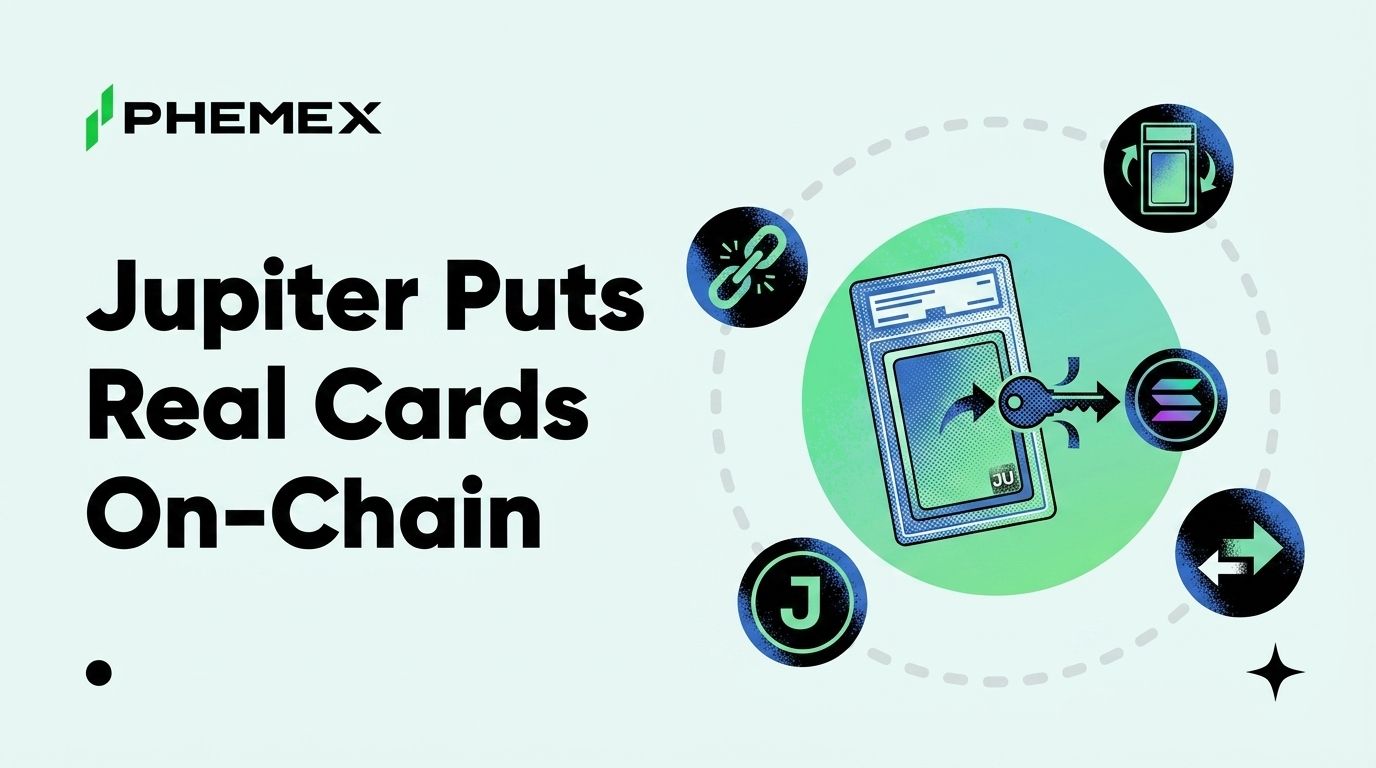
Jupiter Gacha crossed $2 million in trading volume on its first day and launched with a $100,000 rewards pool, and it got there by putting something unusual on-chain. Real, physically graded Pokemon and One Piece cards. Jupiter, the leading DEX aggregator on Solana, opened the beta on July 13, 2026, and momentum has carried into this weekend. JUP trades around $0.196, up roughly 3% on the launch, a modest move for a product getting a lot of attention.
The idea is easy to state and much harder to pull off. Each token represents one specific graded card sitting in custody, matched one-to-one against the physical slab, and you can trade that position on-chain around the clock instead of shipping a card and waiting weeks for a buyer.
- Product: Jupiter Gacha beta, live since July 13, 2026
- JUP price: around $0.196, up about 3% on the launch
- Day-one volume: more than $2 million
- Rewards pool at launch: $100,000
- Buy-back backstop: 85% of insured value within 3 days
- SOL: $76.03
Here is what the product actually does, why tokenizing graded cards attacks a real problem, and where the skeptics have a fair point.
What Jupiter Gacha Actually Is
A graded collectible card is a card that a professional grading service has authenticated and scored, then sealed inside a tamper-evident plastic case the hobby calls a "slab." The grade and the seal are what carry the value, because a top-condition graded card can be worth many multiples of the same card sold loose.
Jupiter Gacha takes those slabs and issues an on-chain token for each one. The token is backed one-to-one by a specific real card held in custody, so it is not a fractional basket or a synthetic index. Buy the token and you own the claim on that exact graded card. The tokens trade 24/7 on Solana, which means a market that normally moves at the speed of shipping and auction settlement now moves at the speed of a swap.
That is the whole conceit. Take an illiquid physical object with real collector value, verify it, lock it in custody, and represent it as something tradable in seconds. The "what is Jupiter" part is quick. It is the DeFi protocol that routes most of Solana's swap volume, and Gacha is its bet that the same rails can carry physical collectibles.
Why Tokenizing Graded Cards Solves a Real Problem
The graded-card market is large, and it is full of friction that has nothing to do with the cards themselves. Every serious buyer has to answer the same questions before money changes hands. Is the card real, is the grade legitimate, who is actually holding it right now, and how fast can I get out if I want to.
Tokenizing the slab one-to-one goes straight at those questions. Provenance lives on-chain, so the ownership history is public and verifiable rather than buried in a private ledger or an email thread. The physical card sits in verified custody, which removes the "will the seller actually ship" risk that haunts peer-to-peer deals. And liquidity stops being a scheduling problem, because you trade the position in seconds instead of mailing an object and hoping a buyer shows up.
This is where the real-world-asset thesis gets interesting. Most tokenization so far has pointed at Treasuries, stablecoins, and stocks, the safe and familiar end of finance. Jupiter Gacha points the same machinery at a consumer collectibles market that is messier, more emotional, and far bigger in cultural reach. That is the same retail energy that made memecoin launchpads a Solana phenomenon, aimed this time at objects people already collect.
|
Buyer's question
|
Traditional graded card
|
Jupiter Gacha token
|
|
Is it authentic?
|
Trust the listing and the photos
|
Slab verified, held in custody
|
|
Who holds it right now?
|
The seller, until they ship
|
A custodian, backing the token
|
|
How fast can I sell?
|
Days to weeks of listing and shipping
|
Seconds, on-chain
|
|
Where is the ownership record?
|
Private, hard to audit
|
On-chain and public
|
The Buy-Back Guarantee Is the Clever Part
The classic failure mode for any tokenized collectible is drift. The token trades on its own supply and demand, and over time its price can wander far from what the underlying card is actually worth. A holder ends up with a token that says one thing while the real slab is worth another, and there is no clean way to close that gap.
Jupiter Gacha answers that with a buy-back guarantee. Holders can redeem for 85% of the card's insured value within three days, a liquidity backstop that puts a floor under the token-versus-card gap. It does not promise the full insured value, and the three-day window matters, but it means a holder is never completely stranded with an illiquid token trading at a random discount.
That floor is doing quiet structural work. It is the mechanism that keeps the on-chain price tethered to the off-chain reality, which is the exact place most tokenized-collectible experiments have fallen apart before.
The Bull Case and the Skeptical Case
The bull case is simple. Jupiter Gacha brings instant liquidity and verifiable provenance to a big, disorganized market, and it does it from a major DeFi name rather than an anonymous startup. It is a fresh, consumer-friendly use of tokenization that could pull non-crypto collectors on-chain for the first time, and the $2 million first day shows real appetite.
The skeptical case deserves equal weight. The on-chain token is only as good as the off-chain custody and insurance behind it, so the whole model rests on trusting whoever holds the physical cards. Graded-card prices are volatile and hype-driven on their own, so tokenizing them imports that volatility rather than removing it. A $2 million first day is a promising start and a tiny number next to the real collectibles market. And a product like this ultimately lives or dies on how many people keep trading it after the launch novelty fades.
Both cases are true at the same time, which is usually the sign of a product worth watching rather than dismissing or overhyping. For a crypto trader, the useful signal is not the size of the JUP move, which was small against a soft weekend tape where the altcoin market cap fell about $8.8 billion over the week. The signal is that a serious Solana team just pushed tokenization past finance and into consumer assets, and if it sticks that tells you how far the tokenize-everything thesis can actually reach.
Frequently Asked Questions
What is Jupiter Gacha?
Jupiter Gacha is a product from Jupiter, the leading DEX aggregator on Solana, that tokenizes real, professionally graded Pokemon and One Piece cards one-to-one against the physical slab held in custody. Each on-chain token represents one specific graded card and trades around the clock, with the beta live since July 13, 2026.
How does Jupiter Gacha tokenize Pokemon cards?
Each graded card is authenticated, sealed in its slab, and placed in verified custody, then represented by a single on-chain token backed one-to-one by that exact card. The token is not a fractional share of a pool, so owning it is a claim on one specific card rather than a slice of a basket.
What is the Jupiter Gacha buy-back guarantee?
It lets holders redeem a token for 85% of the card's insured value within three days of requesting it. The point is to keep the token price from drifting too far from the real card's value, which is the failure that has sunk earlier tokenized-collectible attempts.
Did the JUP token rise after the Gacha launch?
JUP rose about 3% to roughly $0.196 on the launch, a modest move rather than a breakout. The story here is the product and the tokenization narrative, not a large price swing, especially across a quiet weekend with altcoins broadly under pressure.
The Bottom Line
The number that matters is not JUP at $0.196. It is how much of the $2 million day-one volume holds through day two and week two, because a tokenized-collectibles market only works if trading continues after the launch crowd leaves. Watch three things from here, starting with how volume holds past the launch window. Second, does the 85% buy-back floor keep the token price tethered to real card values under stress. Third, does the custodian holding the physical cards stay fully transparent about what backs each token. If those hold, Jupiter Gacha is an early proof that real-world-asset tokenization can reach consumer markets, not only Treasuries and stocks. If they slip, it becomes another launch that spiked and faded, and that answer will say more about the tokenize-everything thesis than any single JUP candle this weekend.
This article is for informational purposes only and does not constitute financial or investment advice. Cryptocurrency trading involves substantial risk. Always conduct your own research before making trading decisions.