

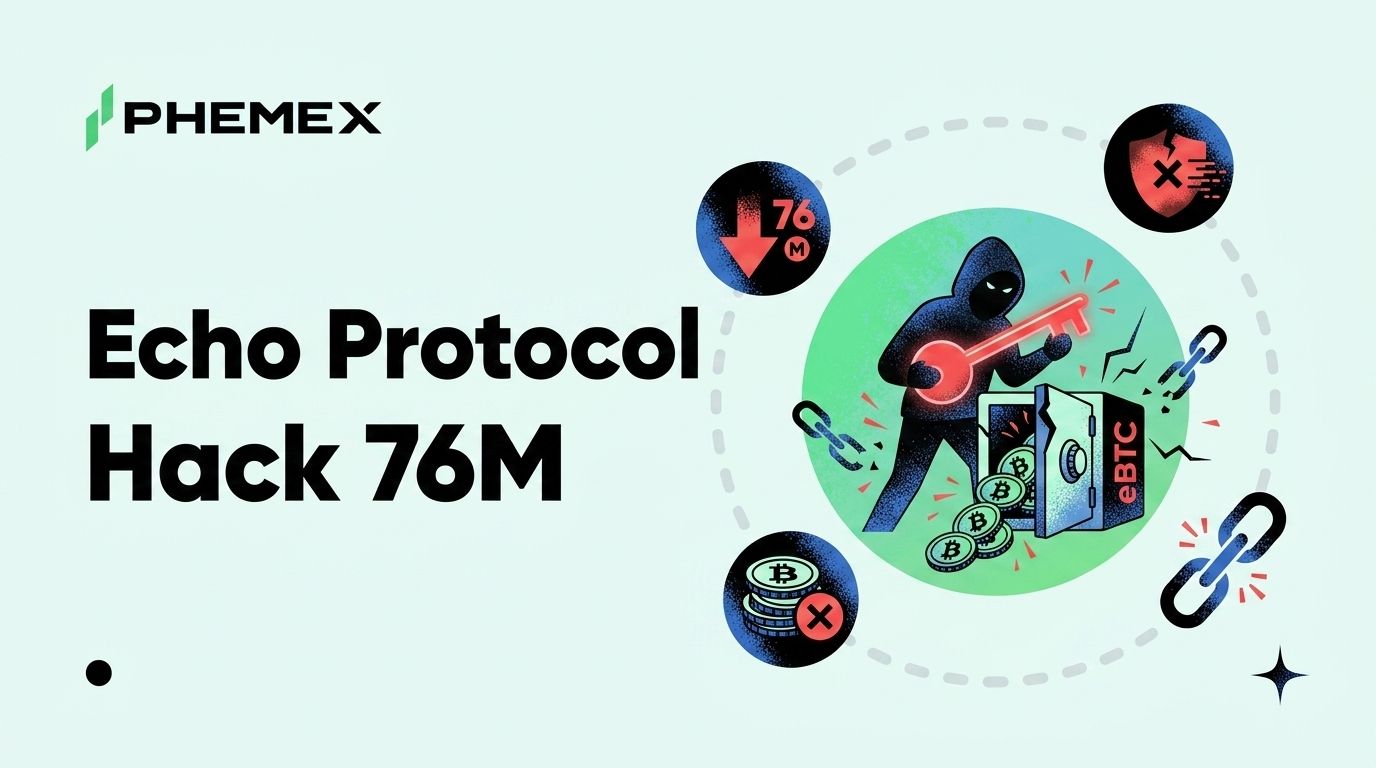
Echo Protocol, a Bitcoin-DeFi platform built on the Monad chain, lost roughly $76.6 million in unbacked eBTC on May 19, 2026, after an attacker took over the admin role on the eBTC token contract and minted 1,000 fresh tokens out of thin air. The actual extracted value was around $816,000 in ETH sent through Tornado Cash, because Monad's young DeFi stack simply did not have enough downstream liquidity to absorb the fake supply. That gap between paper loss and real loss is the entire story.
This is the 14th notable crypto exploit logged in May 2026 alone, and it sits right at the intersection of two ongoing trends: Bitcoin-DeFi platforms moving onto faster execution chains, and admin-key compromises continuing to outpace pure smart-contract bugs as the dominant attack class. Here is what happened, how the attacker structured the exit, what Echo did in response, and what users and builders should actually take from it.
What Actually Happened on May 19
The attack chain played out over a few hours on the Monad mainnet deployment of Echo Protocol's eBTC contract. eBTC is the protocol's wrapped Bitcoin representation, designed to let BTC holders earn yield and use their collateral inside Monad-native DeFi applications. The token is supposed to be backed 1:1 by Bitcoin held in custody on the Bitcoin side of Echo's infrastructure.
That backing assumption broke when the attacker assigned themselves the DEFAULT_ADMIN_ROLE on the eBTC contract. Once they held the admin role, they granted the same wallet the `MINTER_ROLE`, which lets the holder call `mint()` without restriction. Then they minted 1,000 fresh eBTC, worth roughly $76.6 million at market price.
The cleanup step is what makes this attack feel deliberate rather than opportunistic. After minting, the attacker revoked their own admin permissions to make the on-chain trail look less obvious. Standard cover-your-tracks behavior for someone who has access to the keys and knows post-mortem investigators will scan role assignments first.
How an Admin-Key Compromise Works in Plain English
Most DeFi tokens have a layered permission system inherited from OpenZeppelin's AccessControl pattern. Think of it like a building with master keys, floor keys, and room keys. The DEFAULT_ADMIN_ROLE is the master key. Whoever holds it can hand out any other role to any address, including the role that prints new tokens.
When that master key sits behind a single private key or a weak multisig, the protocol's entire token supply is one phishing email, one compromised hardware wallet, or one rogue insider away from being fully controlled by the attacker. There is no clever code exploit here, no reentrancy, no oracle manipulation, no flash-loan vector at all. The contract did exactly what it was programmed to do once the attacker held the right role.
This is why operational security around admin keys is becoming the dominant attack surface in DeFi. According to on-chain forensics firms tracking 2026 incidents, more than 70% of large crypto losses this year have started with a compromised key rather than a code vulnerability. Echo Protocol is now a textbook case for that category.
The WBTC Borrow and the Tornado Cash Exit
Minting 1,000 unbacked eBTC creates a paper position. Turning that paper into real, withdrawable money is the harder problem, and this is where Monad's still-thin DeFi ecosystem actually limited the damage.
The attacker moved 45 of the freshly minted eBTC, worth roughly $3.5 million on paper, into Curvance, a lending market on Monad. Curvance accepted the eBTC as collateral because the system had no sanity check to verify that newly minted eBTC was actually backed by Bitcoin. From that collateral, the attacker borrowed about 11.29 WBTC, the only sizable Bitcoin-denominated borrow market available on the chain. At the time of the borrow that was worth approximately $867,700.
From there the exit was textbook. The attacker bridged the WBTC over to Ethereum mainnet, swapped it into ETH, and pushed roughly 384 ETH (about $821,700) into Tornado Cash for mixing. The remaining 955 eBTC, still sitting in the attacker's wallet on Monad, was effectively stranded. No deeper liquidity existed on Monad to convert that paper into anything liquid before the protocol team caught up.
So the headline number is $76.6 million, but the actual realized loss is the $816,000 that made it through the funnel. Echo's incident report puts the figure at $816K. Some trackers round to $822K depending on the exchange rate used at exit. Both numbers tell the same story.
Echo's Response and the Burn
Echo Protocol regained control of the admin role within hours and burned the 955 eBTC the attacker still held, eliminating the paper inflation at the source. The team also paused cross-chain functionality for the Monad deployment, which prevents any further bridging of unbacked tokens back to Bitcoin-side custody.
A contract upgrade followed. The new version restricts the affected role-management operations behind tighter controls and adds rate-limiting on minting operations. The full forensic report has not been published yet, but Echo has committed to one. The team is also working with security firms to trace the WBTC that made it to Tornado Cash, though tracing through a mixer rarely produces recoverable funds.
For users on the Monad deployment, here is the practical situation. The eBTC supply on Monad is no longer trustworthy until the protocol republishes a full reconciliation. Bridges are paused. Curvance positions collateralized in eBTC are frozen pending review. If you held eBTC on Monad before the exploit, your tokens are still in your wallet, but you cannot move them through Echo's bridge or borrow against them at most lending venues until the upgrade rollout completes.
What This Means for Monad DeFi and Bitcoin-DeFi Generally
Monad is one of the highest-profile new execution layers of 2025-2026, marketed on raw throughput and EVM compatibility. The Echo incident is the first major exploit on the chain. It is not a Monad problem in the strict sense. The chain itself behaved correctly. But it does expose the cost of building a fresh DeFi ecosystem from scratch.
On Ethereum mainnet, an attacker minting 1,000 unbacked WBTC would have several deep markets to dump into. The exit could realistically be tens of millions of dollars. On Monad in May 2026, the deepest BTC-denominated borrow pool topped out at about 11 WBTC. That single liquidity constraint is what kept this from being a nine-figure loss. New chains are inherently safer in dollar terms during the early phase, and inherently more dangerous in trust terms because the infrastructure for monitoring, auditing, and circuit-breaking is still being built.
Bitcoin-DeFi is the broader pattern here. Echo is one of a growing cluster of platforms trying to give Bitcoin holders yield by minting wrapped representations on faster chains. HEMI, Bitlight, Babylon, and several others are pursuing variations on the same idea. Every one of them carries the same structural risk: the bridge contract or the minting contract sits on the new chain, and the BTC custody sits on the Bitcoin side, and the role-based permissions on either side are the single point of failure. The vector that hit Echo can in principle hit any of them.
The honest read for the sector is that 2026 is the year Bitcoin-DeFi will need to either move to fully programmatic, role-less mint mechanisms (mathematical proofs of BTC custody verified directly on the deployment chain) or accept that admin-key risk is permanent. There is no middle ground. The bridges that survive will be the ones whose minting authority cannot be compromised by anyone, including the team that wrote the code.
What Users and Builders Should Take Away
For users holding wrapped BTC on any new chain, the practical takeaway is straightforward.
Check the admin model before you trust the wrapper. Is the mint function controlled by a single key, a 2-of-3 multisig, a 5-of-9 with timelock, or fully programmatic? The first two are radioactive, and the third is only acceptable for small allocations. The fourth is the only configuration that holds up against the Echo attack pattern.
Treat new-chain TVL like venture capital, not savings. If a Bitcoin-DeFi protocol has been live for under a year on a chain that itself has been live for under a year, your position size should reflect the compounded operational risk. Position sizing is the only defense against admin-key compromises, because no amount of personal opsec on your end protects you from a compromise on theirs.
Watch for circuit breakers and rate limits. Echo's post-exploit upgrade introduced minting rate limits as a baseline defense against exactly this kind of unauthorized supply expansion. Any wrapped-BTC platform launching in 2026 without rate limits, mint caps, and on-chain pause functions is shipping unfinished infrastructure. That is now table stakes, not nice-to-have.
For builders, the lesson is the same one every cycle teaches. Smart-contract audits catch code bugs, but they do not catch operational compromises around the key holders themselves. The role-management layer of your contract deserves the same paranoia as the mint logic itself, and probably more, because that is where this year's attackers are actually winning.
Frequently Asked Questions
How much did Echo Protocol actually lose in the attack?
The notional value of the unbacked eBTC minted was about $76.6 million, but the actual realized loss was roughly $816,000 in ETH sent to Tornado Cash. The gap exists because Monad's young DeFi ecosystem did not have enough downstream liquidity for the attacker to convert most of the fake tokens into anything tradable.
Is Monad itself unsafe after this exploit?
The exploit was not a Monad chain bug, and the chain itself executed correctly throughout the entire incident. The vulnerability was inside Echo Protocol's role-management on the eBTC contract, specifically that the admin role could mint tokens without rate limits, timelocks, or backing verification. Any chain hosting that contract design would have produced the same outcome.
What is an admin-key compromise and why does it keep happening?
Most DeFi tokens use role-based access control, where one master role can grant permission to mint new tokens. If that master role lives behind a single private key or a weak multisig, anyone who steals or coerces that key gains full control over the token supply. More than 70% of large 2026 crypto losses started this way, not from code bugs.
Can users recover the lost funds?
Echo burned the 955 eBTC the attacker still held on Monad, which removes most of the paper inflation. The 384 ETH that went through Tornado Cash is unlikely to be recovered, though forensic firms are tracing post-mixer flows. Affected users should follow Echo's reconciliation reports for the bridged eBTC supply on Monad before treating their positions as fully solvent.
Bottom Line
The Echo Protocol hack is not really a $76 million story. It is an $816,000 story dressed in $76 million clothing, and the difference comes down to a young chain accidentally limiting the blast radius of a mature attack pattern. Watch for two follow-on signals over the next two weeks. First, a full root-cause report from Echo naming exactly how the admin key was compromised. Second, emergency upgrades from other Bitcoin-DeFi platforms running on new chains, pushing out mint caps and role timelocks before they become the next case study. If the sector responds in real-time, the lesson sticks. If it does not, the next attack on a deeper-liquidity chain will produce a nine-figure number, and there will be no Monad-style liquidity constraint to save the protocol or the depositors.
This article is for informational purposes only and does not constitute financial or investment advice. Cryptocurrency trading involves substantial risk. Always conduct your own research before making trading decisions.