
Summary: Pizza Day is more than a meme — it is the founding myth of crypto-as-money. Sixteen years after Laszlo Hanyecz's 10,000 BTC pizza order, the industry has matured from peer-to-peer barter into a fully programmable settlement layer for crypto and traditional financial assets. This Pizza Day, Phemex is running a $200,000 TradFi Pizza Day Festival (May 19 – Jun 1 UTC) that rewards traders for participating in that evolution.
The Origin: Why 10,000 BTC for Two Pizzas Was Actually a Win
The standard "he could have been a billionaire" framing misses the point. In 2010 there was:
- No spot exchange with reliable execution.
- No reputable on-ramp from USD to BTC at scale.
- No public consensus that Bitcoin had any future value.
- No derivatives, no margin, no shorting — just a forum and a wallet.
What Laszlo Hanyecz did was price discovery. He gave the market its first real exchange rate between BTC and a recognized consumer good — and that price discovery is what allowed every later exchange listing, ETF approval, and institutional desk to exist. He didn't lose 10,000 BTC. He gifted the industry its first market price.
That single transaction is the difference between "internet money" as a hobbyist curiosity and "internet money" as an emerging asset class. Without a reference trade, the entire price formation mechanism that downstream markets rely on simply doesn't have a starting point.
Why Pizza Day Became Crypto's Most Important Cultural Holiday
Compare it to other crypto anniversaries:
| Date | Event | Cultural Weight |
|---|---|---|
| Oct 31 (2008) | Whitepaper Release | High — intellectual milestone |
| Jan 3 (2009) | Bitcoin Genesis Block | High — technical milestone |
| May 22 (2010) | First Pizza Purchase | Highest — real-world milestone |
| Jul 30 (2015) | Ethereum Mainnet | High — ecosystem milestone |
| Dec 17 (2017) | First CME BTC Futures | High — institutional milestone |
| Jan 11 (2024) | Spot BTC ETF Approval | High — regulatory milestone |
Pizza Day stands out because it is the only date that marks the moment crypto became spendable. Every retail trader, every merchant integration, every payment rail since carries some of that lineage. The whitepaper made it intellectual. Genesis made it real. The pizza made it useful.
What's Different in 2026
The original spirit of Pizza Day was using crypto for real economy goods. In 2026, that has flipped: crypto exchanges now offer real economy assets — gold, oil, equity indices, and individual stocks — directly to crypto-native users.
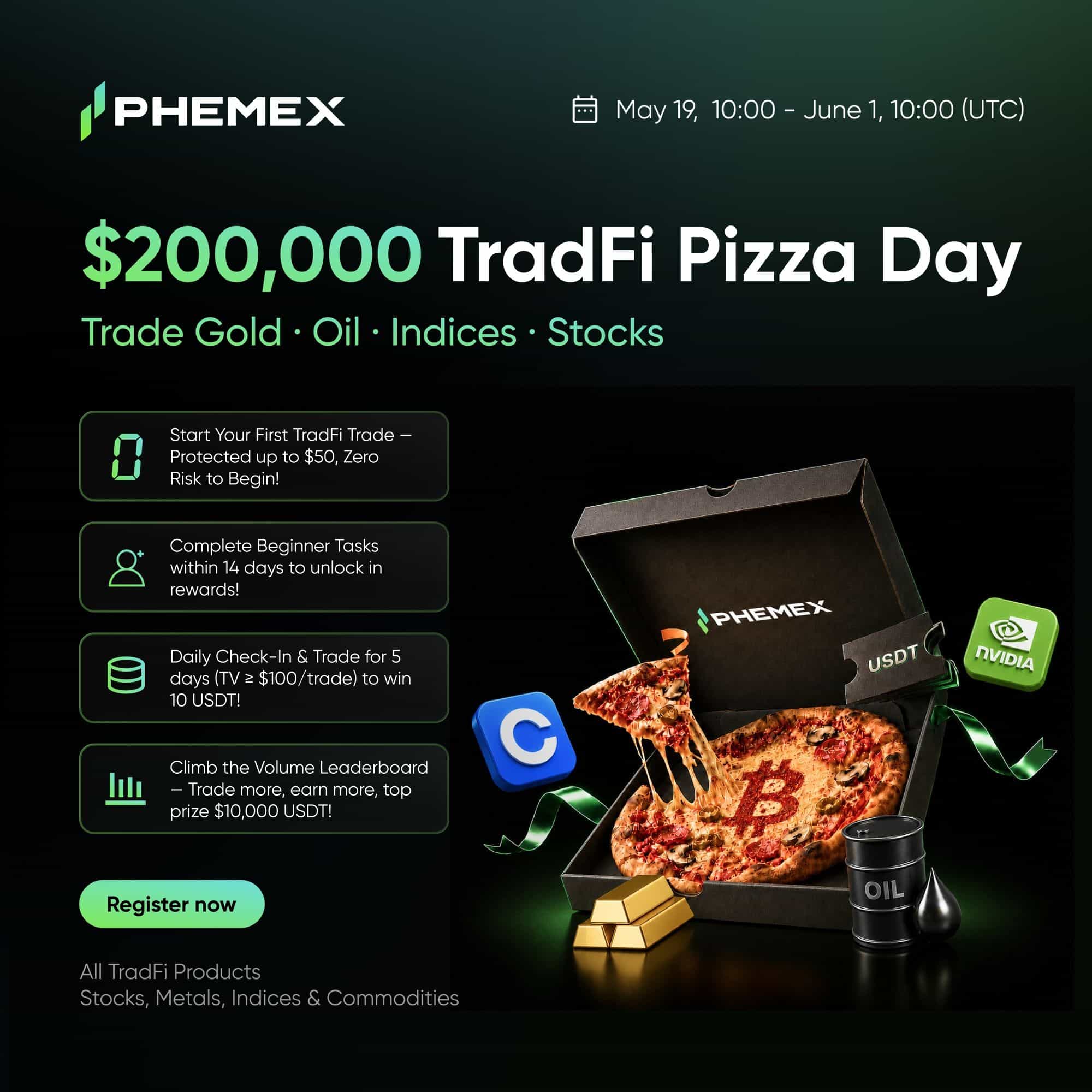
That is precisely the design behind the $200,000 TradFi Pizza Day Festival on Phemex:
| Component | Detail |
|---|---|
| Window | May 19 – June 1 (UTC) |
| Eligible markets | Gold, Oil, Indices, Stocks |
| Basic Tasks pool | $150,000 |
| Leaderboard pool (top 1,500) | $50,000 |
| Grand prize (#1) | $10,000 |
| Risk cushion | First trade protected |
| Entry point | https://phemex.com/en/events/token-fiesta/947 |
It is, in effect, Pizza Day adapted for traders who want a slice of the traditional markets while staying inside their crypto-native venue. The same impulse Hanyecz had — "let me use this thing in the real world" — just running in reverse.
The TradFi-on-Crypto Trend: Why It's the Real Pizza Day Sequel
When a trader can move from a BTC perpetual to a gold pair to a Nasdaq-tracking index without leaving their crypto exchange, two walls have come down at once:
- The friction wall between TradFi and digital assets is gone — no separate brokerage account, no Monday-Friday hours, no settlement delays.
- The access wall that excluded most retail traders from gold futures, equity indices, or crude oil positioning is gone — minimum sizes are dramatically lower, and the user interface is the one crypto traders already know.
This is the same merge that Hanyecz initiated when he ate his pizza. Only now it is at industrial scale, and it is moving in the opposite direction: from real economy → crypto venue, instead of crypto → real economy.
How to Run a Pizza Day Strategy on Phemex (Without Repeating Laszlo's Mistake)
- Anchor in majors. Hold core BTC/ETH spot positions on Phemex so the festival is incremental, not core, risk.
- Use the protected first trade. That cushion lets you size more confidently on day one without locking in regret.
- Diversify the TradFi sleeve. Don't concentrate the entire festival run in one pair — split across Gold, Oil, Indices, Stocks based on your macro view. Gold tends to track real-rate and DXY moves; oil tracks geopolitical and OPEC headlines; indices track risk-on/risk-off rotation; individual stocks track earnings and idiosyncratic news.
- Keep dry powder in Phemex Earn. Stables earning yield mid-festival > stables sitting idle.
- Set hard exits. Pizza Day is two weeks long; emotion peaks midway. Pre-commit your TP/SL before entering.
Why a $200K Pool Beats a Single Mega-Prize
Some competitions concentrate the entire reward at the top — winner-takes-all, with everyone else walking away empty. That structure is good for headlines but bad for actual user experience. The Phemex festival deliberately does the opposite. Of the $200,000 total, only $10,000 (5%) goes to the single #1 trader. The remaining 95% is distributed across the top 1,500 leaderboard pool and the Basic Tasks pool that any qualifying trader can access.
That matters for two reasons. First, it means smaller accounts have a realistic expected value from participating — you don't need to be a leverage-maxed apex trader to come out ahead. Second, it means the leaderboard remains competitive throughout the two-week window. When the top spot already pays out and the tail still has 1,500 paid slots up for grabs, traders in positions 200, 800, and 1,400 all have skin in the game until the final hour. That preserves liquidity and engagement deep into the festival, which benefits everyone trading those pairs.
A Worked Example: The "Slice Strategy"
A balanced way to think about the festival:
- 40% of festival capital → Gold pair (macro hedge, lower beta).
- 30% → Crude Oil pair (event-driven, higher beta).
- 20% → Index pair (broad risk barometer).
- 10% → Single-stock pair (tactical conviction trade).
This isn't financial advice — it's a sizing template. The point is that the festival rewards participation across pairs, not just one heroic concentrated bet.
What History Says About Trading Around Pizza Day
There is a soft seasonality to crypto activity in the second half of May. Volumes typically firm into Pizza Day as the meme cycle re-engages dormant retail accounts. Coverage spikes. New users open accounts at above-trend rates. None of this is investment advice — it's just calendar mechanics that have repeated for several cycles now.
What's different this year is that the activity isn't being absorbed only by BTC and ETH. With TradFi pairs live on a crypto venue, a meaningful share of Pizza Day attention will route into gold and oil — assets that have their own independent macro narratives running. That cross-pollination is, in our view, the most interesting flow story of the cycle.
For active traders, the practical takeaway is: don't assume Pizza Day is just a BTC spot story. Watch the order books in the TradFi pairs, watch the funding rates, and watch how the leaderboard composition evolves over the two-week festival window. Cross-asset signal is going to be richer than usual.
Closing Thought
The 10,000 BTC pizza order is not a cautionary tale. It is a reminder that markets reward people who use them. Sixteen years later, the highest-leverage way to honor that history is to actively participate — informed, sized, and equipped with the right tools. The TradFi Pizza Day Festival is the most direct way to do that this year.
Two pizzas. Ten thousand Bitcoin. One $200,000 prize pool. The arc of the holiday has finally caught up with the arc of the asset class.