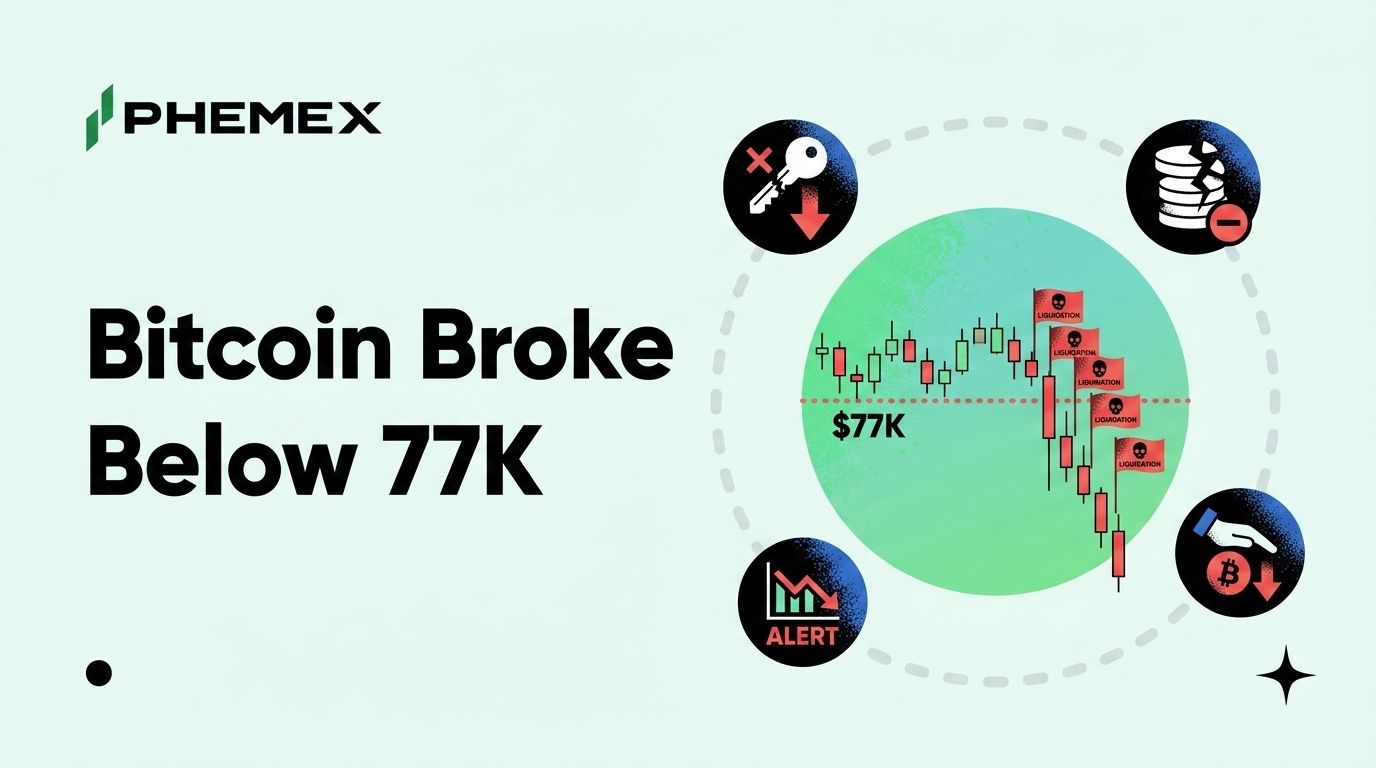
Bitcoin broke below $77,000 on May 19 and traded down to roughly $76,270, the lowest print since late April, as roughly $657 million in 24-hour crypto liquidations flushed leveraged longs. Long positions accounted for about $584 million of that figure, with shorts losing closer to $73 million, putting the long share near 89%. The catalyst was geopolitical, not on-chain. Trump posted that "the clock is ticking" for Iran, Brent crude pushed above $112, and risk assets sold off in a coordinated move across crypto, equities, and gold.
This is not the same setup as the May 18 hold below $80K. The market lost a structural psychological line and turned a sideways range into a fresh downtrend, and the leverage flush confirms that traders were positioned for a bounce that did not arrive. Here is what changed, where the levels are now, and what would invalidate the bearish read.
What Actually Broke the $77K Floor
BTC had been pinned between roughly $77,000 and $80,000 for most of the past week, with the $77K shelf acting as the line buyers kept defending. That defense failed in a single Asia session on May 19, with price slicing through $77K and bottoming near $76,270 before a small intraday recovery attempt stalled around $76,800.
The trigger was a Trump social media post warning Iran that "they better get moving, fast, or there won't be anything left of them." Within an hour, Brent crude was bid up through $112 per barrel, S&P 500 futures fell about 0.3%, and the dollar caught a haven bid. Gold, the cleanest geopolitical hedge for most of 2026, actually weakened as the dollar move pulled it down with risk assets. That combination of weaker gold and a stronger dollar against risk-off in equities and crypto is the classic sign that the market is pricing oil-driven inflation pressure rather than a pure flight to safety.
The order book reaction was textbook. Bids thinned below $77K, the leveraged longs sitting under the shelf got run, and price probed for fresh demand around $76,300 before stalling.
The Liquidation Cascade and Why 89 Percent Longs Matters
The 24-hour liquidation total of roughly $657 million is meaningful, but the composition is where the signal lives. Long liquidations were near $584 million while short liquidations came in around $73 million. That is an 8-to-1 ratio in favor of longs being wiped out, which tells you the leverage in the system going into this drop was overwhelmingly directional and positioned for upside.
When a flush is this one-sided, it does two things at once. It clears out the leveraged buyers who would have provided forced demand on any further dip. It also tells you that the consensus trade going into the weekend was long, which means the surprise was always going to come from the downside. The market does not flush the side that everyone already left.
CoinGlass data shows this was one of the larger single-day flushes of May, comparable in scale to the early-May Iran drone-strike day. The difference is that this one happened without a single piece of incremental hard news. There was no strike, no missile launch, no Iranian response, just a threat that was enough to take out roughly $584 million in long exposure.
Source: Coinglass
Funding rates on major perpetuals flipped briefly negative on Binance and OKX as the flush peaked, which is short-term bullish in the same mechanical way that the heavily positive funding read going into May 19 was short-term bearish. The crowd just got cleaned out, and the next leg will be driven by spot flows and macro rather than by leverage.
The Iran Tensions Catalyst Is Not the Whole Story
The geopolitical headline did the visible damage, but it landed on a market that was already softening. ETH had been bleeding harder than BTC for most of the month (trading near $2.1K as of May 19), and XRP had slipped to roughly $1.37 even with policy news that should have been a tailwind. The breadth of the move was already thin going into Monday.
The more important driver underneath the headline is Brent crude through $112. Oil at this level feeds into Fed inflation math and pushes the rate-cut path further out, and a sustained run above $110 keeps the higher-for-longer message live. Risk assets price that. Coverage of the move framed it as Trump warning Iran, but the underlying story is that the market was looking for an excuse to take leverage out of the system and Trump gave it one. If Iran rhetoric cools over the next 48 hours and oil pulls back below $108, much of this drop is reclaimable. If it does not, $77K becomes new resistance rather than recovered support.
Key Support and Resistance Levels From Here
BTC is trading around $76,800 as of May 20. The levels that matter for the next 48 to 72 hours fall into a clean set.
$76,000 to $76,300 is the immediate floor. This is where the May 19 low formed and where the first defensive bid showed up. A clean break below this band opens the door to the next zone fast, because there is very little price memory between here and the low $75,000s.
$74,500 to $75,000 is the next real support shelf. This range marked the late-April lows and lines up with the lower edge of the broader $74K to $80K trading channel that has defined BTC for most of the month. If $76K breaks, this is where spot buyers historically showed up and where the head-and-shoulders neckline from the larger range sits.
$70,000 to $71,000 is the deep-flush zone. A loss of $74,500 with sustained heavy ETF outflows would activate this as a target. It is the round-number line where institutional buyers stepped in during the February correction, and round-number levels tend to act as magnets in fast-moving tape because stop placements cluster there.
$77,000 to $77,500 is now resistance, not support. What was the floor for the past week is the first ceiling on any bounce attempt. Reclaiming this band cleanly, ideally on a daily close with positive funding, is the minimum condition for arguing the breakdown was a one-day liquidity event rather than a regime change.
$80,000 is the level that flips the read entirely. A reclaim and hold above $80K invalidates the bearish structure and puts the prior $80K to $85K range back in play. That is the level traders should mark as the bullish-invalidation line for the current bearish read.
Invalidation Scenarios and What Would Flip Bullish
Three signals would tell you the May 19 break was a leverage flush rather than the start of a deeper leg down.
First, a reclaim of $77,500 within 48 hours of the breakdown with positive spot ETF flows. Real recoveries across 2025 and 2026 have come with ETF buyers stepping in inside the 24-to-48-hour window after the low. A positive or flat flow print on May 20 is the early signal. Another day of $200M-plus outflows strengthens the bearish case.
Second, oil rolling back below $108 Brent is the macro key. As long as oil holds above $110 with Iran rhetoric escalating, risk assets stay on the defensive regardless of crypto-specific news. A pullback in oil signals that the market is fading the Trump warning rather than positioning for an actual strike.
Third, funding rates staying neutral to slightly negative while spot leads. The healthiest recoveries are spot-driven. If the bounce comes with funding pushing aggressively positive again, that is leverage re-entering a market that just got flushed, and those bounces tend to fail within days.
The bearish-invalidation line is $80,000 on a daily close. The bearish-confirmation line is $74,500 on a daily close with rising volume.
Risk Management for Traders in This Tape
The honest read on this market is that you are trading inside a leveraged unwind, which is the worst possible time to size up. False bounces inside the first 24 hours of a one-sided flush are the rule, not the exception. The reason most traders get stopped out here is they treat the first green hour as a bottom and load up before the actual flush completes.
Liquidation engines on every major exchange use mark price rather than last traded price to trigger forced closes, which means a single wick on a thin book can take out a position even if the spot market recovers within minutes. Three rules consistently separate traders who survive flush-and-recover tape from those who get buried.
Define your invalidation level before you enter. If you are long off the $76K bid, $74,500 is the line where the thesis is wrong. Set the stop and do not move it lower in hope.
Use lower leverage during macro-driven moves. When the price driver is a Trump post rather than a chart pattern, the next headline can take you out before the chart moves. Cut leverage in half until the catalyst clears.
Watch funding rates and ETF flows, not Twitter sentiment. Funding tells you what leveraged positioning looks like in real time, and ETF flows tell you what real spot demand looks like the next day. Both are objective measurements, which is more than you can say for crypto Twitter sentiment. The Phemex crypto liquidations guide covers the stop-placement and mark-price mechanics in detail.
Frequently Asked Questions
Why did Bitcoin drop so hard on a Trump tweet about Iran when nothing actually happened?
The market was positioned long going into the weekend with funding rates positive across major perpetuals, which made the surprise risk asymmetric to the downside. When 89% of the liquidations are longs, the move flushed crowded positioning rather than reacting to genuinely new information.
Is $74,500 a strong support level or just the next stop?
It is the lower edge of the April-to-May trading channel and lines up with the head-and-shoulders neckline from the broader range, so it carries structural weight. A clean daily close below $74,500 with heavy volume opens the $70K to $71K zone as the next real demand area, and the move can happen fast because there is little price memory between those levels.
Should I buy this dip?
The historical pattern after one-sided flushes (8-to-1 long liquidations or higher) favors patient buyers who wait for funding to reset and ETF flows to stabilize over traders who buy the first green candle. Smaller size with a defined stop below $74,500 aligns better with the tape than going all-in at $76,800.
What would flip this bearish read bullish again?
A reclaim of $80,000 on a daily close, ideally with positive spot ETF flows on May 20 and 21, plus oil rolling back below $108 Brent. Any two of those three is meaningful. All three together is a full regime change back to the prior range.
Bottom Line
BTC just lost the $77K shelf that defined the past week, printed a two-week low near $76,270, and cleared roughly $584 million in long liquidations on a single macro headline with no incremental hard news behind it. The setup from here is binary. Hold $74,500, reclaim $77,500 within 48 hours, see oil cool, and the move was a leverage flush. Lose $74,500 on heavy volume with sustained ETF outflows, and $70K to $71K is the next real demand zone. The bullish-invalidation line is $80K on a daily close. Between those two prints, this is a confirmation tape. The traders who do well in flush-and-recover tape are the ones who wait for the chart to tell them which scenario won, not the ones who guess.
This article is for informational purposes only and does not constitute financial or investment advice. Cryptocurrency trading involves substantial risk. Always conduct your own research before making trading decisions.