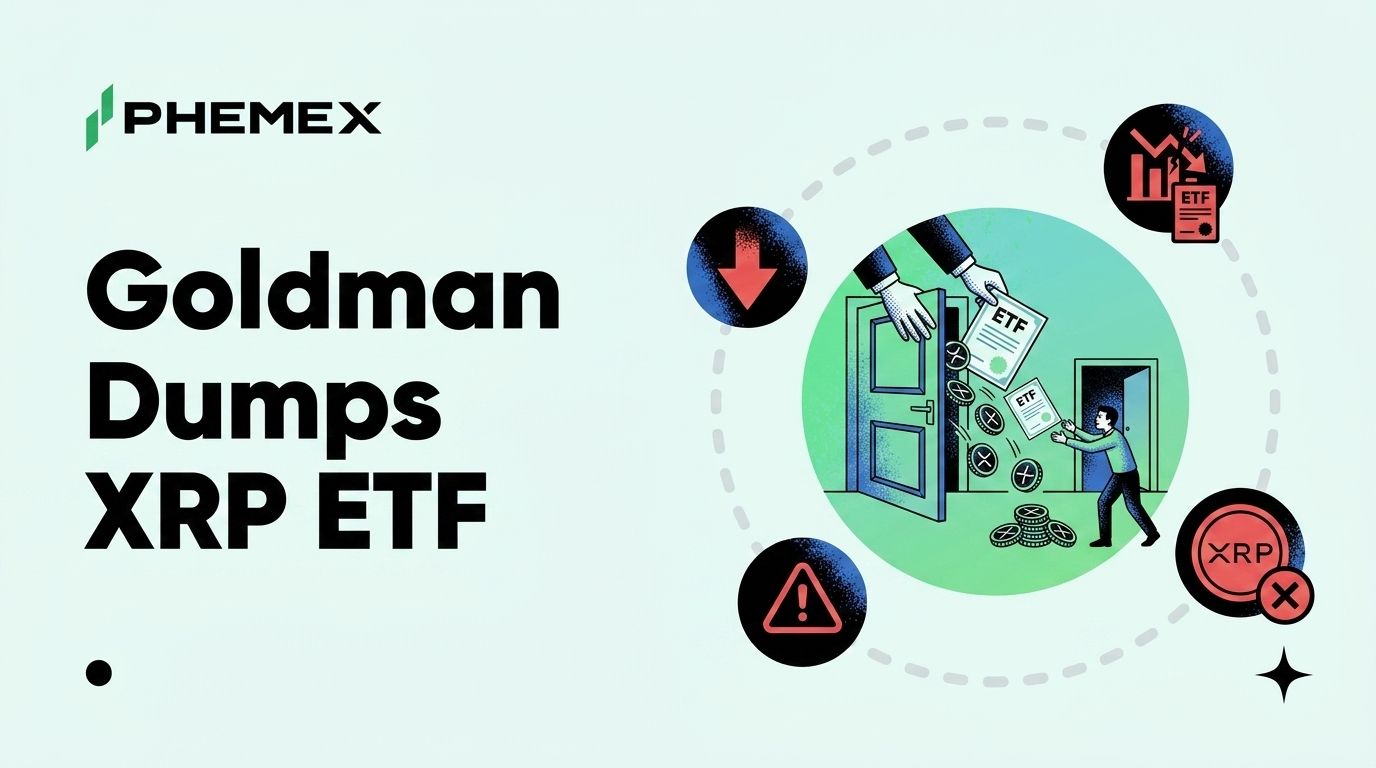
Goldman Sachs disclosed in its Q1 2026 13F filing that it sold its entire XRP ETF position, roughly 154 million dollars across the spot XRP ETF complex it had built up only one quarter earlier. The position is gone in full, not trimmed, and the exit dollar amount is almost identical to what the bank originally bought. The same week the filing landed, US spot XRP ETFs took in about 60.5 million dollars of net inflows according to SoSoValue, the largest weekly print of 2026 so far, pushing cumulative inflows past 1.39 billion dollars since the November 2025 launch.
The price sits at roughly 1.37 dollars, still well below the 1.45 to 1.46 zone where Glassnode counts around 1.16 billion XRP sitting at break-even from earlier accumulation. The story is no longer about retail conviction in XRP ETFs. It is about who is selling into the bid and why a billion-coin overhead supply has kept the chart pinned. Here is what the Goldman exit actually changes, what it does not, and the price conditions that flip the setup either direction.
What the Goldman 13F Filing Actually Disclosed
The Q1 2026 13F, filed in mid-May, shows Goldman Sachs holding zero XRP ETF shares as of March 31. The Q4 2025 filing had shown Goldman as one of the largest single institutional buyers of the new spot XRP ETF complex, with positions across Canary Capital, Bitwise, Franklin Templeton, and 21Shares totaling approximately 154 million dollars at the time the funds launched.
13F filings disclose long US equity positions at quarter-end and do not show intra-quarter trading or derivative exposure. A clean drop from 154 million to zero means Goldman either liquidated the position outright or unwound it through redemption-creation arbitrage with the ETF authorized participants. The exit dollar amount is close to the entry dollar amount, which suggests a flat trade rather than a meaningful gain or loss.
The reaction on filing day was muted. XRP traded in a tight range between 1.35 and 1.39 dollars. That is the most telling part of the disclosure. A 154 million dollar institutional exit landing inside the same week as a 60.5 million dollar retail inflow did not move price, because the two flows roughly netted against each other inside the same 1.16 billion XRP overhead supply zone.
The $1.39 Billion Retail Inflow Story That Did Not Stop
Spot XRP ETFs went live in November 2025. Cumulative net inflows through last week sit at approximately 1.39 billion dollars according to SoSoValue's flow tracker. The 60.5 million dollar print last week was the single best week of 2026, beating every week in February, March, and April. That happened in the same calendar window as the Goldman exit disclosure.
This is the cleanest institutional-versus-retail split the XRP ETF complex has shown since launch. Retail tickets and smaller RIA allocations are still buying while one identified large institutional desk just stepped out. The fund-of-funds and quant allocators that drove the November-January inflow wave have largely paused new commitments, waiting for the CLARITY Act Senate movement that has been stuck since the 15-9 Banking Committee vote.
The flow concentration matters here too. Canary Capital and Bitwise account for the bulk of the cumulative 1.39 billion figure, with Franklin Templeton and 21Shares well behind, which means a single large issuer's institutional book exiting can show up as a measurable single-week event even when broader retail demand stays positive.
The 1.16 Billion XRP Sell Wall and Why Price Has Not Moved
Glassnode's cost-basis distribution shows roughly 1.16 billion XRP clustered between 1.45 and 1.46 dollars. That is the cost basis for coins that accumulated during the late January and February run, when XRP traded sideways in that band before slipping back below 1.40. Those holders are at break-even. The structural behavior of break-even supply is consistent across every major asset. It sells the first time price reclaims the level.
At 1.37 dollars, XRP sits roughly 6% below that wall, and the math on clearing it is uncomfortable. A move from 1.37 to 1.46 requires absorbing 1.16 billion coins of likely selling pressure across a price range only 9 cents wide. At current spot ETF inflow pace (60 million dollars at a 1.40 average is about 43 million coins per week), absorbing the full overhead supply through ETF buying alone would take approximately 27 weeks.
The reason the chart has been pinned is not a lack of demand. It is the structural reality that any rally into 1.45 hits a wall of holders who waited months to get back to flat. Until that wall thins through exhaustion selling or a single dollar-flow event large enough to absorb it in one push, the 1.42 to 1.46 zone keeps acting as a ceiling.
|
Zone
|
Price
|
What Sits There
|
|
Sell wall
|
$1.45-$1.46
|
~1.16B XRP at break-even (Glassnode)
|
|
Current spot
|
~$1.37
|
Local equilibrium, ETF inflows absorbing Goldman exit
|
|
First support
|
$1.28-$1.30
|
March consolidation base
|
|
Major support
|
$1.18-$1.20
|
January swing low, 200-day moving average zone
|
What Institutional-vs-Retail Divergence Usually Signals
When a single named institutional desk exits a fresh long inside one quarter and retail keeps buying, the pattern reads in one of two ways. The bearish read is that the smart money saw something in the legislative or flow picture that retail has not yet priced. The bullish read is that the desk is taking a tactical book-management decision (year-end risk reset, regulatory capital recalculation, basket rebalancing) and the underlying thesis is unchanged.
The honest answer is that Goldman's individual decision rarely tells you which read is correct. Banks rotate ETF books constantly, and Goldman was the institutional buyer of Grayscale's GBTC discount trade in 2023 before exiting long before the broader Bitcoin rally that followed.
What matters is the aggregate. The Q1 2026 13F season showed total institutional XRP ETF holdings flat to slightly down quarter-over-quarter while retail tickets continued growing. That kind of divergence historically resolves one of two ways. Either retail capitulation eventually drags the institutional bid back in at lower prices, or a single binary catalyst (in this case the CLARITY Act Senate floor vote) re-rates the institutional view and brings the desks back fast.
What Would Clear the Wall
Three conditions, in order of probability, would absorb the 1.45 overhead supply and let XRP reclaim the 1.50-plus range.
A clean Senate floor vote on the CLARITY Act. This is the highest-impact single catalyst. The bill has been stuck in Senate Banking since the 15-9 committee vote, and the floor schedule is the binding constraint. A passing margin would force institutional allocators sitting on the sidelines to update their compliance models in days. Standard Chartered's Geoffrey Kendrick has modeled 4 to 8 billion dollars of additional XRP ETF inflows in a six-month window if the bill passes.
Sustained 100 million dollar weekly ETF inflow prints. Last week's 60.5 million was the strongest of 2026 but still short of the 100-million-plus weekly pace XRP ETFs hit in their November-December launch window. Two or three consecutive weeks above 100 million would mechanically tighten the float and force short-dated derivatives positioning to flip.
A direct US bank custody win for Ripple. Ripple's Federal Reserve master account application is still pending. Approval, or a formal OCC charter conversion, would re-rate every institutional allocator's view of Ripple's terminal value and pull spot demand from desks that currently treat XRP as a regulatory-risk asset rather than a payments-infrastructure asset.
Risk Scenarios If the Wall Holds
The bearish case does not need any new bad news. It just needs the current setup to continue. If the CLARITY Act stays stuck through June, weekly ETF inflows fade back toward the 10 to 20 million range, and the 1.45 sell wall remains intact, XRP likely grinds lower into the 1.28 to 1.30 first-support zone. That is roughly 5 to 7 percent of additional downside from spot. The base case from there is range-bound between 1.20 and 1.45 through the summer, exactly the regime XRP has been in since March.
The deeper-risk scenario is a break of the 1.18 to 1.20 zone. That is where the 200-day moving average sits and where the January swing low printed. A daily close below 1.18 would invalidate the multi-month accumulation structure and likely accelerate selling toward the 0.95 to 1.05 zone where pre-ETF cost basis sits. The trigger for that scenario would most likely be a CLARITY Act failure inside the Senate (a no-vote or an indefinite hold past August), combined with a broader risk-off macro event.
The thing to watch is not the daily price. It is the weekly ETF flow print published every Friday and the Senate calendar. Those two data series are what move XRP from here.
Frequently Asked Questions
Did Goldman Sachs sell its XRP ETF position because it turned bearish on XRP?
Not necessarily. Goldman's 13F shows the position was fully exited at roughly the same dollar amount it was entered, which is consistent with a flat tactical trade rather than a conviction shift. Banks rotate ETF books constantly for capital and risk reasons that have nothing to do with directional views.
Is the 1.16 billion XRP at 1.45 dollars a confirmed sell wall or an estimate?
It is a Glassnode cost-basis estimate based on on-chain accumulation data, not a literal limit-order book reading. The number is reliable for the directional point that significant overhead supply sits there, but the exact selling intensity at 1.45 cannot be measured precisely until price tests the level.
What is the single most important catalyst for XRP in the next 60 days?
The Senate floor vote on the CLARITY Act. The bill has been stuck since the January 15-9 Banking Committee vote, and a floor vote (either direction) would re-rate every institutional XRP ETF allocator's model. No other near-term catalyst comes close in expected impact.
How long would current ETF inflows take to absorb the overhead supply?
At last week's pace of 60.5 million dollars and an average price of 1.40, ETF buying absorbs roughly 43 million XRP per week. The 1.16 billion-coin overhead supply at 1.45 would take approximately 27 weeks to clear at that rate, assuming every ETF dollar flows to spot demand and no additional selling appears.
Bottom Line
Goldman's 154 million dollar XRP ETF exit is one data point inside a Q1 2026 13F that mostly showed flat institutional positioning. Retail inflows hit a 2026 high in the same week the exit was disclosed, which tells you the broader bid has not broken. The trade is not institutional capitulation, it is one desk closing a flat book at roughly its entry price.
The real story is the 1.16 billion XRP at 1.45 dollars and what it would take to clear it. The math says ETF inflows alone get there in roughly six months at the current pace. A CLARITY Act Senate floor vote gets there in roughly six weeks. The base case while neither catalyst hits is a 1.20 to 1.45 range through the summer, with the weekly ETF flow print and the Senate calendar as the two data series that flip the regime. A daily close above 1.46 confirms the wall has broken. A daily close below 1.18 invalidates the structure entirely and opens the 0.95 to 1.05 zone.
This article is for informational purposes only and does not constitute financial or investment advice. Cryptocurrency trading involves substantial risk. Always conduct your own research before making trading decisions.