

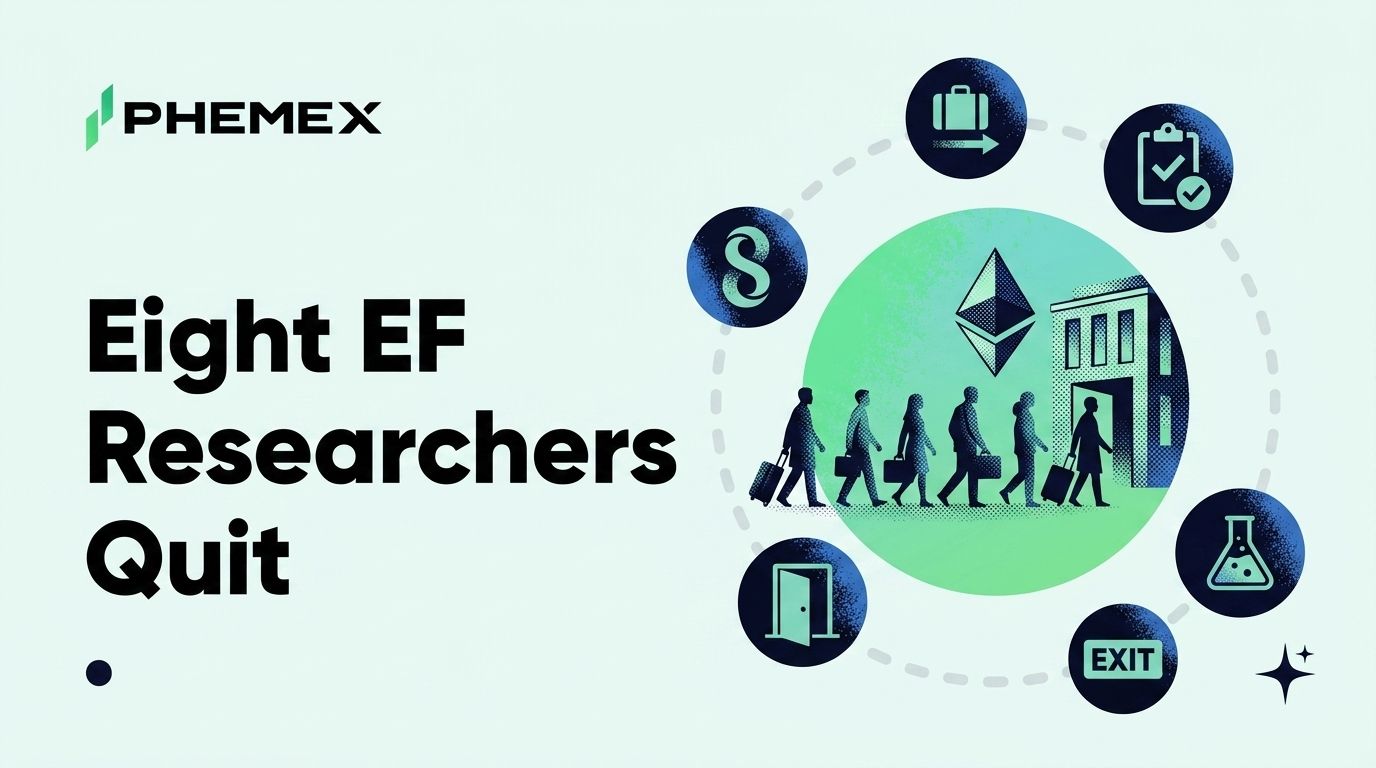
Eight senior researchers have quit the Ethereum Foundation in 2026, with five of those resignations landing in May alone. Carl Beek announced his exit on Monday after seven years, with a last day of May 29, and Julian Ma resigned the same day after roughly four years on the protocol R&D team. They join Barnabé Monnot, Tim Beiko, Trent Van Epps, Alex Stokes, Josh (the long-time EF operations and writing lead), and former co-executive director Tomasz Stańczak on the 2026 roster of departures. The Foundation's "Protocol Cluster," the team responsible for Ethereumprotocol research, has now lost contributors across every layer it covers.
Here is the full roster, the institutional reasons behind the wave, the community reaction, what is still working, and what would actually be at risk if the brain drain continues.
The Full Roster of 2026 Departures
The list spans research, governance, and operations, and the tenures involved range from four years to seven. Below is the eight-person roster, with the work each one leaves behind.
|
Name
|
Tenure
|
Role / area
|
Exit timing
|
|
Carl Beek
|
7 years
|
Consensus-layer research, Beacon Chain, proof-of-stake transition
|
Last day May 29, 2026
|
|
Julian Ma
|
~4 years
|
Mechanism design, cryptoeconomics, FOCIL (EIP-7805), Fast Confirmation Rule
|
Announced May 18, 2026
|
|
Barnabé Monnot
|
Multi-year
|
Proposer-builder separation, validator economics, ePBS research
|
2026
|
|
Tim Beiko
|
Multi-year
|
Public-facing protocol coordinator, ran All Core Devs calls
|
2026
|
|
Trent Van Epps
|
Multi-year
|
Ecosystem coordination, central role organizing Protocol Guild
|
Earlier in 2026
|
|
Alex Stokes
|
Multi-year
|
Consensus-layer research, MEV-related mitigations
|
2026
|
|
Josh (operations lead)
|
7 years
|
EF operations, the annual "Atoms, Institutions, Blockchains" essay tradition
|
March 2026
|
|
Tomasz Stańczak
|
<1 year
|
Former co-executive director, ex-Nethermind CEO
|
End of February 2026
|
The two highest-profile names in that table need a closer read because they shape how everything else is interpreted.
Beek's exit, first reported by The Block on May 18 alongside Ma's resignation, closes a tenure that put him at the center of every major consensus-layer milestone since the original Beacon Chain rollout. Ma leaves behind FOCIL, the censorship-resistance mechanism built around inclusion lists that is one of the more meaningful protocol-level resilience upgrades on the medium-term roadmap.
Stańczak's case is structurally different from the researchers because he ran the institution rather than the protocol research. He joined as co-ED in March 2025 after stepping down as Nethermind CEO and stepped down himself at the end of February 2026, less than a year into the role. His stated reason was that the restructuring objectives set in early 2025 were "either completed or structurally embedded." Bastian Aue replaced him as co-ED alongside Hsiao-Wei Wang.
Eight names, one calendar year, every layer of the Protocol Cluster touched. That is the signal worth covering, separate from any individual departure.
The EF's New Mandate and the Governance Transition
This is the institutional context most short news pieces leave out. The departures are not random. They sit on top of a 2025 restructuring that explicitly changed what the Ethereum Foundation does.
Vitalik Buterin's 2025 reorganization repositioned the EF away from top-down roadmap ownership and toward a focused research and grants hub. Execution moved outward, to independent client teams (Geth, Nethermind, Besu, Erigon, Reth, Lighthouse, Prysm, Teku, Lodestar) and to standalone organizations that already employ many former EF researchers. The implicit deal was that the EF would coordinate less and fund more, while the actual building got pushed to the edges.
Under that mandate, several long-tenured researchers concluded that their work had a better home outside the Foundation. The honest read is not that these contributors stopped working on Ethereum. Several have already announced new affiliations with L2 teams, independent research outfits, or their own ventures. The protocol still gets their work. The EF, as an institution, no longer claims it.
The replacement structure inside the Protocol Cluster names Will Corcoran, Kev Wedderburn, and Fredrik as new leads. None of them carries the public profile of the people they are replacing, which is also part of the design. The new mandate de-emphasizes individual researcher prominence in favor of a flatter, grants-funded model.
Community Reaction and the Concerns Worth Taking Seriously
Bankless reported on the scrutiny the EF is now under, raising questions about compensation, role clarity, and the size of competing offers from L2 teams and AI-aligned crypto projects that may have widened a pay gap the Foundation has not closed. CoinDesk's coverage framed the wave as the deepening of an "internal shakeup" rather than a one-off cluster of unrelated exits.
The concerns that matter, separated from the noise:
Coordination capacity. Beiko's role in All Core Devs is the one that takes the most institutional muscle to replicate. Client teams agreeing on hard fork content is the single bottleneck for every upgrade. If that coordination layer thins out, hard forks slow down.
Credentialing. The EF historically signaled which research mattered, and a paper or proposal carrying an EF affiliation got read faster, cited more, and integrated into client roadmaps sooner. If the credentialing function weakens, the protocol risks fragmenting into competing research factions with no neutral arbiter to call the line between live work and dead ends.
Funding distribution. Protocol Guild, which Van Epps helped organize, is the main mechanism for paying independent client developers. His departure does not break the contract, but the institutional knowledge that built it now lives outside the Foundation.
The concerns that are getting overweighted:
That Ethereum protocol development is in trouble. It is not. Dozens of independent teams ship to mainnet, testnets, and L2s every week. The EF payroll has never been the limiting factor on Ethereum's roadmap.
That this is a "Vitalik losing control" story. Buterin himself designed the 2025 restructuring and was the one who pushed execution outward to client teams and independent organizations. The departures, in his framing, are evidence the new mandate is working as intended rather than evidence of governance failure.
What Continues to Work: The Protocol Roadmap
The protocol does not run on EF headcount. It runs on client software, validator participation, and the multi-team upgrade process. All three are functioning.
Fusaka shipped in December 2025, the consensus and execution upgrade that introduced PeerDAS and data-availability sampling improvements. That landed without disruption. Glamsterdam, Ethereum's next hard fork, is targeted for the first half of 2026, tentatively around June. It enshrines Proposer-Builder Separation (ePBS) and introduces Block-Level Access Lists (BALs), the foundations for parallel execution and the path toward 10,000 TPS on L1. After Glamsterdam, the developers named the next upgrade Hegota, targeting H2 2026 with a focus on statelessness work tied to The Verge and The Purge.
ETH staking participation has not moved on the departures. Validator counts are stable. The BlackRock ETHB staking ETF, which launched in March 2026, continues to take inflows. Layer 2 activity (Base, Arbitrum, Optimism, Linea, Scroll) has not paused on EF news cycles. Most users of the network have no direct interaction with the Foundation at all.
The shorthand for ETH holders is that the protocol roadmap is decoupled from the EF roster in a way that did not exist five years ago. That decoupling is the point of the restructuring.
What Would Actually Be at Risk If the Drain Continues
The honest framing of risk, separate from the protocol-collapse narrative, is institutional.
The first risk is hard-fork cadence. Glamsterdam still has the protocol-coordination muscle in place because it was scoped before most of the May departures. If Hegota and the upgrades beyond it lose that coordination layer, the gap between named hard forks could stretch from six to twelve months to something longer, and the "engineering upgrade era" the EF promised could quietly slide.
The second is research direction. Without a strong EF research voice, the protocol's research agenda becomes whatever the loudest L2 teams and the best-funded independent labs want it to be. That is not automatically bad, but it removes a neutral coordinator from a process that benefits from one.
The third is the bear case nobody wants to write down. If the new mandate fails to produce credible new leadership over the next year, the EF risks becoming a passive grants office while the actual coordination work either consolidates inside a single client team or moves to a parallel organization. That outcome would not break Ethereum the protocol, but it would meaningfully change the politics of who decides what ships.
None of those risks are priced into ETH today, and none should be. They are institutional, not technical. They matter on a 24-month horizon, not a 24-hour one.
Frequently Asked Questions
Is the Ethereum Foundation collapsing?
The short answer is no, even with eight high-profile researcher exits in 2026 representing significant institutional churn for a single calendar year. The EF still employs a large research and operations staff, controls a multi-billion-dollar treasury, and continues to fund grants across the ecosystem. The structure is changing under the 2025 mandate, but the institution is not failing on any measurable metric.
Does the brain drain affect ETH price?
There is no direct effect that the data supports as a near-term catalyst. ETH trades on macro conditions, ETF flows, network usage, and the broader risk environment that drives crypto majors as a class. The departures are an institutional story that may matter on a 12 to 24 month horizon for governance, but they are not a near-term price catalyst on their own.
Where are the departing researchers going?
Several have already announced moves to L2 teams, independent research organizations, AI-adjacent crypto projects, or their own ventures. The protocol still benefits from their work because much of it ships through the same client teams and standards bodies. The Foundation simply no longer employs the contributors directly on its payroll.
Will Glamsterdam still ship on time?
On current information, the H1 2026 target around June still holds with the work scoped before the May departures. The upgrade is scoped, ePBS and BALs specifications are advanced, and client teams that sit outside the EF handle the actual implementation. The departures touch coordination and research direction more than the engineering pipeline for the next hard fork.
Bottom Line
Eight senior departures in one calendar year is the worth-covering signal, not a protocol obituary. The EF rolled out a new mandate in 2025 that pushed execution outward and kept research and grants at the center, and the 2026 exits are the second-order effect of that restructuring playing out. Glamsterdam is the next test in H1 2026, and the question worth watching is the on-schedule delivery of ePBS and Block-Level Access Lists under the new Protocol Cluster leadership. If they do, the new mandate is working. If Hegota slips into 2027 and All Core Devs coordination visibly thins, the institutional risk becomes a real one. ETH holders should track upgrade cadence and client-team independence, not EF headcount, as the actual leading indicator.
This article is for informational purposes only and does not constitute financial or investment advice. Cryptocurrency trading involves substantial risk. Always conduct your own research before making trading decisions.