




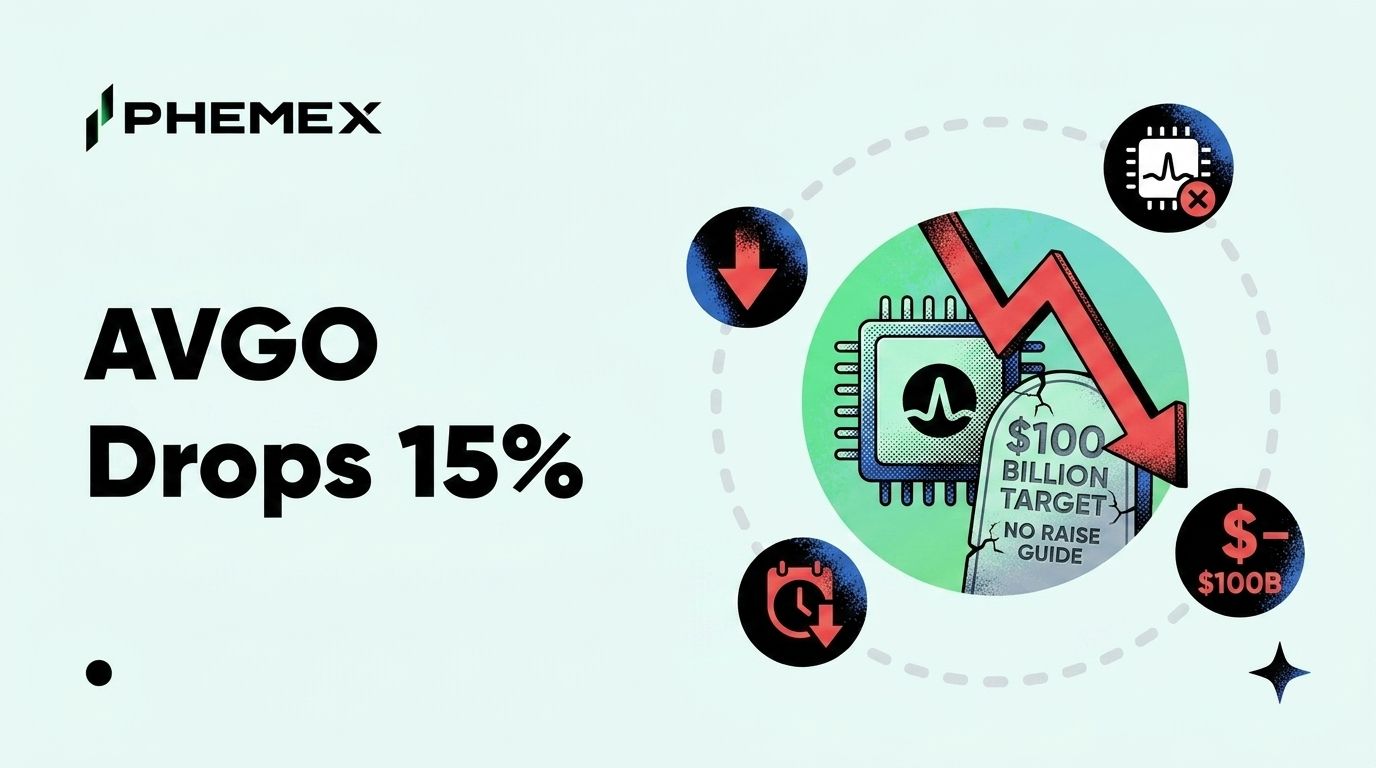
Broadcom closed down 15% on Thursday June 4 after delivering a fiscal Q2 print that beat on the bottom line and missed on the top. EPS came in at $2.44 against a $2.40 consensus from Refinitiv-tracked sell-side estimates, revenue printed at $22.19 billion against $22.27 billion expected, and net income jumped 88% year over year to $9.31 billion. AI revenue alone hit $10.8 billion, more than doubling year over year. On every dollar-printed metric, the quarter was strong.
The stock dropped anyway, and the reason was the call. CEO Hock Tan left the full-year $100 billion AI chip serviceable addressable market target intact rather than raising it, and he guided next-quarter AI chip sales to roughly $16 billion against a $17.2 billion sell-side consensus. The market read both as confirmation that the hyperscaler digestion phase is real, and the stock repriced accordingly.
Why a Beat Triggered the Biggest Drop in Two Years
Source: Yahoo.Finance
The simplest answer is expectations. AVGO had rallied roughly 28% over the prior two months on the assumption that the AI chip ramp would force Tan to revise the $100 billion 2027 target upward, and the sell-side notes going into the print were modeling a guide-up to $115 billion to $120 billion. When the guide came in flat at $100 billion and next-quarter sales landed below the model, the gap between expectations and reality was enough to flush every long that had bought the run-up.
The exit pattern from the Bloomberg post-call analysis is instructive. The biggest single-day flow out of AVGO was concentrated in the first 45 minutes of Friday's session, and the selling was dominated by systematic and momentum-following desks rather than long-only allocators. The long-only book mostly held, which is consistent with the read that the underlying business is intact and the move was a positioning unwind rather than a fundamental rerate.
This is the second time in the AI cycle a mega-cap chip name has dropped 15% on a beat. The previous instance was the May 2025 NVDA print, where forward guide landed slightly below the most aggressive whisper numbers and the stock dropped 11% before recovering within three weeks. The historical analog suggests the AVGO drawdown follows a similar shape, per the post-print recovery patterns tracked across the major semis on TradingView.
What the Refused $100 Billion Guide-Up Actually Signals
The $100 billion 2027 AI SAM target was first floated by Tan on the December 2024 Broadcom earnings call, where he framed it as the addressable market across Broadcom's three named hyperscaler customers (widely understood as Google, Meta, and ByteDance) plus a fourth and fifth he hinted were in the pipeline. The market took the original framing as conservative and modeled organic upgrades over the next four quarters as Broadcom secured the additional customers.
The refusal to raise on Thursday is not a demand-collapse signal. It is a digestion-phase signal. Hyperscalers placed their largest custom-ASIC orders in the 2024 to early 2026 window, and the chip volumes shipped from those orders are now sitting in deployed training and inference racks. The follow-on order cycle for the next architecture generation is a 12 to 18 month process from spec lock-in to silicon delivery, and the customers are currently in the spec phase rather than the order phase.
Tan said on the call that visibility through fiscal 2027 supports the $100 billion target without revision and that any guide-up will wait until the next round of customer commitments lands. That language is exactly what a digestion phase sounds like. It does not mean the AI buildout is over. It means the order flow is lumpy and the next acceleration is later than the bulls wanted.
What the Read-Through Means for NVDA, MRVL, and TSM
The semiconductor sector lost roughly $1 trillion in market cap across Thursday and Friday, and the spillover is not symmetrical across the names. The read-through depends on each company's revenue mix and where they sit in the AI supply chain.
NVDA holds up structurally better because its merchant-GPU business is decoupled from the custom-ASIC cycle that Broadcom services. The hyperscaler customers ordering AVGO custom ASICs are the same customers buying NVDA H200 and Blackwell silicon for their merchant-GPU clusters, and the NVDA backlog is still printing record bookings. The NVDA drawdown was roughly 5% across the two days, which is the cleanest signal that the market views the AVGO guide as custom-ASIC-specific rather than general-AI.
MRVL took the worst spillover at down 8% on Friday alone, and the reason is structural overlap. MRVL's custom-ASIC programs for Trainium and TPU sit in the exact same business model that AVGO's print just questioned, which is the context the Phemex AI agents primer frames in terms of the broader AI compute stack. The MRVL Q1 print on June 18 is now the next major data point.
TSM as the manufacturing layer for the entire custom-ASIC complex is exposed indirectly. The TSM wafer commitments from AVGO, MRVL, and the hyperscaler-direct programs are already locked through 2026, but the 2027 capacity allocation conversations will be informed by the digestion-phase signal Tan just delivered. TSM was down roughly 4% on the spillover, which is a normal beta-driven move rather than a structural rerate.
Where AVGO Support Actually Sits
AVGO closed Friday at roughly $1,510 after the 15% drop. The support stack from here is clean and well-defined by prior consolidation zones.
$1,470 is the immediate test. That is the early-May consolidation low and the level where buyers stepped in twice during the spring chop. A hold at $1,470 with a reclaim of $1,540 inside two weeks is the constructive setup and would suggest the post-earnings flush is complete.
$1,400 is the structural floor. That is the February 2026 swing low and the level where the post-DeepSeek volatility resolved. A break of $1,470 likely leads to a quick test of $1,400, and that level is where the long-term thesis either holds or breaks. A clean hold at $1,400 with positive flows on a recovery rally is the bull setup. A close below $1,400 invalidates the multi-month base and opens $1,280 as the next major level.
The catalyst calendar between now and the next print is light. The biggest scheduled event is the NVDA Q2 print on August 27, which will reset sector expectations for the full custom-ASIC supply chain. AVGO will trade as a beta to the AI sector through that window unless a specific Broadcom catalyst hits in the interim.
Frequently Asked Questions
Is the AVGO drop a buying opportunity?
It is for investors who believe the digestion-phase read is correct and the order cycle resumes in fiscal Q4. The risk is that the digestion phase extends through 2027 and the $100 billion target stays static or gets revised lower. The cleanest entry waits for the $1,470 level to hold on a retest and for AI flow data to confirm the customer commitment cycle is reaccelerating.
Does this mean the AI capex cycle is over?
No. The AI capex cycle is structurally intact and is still tracking at the $200 billion-plus annual run-rate across the major hyperscalers. The AVGO print signals lumpy order flow in the custom-ASIC layer, not collapsing capex. Merchant-GPU and inference-chip demand both remain at full ramp through 2026 based on the public commentary from the hyperscaler customers.
What does it mean for the broader Phemex tokenized-stock complex?
The tokenized stock products that track the AI semiconductor names will follow the same price discovery as the underlying equities. AVGO-USDT and MRVL-USDT will track the cash settlement closely. NVDA-USDT held up better through the spillover, consistent with the read that NVDA is the structurally cleanest AI long inside the current setup.
When does the next major AVGO catalyst land?
The next scheduled earnings print is fiscal Q3 in early September 2026. The biggest interim catalyst would be a specific hyperscaler customer commitment that allows Tan to revise the $100 billion target upward at a mid-cycle update. Without that, the stock trades as a beta to the broader semiconductor sector and to NVDA's August 27 print.
Bottom Line
Broadcom delivered a strong quarter on every absolute metric and the stock dropped 15% anyway. The drop was about the gap between consensus expectations and Hock Tan's measured guide, not about a collapse in the underlying AI demand picture. The $100 billion 2027 SAM target stays intact, the digestion phase is real, and the next customer commitment cycle is the catalyst that resumes the upside. AVGO support sits at $1,470 and $1,400. The first level is the trade. The second level is the thesis. The read-through to NVDA is mild, the read-through to MRVL is severe, and the read-through to TSM is muted. The next major datapoint is the MRVL print on June 18 and then NVDA on August 27.
This article is for informational purposes only and does not constitute financial or investment advice. Cryptocurrency trading involves substantial risk. Always conduct your own research before making trading decisions.