

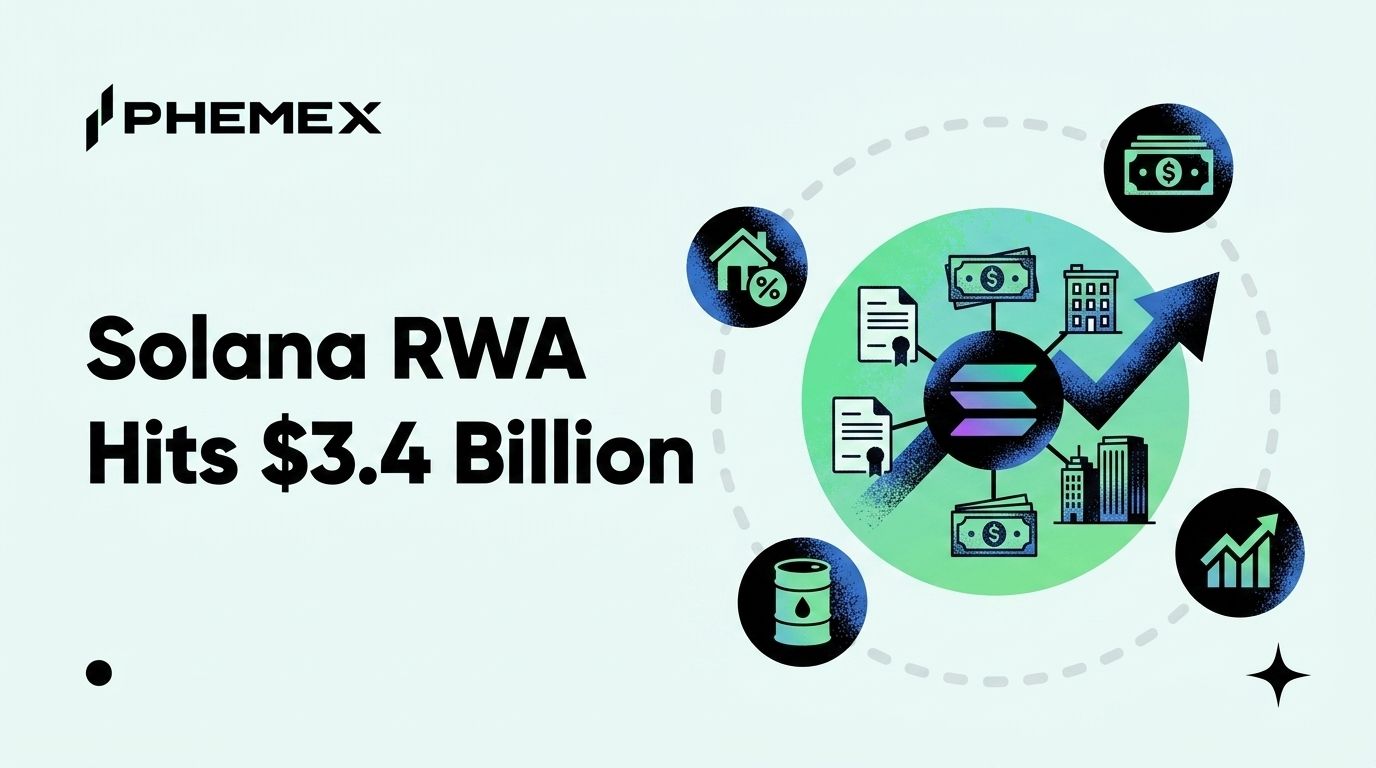
The value of tokenized real-world assets living on Solana reached a fresh all-time high of roughly $3.41 billion in July 2026, according to on-chain tracking data. That figure covers US Treasuries, private credit, tokenized funds, and equities that were minted or settled directly on the network, and it marks one of the fastest expansions of any single chain's RWA base this year.
Real-world asset tokenization has become one of 2026's defining crypto narratives, and Solana has quietly turned into a serious venue for it. SOL trades near $76.83 today, but the more interesting story is not the token price. It is the institutional capital settling on-chain and choosing Solana's rails to do it. Here is what real-world asset tokenization on Solana actually means, what pushed the number to a $3.4 billion record, which asset types and issuers lead, and where the risks sit.
What Real-World Asset Tokenization on Solana Actually Means
A real-world asset, or RWA, is a tokenized version of something that exists off-chain. That includes short-term US Treasuries, money market funds, private credit, commodities, and increasingly tokenized stocks and pre-IPO equity. The off-chain asset gets wrapped into a token that is issued, tracked, and settled on a blockchain, which lets it move and clear with the speed of crypto while still representing a claim on a traditional instrument.
Solana is a high-throughput Layer-1 blockchain known for sub-second block times and transaction fees that stay a fraction of a cent even under load. Those two properties are exactly what a tokenization issuer wants. When a fund manager needs to settle thousands of subscriptions, redemptions, and interest payments a day, per-transaction cost and finality speed become the whole game. A chain that charges dollars per transfer makes small-ticket, high-frequency RWA products uneconomical, and Solana's fee structure sidesteps exactly that problem.
The other draw is composability, and it arguably matters even more than raw cost. Once a Treasury token lives on Solana, it can plug into the network's DeFi ecosystem, serve as collateral, or pair against a stablecoin in a lending market. That turns a static yield instrument into something a trader or treasury desk can actually use, which is a large part of why builders keep choosing the chain.
What Drove the $3.41 Billion Record
Three forces pushed Solana's RWA base to its all-time high, and none of them are speculative narratives. The first is the tokenized Treasury and money-market wave. As US yields stayed elevated through the first half of 2026, on-chain Treasury products became one of the most in-demand instruments in crypto, and several of the largest issuers expanded their Solana deployments to capture that flow.
The second driver is the tokenized-equity push. Solana became the headline venue for stock tokenization earlier this year, with SpaceX and a growing list of public equities trading as on-chain tokens. That story pulled both retail attention and issuer commitment onto the chain, and every new equity product added directly to the RWA total.
The third is institutional settlement. Asset managers and fintech firms are increasingly moving fund shares and credit instruments on-chain to cut settlement times from days to seconds, and a meaningful share of that activity has landed on Solana. Combined, these flows lifted the network's tokenized-asset value to the $3.41 billion mark, up sharply from where it sat at the start of the year. On-chain data aggregators like RWA.xyz's Solana network page track the running total in real time.
The Asset Types and Players Leading the Growth
The record is not one product but a stack of different asset classes, each with its own issuers and demand base. Tokenized US Treasuries and money-market funds make up the largest slice, followed by private credit, tokenized equities, and a smaller layer of commodities and other instruments.
The table below breaks down the rough composition of Solana's RWA base and the kinds of issuers behind each category. Exact figures shift daily as products mint and redeem.
|
Asset type
|
Share of Solana RWA
|
What it represents
|
Example issuer profile
|
|
Tokenized Treasuries and funds
|
Largest slice
|
Short-term US government debt and money-market funds
|
Major asset managers and on-chain fund platforms
|
|
Private credit
|
Second largest
|
Loans and credit facilities packaged on-chain
|
Institutional credit and lending platforms
|
|
Tokenized equities and pre-IPO
|
Fast growing
|
Public stocks and private shares as on-chain tokens
|
Brokerage and tokenization specialists
|
|
Commodities and other
|
Smaller layer
|
Gold and other real-world instruments
|
Commodity-backed token issuers
|
The players matter as much as the categories. The biggest tokenized-fund issuers now run Solana deployments alongside their other chains, and specialist tokenization firms have made Solana a primary settlement layer for equities. You can see the live scale of the on-chain Treasury market on RWA.xyz's tokenized Treasuries dashboard and the equity side on its tokenized stocks page. For a broader look at which assets are leading the sector, Phemex's top RWA tokens breakdown covers the projects driving the narrative.
How Solana Stacks Up Against Ethereum and the XRP Ledger
Solana is a fast-growing challenger, not the market leader. Ethereum still holds the large majority of tokenized real-world asset value, thanks to a first-mover base of Treasury funds and its deep institutional custody infrastructure. Its lead is real and it is not disappearing this quarter. What is changing is the pace at which challengers are closing ground.
The XRP Ledger has also grown its tokenized-asset base past the multi-billion-dollar mark, positioning itself around cross-border settlement and payments. Solana's differentiator is throughput and cost combined with a large, active DeFi ecosystem that gives tokenized assets somewhere to go once they are minted. Where the XRP Ledger leans into payments and Ethereum leans into institutional custody depth, Solana competes on raw settlement economics and composability with on-chain liquidity.
The honest read is that this is not a winner-take-all race yet. Issuers are deploying the same product across multiple chains, and stablecoin liquidity, which underpins most RWA settlement, is expanding on all three. Solana's edge is that its cost structure makes small-ticket, high-frequency products viable in a way slower or pricier chains struggle to match. Solana's official real-world asset overview lays out the network's pitch to issuers directly.
The Risks and What Comes Next
A record number is a milestone, not a guarantee. The first risk is concentration. A large share of the RWA total sits in a handful of Treasury and fund products, so a single issuer pulling back or a redemption wave could dent the figure quickly. Growth built on a few big deployments is faster to climb and faster to fall.
Regulation is the second overhang. Tokenized securities sit inside an evolving legal framework, and the rules around what a token holder actually owns, how redemptions are honored, and which jurisdiction governs the instrument are still being written. Tokenized-stock products in particular have already drawn scrutiny over how much of the underlying share a holder truly owns versus a derivative claim on it. The third risk is the usual smart-contract and stablecoin exposure, since most RWA settlement runs on stablecoin rails and any de-peg or contract exploit would ripple straight into the tokenized-asset base.
The outlook still points up. If US yields stay firm and the tokenized-equity story keeps pulling issuers onto the chain, Solana's RWA base has a clear path to keep setting records through the second half of 2026. The number to watch is if growth broadens beyond Treasuries into credit and equities, because a wider base is a more durable one. SOL's own price action, tracked on data pages like its CoinMarketCap page, tends to follow network usage over long horizons rather than lead it.
Frequently Asked Questions
What are real-world assets on Solana?
Real-world assets on Solana are tokenized versions of off-chain instruments like US Treasuries, money-market funds, private credit, and stocks that are issued and settled on the Solana blockchain. The token represents a claim on the underlying asset while moving with the speed and low cost of the network.
Why did Solana's RWA value hit a record?
The $3.41 billion record was driven by strong demand for tokenized US Treasuries during a high-yield stretch, a wave of tokenized equities trading on Solana, and asset managers moving fund shares on-chain for faster settlement. Those three flows compounded through the first half of 2026.
Which real-world assets are the biggest on Solana?
Tokenized US Treasuries and money-market funds make up the largest share, followed by private credit and a fast-growing layer of tokenized equities and pre-IPO shares. Commodities and other instruments make up a smaller slice.
Is Solana better than Ethereum for tokenization?
Ethereum still holds most of the tokenized real-world asset value and has deeper institutional custody infrastructure. Solana competes on faster settlement, near-zero fees, and composability with its DeFi ecosystem, which makes it attractive for high-frequency, small-ticket products rather than a clear across-the-board winner.
The Bottom Line
Solana's climb to a $3.4 billion tokenized real-world asset base is a signal that the RWA narrative has moved from pitch decks to actual settlement volume. The record was built on tokenized Treasuries, a booming equity-on-chain story, and institutions choosing Solana's cheap, fast rails, not on speculation. The watch items are concentration in a few large products and the unsettled regulation around tokenized securities. If growth keeps broadening beyond Treasuries into credit and equities through the back half of 2026, the next record is a question of when, not if. Track the network's usage, not only SOL's price, because on-chain adoption is what has been driving this number all year.
This article is for informational purposes only and does not constitute financial or investment advice. Cryptocurrency trading involves substantial risk. Always conduct your own research before making trading decisions.