








Real-world asset (RWA) tokens - cryptocurrencies backed by tangible assets like real estate, commodities, bonds, or equities - have surged into the spotlight. Retail crypto users and curious investors are now eyeing this niche as it grows from a promising concept into a $35–45 billion on-chain market. In this article, we present the top RWA tokens 2026 in a neutral, educational overview. We’ll explain what the tokenization crypto sector is, how these tokens bridge traditional finance and blockchain, and why they matter. This Top 10 RWA Tokens in 2026 list is based on market activity, adoption, ecosystem development, and relevance to tokenizing real assets – not a buy list or financial advice. By the end, you’ll understand each project’s role, strengths, and risks in the RWA landscape as of 2026.
What Is the RWA Crypto Sector?
Real-world asset (RWA) tokens are crypto tokens that represent ownership of physical or financial assets in the real world. These assets can include stocks, bonds, real estate, commodities (like gold), or even infrastructure and machinery. In essence, RWA projects bring familiar, off-chain assets into the blockchain and decentralized finance (DeFi) space, making them more accessible and fractionalized for investors globally. For example, a token might represent a share of a rental property, a bar of gold, or a U.S. Treasury bond.
Common use cases in the RWA sector span multiple industries:
Bonds: Government or corporate bonds can be tokenized, letting investors buy into bond-backed tokens and earn interest from the yield. For instance, there are tokens backed 1:1 by U.S. Treasury bills that provide on-chain stablecoin yield.
Real Estate: Tokenized real estate platforms allow fractional investment in properties, with token holders earning a share of rental income. This makes real estate investment more accessible, as you no longer need to buy an entire building – just a token slice of it.
Commodities and Luxury Assets: Precious metals like gold and silver have been popular RWA tokens (each token representing a fixed amount of physical metal in vaults). Even fine art or collectibles can be tokenized, enabling people to own a fraction of a painting or rare item and benefit if its value rises.
Private Credit and Invoices: Some platforms turn invoices, loans, or other forms of private credit into tokens to be used as collateral or yield-bearing assets in DeFi. This bridges small business financing or trade finance with the crypto lending markets.
Funds and Equities: Investment funds (like mutual funds or ETFs) and even publicly traded stocks can be mirrored on-chain via tokens. For example, there are tokens tracking shares of major tech companies or tokens representing shares in a money market fund. These give crypto users exposure to equities or funds without going through traditional stock brokers.
In short, the RWA crypto sector is about bridging the gap between TradFi and crypto by using blockchain tokens as wrappers for real assets. Tokenization doesn’t replace the underlying asset (you can’t delete a house by losing the token, nor conjure gold out of thin air), but it makes these assets usable in modern, digital portfolios alongside cryptocurrencies. The goal is a more inclusive and efficient market: smaller investors can participate in traditionally high-barrier assets, and transactions can settle faster and more transparently on-chain.
Top 10 RWA Tokens in 2026
Chainlink (LINK)
Chainlink is the leading decentralized oracle network that connects blockchains with real-world data. Its core mission is to serve as reliable middleware – providing external information (like asset prices, interest rates, or any API data) to smart contracts in a secure, tamper-resistant way. In the RWA context, Chainlink plays a critical role by feeding on-chain systems with the off-chain data they need, such as commodity prices for gold tokens, interest rate benchmarks for bond tokens, or proof-of-reserves attestations for assets held in custody.
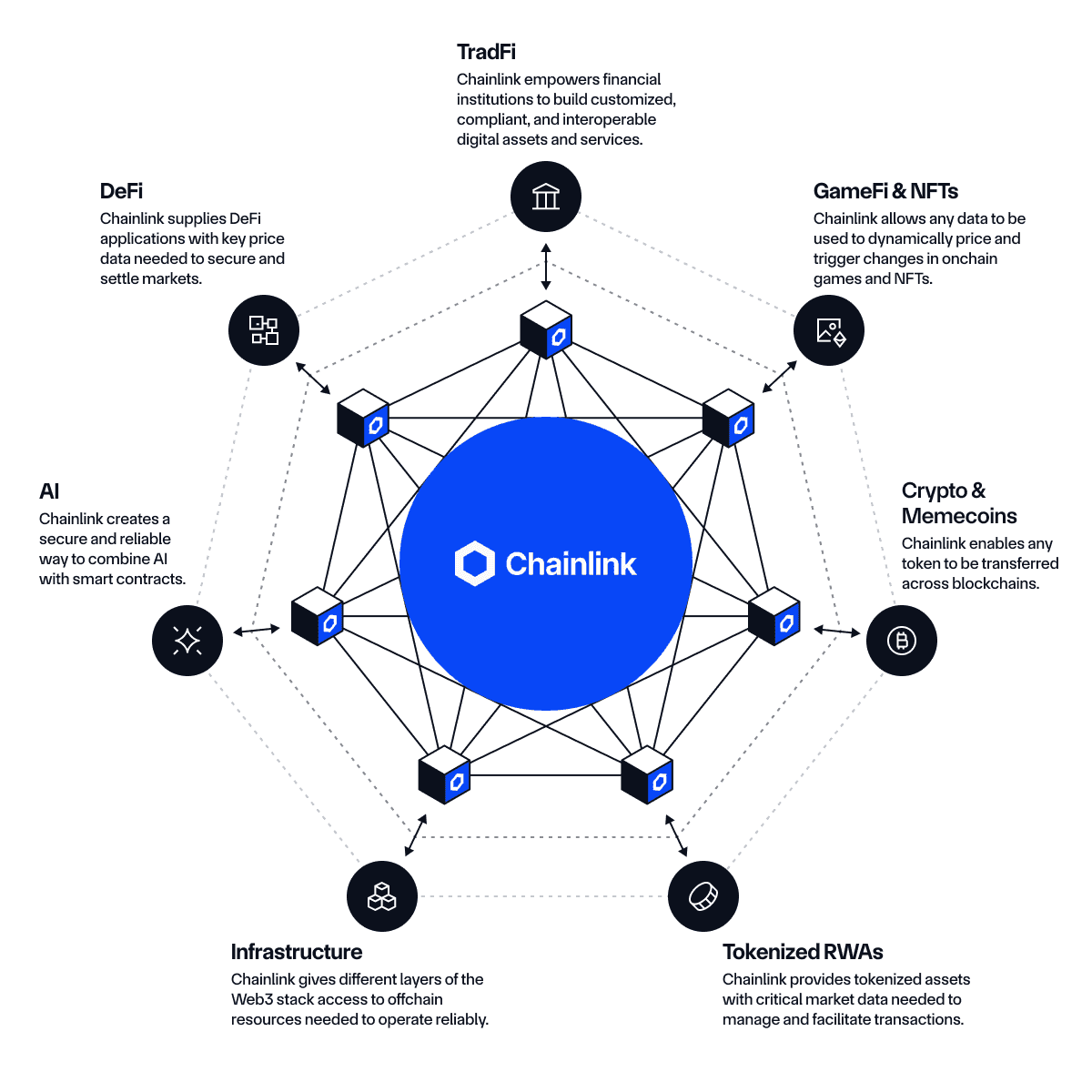
Chainlink Overview (source)
Many RWA platforms rely on Chainlink for market data and proof-of-reserves services. For example, a tokenized gold project might use Chainlink oracles to regularly verify that the gold reserves in vaults match the tokens circulating (ensuring the tokens are fully backed) – this is exactly the kind of trust mechanism Chainlink provides. Chainlink’s Cross-Chain Interoperability Protocol (CCIP) also enables different blockchains and enterprise systems to communicate, which could let banks and traditional ledgers interface with public blockchains carrying RWA tokens. Major institutions have partnered with Chainlink on RWA-related initiatives – from SWIFT (the global interbank network) exploring bond transfers via Chainlink, to Mastercard and even central banks testing CBDC integrations. This underscores Chainlink’s position as a standardized, secure, and compliant oracle solution for tokenizing assets.
MakerDAO is the decentralized protocol behind the DAI stablecoin, and MKR is its governance token. Maker’s mission evolved from simply creating a crypto-collateralized stablecoin to becoming a bridge between real-world financial assets and DeFi. In 2025, MakerDAO aggressively expanded into RWA collateral – meaning DAI is now partially backed by real-world assets (like bonds and loans) in addition to crypto. This makes MakerDAO a pioneer in injecting real-world yield into the crypto ecosystem.
MakerDAO essentially functions as a central bank of DeFi, and by including RWAs in its reserves, it has become one of the largest RWA investors. For example, Maker has held over $1 billion in real-world assets backing DAI at times, including U.S. Treasury bonds, commercial paper, and loans purchased via partner fintechs. These RWAs now contribute a significant portion of Maker’s revenue (interest from bonds and loans flows to Maker). MakerDAO’s RWA team set up legal structures (trusts and special purpose vehicles) to securely hold these assets on behalf of the DAO. By 2026, RWAs are a core pillar of DAI’s stability and yield, moving Maker beyond reliance on volatile crypto collateral. This approach also proved that DeFi protocols can interface with TradFi markets at scale.
Ondo Finance (ONDO)
Ondo Finance is a DeFi platform purpose-built for tokenizing real-world financial assets, especially fixed-income products. Launched in the mid-2020s, Ondo’s mission is to bring regulated, yield-generating assets like U.S. Treasuries, corporate bonds, and even stocks onto the blockchain and make them accessible globally. In practical terms, Ondo packages traditional assets into tokens that can be held and traded by crypto users (in compliance with regulations).
Ondo emerged as a leader in tokenized Treasuries and other RWA offerings on Ethereum. It created products like OUSG, a token representing shares in a short-term U.S. Treasury fund (providing a yield similar to T-bill rates), and USDY, a yield-bearing stablecoin backed by a mix of Treasury notes and bank deposits. Essentially, Ondo offers on-chain versions of conservative, institutional-grade investments. By 2025, Ondo had also facilitated tokenization of many stocks and ETFs (via partnerships or on its platform), listing tokens for equities like Pfizer, Nvidia, etc.. Thanks to these efforts, Ondo’s ecosystem grew rapidly – it reached about $1.4 billion in total value locked (TVL), making it the third-largest RWA platform in DeFi by that metric. This high TVL and diverse asset support underscore Ondo’s role as a pioneer bridging mainstream finance and DeFi.
Stellar (XLM)
Stellar is a veteran Layer-1 blockchain (launched in 2014) designed for fast, low-cost payments and asset issuance. Its mission has been to bank the unbanked and streamline cross-border money transfers. In 2026, Stellar’s role has expanded beyond payments – it’s now a key network for tokenizing conventional assets like currencies and bonds, thanks to built-in token features and an array of fintech partnerships. Stellar’s consensus mechanism (a variant of federated Byzantine agreement) enables quick finality with minimal fees, making it attractive for moving both digital dollars and real-world value on-chain.
Stellar has quietly become a hub for asset tokenization, especially for fiat stablecoins and funds. Many stablecoins (e.g., USDC, a regulated dollar coin) have versions on Stellar. Notably, Franklin Templeton’s BENJI fund – a tokenized U.S. money market fund – partially operates on Stellar, where it holds a significant share of that fund’s on-chain supply. This means investors can purchase shares in a traditional mutual fund through Stellar’s network. Stellar’s ecosystem also includes tokens like an Australian Dollar stablecoin (AUDD), Euro Coin (EURC), and even some tokenized bonds and commodities issued by asset managers like WisdomTree. As of 2025, Franklin’s fund accounted for roughly 90% of Stellar’s RWA value (showing one big use-case dominated) but dozens of other assets exist on the network. In essence, Stellar has positioned itself as an enterprise-friendly chain for digitizing fiat and financial instruments, complementing its payment use-case.
Pax Gold (PAXG)
Pax Gold is a commodity-backed RWA token that lets people own physical gold in digital form. Launched by Paxos Trust Company in 2019, each PAXG token represents one fine troy ounce of gold stored in professional London vaults. Paxos’s mission with PAXG is to democratize access to gold investment – giving crypto users an easy, cost-effective way to hold and transfer investment-grade gold without needing to manage storage or transport of the physical bars.
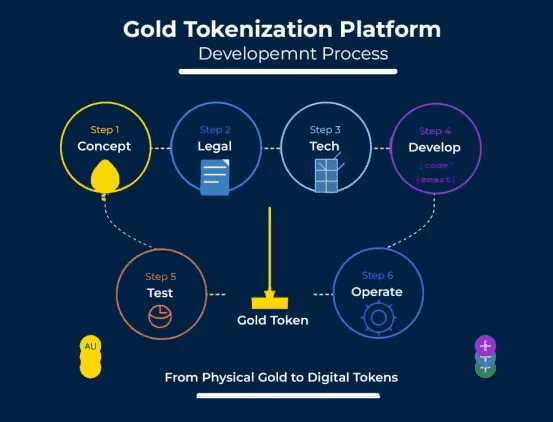
Gold Tokenization (source)
PAXG has become one of the most prominent gold-backed cryptocurrencies. It serves as a prime example of tokenized commodities in the RWA space. Holders of PAXG effectively have legal ownership rights to specific gold bars (Paxos even provides serial numbers for the allocated bars on their website). As a regulated trust company in New York, Paxos offers a high level of transparency and investor protection: PAXG’s gold reserves are audited regularly, and the token is approved by the New York Department of Financial Services, giving credibility to its 1:1 backing claim. In 2025, with macroeconomic uncertainty and inflation concerns, gold reached record high prices, and PAXG’s market cap grew accordingly. By 2026, PAXG (along with a couple of competitors like Tether Gold) dominates the commodity RWA niche, showing how traditional safe-haven assets can live on-chain.
XDC Network (XDC)
XDC Network is an enterprise-grade Layer-1 blockchain specifically optimized for trade finance and real-world asset tokenization use cases. It’s a fork of Ethereum (EVM-compatible) with a delegated proof-of-stake consensus, aiming to offer fast transactions and low fees for businesses. The mission of XDC (also known as XinFin Network) is to help companies and financial institutions digitize trade documents, invoices, and other traditional instruments and transact them more efficiently on-chain. Think of things like letters of credit, factoring, supply chain finance – XDC targets that niche.
XDC has steadily gained a reputation as a blockchain for trade-related RWAs. Several projects have launched on XDC to tokenize real-world financial assets. A notable example is TradeFinex, a platform for tokenizing trade finance instruments (like invoice receivables) that utilizes XDC. Also, XDC hosts commodity-backed tokens – for instance, ComTech Gold (CGO) issues gold tokens on XDC (similar in concept to PAXG) which have gained traction in certain markets. Another example is Securitize’s tokenized U.S. Treasuries (USTY) which were issued on XDC Network. These and several private credit tokens contributed to XDC’s growing RWA ecosystem.
Centrifuge (CFG)
Centrifuge is one of the earliest DeFi projects wholly focused on bringing real-world assets into DeFi lending. Its mission is to bridge real assets – like invoices, mortgages, trade receivables – to the blockchain by converting them into NFTs and pooling them for liquidity. Launched around 2019–2020, Centrifuge built an open platform (Tinlake) where asset originators can tokenize their assets and borrow against them from DeFi investors. The idea is to unlock capital for businesses (who have traditionally illiquid assets) and provide stable yield to crypto investors from real-world loans.
Centrifuge can be considered a pioneer of RWA in DeFi. Long before the 2025 RWA boom, Centrifuge had live pools of tokenized invoices and loans that were used as collateral to generate DAI (MakerDAO was an early partner – Maker accepted Centrifuge pool tokens as collateral for DAI). By 2024–2025, as larger players like Ondo emerged, Centrifuge still held a leadership position, especially in private credit tokenization. In 2024, Centrifuge partnered with asset manager Janus Henderson to launch the first tokenized U.S. Treasury fund on-chain (called JTRSY), licensed out of BVI. They also tokenized a Collateralized Loan Obligation (CLO) fund (JAAA), giving DeFi users exposure to slices of bundled corporate loans.
Avalanche (AVAX)
Avalanche is a high-performance Layer-1 blockchain known for its subnet architecture and focus on institutional adoption. Its mission can be described as creating the “Internet of Finance,” providing a platform where anyone – from DeFi degens to traditional institutions – can issue and trade assets efficiently. While not built exclusively for RWA, Avalanche has, by 2025, emerged as one of the fastest-growing hubs for tokenized real-world assets, thanks in part to its technological features that resonate with enterprise needs (like custom subnets for compliance) and proactive efforts to onboard real-world financial products.
By late 2025, Avalanche had over $1.25 billion of real-world assets tokenized on its network, making it one of the top chains for RWA by on-chain value. It’s been chosen for some headline projects: for instance, BlackRock’s tokenized money market fund (BUIDL) – one of the first major tokenized funds by the world’s largest asset manager – launched on Ethereum but utilized Avalanche as well via bridging, eventually holding over $500M on Avalanche alone. Avalanche also saw Janus Henderson’s AAA-rated CLO fund ($250M) tokenized on it, SkyBridge Capital’s tokenized hedge funds ($217M), and Franklin Templeton’s tokenized money fund ($34M) on its blockchain.
Quant (QNT)
Quant is a unique project in this list – it’s not an asset tokenization platform or a chain, but rather an interoperability and enterprise blockchain solution. Quant Network’s mission is to connect different blockchains and legacy systems in a seamless way, enabling the creation of what it calls an “Internet of Trust”. Its flagship product is Overledger, an API gateway that allows developers (especially in banks and large institutions) to build applications that interact with multiple blockchains without needing to learn each one’s specifics. Essentially, Quant aims to be the middleware that bridges blockchains, governments, and institutions as they adopt digital assets, including RWA tokens.
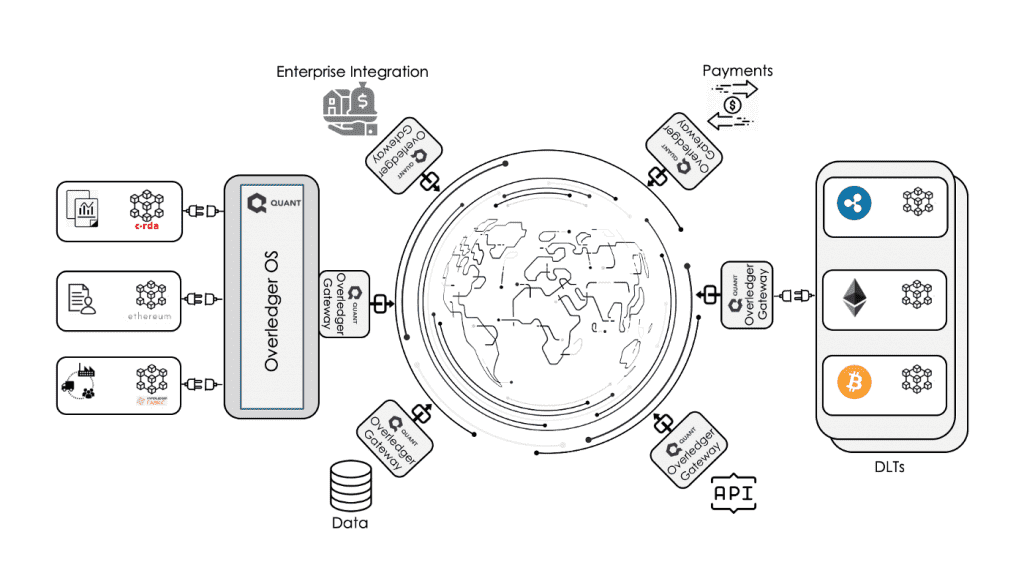
Quant Overview (source)
As tokenization of real-world assets often involves enterprises and various blockchain networks (public and permissioned), Quant finds a role by providing the interoperability and compliance layer. For example, imagine a government that issues a bond on a private ledger but wants selected investors on a public chain to be able to purchase it – Quant’s Overledger could facilitate that cross-network transaction. Quant has actively worked with central banks on CBDCs and with entities like banks for settling digital securities. Its focus on standards and compliance means it’s often involved in projects requiring KYC/AML integration.
Polymesh (POLYX)
Polymesh is a Layer-1 blockchain purpose-built for regulated assets and security tokens. It evolved from the earlier Polymath project (which in 2018 created ERC-1400, a token standard for securities on Ethereum). Learning from limitations on Ethereum, the team launched Polymesh as its own chain in 2021–2022, with the mission of creating a blockchain where identity, compliance, confidentiality, and governance are built into the base layer. The aim is to enable markets for tokenized stocks, bonds, funds, and other securities in a way that satisfies regulators and institutions.
Polymesh occupies a niche as the blockchain for regulated RWAs. By requiring every participant to have a verified identity and by allowing token issuers to enforce rules (like who can hold their token, how it can trade, etc.), Polymesh makes it easier to tokenize assets that are legally securities. In 2026, Polymesh is used by various financial entities to issue and manage digital securities.
Trends Shaping the RWA Token Landscape in 2026
Several powerful trends are shaping the RWA token sector in 2026:
Evolving Regulatory Frameworks: Regulatory clarity is increasing with laws like the EU's MiCA, fostering a more favorable environment for tokenization in Europe. Traditional firms are exploring RWA projects under these regulations, with examples like BlackRock launching a tokenized money market fund via a regulated process.
Tokenization of Government Bonds and Cash Equivalents: The tokenization of yield-generating assets, particularly government bonds, is driving RWA growth. Projects like Ondo offer tokenized Treasuries that allow investors to earn interest while using stablecoins. Governments are also experimenting with tokenized bonds, enhancing the intersection of DeFi and TradFi.
Real Estate, Funds, and Equity Tokenization: Real estate tokenization is gaining momentum, with initiatives targeting large commercial properties and luxury assets becoming tradeable. Investments in equity and funds are increasingly going on-chain, blurring lines between crypto and traditional markets, though regulatory scrutiny remains.
Institutional Partnerships & Adoption: Major financial institutions like Goldman Sachs and Fidelity are now heavily involved in RWA tokenization, supporting blockchain projects and developing custody solutions for digital assets. This involvement marks a significant shift in institutional engagement with cryptocurrencies.
Conclusion
Real-world asset (RWA) tokens have transitioned from niche experiments to a powerful force in crypto by 2026, significantly impacting both crypto and traditional finance. They provide crypto investors access to stable yields and diverse assets, while offering traditional issuers benefits like 24/7 markets and instant settlement. This convergence suggests a future where public blockchains facilitate value transfer, populated by digital tokens representing real assets.
However, it’s crucial to recognize the challenges. Tokenization doesn’t eliminate investment risk or guarantee asset liquidity. Each project faces legal, technical, and market hurdles; some will succeed while others may falter. Investors should approach RWA tokens with a balanced mindset, acknowledging their real-world adoption without viewing them as entirely risk-free.
Due diligence is vital for potential investors. Read offering documents, understand redemption processes, check issuer reputations, and assess technological soundness. Diversification can help mitigate risks, and it's essential to consider your risk tolerance.
