

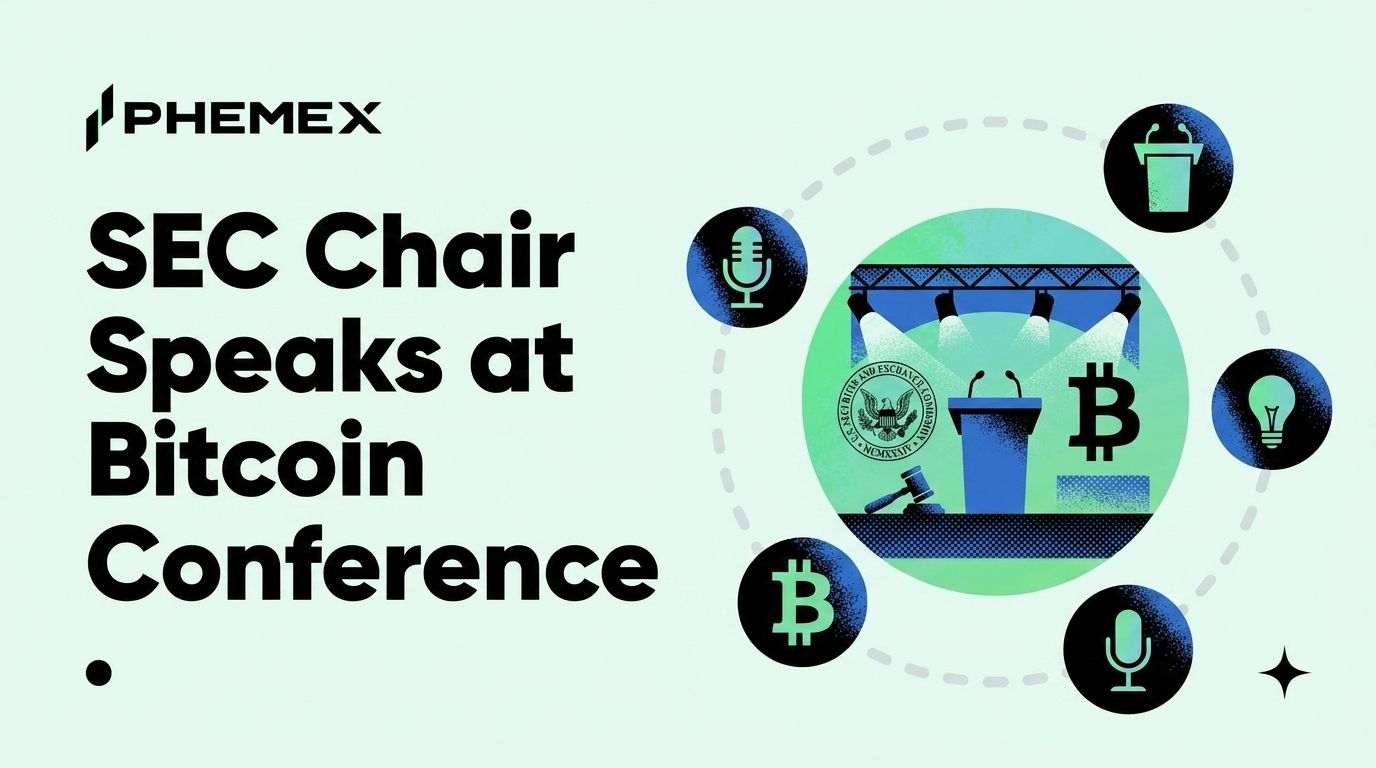
No sitting SEC chairman had ever set foot on a Bitcoin conference stage before April 27, 2026. Paul Atkins changed that at Bitcoin 2026 in Las Vegas, standing in front of more than 40,000 attendees at the Venetian Resort and declaring it "a new day at the SEC." The speech lasted roughly 25 minutes, but the policy substance packed into it will reshape how every crypto asset in the United States is regulated, traded, and built on for years.
Atkins was not there to give a neutral bureaucratic update. He laid out a three-pillar strategy called ACT, confirmed that four out of five categories in the SEC's token taxonomy are not securities, and announced a tokenization sandbox arriving "in weeks" that would let firms test tokenized instruments on public blockchains under supervised conditions. CFTC Chair Mike Selig followed immediately with his own fireside chat, calling the moment "turning over a new page" for both agencies.
Here is what Atkins actually said, what it means for traders and builders, and why both regulators showing up at the same Bitcoin conference matters more than the headlines suggest.
What Is the ACT Strategy and Why Did Atkins Build His Entire Speech Around It
The centerpiece of Atkins' address was a three-word framework that now defines the SEC's approach to digital assets. ACT stands for Advance, Clarify, Transform. Each pillar targets a different failure of the previous regulatory era.
Advance is about reversing the brain drain. Atkins admitted that "for too long, the SEC's default setting was to fend off new technologies rather than understand them." The result was that crypto firms moved offshore to Singapore, Dubai, and the EU, taking jobs, tax revenue, and innovation with them. The Advance pillar commits the SEC to actively courting those firms back to U.S. soil by making domestic registration viable rather than punitive.
Clarify addresses the legal chaos that defined the Gensler era. The SEC and CFTC have now published a joint interpretive release under Project Crypto that draws a formal line between tokenized securities and commodities. That release produced the five-category token taxonomy. Atkins framed it as giving builders and compliance teams "one set of answers instead of fifty conflicting enforcement actions."
Transform is the most ambitious pillar. It aims to rewrite the SEC rulebook itself so that the regulatory framework built for 1930s paper markets can accommodate programmable, 24/7, borderless digital assets. Atkins did not give a specific timeline for Transform, but he tied it directly to the tokenization sandbox announcement, which represents the first concrete product of that effort.
The ACT framework is not a press release. It is the SEC's stated operating doctrine going forward, and every regulatory action the agency takes on crypto will now be measured against it.
The Five-Category Token Taxonomy and Why Four Categories Are Not Securities
The five-category taxonomy was first published in March 2026 as part of the joint SEC-CFTC interpretive release, but Atkins used his Bitcoin 2026 speech to reinforce its significance and connect it to the broader ACT agenda.
The framework sorts every digital asset into one of five buckets.
|
Category
|
What It Covers
|
Securities Status
|
Primary Regulator
|
|
Digital Commodities
|
BTC, ETH, SOL, XRP, ADA, and 11 others
|
Not securities
|
CFTC
|
|
Digital Collectibles
|
NFTs, unique digital assets
|
Not securities
|
Neither (currently)
|
|
Digital Tools
|
Utility tokens, memberships, access tokens
|
Not securities
|
Neither (currently)
|
|
Payment Stablecoins
|
USD-pegged and fiat-backed tokens
|
Separate legislation (GENIUS Act)
|
TBD
|
|
Digital Securities
|
Tokenized stocks, bonds, investment contracts
|
Securities
|
SEC
|
Four out of five categories fall outside the SEC's enforcement jurisdiction entirely. Only digital securities remain under the SEC, and even those are getting a new framework through the innovation exemption.
The practical impact is that the vast majority of crypto assets people actually trade are now confirmed non-securities. The 16 named digital commodities alone represent over 85% of total crypto market capitalization. Add in NFTs, utility tokens, and stablecoins, and the SEC has effectively told the market that its enforcement era over mainstream crypto is finished.
Atkins put it bluntly at the conference. The SEC is returning to "its core mission and statutory authority of protecting investors involved in securities transactions" rather than treating every digital asset as something it needs to police.
What Is the Tokenization Sandbox and When Does It Launch
The biggest new announcement from the speech was the tokenization sandbox, formally called the Innovation Exemption. Atkins confirmed it would launch "in weeks," making it the fastest policy-to-product turnaround of his tenure.
The sandbox allows firms to issue and trade tokenized securities on public blockchains and DeFi protocols without full SEC registration for a window of 12 to 36 months. During that period, participants operate under supervised conditions with specific guardrails.
Eligible firms include U.S.-based crypto startups, DeFi developers, and traditional financial institutions looking to pilot tokenized products like real estate, treasury bills, or equity shares. The key conditions include volume caps on trading activity, a whitelist system for verified buyers and sellers, full KYC/AML compliance, anti-fraud protections, and periodic reporting to the SEC.
At the end of the exemption window, firms must either achieve full regulatory compliance or demonstrate sufficient decentralization of their protocol. The "sufficient decentralization" clause is significant because it creates a formal off-ramp from securities regulation for projects that genuinely distribute control away from a central team.
This is not a theoretical concept paper. According to reporting from Benzinga, the proposal was under White House review as of April 21 and Atkins confirmed at the conference that final rules would be published within weeks. For the tokenized real-world asset market, which already exceeds $19 billion in total value locked, the sandbox removes the last major regulatory barrier to institutional-scale adoption in the United States.
Why the CFTC Chair Speaking Back-to-Back Matters
Atkins was not the only regulator on the Nakamoto Stage that day. CFTC Chair Mike Selig followed immediately with his own fireside chat, and the optics of both agency heads appearing sequentially at a Bitcoin conference were deliberate.
Selig's core message was coordination. He said regulators are "turning over a new page" and emphasized that the SEC and CFTC need a harmonized framework rather than overlapping or conflicting rules. For markets that trade products with both commodity-like and security-like features, he argued, the two agencies must work together instead of competing for jurisdiction.
Selig grounded his remarks in a broader philosophical point, saying "our country was founded on the idea of private property" and arguing that token holders and innovators deserve clear, enforceable rights in law. He also outlined the CFTC's own agenda for crypto spot market oversight, prediction market rulemaking, and DeFi regulation.
The reason this dual appearance matters beyond symbolism is that the previous decade of crypto regulation was defined by inter-agency turf wars. The SEC under Gensler claimed jurisdiction over nearly everything, while the CFTC argued that most tokens were commodities under its purview. That conflict created regulatory paralysis where neither agency could provide clear rules because neither would concede ground. Both chairs standing on the same stage, delivering complementary messages, signals that the turf war is over.
For traders and builders, harmonized regulation means one set of compliance requirements instead of two conflicting ones, faster product approvals, and significantly reduced legal costs for operating in the United States.
What This Means for Traders Right Now
The speech was policy-heavy, but the trading implications are concrete and time-bound.
The tokenization sandbox launching in weeks opens a new asset class for on-chain trading. Tokenized treasuries, real estate, and equity products that were previously restricted to accredited investors through private placements could become accessible on DeFi protocols. The first wave of sandbox participants will likely include firms already active in the RWA space like BlackRock (which tokenized its BUIDL fund on Ethereum), Franklin Templeton, and Ondo Finance.
The confirmation that four out of five token categories are non-securities removes lingering uncertainty for any asset that had not yet received explicit classification. Projects building utility tokens, NFT platforms, or stablecoin infrastructure can now operate with confidence that the SEC will not retroactively classify their products as securities.
And the harmonized SEC-CFTC approach accelerates the ETF pipeline. Over 90 crypto ETF applications were pending as of late 2025, and the commodity classification for 16 assets has already unblocked the primary regulatory barrier. With both agencies now publicly aligned, the approval process for spot ETFs on SOL, XRP, ADA, LINK, and other named commodities should move faster than the market expects.
But the key caveat remains the same one Atkins himself acknowledged. This is regulatory interpretation, not legislation. The CLARITY Act, which passed the House 294-134 and cleared the Senate Agriculture Committee, still needs to pass the full Senate and be signed into law to make these frameworks permanent. Until that happens, a future administration could theoretically reverse everything.
Frequently Asked Questions
Has an SEC chairman ever spoken at a Bitcoin conference before?
No. Paul Atkins became the first sitting SEC chairman to address a Bitcoin conference on April 27, 2026, at Bitcoin 2026 in Las Vegas. Previous SEC chairs either avoided the crypto industry entirely or engaged only through enforcement actions and formal hearings.
What does ACT stand for in the SEC's new crypto strategy?
ACT stands for Advance, Clarify, Transform. Advance focuses on bringing offshore crypto firms back to the U.S., Clarify refers to the formal token taxonomy and joint SEC-CFTC interpretive rules, and Transform aims to rewrite the SEC rulebook to accommodate digital assets.
When does the SEC tokenization sandbox launch?
Atkins confirmed at Bitcoin 2026 that the Innovation Exemption would launch "in weeks." The sandbox allows firms to issue and trade tokenized securities on-chain for 12 to 36 months without full registration, subject to volume caps, KYC/AML requirements, and periodic reporting.
Does this mean all crypto regulation is settled?
Not yet, because the current frameworks are regulatory interpretations rather than statutes. The CLARITY Act needs to pass the Senate and be signed into law to make the commodity classifications and token taxonomy permanent. Both Atkins and Selig explicitly said that only Congress can provide permanent regulatory certainty.
Bottom Line
The SEC chair standing on the Nakamoto Stage at a Bitcoin conference goes far beyond symbolism. It is the physical manifestation of a regulatory regime change that has been building since March 2026. Four out of five token categories are non-securities, the tokenization sandbox arrives in weeks, and both the SEC and CFTC are publicly aligned for the first time in the industry's history.
What traders should watch now is execution speed. The sandbox launch timeline, the first wave of approved tokenized products, and the CLARITY Act's path through the Senate will determine if the promises made on April 27 become permanent infrastructure or remain reversible interpretations. The regulatory green light is on, but the real question is how quickly the legislative backstop arrives before the next election cycle creates uncertainty again.
This article is for informational purposes only and does not constitute financial or investment advice. Cryptocurrency trading involves substantial risk. Always conduct your own research before making trading decisions.