










Introduction
Magma Finance is a decentralized finance (DeFi) liquidity hub and exchange deployed on the Sui blockchain, enabling peer-to-peer trading through an Adaptive Liquidity Market Maker (ALMM) that programmatically adjusts liquidity parameters. Built on Sui, Magma Finance supports synthetic assets and stablecoins, including the ioUSD stablecoin, which is primarily backed by on-chain collateral such as liquid staking tokens, with potential exploration of real-world asset (RWA) integration over time.
The MAGMA token is used within the protocol for transaction-related incentives, liquidity rewards, and governance participation. This guide explains what Magma Finance is, how MAGMA functions, key metrics as of early 2026, and how to buy MAGMA on Phemex.
Quick Facts About MAGMA
| Metric | Detail |
|---|---|
| Ticker Symbol | MAGMA |
| Blockchain | Sui |
| Contract Address | 0x9f854b3ad20f8161ec0886f15f4a1752bf75d22261556f14cc8d3a1c5d50e529::magma::MAGMA |
| Circulating Supply | ~190,000,000 MAGMA (as of Jan 4th 2026) |
| Total Supply | 1,000,000,000 MAGMA |
| Max Supply | 1,000,000,000 MAGMA |
| Market Cap | ~USD 27M (as of Jan 4th 2026) |
| Primary Use Case | Governance, liquidity incentives, and support for synthetic assets and stablecoins on Magma Finance |
Quick Trading Links
- Spot Trading: You can trade MAGMA/USDT on the spot market.
- Futures Trading: You can trade MAGMA/USDT on the futures market.
What Is MAGMA?
Magma Finance is a DeFi protocol built on the Sui blockchain, with its mainnet and token launched in December 2025. It provides a non-custodial, permissionless platform for exchanging digital assets, with a focus on adaptive liquidity management and support for synthetic assets and stablecoins.
Magma Finance functions as both a DEX and a liquidity hub, integrating an algorithmic ALMM and governance mechanisms inspired by ve-style token locking models.
Key Features
Adaptive Liquidity Market Maker (ALMM)
The ALMM dynamically adjusts liquidity across trading pairs using algorithmic logic that the project describes as AI-assisted, with the goal of managing slippage and improving capital efficiency under varying market conditions.
Synthetic Assets and ioUSD Stablecoin
Magma Finance supports synthetic assets and ioUSD, a stablecoin designed to be backed primarily by on-chain collateral such as liquid staking tokens, with future RWA integration subject to implementation progress and regulatory considerations.
Non-Custodial and Permissionless
Users interact directly with smart contracts, and the protocol does not take custody of user funds. Market creation and participation are permissionless, subject to protocol-defined rules.
Governance via ve-Style Locking
Governance is structured around veMAGMA, obtained by locking MAGMA to gain voting power over emissions, asset listings, and selected protocol parameters.
Hybrid Liquidity Model
Magma combines concentrated liquidity configurations with adaptive liquidity parameters, aiming to improve capital efficiency and market depth within the Sui ecosystem.
What Does MAGMA Do?
MAGMA is the native token of Magma Finance and provides utility across several protocol functions.
Liquidity Incentives and Market Participation
Liquidity providers may receive MAGMA rewards for contributing liquidity to designated pools, supporting the protocol’s adaptive liquidity mechanisms.
Staking and Yield
Users can stake MAGMA and, in some configurations, lock it as veMAGMA. Resulting yields are variable and depend on pool conditions, emissions, and time period, with historical instances reaching high double-digit annualized rates.
Governance
Locking MAGMA into veMAGMA grants voting power over emission distributions, new asset proposals, and selected protocol upgrades.
Support for Synthetic Assets and ioUSD
MAGMA is integrated into incentive and risk-management structures related to synthetic assets and the ioUSD stablecoin, including emissions to relevant liquidity and stability pools.
Potential Future Integrations
The design of MAGMA and veMAGMA allows for potential extensions into additional DeFi products, cross-chain deployments, or new incentive mechanisms, subject to governance decisions.
MAGMA Tokenomics
MAGMA is the native utility and governance token of Magma Finance on the Sui blockchain. The protocol’s tokenomics are designed to align liquidity usage, trading activity, and long-term ecosystem participation.
The total and maximum supply of MAGMA is fixed at 1,000,000,000 tokens.
Initial Token Allocation
According to a publicly shared token distribution overview released by Magma Finance, the initial allocation of the 1B MAGMA supply is structured as follows:
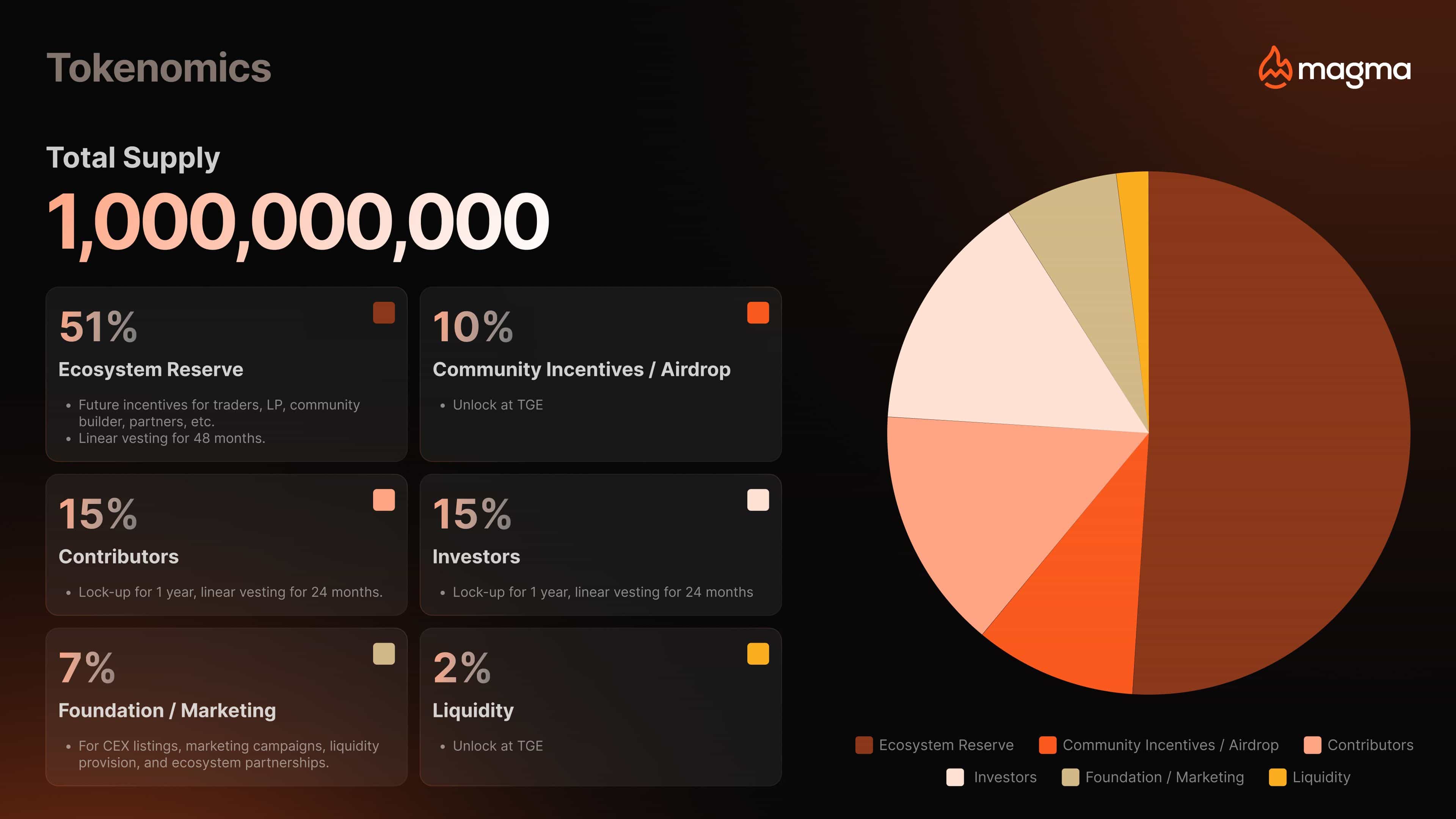
| Category | Allocation | Description |
|---|---|---|
| Ecosystem Reserve | 51% | Allocated for long-term ecosystem development, protocol incentives, and future growth initiatives |
| Community Incentives / Airdrop | 10% | Distributed to early users and community participants through incentive programs and airdrops |
| Contributors | 15% | Allocated to core contributors and builders supporting protocol development and operations |
| Investors | 15% | Allocated to strategic and venture investors participating in the project’s funding rounds |
| Foundation / Marketing | 7% | Used for foundation operations, ecosystem promotion, and outreach initiatives |
| Liquidity | 2% | Reserved for initial and ongoing liquidity provisioning |
Tokenomics Design Considerations
Magma Finance describes its tokenomics as being centered on the relationship between liquidity usage, trading activity, and capital efficiency. Under this framework:
-
Increased trading activity contributes to deeper liquidity pools
-
Deeper liquidity is intended to improve execution efficiency and reduce friction
-
Improved efficiency may support compounding participation across the protocol
Token emissions, incentive distribution, and liquidity allocation are governed by protocol rules and community governance mechanisms, including ve-style token locking.
Circulation and Emissions
While the total allocation framework is publicly defined, the precise timing of token unlocks, emissions, and distribution schedules may vary over time based on protocol parameters and governance decisions. As of early 2026, the circulating supply is estimated to be approximately 190 million MAGMA, reflecting a portion of the total allocation entering the market through incentives, airdrops, and liquidity programs.
Governance Alignment
MAGMA holders can participate in protocol governance through token locking mechanisms that grant voting power over emission direction, incentive allocation, and selected protocol parameters. This structure is intended to align long-term token holders with the ongoing development and sustainability of the Magma Finance ecosystem.
MAGMA vs. Uniswap (UNI) : Token Comparison
MAGMA and Uniswap (UNI) are both associated with decentralized exchange infrastructure but differ in blockchain environment, design philosophy, and feature scope.
| Aspect | MAGMA | Uniswap (UNI) |
|---|---|---|
| Protocol | Magma Finance | Uniswap |
| Blockchain | Sui | Ethereum and multiple EVM-compatible chains |
| Core Function | Decentralized exchange and liquidity hub | Decentralized exchange |
| Liquidity Model | Adaptive Liquidity Market Maker (ALMM) with hybrid liquidity (adaptive + concentrated) | Automated Market Maker (AMM); concentrated liquidity in Uniswap v3 |
| Token Role | Governance, liquidity incentives, staking/locking mechanisms | Governance token |
| Governance Model | ve(3,3)-inspired model via veMAGMA (token locking) | On-chain governance without ve-style locking |
| Supported Assets | Spot trading, synthetic assets, ioUSD stablecoin | Spot trading and liquidity pools |
| Stablecoin Support | Native support for ioUSD within the protocol | No native stablecoin issuance |
| Cross-Chain Scope | Primarily Sui-native; future integrations subject to governance | Deployed across multiple EVM chains |
| Token Supply | Fixed max supply of 1,000,000,000 MAGMA | Fixed max supply of 1,000,000,000 UNI |
| Market Capitalization (early 2026) | ~USD 20–30 million range | Multi-billion USD range |
| Maturity | Early-stage protocol (launched 2025) | Established protocol (launched 2018) |
| Primary Focus | Capital efficiency, adaptive liquidity, DeFi primitives on Sui | High-liquidity token swaps on EVM chains |
Technology Stack
Sui Blockchain
Magma Finance is deployed on Sui, leveraging the Move programming language and Sui’s object-centric model for parallel execution and low-latency transactions.
ALMM and Hybrid Liquidity
The ALMM adjusts price curves and liquidity placement through algorithmic rules that respond to market conditions, combining concentrated liquidity with adaptive parameters.
Synthetic Assets and ioUSD
The protocol issues synthetic exposures and ioUSD using on-chain collateral, primarily LSTs, subject to protocol-defined risk and liquidation parameters.
Security
Magma Finance smart contracts have undergone security reviews by firms including MoveBit and Zellic, according to publicly released audit reports.
Team, Funding, and Milestones
Team Disclosure
As of early 2026, core team and founder identities are not prominently disclosed in public user-facing materials. Project communication is conducted through official documentation and community channels.
Funding
Magma Finance has reported completing a USD 6M funding round with participation from investors including HashKey Capital and SNZ Holding, among others.
Key 2025 Milestones
-
Mainnet launch on Sui and ALMM activation in December 2025
-
MAGMA token launch and listing on Phemex (MAGMA/USDT) in late December 2025
-
Community airdrop and claim activity culminating in December 2025
-
Circulating supply reaching approximately 190M MAGMA with market capitalization in the mid-USD-20M range by late December 2025
What Will Affect MAGMA Price (2026–2031)?
The market value of MAGMA between 2026 and 2031 will depend on a combination of protocol usage, ecosystem development, regulatory conditions, and broader crypto market dynamics. The factors below are presented for informational purposes and reflect general considerations rather than price predictions.
Factors That May Support MAGMA’s Price
1. Protocol Adoption and Usage
As the native token of Magma Finance on the Sui blockchain, MAGMA’s utility is tied to user participation in trading, liquidity provision, staking, and governance. Increased usage of the protocol’s decentralized exchange and liquidity infrastructure may contribute to higher demand for MAGMA through incentive mechanisms and token locking.
Engagement with the protocol’s adaptive, algorithmic liquidity mechanisms and supported assets, including ioUSD and synthetic products, may also influence on-chain activity and token utilization.
2. Technical Development and Protocol Iteration
Continued development of Magma Finance, including refinements to its Adaptive Liquidity Market Maker (ALMM), adjustments to liquidity configurations, or the introduction of additional DeFi modules, could enhance protocol functionality and capital efficiency.
Regular software updates, documentation releases, and transparent communication around protocol changes may improve user confidence and encourage sustained participation over time.
3. Ecosystem Integrations and Market Access
Availability of MAGMA on centralized and decentralized trading venues, including spot trading access on platforms such as Phemex, may affect liquidity and market visibility.
Ecosystem integrations, collaborations, or infrastructure partnerships within the Sui network could also influence adoption by expanding use cases or improving user access to the protocol.
4. Regulatory Environment
Developments in global regulatory frameworks related to decentralized finance, digital assets, and stablecoins may affect user participation and capital inflows. Greater regulatory clarity could reduce uncertainty for some market participants, while unfavorable changes could have the opposite effect.
Factors That May Adversely Affect MAGMA’s Price
1. Regulatory Risk
Restrictive regulations, enforcement actions, or policy uncertainty affecting DeFi platforms or tokenized assets could limit accessibility to Magma Finance or reduce participation, potentially impacting MAGMA demand.
2. Technical and Security Risks
Like most DeFi protocols, Magma Finance is exposed to risks related to smart contract vulnerabilities, oracle failures, or liquidation mechanics within synthetic asset and stablecoin modules. Any significant technical incident could negatively affect user confidence and on-chain activity.
3. Competitive Pressure
The DeFi sector remains highly competitive, with alternative protocols offering decentralized trading, liquidity solutions, or synthetic asset exposure across multiple blockchains. Increased competition, including from other projects within the Sui ecosystem, could draw users and liquidity away from Magma Finance.
4. Market Sentiment and Volatility
MAGMA is subject to broader cryptocurrency market cycles and sentiment shifts. Periods of market-wide risk aversion, declining liquidity, or negative news affecting DeFi may result in increased volatility or price declines, independent of protocol-specific developments.
Contextual Note
MAGMA’s market performance over the 2026–2031 period will likely reflect a combination of protocol adoption trends, technical execution, external market conditions, and regulatory developments. As with most DeFi-related tokens, outcomes are uncertain, and market behavior may not directly track protocol progress.
Is MAGMA a Good Investment?
Growth Considerations
MAGMA is the native token of Magma Finance on the Sui blockchain and has gained visibility as an emerging DeFi asset in early 2026. During this period, the token has traded with an estimated market capitalization in the mid-USD-20M range and a circulating supply of approximately 190 million tokens, reflecting active participation across supported markets.
Magma Finance’s protocol design includes an Adaptive Liquidity Market Maker (ALMM) based on algorithmic, project-described AI-assisted logic, as well as a hybrid liquidity model combining concentrated and adaptive liquidity configurations. These design choices aim to improve capital efficiency and support permissionless market creation within the Sui ecosystem.
The protocol also incorporates the ioUSD stablecoin and synthetic asset infrastructure, primarily backed by on-chain collateral such as liquid staking tokens, with potential future expansion into additional collateral types subject to governance decisions. Staking and ve-style locking mechanisms allow MAGMA holders to participate in emissions and governance, with variable yields that have historically reached elevated levels during certain incentive periods.
Additional factors that may influence MAGMA’s ecosystem development include its early positioning within the Sui DeFi landscape, ongoing protocol iteration, and reported participation from venture capital investors.
Risks and Considerations
Despite these attributes, MAGMA carries risks common to early-stage DeFi tokens. Token price volatility remains significant, and broader regulatory developments affecting decentralized finance could impact protocol usage or accessibility.
Technical risks include potential smart contract vulnerabilities, oracle or liquidation risks associated with synthetic assets and stablecoin mechanisms, and operational challenges related to scaling and maintaining protocol stability as usage grows. Competitive pressure from other DeFi protocols, both within and outside the Sui ecosystem, may also affect liquidity and long-term adoption.
Community and Market Sentiment
Public discussion around MAGMA across social platforms, community channels, and crypto media appears mixed to cautiously constructive as of early 2026. Community members often reference the protocol’s governance framework, documentation updates, and feature experimentation, while external observers typically highlight both the protocol’s differentiated design and the inherent risks of newer DeFi systems.
Overall, MAGMA is generally viewed as a developing DeFi asset with experimental features and ecosystem upside, accompanied by the elevated uncertainty and risk profile typical of emerging decentralized finance projects.
How to Buy MAGMA on Phemex
Step-by-Step Guide to Buying MAGMA on Phemex
-
Sign Up: Start by creating your Phemex account. Visit Phemex, enter your email, and complete the secure verification process.
-
Fund Your Account: Choose your preferred payment method—credit card, bank transfer, or crypto deposit—to add funds to your account. This ensures you can buy MAGMA securely and conveniently.
-
Buy MAGMA: Enter the amount you wish to invest in your local currency. Preview the MAGMA amount you’ll receive, then confirm your purchase. The MAGMA tokens will be instantly credited to your Phemex wallet.
Phemex Trading Event
Phemex is running a limited-time trading event featuring MAGMA and LIT, with a 30,000 USDT reward pool.
-
Event period: Dec 31, 2025, 10:00 UTC – Jan 7, 2026, 10:00 UTC
-
Eligible assets: MAGMA and LIT spot trading pairs
-
Rewards: Shared 30,000 USDT, subject to event rules
Click here to join the event and read the full details and participation requirements.
Frequently Asked Questions (FAQ)
Q: What is MAGMA?
A: MAGMA is the native token of Magma Finance, a decentralized finance (DeFi) protocol built on the Sui blockchain. It is used for governance participation, liquidity incentives, staking-related mechanisms, and other protocol-defined utilities within the Magma Finance ecosystem.
Q: How does Magma Finance work?
A: Magma Finance operates as a DeFi platform that provides a decentralized exchange and liquidity infrastructure supporting synthetic assets and a stablecoin (ioUSD). The protocol uses an Adaptive Liquidity Market Maker (ALMM) based on algorithmic, project-described AI-assisted liquidity management. Users can trade supported assets, provide liquidity, and participate in governance through MAGMA.
Q: What are the main use cases for MAGMA?
A: MAGMA is used for governance voting, liquidity incentives, and participation in protocol emissions. Users may stake or lock MAGMA to obtain voting power (ve-style locking), contribute liquidity to eligible pools, and support incentive mechanisms related to synthetic assets and ioUSD.
Q: Where can I buy MAGMA?
A: MAGMA is available for spot trading on Phemex via the MAGMA/USDT trading pair, subject to platform availability and regional access.
Q: What makes MAGMA different from other DeFi tokens?
A: MAGMA is closely integrated with Magma Finance’s adaptive, algorithmic liquidity framework on the Sui blockchain, along with ve-style governance and incentive mechanisms. The protocol emphasizes non-custodial design, on-chain liquidity management, and community-driven governance.
Q: What are the risks of using Magma Finance?
A: Risks include price volatility, smart contract vulnerabilities, collateral and liquidation risks associated with synthetic assets and stablecoin mechanisms, and potential regulatory changes affecting DeFi platforms. Users should conduct independent research and assess risk tolerance before participating.
Summary: Why It Matters
Magma Finance (MAGMA) is a DeFi protocol built on the Sui blockchain that provides decentralized exchange and liquidity infrastructure with adaptive, algorithmic liquidity management. The protocol supports synthetic assets and a stablecoin component (ioUSD) backed primarily by on-chain collateral, and incorporates ve-style governance mechanisms to align long-term participation with protocol decision-making.
MAGMA plays a central role in governance, liquidity incentives, and participation in protocol emissions, while the platform’s non-custodial design and evolving liquidity architecture position it as an emerging participant within the Sui DeFi ecosystem. As with most DeFi projects, potential users and token holders should remain mindful of technical, market, and regulatory risks.
