









Key Takeaways
Programmable Security: Bitcoin Vault (BTCV) implements a proprietary 3-key system, allowing users to cancel unauthorized transactions within a 24-hour window.
Controlled Supply: Following the Bitcoin model, BTCV has a fixed maximum supply of 21,000,000 coins, governed by a disinflationary mining schedule.
Transaction Flexibility: Users can choose between standard, secure (reversible), and fast (non-reversible) transaction types based on their needs.
Market Context: As of February 2026, BTCV is a micro-cap asset with a self-reported circulating supply, requiring careful due diligence from traders.
Quick Facts: Bitcoin Vault (BTCV)
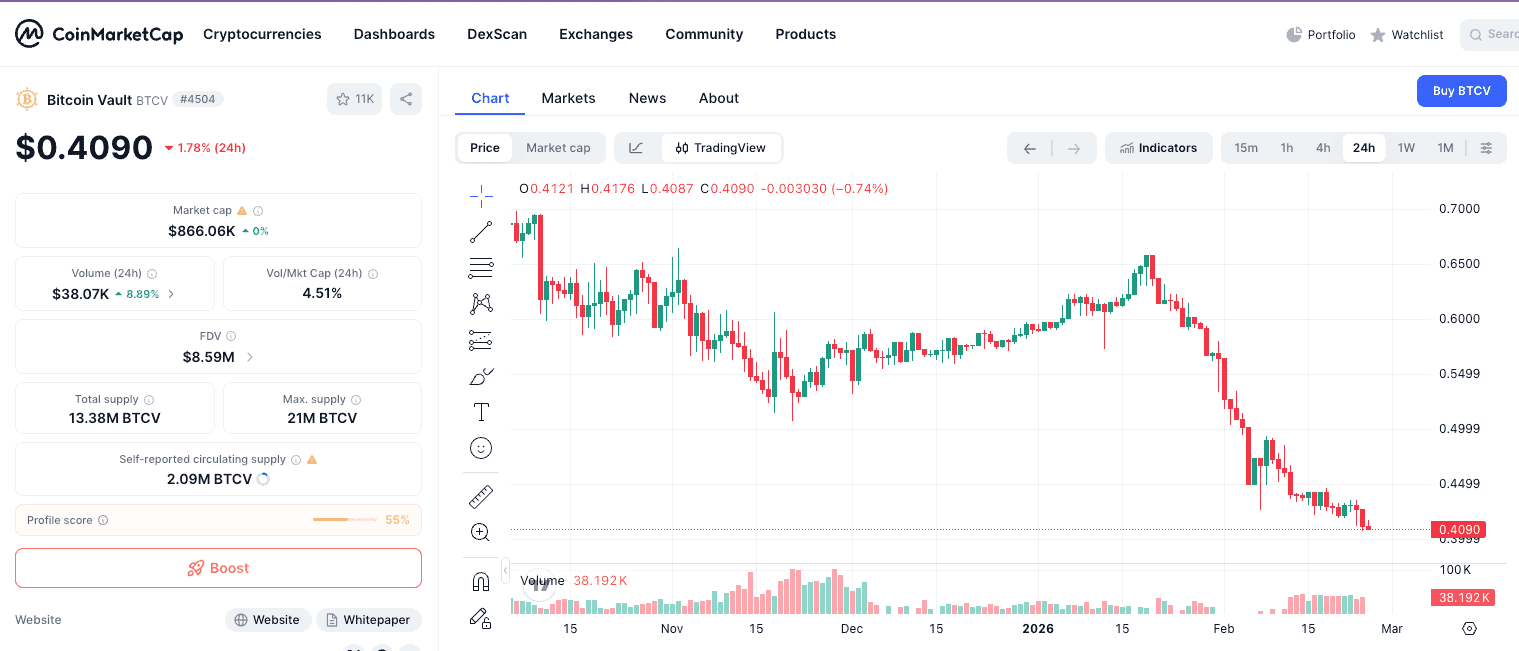
(Data accurate as of Feb 25, 2026,source: CoinMarketCap)
| Feature | Details |
| Ticker Symbol | BTCV |
| Current Price | $0.4090 |
| Market Cap | $866,063 (Variable) |
| 24h Trading Volume | $38,070 |
| Max Supply | 21,000,000 BTCV |
| Total Supply | 13.38M BTCV |
| Circulating Supply | 2.09M BTCV (Self-reported) |
| Consensus | PoW (SHA-256) |
| Availability on Phemex | No (Tracking only) |
What Is Bitcoin Vault (BTCV)?
Bitcoin Vault (BTCV) is a cryptocurrency built on the blockchain protocol (SHA-256) but distinguished by its anti-theft architectural layer. While traditional blockchain transactions are final within minutes, BTCV introduces a "security window" intended to give users the ability to react to potential theft or erroneous transfers.
The core objective of BTCV is to resolve the "irreversibility risk" associated with decentralized assets. By extending the confirmation time for standard secure transactions, it provides a window of opportunity to intervene before funds are permanently moved. To deepen your understanding of secure asset storage, Explore Phemex Academy.
The Technology Behind BTCV: The 3-Key Security System
BTCV’s primary innovation is its proprietary three-key wallet system. This setup allows for different transaction "speeds" and security tiers:
1. Standard Transaction Key
The Standard Key is generated during wallet creation and primarily operates in the background. It ensures the smooth execution of basic network functions and acts as an recovery layer in the event of technical issues or certain security breaches.
2. Cancel Transaction Key
This key is the cornerstone of BTCV’s anti-theft utility. When a standard secure transaction is initiated, it is intentionally delayed for 144 blocks (approximately 24 hours). If the user notices an unauthorized transfer within this window, the Cancel Key allows them to reverse the transaction and recover the funds to a safe address.
3. Fast Transaction Key
Recognizing that not all transfers require a 24-hour delay, the Fast Key allows for "Secure Fast" transactions. These are completed in approximately 10 minutes (1 block), similar to standard Bitcoin transfers. This is intended for use with trusted parties where immediate finality is preferred over the ability to reverse.
BTCV Tokenomics and Supply
Understanding the supply dynamics is critical for evaluating BTCV’s market profile.
Max Supply: BTCV adheres to a strict limit of 21,000,000 coins.
Mining Mechanism: New coins enter the market via Proof-of-Work (PoW) mining. Miners secure the network by solving complex cryptographic puzzles using the SHA-256 algorithm and receive block rewards as compensation.
Supply Status: According to recent market data, approximately 13.38 million BTCV have been minted. However, users should note that the circulating supply of 2.09 million BTCV is self-reported by the project and has not been independently verified by all major market aggregators.
Bitcoin Vault (BTCV) vs. Bitcoin (BTC): A Technical Comparison
While Bitcoin Vault is derived from the original Bitcoin protocol and shares its core cryptographic DNA, the two assets prioritize different functional outcomes. Bitcoin focuses on immutability and decentralization, whereas BTCV focuses on transactional flexibility and theft mitigation.
| Feature | Bitcoin (BTC) | Bitcoin Vault (BTCV) |
| Launch Date | 2009 | 2019 |
| Hashing Algorithm | SHA-256 | SHA-256 |
| Max Supply | 21,000,000 BTC | 21,000,000 BTCV |
| Consensus Mechanism | Proof of Work (PoW) | Auxiliary Proof of Work (AuxPoW) |
| Transaction Finality | Immutable: Generally final after 6 blocks (~60 minutes). | Programmable: Standard secure transfers require 144 blocks (~24 hours) for finality. |
| Reversibility | None: All confirmed transactions are permanent. | Conditional: Transactions can be reversed within 24 hours using a specific "Cancel Key." |
| Security Philosophy | User-managed private key responsibility. | Multi-tier security with a technical "safety net." |
| Network Size | Global, massive hash rate (Market Leader). | Niche, leveraging merged mining (AuxPoW). |
| Primary Use Case | Digital Gold / Global Store of Value. | Security-focused store of value with anti-theft tech. |
| Listing Status | Widely available on all major exchanges. | Limited availability; requires verified liquidity monitoring. |
Deep Dive: Key Differences Explained
1. The Concept of Finality
In the world of Bitcoin (BTC), the principle of "Code is Law" prevails. Once a transaction is broadcast and confirmed on the blockchain, it cannot be undone. This ensures that no central authority or user can censor or roll back payments.
In contrast, Bitcoin Vault (BTCV) challenges this "instant finality" by introducing a deliberate 24-hour delay for its secure transaction tier. This is a trade-off: users sacrifice the speed of finality to gain a "cancellation window." From a regulatory and risk-management perspective, this makes BTCV a specialized tool for users who prioritize protection against private key theft over the rapid settlement of funds.
2. Network Security and AuxPoW
Bitcoin's security is derived from its massive, standalone mining network—the largest in the world. BTCV utilizes Auxiliary Proof of Work (AuxPoW), also known as merged mining. This technical bridge allows Bitcoin miners to provide security to the BTCV network simultaneously.
Risk Disclosure: While AuxPoW enhances the security of smaller chains, it is important to note that BTCV's total hash power is a fraction of Bitcoin’s. Traders should consider this difference in network strength when evaluating long-term protocol stability.
3. Complexity vs. Simplicity
Bitcoin is intentionally simple, reducing the "attack surface" of the protocol.
Bitcoin Vault adds complexity through its 3-key architecture. While this adds a layer of security, it also increases user responsibility. Losing access to any of the three keys (Standard, Cancel, or Fast) can lead to different levels of asset restriction, making it essential for users to employ robust backup strategies.
Market Position and Liquidity
As shown in recent CoinMarketCap data, Bitcoin remains the dominant market force with a trillion-dollar valuation. BTCV, with a market cap of approximately 0.4090, occupies a micro-cap niche. For Phemex users, this highlights the importance of checking real-time market data and liquidity depth before entering positions in lower-cap assets like BTCV.
Market Analysis & Risk Considerations (Feb 2026)
As of late February 2026, BTCV’s price is $0.4090, reflecting a volatile market period. The project currently holds a market rank of #4504 on CoinMarketCap.
Risks to Consider:
Liquidity: With a 24-hour trading volume of approximately $38K, BTCV is considered a low-liquidity asset. Large trades may experience significant slippage.
Price Volatility: Recent charts indicate a downward trend from previous highs; investors should monitor the BTCV price closely.
Complexity: The 3-key system requires users to manage three distinct private keys. Losing the Cancel or Fast keys can negate the security benefits of the ecosystem.
FAQ
Is BTCV listed on Phemex?
Currently, BTCV is not available for trading on Phemex. Phemex maintains high listing standards, focusing on projects with verified circulating supply, high liquidity, and robust community engagement.
How long does it take to reverse a BTCV transaction?
A reversible transaction can be cancelled within a window of 144 blocks, which typically equates to 24 hours. Once the 144th block is confirmed, the transaction becomes final and irreversible.
Where can I verify BTCV network data?
Real-time information regarding block heights, hash rates, and wallet addresses can be found on the official Bitcoin Vault Explorer.
Disclaimer: The information provided is for educational purposes and does not constitute financial advice. Cryptocurrency investments carry high risk. Always perform your own research and only invest capital you can afford to lose.
