




XRP price: $1.11, holding the lower half of its June range while the broad market leans risk-off.
24-hour change: -2.03%, in line with a soft session across large-cap alts rather than an XRP-specific sell signal.
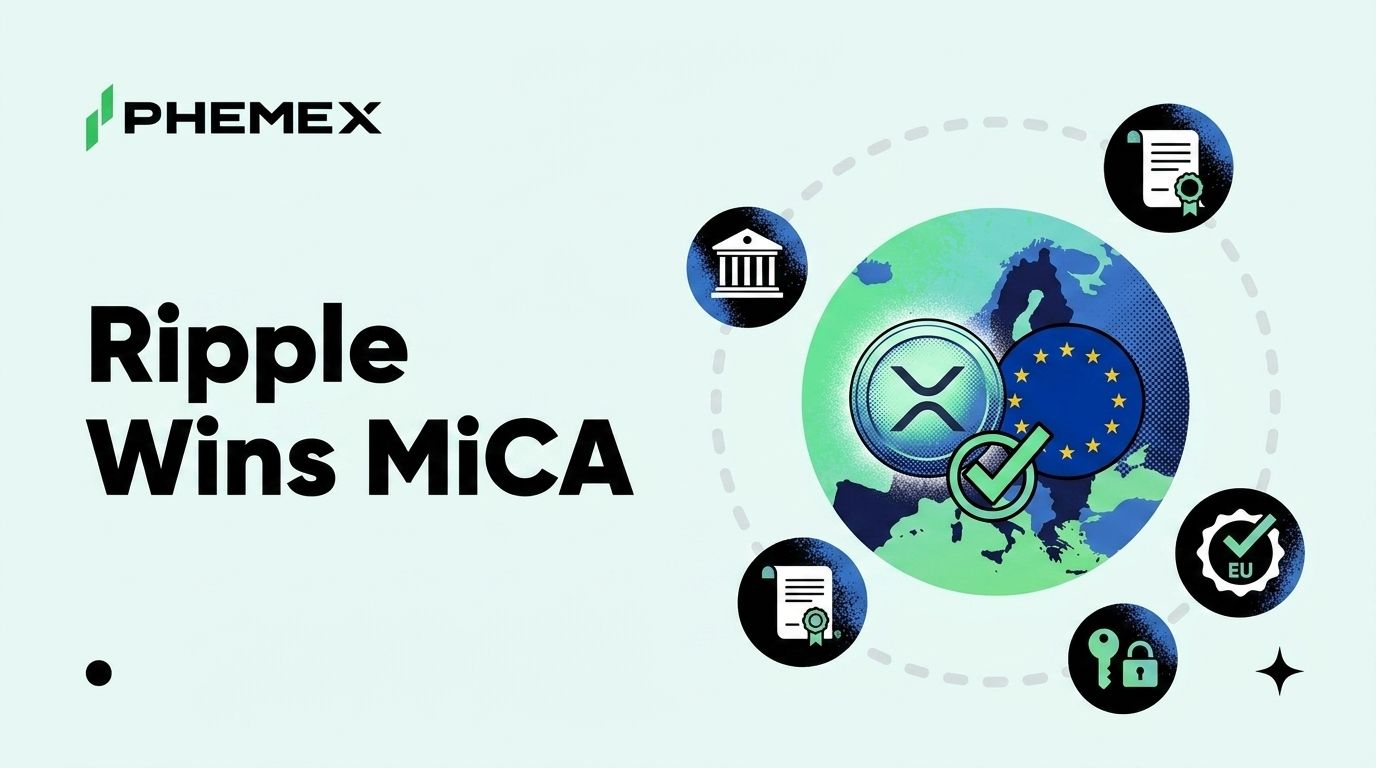
The catalyst: Ripple secured preliminary MiCA approval through Luxembourg's financial regulator, opening a path to offer RLUSD-based payment systems and broader crypto services across the European Union.
ETF flow: XRP products still attracted roughly $5.30 million in net inflows on June 17, a quiet vote of confidence against the red tape.
Level that matters: $1.08 is the first support that decides if this dip stays orderly or turns into a slide toward $1.04.
The price tape and the headline tell two different stories today, and the gap between them is where the opportunity sits. Here is what the Luxembourg approval actually opens up, where the levels sit around $1.11, and how this positions Ripple before the July 1 MiCA compliance deadline.
XRP Price Levels to Watch Around $1.11
XRP is trading at $1.11, off 2.03% on the day, and the move is more about the broader tape than anything specific to Ripple. Large-cap alts are leaning defensive, and XRP is doing what it usually does in those windows, which is drift with the group rather than lead it. That matters for how you read the dip, because a market-wide pullback tends to mean-revert faster than a token-specific breakdown.
The structure right now is a contained range with clearly defined edges. The first line of defense is $1.08, the level that has absorbed selling on the last few intraday flushes. Below that, $1.04 is the deeper support where a real test of buyer conviction would happen. On the upside, $1.15 is the immediate ceiling that has capped every bounce this week, and a clean reclaim of $1.18 would signal the range is breaking higher rather than just bouncing inside it.
The honest read is that none of these levels have broken yet, so this is still a range, not a trend. Traders who get chopped up here are the ones treating every tap of support or resistance as a breakout. It is not. The setup resolves only when one of the outer levels gives way on volume.
|
Level
|
Price
|
What it signals
|
|
Resistance 2
|
$1.18
|
Range breaks higher, momentum shift
|
|
Resistance 1
|
$1.15
|
Immediate ceiling, caps this week's bounces
|
|
Spot
|
$1.11
|
Current price, lower half of the range
|
|
Support 1
|
$1.08
|
First defense, dip stays orderly above it
|
|
Support 2
|
$1.04
|
Deeper test of buyer conviction
|
For context on how this range fits the larger June picture, the XRP price June 2026 breakdown covers the escrow-supply and regulatory threads still in play. Live tape and depth are worth cross-checking against a neutral data source like the CoinGecko XRP page before you size a position. If you want the asset-level fundamentals behind the ticker, the Ripple and XRP overview lays out where utility comes from.
What Ripple's Preliminary MiCA Approval in Luxembourg Actually Means
The news that cuts through the red day is regulatory. Ripple secured preliminary MiCA approval via Luxembourg's financial regulator, the supervisory authority that sits inside the European framework now governing crypto across the bloc. MiCA, the Markets in Crypto-Assets regulation, is the EU's unified rulebook for stablecoin issuers, exchanges, and crypto service providers. A preliminary approval is the regulator signaling that Ripple's application clears the bar, with the formal license expected to follow.
The practical payoff is access. The approval would let Ripple offer its RLUSD stablecoin payment systems to European companies and run broader crypto functions, things like custody and transfers, with a passport that works across all 27 member states. Under MiCA, a license granted in one EU country can be passported into the others, so a Luxembourg green light is functionally a key to the entire European market rather than one country.
This is the difference between operating in a gray area and operating with a stamp. Ripple has spent years fighting for exactly this kind of legal certainty in the United States, and Europe is now handing it a clearer path. Luxembourg is a deliberate choice here, since it is one of the EU's primary financial hubs and a jurisdiction that institutional money already trusts for fund domiciliation and payments infrastructure.
You can read the company's own framing on its Ripple newsroom, and the regulator's role under the EU framework is detailed on the ESMA MiCA page. For the asset class context on why a regulated dollar token matters here, the stablecoins primer is a useful baseline.
How RLUSD and XRP Utility Change Inside the EU
RLUSD is Ripple's regulated dollar stablecoin, and the Luxembourg approval is the piece that lets it operate as a compliant payment rail inside Europe rather than a token that European businesses can only hold at arm's length. For a company moving money across borders, the appeal of a MiCA-compliant stablecoin is that it settles in seconds, runs around the clock, and carries a regulatory wrapper that a treasury team can actually sign off on.
The link back to XRP is the settlement layer underneath. Ripple's payment products use the XRP Ledger as connective tissue between currencies and stablecoins, so deeper RLUSD adoption in Europe tends to mean more activity routed through the same infrastructure XRP secures. The token is not the headline of the approval, but it is the rail the approval runs on, and that is the relationship traders should keep in view.
There is a real demand backdrop here too. European corporates have been waiting for compliant on-chain payment options, and MiCA was written specifically to give them a framework they can use without legal guesswork. A regulated issuer with a passport across the bloc is positioned to capture exactly that demand, and the firms that get there first tend to set the defaults that everyone else integrates against. The piece worth watching is how fast RLUSD volume actually grows once the formal license lands, because adoption, not the announcement, is what eventually shows up in network activity.
It also reframes the competitive map. Most regulated euro and dollar stablecoins inside MiCA are being issued by banks and payment firms rather than crypto-native companies, so a token whose settlement layer is a public blockchain is a different proposition for a treasury team. The question Ripple now has to answer is simple to state. Do European businesses prefer a bank-issued token or a blockchain-native one with the same regulatory wrapper. That contest plays out over quarters, not days, and it is the real prize behind a single Luxembourg approval.
If the broader on-chain payments and lending picture is new to you, the DeFi overview frames where stablecoin rails fit into the wider crypto economy.
How This Positions Ripple Before the July 1 MiCA Deadline
Timing is the part of this story that gets underrated. July 1 is a key MiCA compliance milestone, the point by which crypto firms operating in the EU need to be on the right side of the framework, and Ripple landing a preliminary approval in late June puts it ahead of the curve rather than scrambling against the clock. Being early to a regulatory deadline is a competitive edge, because the firms that arrive late spend the next quarter on paperwork instead of customers.
The flow data backs the read that institutions are not flinching. XRP products still pulled roughly $5.30 million in net inflows on June 17 even as price softened, which tells you allocation is continuing through the chop. That is a small number in absolute terms, but the direction is what counts on a risk-off day. Money leaving would confirm the bearish tape. Money arriving says the bigger players are looking past the daily candle toward the regulatory runway. If reading flow data is unfamiliar territory, the ETF flows explainer walks through how to interpret inflow and outflow prints.
So the setup heading into July is a token sitting mid-range on price, with a fresh European regulatory tailwind and steady institutional bids underneath. None of that guarantees an immediate breakout. What it does is shift the asymmetry, since the catalysts now sit on the bullish side of the ledger while the price has not yet moved to reflect them.
Frequently Asked Questions
Why is XRP down today if the MiCA news is positive?
XRP is down 2.03% at $1.11 because the broad market is risk-off, not because of anything specific to Ripple. Large-cap alts are drifting together on a soft session, and XRP is moving with the group. Regulatory wins often take time to show up in price, especially when they land during a defensive tape.
What is RLUSD and why does the Luxembourg approval matter?
RLUSD is Ripple's regulated dollar stablecoin. The preliminary MiCA approval through Luxembourg's regulator would let Ripple offer RLUSD payment systems and broader crypto services across the EU, since a license in one member state passports into all 27. It moves Ripple from operating in a gray area to operating with a clear regulatory mandate.
Will XRP go up in June 2026?
Nobody can promise a direction, but the catalysts currently lean bullish while price has not yet followed. XRP is holding mid-range with a fresh EU regulatory tailwind and roughly $5.30 million in ETF inflows on June 17. The trigger to watch is a clean reclaim of $1.15, which would signal the range is breaking higher.
What happens to XRP at the July 1 MiCA deadline?
July 1 is a MiCA compliance milestone for crypto firms operating in the EU. Ripple's preliminary approval puts it ahead of that deadline rather than scrambling against it, which is a competitive edge over firms still working through paperwork. The deadline itself is regulatory, so the price impact depends on how quickly RLUSD adoption follows.
Bottom Line
XRP at $1.11 is a range trade with a regulatory tailwind that the price has not yet priced in. Hold $1.08 and the dip stays orderly, with the range intact toward the $1.15 ceiling. Lose $1.04 and the structure breaks, opening a deeper test toward $0.95. Reclaim $1.18 on volume and the bounce becomes a breakout, with the Luxembourg approval and steady ETF inflows giving that move a fundamental story to stand on. The setup that pays here is patience at the edges of the range, not chasing every tap in the middle.
This article is for informational purposes only and does not constitute financial or investment advice. Cryptocurrency trading involves substantial risk. Always conduct your own research before making trading decisions.