




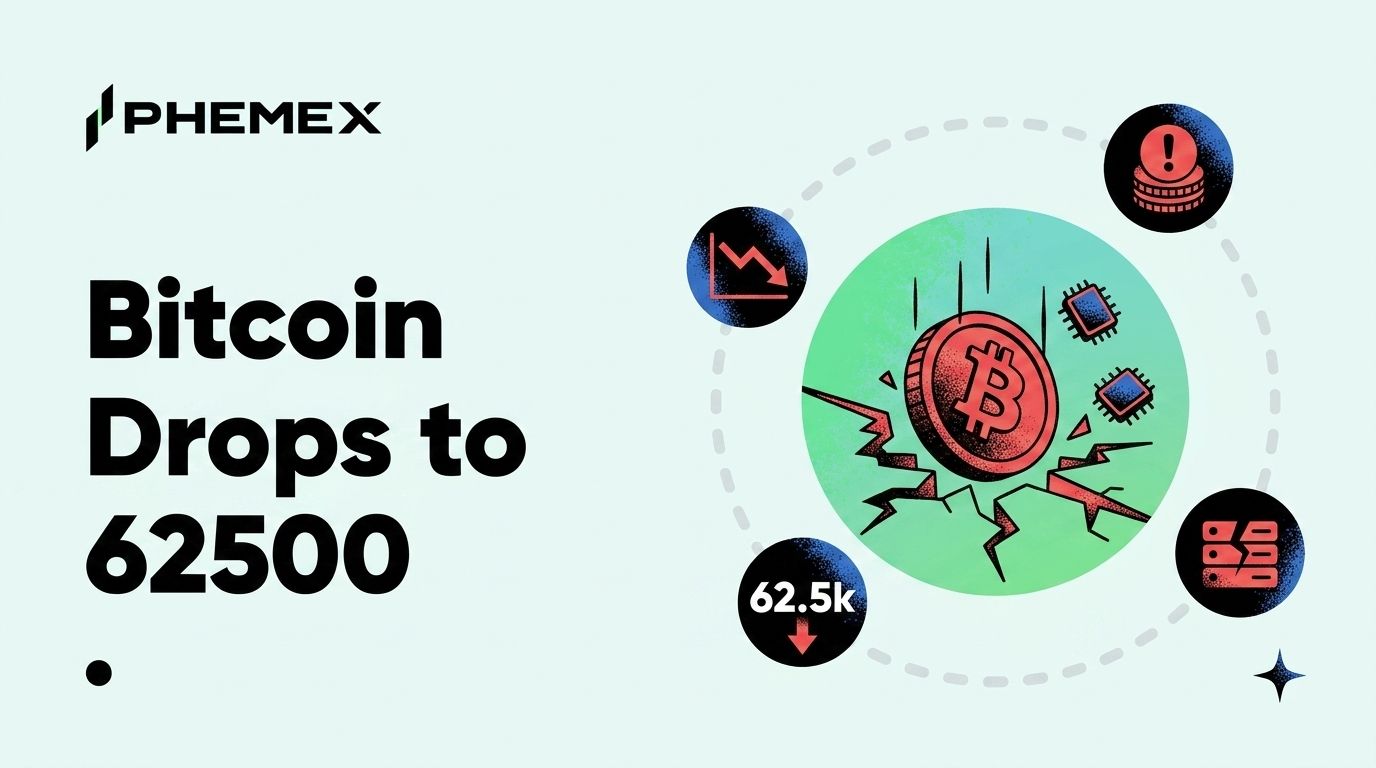
Bitcoin is trading at $62,582, down 2.44% over the past 24 hours, after a sharp selloff in AI and semiconductor stocks spilled out of equity markets and into crypto. The trigger sat thousands of miles from any trading desk that touches BTC. A leveraged chip-sector ETF in South Korea collapsed overnight, dragging the broader Nasdaq chip complex lower, and the risk-off wave rolled straight through the correlation that now ties crypto to the AI trade. Ethereum fell harder, down 3.93% to $1,663, and roughly $717 million in positions were liquidated across the market as leveraged longs got flushed.
None of this came from inside crypto. There was no exploit, no regulatory shock, no failed token. The selling pressure arrived from the outside, which changes how you read the levels. Here is what dragged Bitcoin to $62,500, what the liquidation wave actually means, and the exact prices that decide if this holds or keeps bleeding.
Bitcoin Price Snapshot for June 24, 2026
- BTC price: $62,582
- 24h change: -2.44%
- ETH price: $1,663 (-3.93%)
- Liquidations (24h): ~$717 million across the market
- Sentiment: risk-off, Fear and Greed sliding back toward fear
The numbers tell a coordinated story rather than an isolated one. Bitcoin sold off in lockstep with equities, and the relative weakness in ETH and the size of the liquidation print both confirm that leverage, not spot conviction, was driving the move. That distinction matters for what comes next.
Bitcoin Price Levels That Decide the Next Move
The current price sits in an awkward spot. $62,582 is below the comfortable mid-range and close enough to a real support shelf that the next few sessions are likely to be decisive. Here is the map traders are working from right now.
|
Level
|
Type
|
Why it matters
|
|
$66,000
|
Resistance
|
Pre-selloff range high, the ceiling bulls lost on the way down
|
|
$64,000
|
Resistance
|
First reclaim target, the level that flips the short-term tone
|
|
$62,582
|
Current price
|
The line being fought over right now
|
|
$60,000
|
Support
|
Round-number psychological floor and prior demand zone
|
|
$58,000
|
Support
|
The line that, if lost, invalidates the range and opens lower
|
The honest read is that $60,000 is the level that matters most. It is round, it carried demand on the last two retests, and a large block of stop orders sits just beneath it. Hold there and this stays a correction inside a range. Lose it on heavy volume and the $58,000 retest becomes the base case fast, because there is thin support between those two figures. On the upside, nothing improves until BTC reclaims $64,000 and holds it on a closing basis, which would signal the equity-driven selling has been absorbed.
How a Korean Chip ETF Crash Reached Bitcoin
The chain of events started in a corner of the market that has nothing to do with crypto. A heavily leveraged South Korean ETF tracking the semiconductor sector unwound overnight, forcing mechanical selling into AI and chip names. That selling cascaded into the US-listed Nasdaq chip complex, and from there into the broader risk-asset bid. Crypto sat downstream of all of it.
The reason a chip-ETF blowup can move Bitcoin at all comes down to correlation. Over the past year, BTC has traded increasingly like a high-beta version of the Nasdaq, rising when the AI trade rips and falling when it cracks. When semiconductors lead a risk-off session, crypto rarely escapes it. This is the same mechanism that links Bitcoin to exchange-traded fund flows, where institutional money treats BTC as one more line in a risk book rather than a separate asset class. The clearest read on if this selloff is institutional or retail-driven shows up in the spot ETF flow data, tracked daily on Farside's Bitcoin ETF flow page. Heavy net outflows on a day like this would mean institutions are repositioning, while flat or positive flows would suggest the selling was leveraged retail longs getting flushed.
What makes today different from a crypto-native selloff is the absence of any internal catalyst. The order books did not break because of leverage built up inside crypto. They broke because a macro shock arrived from outside and hit an asset that now moves with equities. That tends to produce sharper, faster drops that also tend to mean-revert once the external pressure eases, which is the opposite of how a fundamental crypto problem behaves.
What the 717 Million Liquidation Wave Means
The $717 million in liquidations is the part of today's move that tells you the most about positioning. The bulk of it was long liquidations, traders who were leveraged into the upside and got force-closed as price fell through their margin thresholds. That is a leverage flush, not a fundamental repricing.
Here is why the distinction matters for your decisions. When a market is overleveraged on the long side and a sudden drop triggers a cascade, each liquidation sells into the next, accelerating the move beyond what the underlying news justifies. The price overshoots. Once the leveraged longs are cleared out, the selling pressure that was mechanical rather than fundamental disappears, and the market often stabilizes near the level where the cascade exhausted. The reason most traders get stopped out here is that they treat the overshoot as the new trend rather than the spike it usually is.
ETH falling 3.93% while BTC fell 2.44% fits this read exactly. Ethereum and the broader altcoin complex carry more leverage and less institutional ballast than Bitcoin, so they amplify both directions. When the move is leverage-driven, alts fall faster. When it is conviction-driven, the gap is usually narrower. The spread today points to a liquidation event, not a structural shift in how the market values these assets. You can track the live breakdown of long versus short liquidations on the CoinGlass liquidations dashboard, which shows if the cascade is still running or has already exhausted.
The other tell is sentiment. A single hard session is usually enough to swing crowd psychology, and the Fear and Greed Index tends to lurch from greed back toward fear on exactly this kind of move. Extreme fear readings have historically clustered near short-term bottoms rather than the start of deeper declines, which is another reason to treat a leverage flush as a spike to fade rather than a trend to chase.
What Bulls Need to Reclaim From Here
Stabilization is not the same as recovery, and the bar for calling this over is specific. The first thing bulls need is for the liquidation cascade to actually finish, which shows up as a sharp drop in the rolling liquidation rate and a flattening of the order-flow imbalance. As long as longs are still being force-closed, every bounce is suspect.
The second requirement is a reclaim of $64,000 on a closing basis. Until that happens, the path of least resistance stays lower, and any rally back toward the figure is more likely a relief bounce than a trend change. A clean close back above it would signal that spot buyers have stepped in to absorb the equity-driven selling. From there, $66,000 is the level that confirms the range is back intact.
The third factor is external, and it is the one nobody on a crypto desk controls. This selloff started in equities, so it likely ends in equities too. If the Nasdaq chip complex stabilizes and the Korean ETF unwind is a one-session event rather than the start of a broader deleveraging, crypto gets room to mean-revert. If chip names keep bleeding into the next session, the macro pressure on Bitcoin does not lift, and the $60,000 support gets tested for real. Watching the equity tape is not optional here. It is the leading indicator. For traders who want a structural anchor through the noise, the Bitcoin 200-week moving average and the Bitcoin rainbow chart both still sit well below current price, which keeps the longer-term picture intact even on a red day.
Frequently Asked Questions
Why is Bitcoin falling today?
Bitcoin fell 2.44% to $62,582 because a leveraged South Korean chip ETF collapsed overnight and dragged the Nasdaq semiconductor complex lower, sparking a risk-off wave that spread into crypto. The move was macro-driven and external, with no crypto-native exploit, hack, or regulatory event behind it.
Is the drop to $62,500 a buying opportunity?
That depends on if $60,000 holds and if the equity selloff that caused this stabilizes. The $717 million liquidation print suggests this was a leverage flush that tends to overshoot, but buying into a still-running cascade is how traders get stopped out. Waiting for the liquidation rate to cool and for a reclaim of $64,000 is the lower-risk approach.
Why did Ethereum fall more than Bitcoin?
Ethereum dropped 3.93% versus Bitcoin's 2.44% because ETH and the broader altcoin market carry more leverage and less institutional ballast, so they amplify moves in both directions. A wider gap between ETH and BTC losses is a classic signal that a selloff is leverage-driven rather than based on a change in fundamentals.
What level invalidates the current setup?
A close below $58,000 on heavy volume would break the range and open the door to a deeper retracement. The $60,000 floor is the first line of defense, and losing it on strong volume would put $58,000 in play quickly given the thin support between the two.
Bottom Line
This is an outside-in selloff, not an inside-crypto one. A leveraged chip ETF in South Korea cracked, the Nasdaq AI trade followed, and Bitcoin fell 2.44% to $62,582 through a correlation that now ties it to equities. The $717 millionliquidation wave points to a leverage flush that tends to overshoot and mean-revert once the cascade exhausts.
Hold $60,000 and this stays a correction inside a range. Lose it on heavy volume and $58,000 becomes the next test. On the upside, nothing improves until BTC reclaims $64,000 on a closing basis, with $66,000 confirming the range is back. The single most important thing to watch is not the BTC chart at all. It is if the chip complex stabilizes into the next session, because the move that started in equities is the move that has to end there. For traders sizing positions in this kind of macro-driven volatility, the best edge is patience and a defined stop, not a guess at the exact bottom. Pair the chart with the right Bitcoin valuation tools and let the level do the deciding.
This article is for informational purposes only and does not constitute financial or investment advice. Cryptocurrency trading involves substantial risk. Always conduct your own research before making trading decisions.