




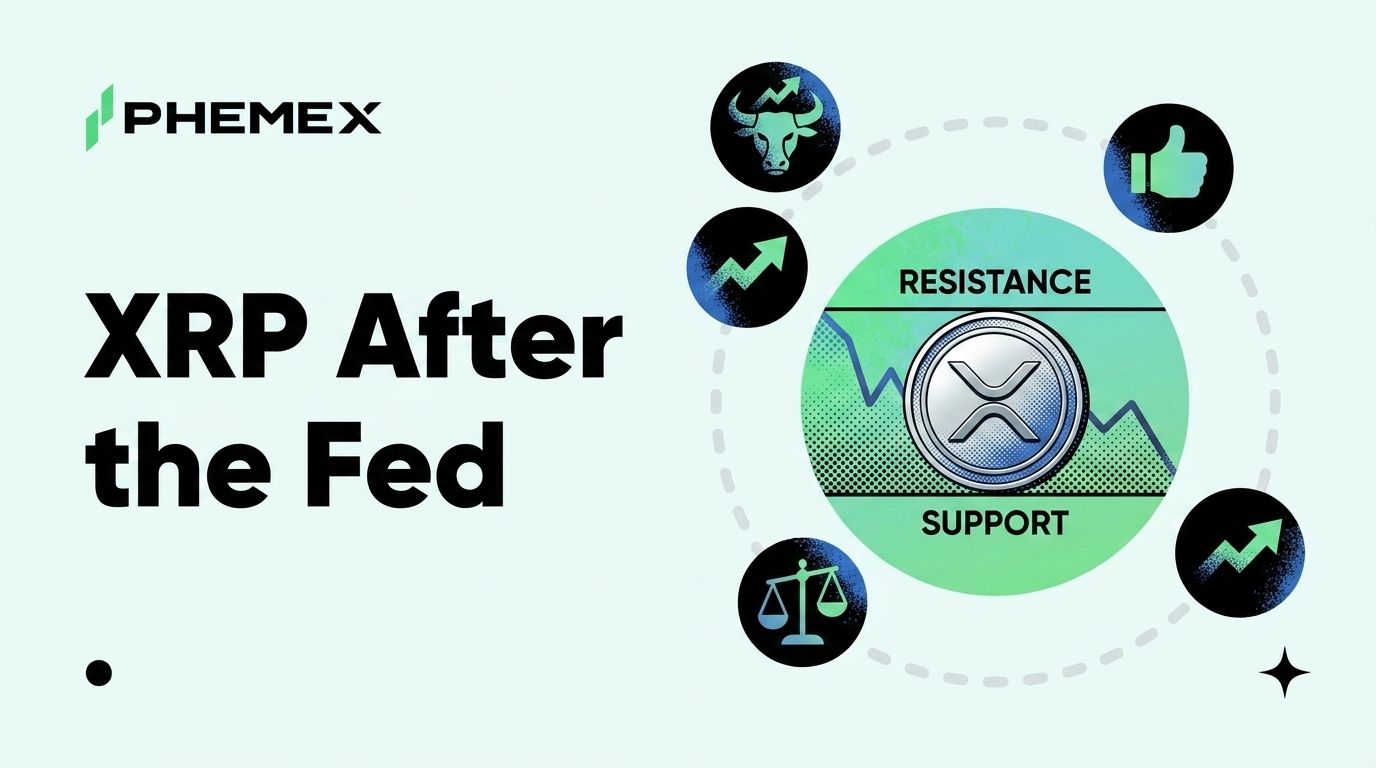
XRP trades around $1.15 this morning, flat on the day but sitting well off the $1.22 area it held before the June 17 Fed meeting. Warsh's hawkish dot plot pulled the whole market lower, sending Bitcoin to roughly $63,000 before it clawed back to $64,187, and XRP followed that beta straight down toward the lower-middle of its $1.08 to $1.32 range. Nothing changed about XRP itself, and the macro tape did all the moving.
That distinction is the honest framing for today. This is a macro-driven price, not an XRP-specific story, and reading it correctly means watching levels rather than headlines. Here is the breakdown.
XRP Snapshot Today
- XRP price: $1.15
- 24h change: +0.67%
- Range: $1.08 to $1.32 (lower-middle after the Fed selloff)
- Catalyst: post-FOMC stabilization plus a standing ETF and DTCC bid
Why XRP Dropped After the Fed Meeting
The June 17 FOMC is the only thing that matters for explaining where XRP sits right now. Kevin Warsh's Fed held rates at 3.50 to 3.75%, which the market expected, but the updated dot plot turned hawkish in a way it did not. Nine of eighteen members now project at least one hike before the end of 2026, the median path moved from 3.4% to 3.8%, and the PCE inflation forecast was raised to 3.6%. Warsh also scrapped forward guidance, which removed the dovish cushion traders had been leaning on.
Risk assets read that combination the only way they could. A hawkish Fed caps near-term risk appetite, and crypto is still the highest-beta corner of the risk-on trade. Bitcoin took the first hit and dipped to about $63,000, then recovered to $64,187 as buyers stepped back in. XRP traded as a satellite to that move, sliding from the $1.22 zone back toward the lower half of its range.
This is the part most retail traders get wrong on days like this. They go hunting for an XRP-specific reason, a delisting rumor or an escrow headline, when the move is just XRP doing what high-beta assets do when the macro wind shifts. If you want the longer fundamental backdrop on the token, the what is Ripple XRP primer covers the ledger and the use case. Today, though, the chart is the story.
The XRP Levels Map That Matters Now
XRP is range-bound, and on a range-bound asset the levels do more work than any narrative. Here is the map traders are watching from $1.15.
|
Level
|
Type
|
What it means
|
|
$1.20 to $1.22
|
Resistance
|
The pre-FOMC shelf XRP lost. Reclaiming it signals the macro dip is being bought.
|
|
$1.32
|
Range top
|
The ceiling of the current band. A close above opens a real breakout discussion.
|
|
$1.15
|
Current price
|
Lower-middle of the range, no man's land between support and resistance.
|
|
$1.12
|
First support
|
The level bulls need to defend to keep the range intact.
|
|
$1.08
|
Invalidation
|
Lose this on a closing basis and the range breaks down toward $0.95.
|
The structure is simple to trade because the edges are clean. $1.12 is the first line in the sand, and it has absorbed selling on prior macro flushes. Below that, $1.08 is the level that actually changes the picture. A daily close under $1.08 invalidates the range and puts $0.95 in play as the next logical support shelf, because there is little structure between those two prices.
On the upside, $1.20 to $1.22 is the reclaim level. That band was support before the Fed meeting and now acts as resistance, which is the textbook flip that happens when a level breaks. Getting back above it tells you the post-FOMC selling has exhausted. Above that, $1.32 is the range top, and only a close through it turns this from a range trade into a trend trade. For a fuller technical read on how XRP has been behaving inside this band, the earlier XRP price action breakdown from June 3 walks through the same range from a different week.
The Macro Overhang Capping the Upside
The reason XRP cannot simply snap back to $1.32 is sitting in the Fed's projections, not in the chart. A hawkish dot plot does one thing to risk assets. It raises the cost of holding them.
When the median rate path drifts higher and the inflation forecast goes up, the market prices a longer wait for any relief. That pushes capital toward the front of the curve and away from the back of the risk spectrum, and crypto sits at the very back. XRP does not get a pass on that math just because its own regulatory and institutional story is improving. Until the macro tape stabilizes, rallies in XRP are likely to be sold into resistance rather than carried through it.
This is why the $1.20 to $1.22 reclaim is the single most important near-term signal. It is the level where you find out if the market is willing to pay up for risk again. If buyers cannot reclaim it within a few sessions, the path of least resistance stays sideways to lower, and the range holds XRP captive.
The Structural Bid Underneath the Range
Here is the counterweight to the macro overhang, and it is the reason $1.08 has held instead of giving way. XRP has built a structural institutional floor over the past two quarters that did not exist in prior cycles.
Seven spot XRP ETFs are now live and collectively hold more than 840 million XRP, with over $1.5 billion in net inflows across the trailing 60 days. That is real, persistent demand that does not care about a single Fed meeting, and it sits underneath the price as a bid that buys dips the way passive flows always do. You can track that flow data directly on Farside rather than relying on secondhand summaries, the same way ETF watchers read the Bitcoin ETF flows tape for BTC. If you are newer to how these products work, the what is a Bitcoin ETF explainer applies to the XRP versions in the same way.
The institutional plumbing goes deeper than the ETFs. Ripple Prime is now part of the DTCC tokenized-securities working group, which is the settlement infrastructure layer the entire US securities market runs on. That is the kind of slow, structural integration that does not move price on any given Tuesday but raises the floor over time. The DTCC participation matters because it signals XRP-adjacent rails are being treated as serious settlement infrastructure, not a speculative sideshow. For the live token data and supply context behind these flows, CoinGecko's XRP page and the XRP Ledger documentation are the cleanest primary references.
This is the tension that defines XRP right now. A hawkish macro lid pressing down, a structural ETF and DTCC bid pushing up, and a price stuck in the middle while the two forces fight it out.
The CLARITY Act Catalyst That Swings the Range
If the macro is the lid and the ETF bid is the floor, the CLARITY Act is the swing factor that could break XRP out of the range entirely. The bill is in its Senate Banking markup window, and that markup is the next binary catalyst on the calendar with real upside potential.
The reason it matters for XRP specifically is permanence. The token already carries a commodity classification, but legislation codifies that status in federal law and puts it beyond the discretion of any future regulator. That is the single piece of certainty large institutional allocators have said they want before deploying at full scale. A clean markup that advances the bill would give the structural bid a reason to accelerate, and that is the scenario that takes XRP back through $1.22 and toward the $1.32 range top.
The honest caveat is timing. Markup windows slip, and a hawkish macro backdrop blunts the impact of even good legislative news in the near term. The June 2026 XRP outlook covering escrow, CLARITY, and the ETF pipeline lays out the full catalyst stack if you want the longer view. For today, treat CLARITY as the upside swing factor, not a base case.
Frequently Asked Questions
Why did XRP drop?
XRP dropped because of macro, not anything specific to the token. The June 17 hawkish Fed dot plot dragged the whole risk market lower, Bitcoin dipped to roughly $63,000, and XRP followed that beta from $1.22 toward the lower half of its range. There was no XRP-specific bad news driving the move.
What is XRP's support level?
The first support is $1.12, the level bulls need to defend to keep the range intact. The more important line is $1.08, because a daily close below it invalidates the entire range and opens the door toward $0.95. Above $1.08, the structural ETF and DTCC bid tends to absorb dips.
Will XRP recover?
Recovery depends on two things, macro stabilization and a reclaim of $1.20 to $1.22. The structural floor from seven live ETFs holding over 840 million XRP supports the downside, but the hawkish Fed caps the upside until risk appetite returns. A CLARITY Act markup that advances is the catalyst most likely to drive a real move higher.
Is XRP a buy at $1.15?
At $1.15, XRP sits in the lower-middle of its range, which is neither a clean entry nor a clean exit. Traders who want defined risk tend to wait for either a $1.12 hold with a reclaim of $1.20, or a flush to $1.08 support. Entering in the middle of a range is where most traders get chopped up.
Bottom Line
XRP at $1.15 is a macro-driven price, not an XRP story, and the levels tell you everything the headlines cannot. Hold $1.12 and reclaim $1.20 to $1.22, and the post-FOMC dip gets bought back toward the $1.32 range top, especially if a CLARITY Act markup advances. Lose $1.08 on a closing basis, and the range breaks down with $0.95 as the next target. The structural ETF and DTCC bid is the reason $1.08 has held so far, while the hawkish Fed is the reason $1.22 has not been reclaimed. Watch which one cracks first.
Disclaimer: This article is for educational purposes only and does not constitute financial advice. Cryptocurrency and stock trading carries significant risk. Always do your own research and consult a qualified advisor.