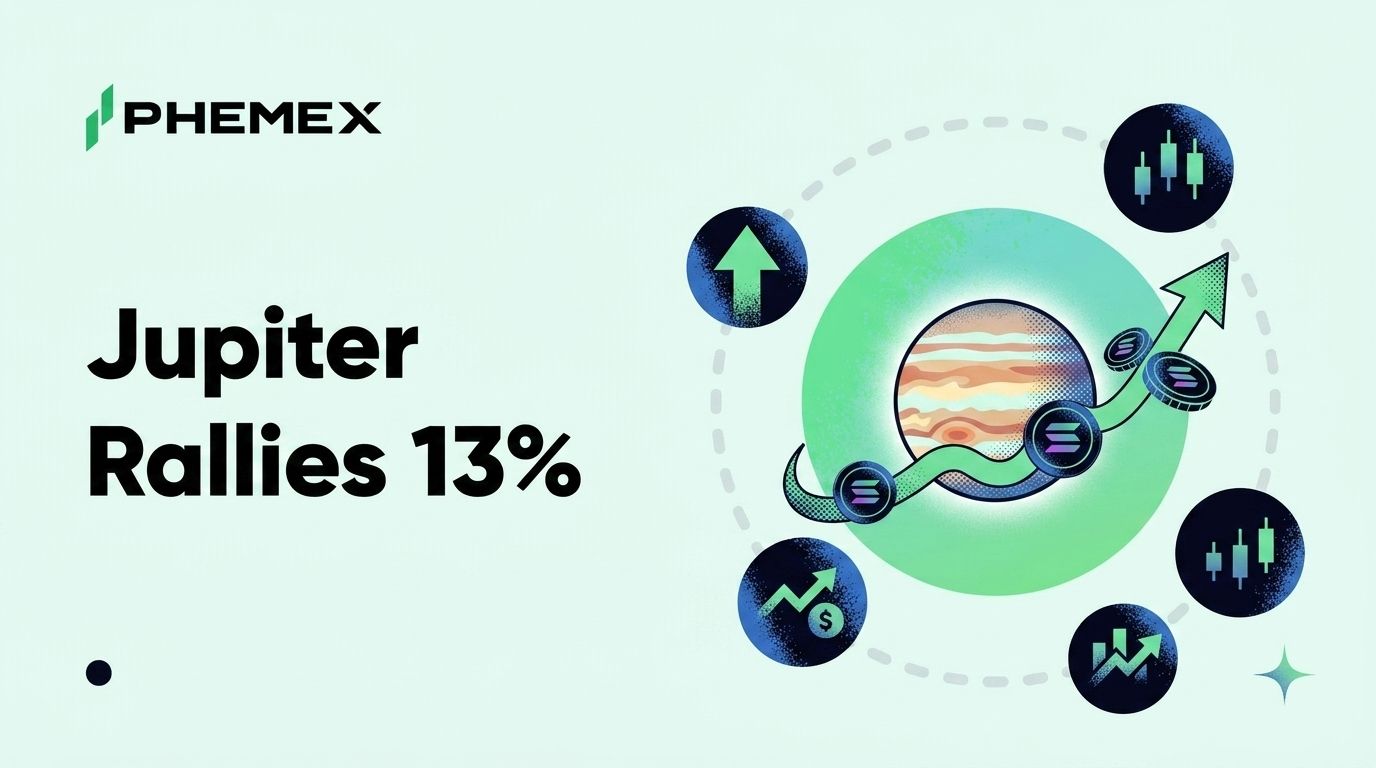
Jupiter (JUP) is trading at $0.2183, up 13% on the day and standing as the largest mover among Solana ecosystem tokens. SOL itself climbed 5.20% to $73.23 while AVAX added 4.90%, but JUP more than doubled that move. The catalyst is not a single headline. It is a stack of them landing at once, from a Solana Foundation partnership to a mobile app posting nine-figure monthly volume to a tokenomics shift that traders have wanted for months.
- JUP price: $0.2183
- 24h change: +13.09%
- Key metric: Jupiter Mobile ~$730M monthly trading volume
- Catalyst: Solana Frontier Traders program + Jupiter Mobile volume + token buybacks
- Context: day's top large-cap mover as Solana momentum returns
When one token outruns its entire sector by 8 percentage points, the question is always the same. Is this rotation lifting everything Solana-related, or is something specific to this asset doing the work? Here is the breakdown.
What Jupiter Actually Is on Solana
Jupiter is the dominant DEX aggregator on Solana, and that single sentence carries more weight than it looks. When you swap one token for another on Solana, your trade rarely executes on just one venue. Jupiter scans across the network's decentralized exchanges, splits your order where it makes sense, and routes it for the best available execution. Think of it as the search engine that sits on top of Solana liquidity rather than a single exchange competing for it.
That routing role made Jupiter the default plumbing for Solana DeFi. A huge share of swap volume on the network passes through its interface or its API, which means Jupiter captures activity no matter which underlying venue wins the trade. It became the liquidity backbone almost by default, the layer most users touch without thinking about it. When a memecoin launches on a Solana launchpad like Pump.fun, much of the resulting swap flow ends up routed through Jupiter too.
The product has expanded well beyond aggregation. Jupiter now runs a perpetual futures exchange, a mobile app, a limit-order and dollar-cost-averaging engine, and a growing set of tools aimed at becoming an "everything app" for Solana DeFi. The thesis is simple. If most Solana trading touches Jupiter at some point, owning the layer that captures that flow is a leveraged bet on Solana activity itself. That is why JUP tends to move harder than SOL in both directions.
Why JUP Is Up 13% Today
Four catalysts are stacking, and no single one explains the full move on its own.
The Solana Frontier Traders program launched with Jupiter as a core partner. The Solana Foundation rolled out the initiative to deepen on-chain trading activity, and naming Jupiter as a central piece signals that the network's own treasury and developer base are leaning on Jupiter as the trading layer. Foundation-level endorsement matters because it tends to direct grants, integrations, and user funnels toward the named partners.
Jupiter Mobile recorded roughly $730M in monthly trading volume. That is a real usage number, not a roadmap promise. A mobile app moving that kind of flow tells you retail is trading directly through Jupiter rather than through a desktop interface or a third-party wallet, and it widens the funnel of fees the protocol captures. Protocol-level revenue and TVL are tracked on DefiLlama for traders who want to verify the trend rather than take it on narrative.
Jupiter futures volume surged about 30% to roughly $55.5M in 24 hours, with open interest up 14.75% to around $42.9M. Rising open interest alongside rising price is the cleaner version of a rally. It means new money is opening positions rather than shorts simply being squeezed out, which tends to produce moves that hold rather than instantly reverse.
The fourth driver is tokenomics, and it deserves its own section because it is the part the market has been waiting on.
The Tokenomics Shift That Sets JUP Apart Today
Most ecosystem-token rallies run on narrative. This one has a structural leg under it. Jupiter has been running a buyback program that uses protocol revenue to purchase JUP off the open market, and the team has moved to reduce long-term token emission pressure. Those two things work in the same direction. Buybacks add steady demand, while lower future emissions shrink the supply that would otherwise hit the market over time.
For a token like JUP, that combination is the differentiated angle. A DEX aggregator generates real fees from real volume, so a buyback funded by that revenue ties token demand directly to platform usage rather than to speculation alone. The more Solana trades through Jupiter, the more revenue flows in, and the more JUP the protocol can buy back. It is the same demand-flywheel logic that makes fee-generating infrastructure tokens more durable than pure governance tokens, the model that lending protocols like Aave helped popularize across DeFi.
The honest caveat is that buybacks do not levitate a price by themselves. Emissions, unlocks, and broader market direction still matter more in the short run. But for traders trying to separate this rally from a generic Solana bounce, the buyback-plus-emission-reduction story is the piece that gives JUP a reason to outperform its own sector on a green day.
Is This Solana Rotation or a JUP-Specific Move
This is the question that decides how you trade it. The broad Solana tape is clearly green, with SOL up over 5% and AVAX up nearly 5%, so part of JUP's 13% is simply beta. When the ecosystem catches a bid, the aggregator that captures ecosystem volume catches a bigger one. That mechanical relationship explains a good chunk of the candle.
What separates JUP from a pure rotation play is the catalyst cluster that is specific to it. A Foundation program naming Jupiter, a mobile app posting $730M in volume, and a live buyback are not things that lift every Solana token equally. They are Jupiter-specific tailwinds layered on top of the sector move.
The practical read is that this is both. The Solana tailwind set the stage, and the JUP-specific catalysts are why it is the standout rather than just another green altcoin. The risk to watch is the obvious one. If Solana momentum stalls, the beta portion of this move unwinds fast, and JUP would have to lean entirely on its own catalysts to hold the gains.
The Levels Map for JUP
Here is the structure traders are working with after a double-digit day, with live pricing on the CoinGecko JUP page. The table frames the zones that matter rather than a single price target.
|
Level
|
Zone
|
What it means
|
|
Support
|
~$0.20
|
First line bulls need to defend on any pullback. Holding here keeps the breakout structure intact.
|
|
Invalidation
|
~$0.185
|
A clean break below voids the bullish read. At that point the rally was rotation, not a trend change.
|
|
Resistance
|
$0.24-$0.25
|
The first ceiling above current price. Reclaiming and holding it confirms buyers still control the move.
|
|
Extension
|
~$0.30
|
The next target if resistance breaks and Solana momentum stays intact. The momentum scenario, not the base case.
|
The structure is straightforward to manage. As long as JUP holds above $0.20 on pullbacks, the rally has a base. Lose $0.185 and the move was sector beta that faded. Clear $0.24-$0.25 with rising open interest and $0.30 comes into range. The levels do the deciding, not the narrative.
Frequently Asked Questions
What is Jupiter crypto?
Jupiter is the leading DEX aggregator on Solana. It routes your trades across the network's decentralized exchanges to find the best execution, and it has expanded into perpetual futures, a mobile app, and a broader suite of Solana DeFi tools. Its native token is JUP, which is tied to the platform through governance and a revenue-funded buyback program.
Will JUP keep rising?
That depends on two things holding together. Solana ecosystem momentum needs to stay intact, since a meaningful slice of today's move is sector beta, and JUP needs to defend the $0.20 support zone. The buyback and emission-reduction story gives it a structural reason to outperform, but no token sustains a 13% daily move indefinitely. Watch open interest. If it keeps climbing with price, the move has staying power.
Is JUP a good investment?
JUP is a leveraged bet on Solana trading activity, since the protocol captures fees from a large share of network volume. The revenue-funded buyback and lower emissions improve its long-term setup compared with pure governance tokens. It is also a high-beta asset that moves harder than SOL in both directions, so it belongs in the speculative portion of a portfolio, not the core. Do your own research before sizing a position.
How does Jupiter make money?
Jupiter earns fees from its perpetual futures exchange and from various trading products built on top of its aggregation layer. A portion of that revenue funds the JUP buyback program, which is what ties token demand to actual platform usage rather than speculation alone.
Bottom Line
JUP's 13% day is part Solana rotation and part Jupiter-specific catalyst, and the second part is why it led the sector instead of tracking it. The Frontier Traders program, $730M in mobile volume, surging futures open interest, and a revenue-funded buyback gave traders four reasons to bid the aggregator that captures Solana flow. Hold $0.20 and the breakout structure stays alive toward $0.24-$0.25 and then $0.30. Lose $0.185 and this was beta that faded, not a trend change. The cleanest tell is open interest. As long as it rises with price, real money is still positioning, and the move is not done.
Disclaimer: This article is for educational purposes only and does not constitute financial advice. Cryptocurrency and stock trading carries significant risk. Always do your own research and consult a qualified advisor.