


BlackRock's iShares Bitcoin Trust (IBIT) now holds roughly 774,000 BTC, about 3.7% of all Bitcoin in existence, with assets under management north of $70 billion as of early 2026. But for the first year of its life, IBIT operated with a structural handicap that no traditional commodity ETF like GLD or IAU has ever had to deal with. Every time an authorized participant created or redeemed shares, they had to convert between Bitcoin and cash, generating taxable events, market slippage, and unnecessary costs that got passed on to you as a shareholder.
That changed on July 29, 2025, when the SEC voted to permit in-kind creations and redemptions for Bitcoin and Ethereum ETPs. The approval brought crypto ETFs in line with how every other commodity ETF has operated for decades, and the practical impact on tracking, taxes, and fees is worth understanding if you hold any crypto fund.
How ETF Creation and Redemption Actually Works
Most investors buy ETF shares on an exchange the same way they buy stocks. But behind the scenes, a separate process keeps the ETF's market price aligned with the value of its underlying assets.
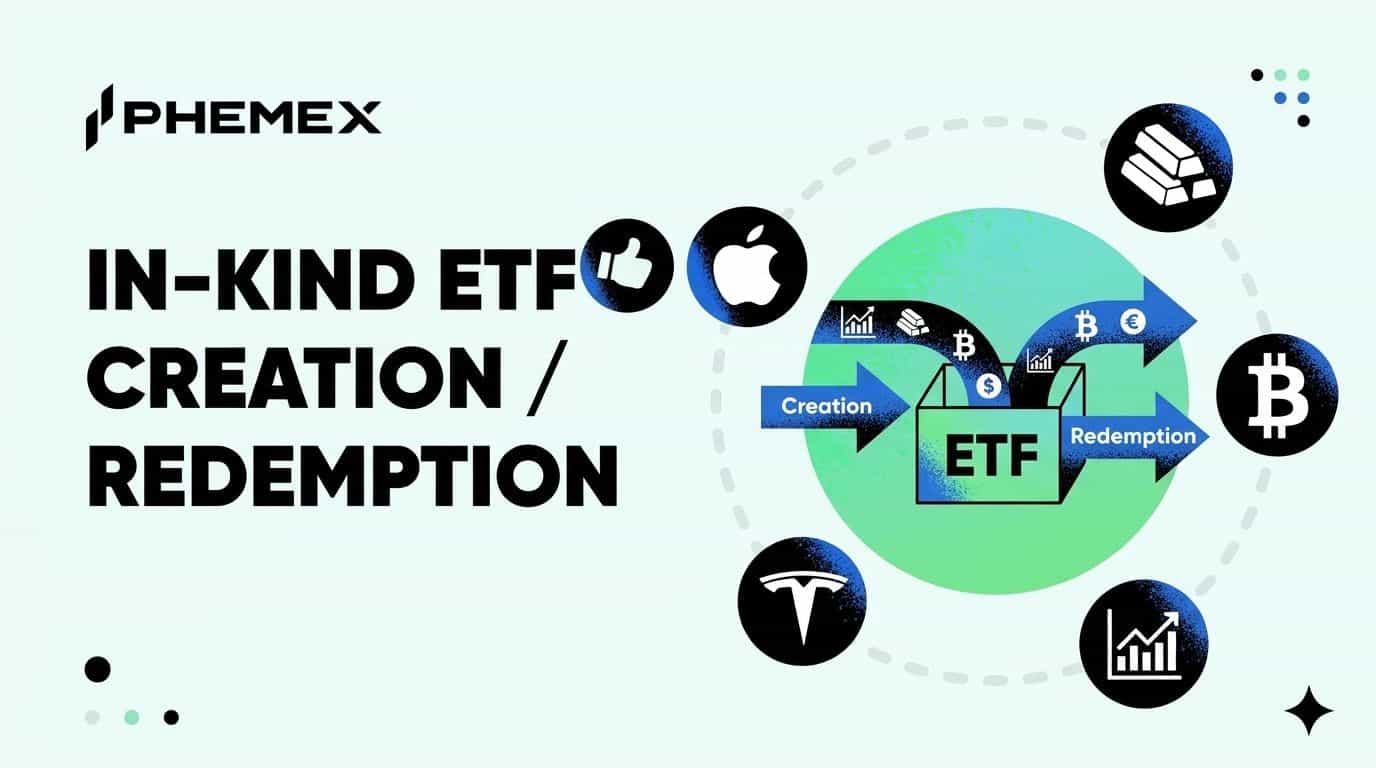
Large institutional players called authorized participants (APs) can create new ETF shares by delivering the underlying assets to the fund, or redeem existing shares by returning them in exchange for the underlying assets. When the ETF price drifts above NAV, APs create new shares to capture the spread, and when it drifts below, they redeem shares to close the gap. This constant arbitrage is what keeps ETF prices tight against net asset value.
For a gold ETF like GLD, this has always worked by moving actual gold bars. An AP delivers gold to the trust and receives ETF shares, with no cash conversion needed, no taxable event triggered, and no slippage from buying and selling on the open market. That is in-kind creation and redemption, and it has been the standard for commodity ETFs since long before crypto existed.
Why Crypto ETFs Were Stuck with Cash-Only Until July 2025
When the SEC approved spot Bitcoin ETFs in January 2024, it imposed a restriction that traditional commodity ETFs never faced. All creations and redemptions had to be conducted in cash. The SEC's reasoning centered on concerns about APs handling Bitcoin directly and anti-money-laundering controls around crypto custody.
In practice, cash-only creation meant a costly multi-step process on every single transaction. To create new IBIT shares, an AP had to sell BTC on the open market for cash, transfer the cash to the fund, and then the fund would buy BTC back. To redeem, the process ran in reverse. Every one of those buy-sell legs introduced market impact, bid-ask spread costs, and a taxable capital gain or loss. For a fund processing billions of dollars in daily flows, the friction compounded fast, and every forced sale of appreciated BTC inside the fund created a potential capital gains distribution for shareholders who never sold a single share.
Cash-Create vs. In-Kind: What Actually Changes
The difference between the two models comes down to how many times the underlying asset changes hands during the creation and redemption process.
|
Feature
|
Cash-Only (Pre-July 2025)
|
In-Kind (Current)
|
|
Creation process
|
AP sells BTC for cash, sends cash to fund, fund buys BTC
|
AP delivers BTC directly to fund
|
|
Redemption process
|
Fund sells BTC for cash, sends cash to AP
|
Fund delivers BTC directly to AP
|
|
Number of BTC transactions
|
2 per creation, 2 per redemption
|
0 market transactions needed
|
|
Taxable event inside the fund
|
Yes, on every creation and redemption
|
No, in-kind transfers are not taxable events
|
|
Market slippage
|
Present on every leg
|
Eliminated
|
|
Tracking to NAV
|
Wider spreads due to conversion friction
|
Tighter arbitrage, compressed spreads
|
|
How traditional commodity ETFs work
|
N/A
|
This is the standard model
|
The takeaway from that table is straightforward. In-kind removes an entire layer of unnecessary transactions from the process. The BTC moves once instead of being sold and rebought, which eliminates slippage, removes taxable events inside the fund, and tightens the link between the ETF price and Bitcoin's actual spot value.
Who Filed and Who Benefits
The SEC's July 29 order (Release No. 34-103571) granted accelerated approval to rule changes from Nasdaq, Cboe BZX, and NYSE Arca, covering products from BlackRock (IBIT and iShares Ethereum Trust), Fidelity, ARK 21Shares, VanEck, and several others.
Four firms were initially named as authorized participants for IBIT's in-kind process, with Jane Street, Virtu Americas, JP Morgan Securities, and Marex now able to swap Bitcoin directly against IBIT shares instead of routing everything through cash. With $70 billion in AUM and daily flows that sometimes moved thousands of BTC in a single day (IBIT added over 25,000 BTC on October 7, 2025 during a massive inflow event), the cost savings from removing the cash conversion layer compound at scale for every spot Bitcoin and Ethereum ETF holder.
The Tax Angle That Most Investors Miss
The tax efficiency of in-kind redemptions is one of the most underappreciated features of the ETF structure, and crypto ETFs were missing it entirely under the cash-only model.
When a traditional ETF redeems shares in-kind, the fund transfers appreciated securities (or in this case, BTC) directly to the authorized participant, and under current tax law, that transfer is not a taxable event for the fund. The fund can offload its highest-cost-basis Bitcoin to the AP during redemptions, keeping the lowest-cost-basis coins in the fund and effectively purging unrealized gains from its books without triggering a tax bill for remaining shareholders.
Under the old cash-only model, the fund had to sell BTC on the open market to generate cash for redemptions, and every sale of appreciated BTC was a taxable event inside the fund. If enough of those gains accumulated, the fund would distribute capital gains to shareholders at year-end, even if those shareholders never sold their own shares. You could hold IBIT for years and still receive a capital gains distribution because the fund was forced to sell BTC to process other people's redemptions.
In-kind redemptions make that scenario far less likely. The mechanism is the same one that has allowed equity ETFs like SPY to go decades without distributing capital gains, and it is now finally available to crypto ETF holders.
What This Means for Crypto ETF Competitiveness
Before in-kind approval, one legitimate argument against holding BTC through an ETF was the added cost layer. You paid the fund's expense ratio (0.25% for IBIT after the fee waiver), plus the hidden costs of cash creation friction, plus potential capital gains distributions. Direct spot holding had none of those beyond the initial trading fee.
In-kind narrows that gap considerably because slippage costs are gone and tax drag is minimized, even though the expense ratio remains. For institutional investors who need regulated custody with audit trails, the ETF wrapper is now competitive with direct holding on an after-tax basis. And for retail investors in IRAs, where you cannot hold spot Bitcoin directly at most brokerages, the ETF is a cleaner vehicle than it was in its first 18 months.
Frequently Asked Questions
What is in-kind ETF creation and redemption?
In-kind means authorized participants deliver or receive the actual underlying asset (like BTC) when creating or redeeming ETF shares, instead of converting to cash first. This is how gold and equity ETFs have always operated. Crypto ETFs were forced to use cash-only until the SEC approved in-kind in July 2025.
Does in-kind redemption make Bitcoin ETFs tax-free?
Not tax-free, but the tax efficiency improvement is significant for long-term holders. In-kind redemptions are not taxable events for the fund, so the fund avoids realizing capital gains when processing redemptions. You still owe taxes when you personally sell your ETF shares at a profit, but you are far less likely to receive unwanted capital gains distributions while holding.
How much do investors save from in-kind versus cash creation?
The savings come from eliminated slippage on buy-sell legs, removed capital gains drag inside the fund, and tighter NAV tracking that reduces the spread you pay when buying or selling. For a fund the size of IBIT processing billions in daily flows, cumulative savings add up to millions of dollars annually across all shareholders.
Which crypto ETFs support in-kind creation and redemption?
The SEC's July 2025 order covers spot Bitcoin and Ethereum ETPs listed on Nasdaq, Cboe BZX, and NYSE Arca. This includes products from BlackRock, Fidelity, ARK 21Shares, VanEck, Grayscale, and others. Future crypto ETPs for newly classified digital commodities like SOL and XRP are expected to launch with in-kind from the start.
Bottom Line
In-kind creation and redemption is not a new invention. It is the standard plumbing that has made ETFs the most tax-efficient fund structure in traditional finance for decades, and what happened in July 2025 was the SEC finally letting crypto ETFs use it.
The practical result is tighter tracking because APs are not buying and selling BTC on the open market to process flows, better tax efficiency because the fund no longer realizes gains on every redemption, and lower overall cost of holding a crypto ETF relative to spot. For anyone already in IBIT, FBTC, or any other spot BTC or ETH fund, this is a structural upgrade that works in the background without you lifting a finger. For anyone comparing ETF vs. direct holding, the cost math just shifted meaningfully in the ETF's favor.
This article is for informational purposes only and does not constitute financial or investment advice. Cryptocurrency trading involves substantial risk. Always conduct your own research before making trading decisions.