Key Takeaways
Fetch.ai has evolved from a single AI-crypto project into a core part of the Artificial Superintelligence (ASI) Alliance, which now includes Fetch.ai, SingularityNET, and CUDOS; the alliance says the merged token still uses the FET ticker for now.
As of May 2026, Fetch.ai’s live product stack is no longer just a white paper story. It includes Agentverse, developer tooling, ASI:One/ASI-1 Mini, and documentation for building autonomous agents and DeFi-oriented agent workflows.
The investment case for FET is tied less to generic “AI hype” and more to whether autonomous agents become genuinely useful in execution, research, on-chain data processing, and DeFi automation.
The biggest opportunity is clear: AI agents could help traders move from manual workflows toward always-on, multi-step systems that gather data, reason, and act. The biggest risk is also clear: most crypto AI-agent narratives still need to prove durable real-world adoption and token value capture.
Price-wise, FET remains a meaningful AI-crypto asset, but it has also repriced sharply from earlier highs; CoinGecko currently places Artificial Superintelligence Alliance (FET) at roughly $0.21–$0.22 with a market cap a little above $500 million.
AI agents have become one of crypto’s biggest narrative shifts. Not long ago, most market participants thought of AI in trading as simple signal tools, chatbots, or quant dashboards. Now the discussion is moving toward something more ambitious: autonomous agents that can gather data, reason across multiple inputs, coordinate with other software agents, and execute actions on-chain or across exchanges with less direct human input.
That shift matters because crypto markets are uniquely suited to agent-based systems. They are global, data-rich, programmable, and always open. In theory, this makes them an ideal environment for AI agents that monitor price, liquidity, sentiment, on-chain data, and market conditions continuously rather than only when a human trader happens to be awake.
Few projects are more directly tied to that thesis than Fetch.ai. The project has long positioned itself around autonomous agents, multi-agent systems, and machine-to-machine coordination. In 2026, that story is broader than ever because Fetch.ai now sits inside the Artificial Superintelligence Alliance, while continuing to push live agent products and developer infrastructure.
So the real question is not just whether FET can rally with the next AI narrative. It is whether Fetch.ai can become part of the actual infrastructure layer for AI agents in crypto trading.
What Fetch.ai Is in 2026
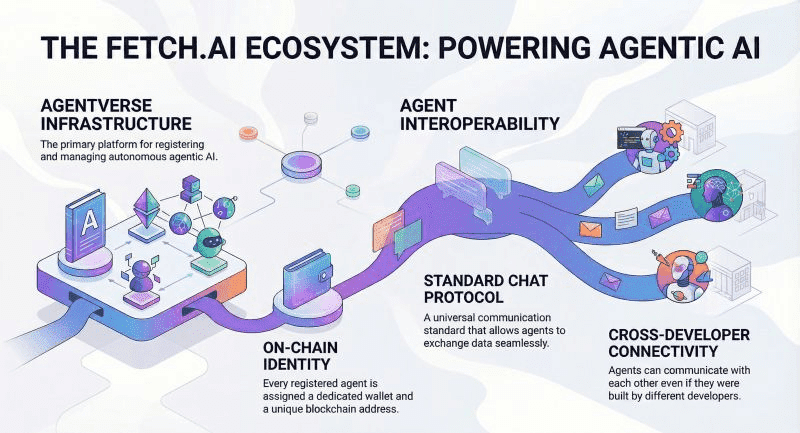
Fetch.ai is no longer best described as just another AI token. Its official site now presents it as a platform for building, deploying, and discovering autonomous agents, while its docs describe a developer platform and agent tooling aimed at brands, SMEs, creators, and builders. Agentverse is positioned as the universal platform for hosting and managing autonomous agents in the cloud.
At the same time, the project’s identity now overlaps with the broader ASI Alliance. The alliance says it was formed by Fetch.ai, SingularityNET, and CUDOS to build decentralized AGI and ASI infrastructure, and that the community-approved tokenomic merger combines AGIX, FET, and CUDOS into a single token still trading as FET.
That matters because the FET token is no longer just a bet on one team shipping one protocol. It is increasingly a bet on a larger decentralized AI ecosystem trying to build open infrastructure across agents, models, compute, and developer tools.
Why Fetch.ai Fits the AI-Agent Trading Narrative So Well
Crypto trading is one of the clearest use cases for AI agents because it naturally breaks down into tasks that software can automate.
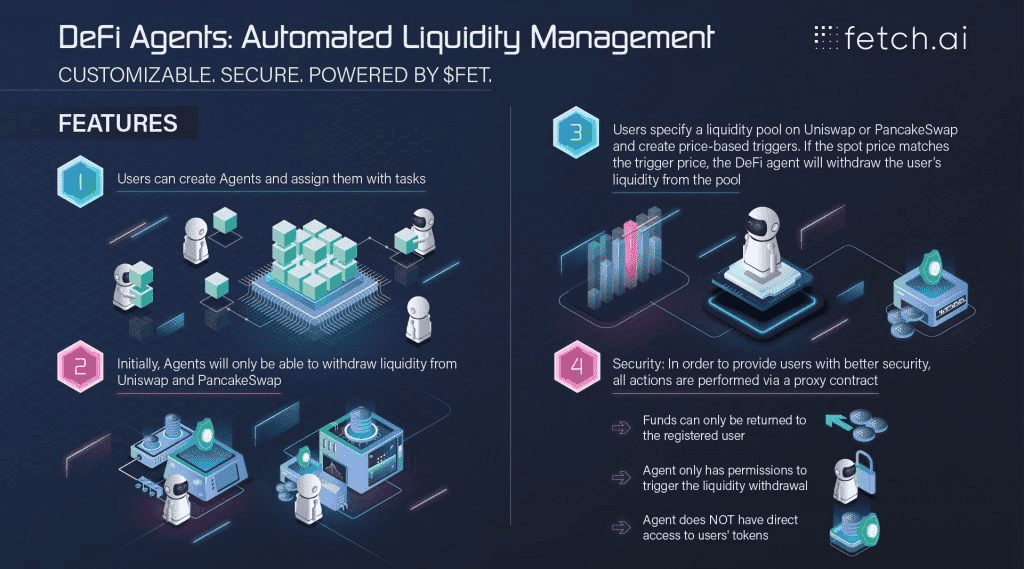
A serious trading workflow involves collecting market data, monitoring on-chain flows, interpreting context, watching liquidity, spotting changes in sentiment, comparing venues, and then deciding whether to route, hedge, rebalance, or stand aside. That is exactly the kind of multi-step workflow where agents can outperform isolated scripts or static dashboards. Fetch.ai’s own materials frame agents as autonomous systems that can make informed decisions, execute tasks efficiently, respond to on-chain events, manage digital assets, and facilitate multi-chain interactions.
This is where Fetch.ai’s long-term positioning looks stronger than many AI-themed tokens. A lot of AI coins rally on branding alone. Fetch.ai, by contrast, has spent years talking specifically about autonomous agents and the coordination layer they need. Even older Fetch.ai materials emphasized multi-agent systems as the core scientific formalism for its blockchain applications.
In other words, if the crypto market really does move toward agentic execution, automated DeFi workflows, and machine-to-machine financial coordination, Fetch.ai is conceptually much closer to that future than projects that merely attach an LLM wrapper to a token narrative.
What Fetch.ai Has Actually Built
The bullish case becomes much more credible when a project has real products.
Fetch.ai’s most visible live platform is Agentverse, which it describes as an open directory and universal platform for deploying and managing agents. The site says millions of agents are discoverable there, while the broader documentation stack gives developers concrete pathways to build and deploy agents rather than just speculate on the token.
The project has also launched ASI-1 Mini, which Fetch.ai calls a Web3-native LLM designed for agentic AI, with adaptive reasoning and context-aware decision-making. Related documentation says ASI:One is aimed at intelligent applications in areas like DeFi and other agent-driven workflows.
Most relevant for traders, Fetch.ai’s Innovation Lab resources already include DeFi-oriented examples. One guide shows a multi-agent DeFi analysis system combining a Fear and Greed Index agent, a coin-info agent, and a coordinating agent using ASI-1 Mini to help drive trading decisions. Another resource explains how on-chain agents can respond to blockchain events, manage assets, and automate workflows across chains.
All this doesn’t mean that Fetch.ai has already won AI trading. But it does mean the project has crossed an important threshold: it has moved beyond abstract vision into a live toolkit for building agent workflows.
Why AI Agents Could Matter So Much in Crypto Trading
The reason AI agents matter is not that they magically predict markets. It is that they can compress and automate complex market workflows.
A human discretionary trader may monitor charts, funding rates, order-book changes, on-chain data, and sentiment manually. An agent-based system can do all of that continuously, then route the result into a decision tree or execution engine. Fetch.ai’s own descriptions emphasize autonomous agents operating in real time, using structured on-chain data and making informed decisions without constant human intervention.
That opens several possible use cases for crypto trading:
always-on market surveillance
multi-source research aggregation
on-chain risk monitoring
execution routing across venues
strategy orchestration between specialized sub-agents
Fetch.ai’s documentation and product materials strongly support this direction, especially in DeFi analysis and agent orchestration.
The deeper implication is that crypto trading may gradually shift from “one trader, one dashboard” toward networks of cooperating agents, each handling a narrower job. If that happens, infrastructure projects like Fetch.ai could become more important than meme-level AI tokens that lack agent tooling altogether.
FET Token Price and Market Context
As of now, Artificial Superintelligence Alliance (FET) sits with a market cap a little above $500 million, and current pricing roughly around the low $0.20s depending on real-time market moves. There are about 2.3 billion FET circulating.
The first is that FET is still a serious mid-cap AI-crypto asset. It has not disappeared, and it remains one of the better-known tokens tied to the AI-agent theme. CoinGecko’s AI Agents category also continues to include Artificial Superintelligence Alliance among the notable tokens in the space.
The second is that the market is no longer giving it peak-cycle valuation by default. FET has already gone through narrative expansion and repricing, which means investors now need stronger evidence of utility and adoption rather than just AI enthusiasm. That is healthier in one sense, because it forces the thesis to become more fundamental.
The Bull Case for FET
The strongest bull case for FET is simple: if AI agents become a real operating layer in crypto, Fetch.ai is one of the most directly aligned projects in the sector.
It already has agent infrastructure, developer docs, a discovery/deployment layer through Agentverse, AI-model initiatives such as ASI-1 Mini, and explicit DeFi/agent examples. That gives it more substance than many tokens whose only AI angle is branding.
The second part of the bull case is ecosystem scale. The ASI Alliance broadens the story beyond Fetch.ai alone and creates a larger umbrella around decentralized AI, open-source infrastructure, and aligned tokenomics. If that alliance succeeds in creating a stronger shared ecosystem, FET benefits as the token currently representing that merged effort.
The third part is timing. Agentic AI has moved from fringe concept to one of tech’s central themes, and crypto is one of the few sectors where autonomous software can not only analyze information but also act economically on-chain. That gives Fetch.ai a rare chance to sit at the intersection of two major narratives: AI agents and programmable finance.
The Bear Case for FET
The bear case is just as important.
First, the AI-agent theme is crowded. Even if Fetch.ai is more credible than many competitors, the market does not guarantee that the most conceptually elegant project captures the most value. Hype can rotate quickly, and technically strong infrastructure can still underperform if adoption remains niche. This is an inference from the current competitive AI-crypto landscape reflected in token-category listings and ecosystem fragmentation.
Second, there is still a difference between building agents and creating token demand. A project can have useful tools and active developers without generating durable value capture for the token. Investors should always separate product excitement from token economics. The ASI materials explain the alliance mission well, but mission alone does not guarantee value accrual.
Third, autonomous trading agents carry obvious risks. They can overfit, misread changing conditions, act on bad data, or create false confidence in fully automated strategies. Fetch.ai’s own materials highlight reasoning and orchestration, but in live markets the challenge is less about demos and more about robustness under stress.
What the Future of AI Agents in Crypto Trading Could Look Like
The long-term opportunity is bigger than just having AI bots picking tradable coins.
A more mature agentic trading system could involve research agents parsing macro news, on-chain agents monitoring flows, execution agents routing orders, risk agents checking exposures, and treasury agents handling collateral and rebalancing. That kind of architecture fits Fetch.ai’s multi-agent logic much better than the old model of one monolithic trading bot.
In that future, the winning platforms may not be the ones with the loudest AI narrative. They may be the ones that make agents easier to build, deploy, coordinate, and trust. That is the strategic lane Fetch.ai is trying to occupy with Agentverse, ASI:One, and its developer stack.
The open question is how quickly that future arrives. Crypto often prices narratives years before the infrastructure is mature enough to justify them. So FET may still face a gap between long-term strategic relevance and near-term market pricing.
Conclusion
Fetch.ai remains one of the clearest pure-play bets on AI agents in crypto. In 2026, that thesis looks more credible than it did a year or two ago because the project now has a broader alliance structure, live products, developer tooling, and explicit examples tied to agentic DeFi and on-chain automation.
That said, investors should stay disciplined. FET is not just an AI narrative trade anymore. It is a bet that autonomous agents become a real part of crypto trading infrastructure, and that Fetch.ai captures meaningful value from that shift. That could happen. It just has not been fully proven yet.
Want more research on AI-agent tokens, crypto trading infrastructure, and where emerging narratives may create real long-term value? Explore Phemex for smart and intuitive crypto trading opportunities.
Register](https://phemex.com/register?group=7916&referralCode=CUFKP8%22>Register) on Phemex Now