
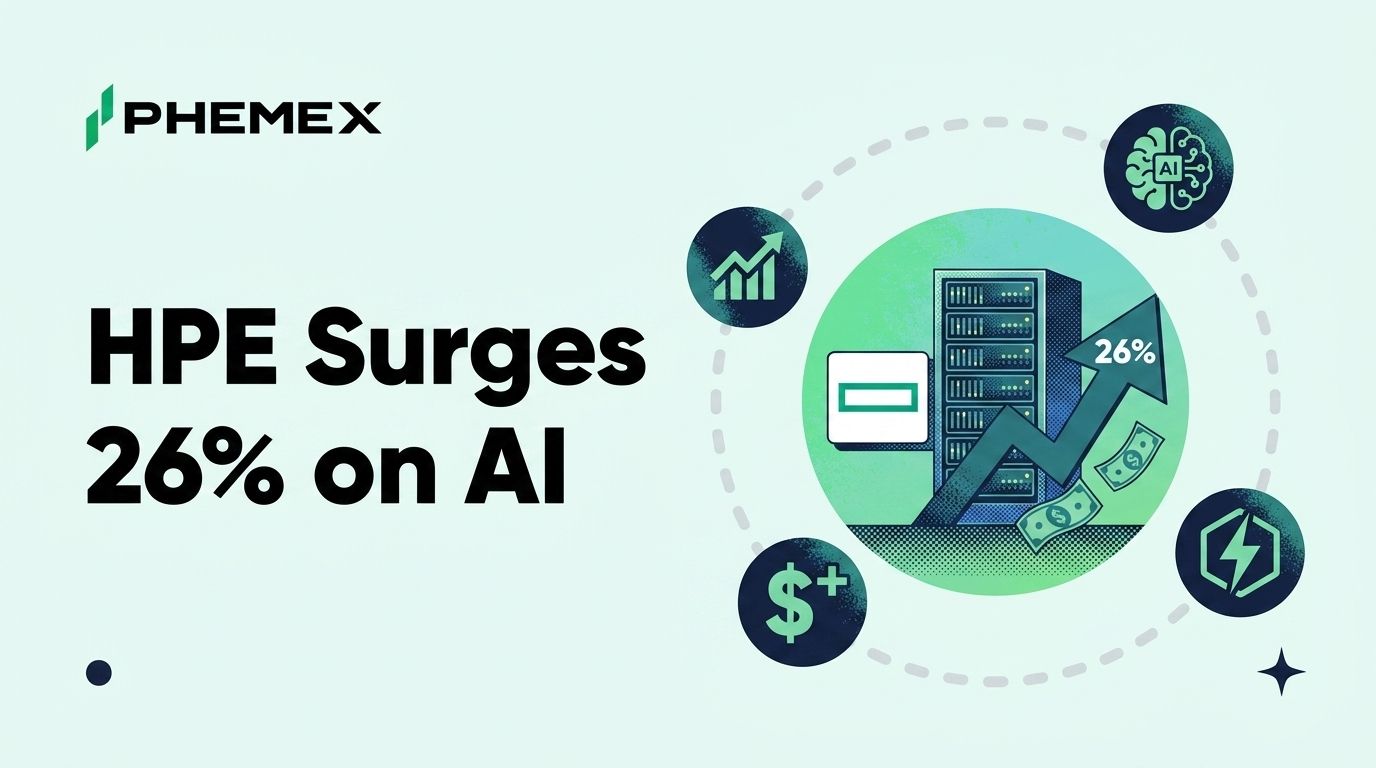
Hewlett Packard Enterprise reported fiscal Q2 2026 earnings after the close on June 1 and the stock surged 26% on June 2 to close at $34.20, the largest single-session move in the company's history as a standalone listing. AI infrastructure revenue climbed 52% year over year, GreenLake annualized recurring revenue crossed $2.1 billion for the first time, and CEO Antonio Neri described the demand environment on the call as "the strongest AI-server backlog we have ever seen." Total revenue beat the consensus by 8.4% and operating margin expanded 220 basis points. Free cash flow guidance for the second half was raised by 31%.
The print landed alongside Jensen Huang's Computex keynote naming Marvell the next trillion-dollar AI company, and the two signals together moved the entire AI infrastructure complex meaningfully higher on the session. Here is what HPE actually builds, why this quarter matters more than prior beats, and what the GreenLake structure says about the durability of the AI cycle.
What HPE Actually Builds
HPE is the enterprise hardware and hybrid cloud business that split from HP Inc in 2015. The product portfolio has four core lines that matter for the AI thesis. The first is the server business, which includes the ProLiant general-purpose servers and the Cray-branded AI training clusters acquired in 2019. The Cray business is the line that captures the AI infrastructure revenue growth that drove this quarter's beat. HPE sells direct to enterprises and to the second-tier hyperscalers that buy off-the-shelf hardware rather than designing custom.
The second line is Aruba networking. Aruba provides the enterprise switching and wireless infrastructure that lives alongside HPE servers in enterprise data centers and increasingly in AI cluster builds. The Aruba revenue line has lower growth than the AI-server line but materially higher recurring margin.
The third line is GreenLake. GreenLake is the recurring revenue hybrid cloud product, structured as consumption-priced on-premise infrastructure that customers pay for monthly rather than capex. The product launched in 2018 and was deliberately positioned by Neri as the structural pivot away from cyclical hardware sales. The ARR crossing $2.1 billion this quarter is the milestone that confirms the pivot is working.
The fourth line is the Juniper Networks acquisition that closed in 2025 for $14 billion. Juniper added the AI-Native Networking Platform, the Mist AI-driven network operations product, and a meaningful service provider customer base. The integration is still in the early innings, but the cross-sell opportunity between Aruba enterprise customers and Juniper service provider customers is the strategic logic. For the broader AI-agent thesis and how onchain agents intersect with the enterprise AI infrastructure HPE sells, the Phemex academy guide walks through the supply-chain layer. The DeFi primer covers the onchain consumption layer that will eventually become a buyer of the same hyperscale compute.
Why This Quarter Matters More Than Prior Beats
HPE has beaten consensus in seven of the past eight quarters. The pattern of small beats followed by guidance raises has driven a steady share price uptrend without producing the kind of vertical move that this Q2 print produced. The reason this quarter is different is the composition of the beat rather than the size.
The AI infrastructure revenue line specifically grew 52% year over year, which is the fastest growth rate of any product line in the company's history. The line accounted for over 38% of incremental revenue dollars in the quarter, which is the first time AI has been the dominant single-line contribution to growth. The backlog disclosed on the call was over $4.6 billion in AI-server orders, which represents more than three quarters of forward demand visibility at the current run rate. That is structurally different from a hardware business that historically had three to six week order visibility.
The GreenLake ARR crossing $2.1 billion is the second structural signal. Recurring revenue at that scale on a $40 billion annual revenue business represents a real shift in the operating model. Recurring revenue carries higher gross margin and lower customer churn, which compresses the operating cyclicality that has historically gated HPE's multiple.
How HPE's Structure Differs From Dell and Cisco
The closest competitive comparisons are Dell Technologies in the server line and Cisco in the networking line. The structural difference that the bull case rests on is the GreenLake model. Dell has a similar consumption product called Apex but at materially smaller scale, and Dell's revenue mix is still 80%-plus traditional capex hardware. Cisco has structurally higher recurring revenue than HPE on the networking side but does not have a comparable server business in AI.
The competitive position that HPE has carved out is being the enterprise alternative for customers who do not want to buy directly from the hyperscaler cloud providers but do want consumption pricing. That positioning has hit two consecutive tailwinds in 2025 and 2026. The first is the enterprise AI buildout, where Fortune 1000 customers are deploying GPU clusters on-premise rather than in the public cloud. The second is the geopolitical sovereignty push, where European and Asian customers want infrastructure that is not US-hyperscaler-dependent.
The Juniper acquisition is the bet that the networking side of the AI cluster spend is the next leg. AI training fabrics require specialized switching and optical interconnect, and Juniper's installed base in the service provider segment provides a faster on-ramp than building it organically.
What the AI Capex Cycle Now Looks Like
The combination of the HPE print, the Marvell endorsement at Computex, and the most recent NVDA earnings call commentary points to a structural extension of the AI capital expenditure cycle. The bear case for AI semis through 2025 was that hyperscaler capex would normalize in 2027 as first-wave training capacity was absorbed. The combined data through Q2 2026 says the second wave is already being built.
The enterprise AI line that HPE captures is structurally different from the hyperscaler line that NVDA captures directly. Enterprise AI deployments are smaller per cluster but more numerous, which extends the cycle in time even if the dollar concentration remains in hyperscalers. The second-tier cloud providers and the European sovereign cloud builds also use HPE-style off-the-shelf hardware rather than custom hyperscaler designs, which creates a durable secondary market for the enterprise hardware vendors.
HPE stock is not currently tokenized on Phemex. Traders looking for tokenized AI infrastructure exposure use NVDA for the GPU line, AVGO for the custom silicon angle, and AMD for the alternative accelerator angle. AAPL and MSFT also capture the consumer and hyperscaler end of the same AI capex story.
What the Print Signals for the Broader Tape
The 26% HPE move and the 21% Marvell move on the same session is the strongest single-day reaction the AI infrastructure basket has produced in 2026. The complex move included NVDA up 4.2%, AVGO up 3.8%, AMD up 2.9%, and the broader semiconductor index up 2.4%. The reaction confirms that positioning into June was defensive and that the bid for AI infrastructure exposure is intact when the data delivers.
For traders running crypto books alongside cash equities, the AI infrastructure tape is the most reliable risk-on signal that still holds correlation with BTC and ETH over 5-day rolling windows. AI semi strength has led BTC by two to five sessions through most of the past 18 months. The relationship has been disrupted in the past three weeks by the Bitcoin ETF outflow story, but a sustained AI rerating into June and July would create the tailwind needed for crypto risk to absorb the ETF supply.
The next data points to watch are the Q2 earnings prints from the rest of the AI infrastructure complex. Marvell reports late June, NVDA reports late August, and Dell reports late June. Confirmation across those three prints would extend the cycle thesis materially.
Frequently Asked Questions
Why did HPE stock surge 26% on June 2?
Fiscal Q2 2026 earnings beat consensus by 8.4% on revenue, AI infrastructure revenue grew 52% year over year, GreenLake annualized recurring revenue crossed $2.1 billion for the first time, and the AI-server backlog disclosed on the call exceeded $4.6 billion. Free cash flow guidance for the second half was raised by 31%.
What is HPE GreenLake and why does it matter?
GreenLake is HPE's consumption-priced hybrid cloud product, structured as on-premise infrastructure paid monthly rather than purchased capex. The product is the structural pivot from cyclical hardware sales to recurring revenue. ARR crossing $2.1 billion represents a real shift in the operating model and compresses the multi-cycle volatility that has historically gated HPE's multiple.
How does the HPE print compare to the broader AI capex cycle?
The HPE AI-server backlog of $4.6 billion plus the Marvell endorsement at Computex 2026 plus the most recent NVDA commentary together point to a structural extension of the AI capex cycle through 2027 and beyond. The enterprise AI deployments HPE captures are smaller per cluster than hyperscaler builds but more numerous, which extends the cycle in time.
Is HPE stock tokenized on Phemex?
HPE is not currently in the 22-ticker tokenized stock list on Phemex. Traders looking for tokenized AI infrastructure exposure use NVDA for the GPU angle, AVGO for the Broadcom custom silicon angle, AMD for the alternative accelerator angle, or MSFT for the hyperscaler end of the same capex story.
Bottom Line
The HPE quarter is the cleanest data point yet that the AI capital expenditure cycle is extending rather than peaking. The composition of the beat matters more than the size. AI infrastructure revenue growing 52% year over year and contributing the dominant share of incremental revenue means HPE is now a structural AI play rather than a cyclical hardware vendor. GreenLake at $2.1 billion ARR compresses the operating cyclicality that historically gated the multiple.
Watch the rest of the AI infrastructure earnings complex over June and August. Marvell, Dell, and NVDA prints in sequence either confirm or break the structural cycle thesis. For tokenized stock traders on Phemex, the cleanest expressions of the same thesis remain NVDA, AVGO, AMD, and AAPL. HPE itself is not yet tokenized, but the print is the proof of concept the bulls have been waiting for.
This article is for informational purposes only and does not constitute financial or investment advice. Cryptocurrency trading involves substantial risk. Always conduct your own research before making trading decisions.