

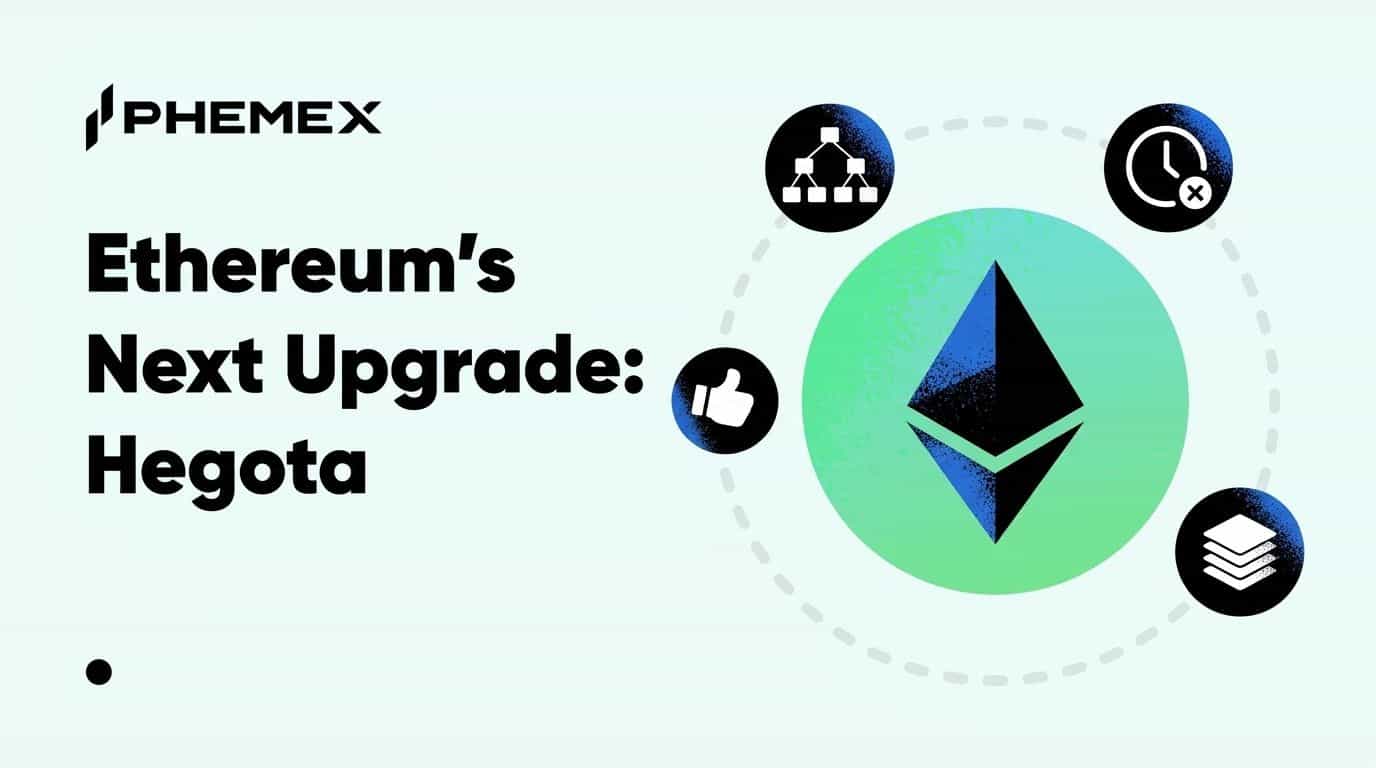
Ethereum core developers have pinned the Hegota hard fork to the second half of 2026, making it the network's second major upgrade this year after Glamsterdam ships in H1. The headline feature is Verkle Trees, a data structure swap that could slash the storage burden on node operators by roughly 90% and open the door to stateless clients for the first time in Ethereum's history. With ETH trading around $2,160 and over 37 million ETH locked in staking, the network is betting that making validation cheaper and censorship harder will matter more than any short-term price catalyst.
This article breaks down what Hegota actually changes under the hood, why Verkle Trees are the upgrade the roadmap has been building toward for years, and what it all means if you hold or trade ETH.
Where Hegota Fits on the Ethereum Roadmap
The name follows Ethereum's naming convention of combining a Devcon host city with a star. "Hegota" blends Bogota (the execution layer upgrade name) with Heze (the consensus layer name). It sits directly after Glamsterdam on the Ethereum Foundation's 2026 protocol priorities, which organize development into three tracks. Scale focuses on throughput and cost reduction, Improve UX targets account abstraction and wallet-level improvements, and Harden L1 addresses censorship resistance and validator decentralization.
Glamsterdam handles the execution side. It introduces parallel transaction processing, on-chain block building through Enshrined Proposer Builder Separation, and pushes the gas limit from 60 million toward 200 million per block. That fork is fundamentally about raw speed and capacity.
Hegota picks up everything Glamsterdam leaves behind, primarily storage efficiency, state management, and censorship-resistance guarantees. Think of it this way. Glamsterdam widens the highway so more cars can drive at once. Hegota redesigns the toll booths so you no longer need a warehouse full of records to operate one.
What Are Verkle Trees and Why Do They Matter?
This is the centerpiece of Hegota, and it is worth understanding properly because it has been on Ethereum's wish list since 2020.
Right now, Ethereum uses Merkle Patricia Trees to organize and verify all the data that nodes store. Every account balance, every smart contract state variable, every piece of storage lives in this tree structure. When a node needs to prove that a particular piece of data is correct, it generates a "proof" by walking through all the branches between the root of the tree and the specific data point. The problem is that these proofs are enormous. A single state proof in Ethereum's current system can be several kilobytes, and nodes need to store the entire state tree locally to generate them.
Verkle Trees use a different mathematical approach. Instead of hashing pairs of data together at each branch (like Merkle Trees do), Verkle Trees use polynomial commitments that can verify much wider branches in a single proof. Imagine the difference between a filing cabinet where you need to open every drawer in sequence to find one document, versus a system where you can point at any drawer from across the room and confirm its contents without touching it. That is roughly what Verkle Trees do for Ethereum state verification.
The practical result is a roughly 90% reduction in the size of state proofs. And that reduction is what enables stateless clients.
Stateless Clients: The Real Prize
A stateless client is a node that can validate new blocks without storing the full Ethereum state locally. Today, running an Ethereum node means downloading and maintaining over 1 terabyte of state data, and that number grows every month. This is one reason the validator set has concentrated around well-capitalized operators and staking services like Lido and Coinbase, even though the protocol is technically open to anyone with 32 ETH.
With Verkle Trees, block proposers would attach compact proofs to each block. A receiving node could verify the block's validity using just those proofs, without needing the full state database sitting on its hard drive. New validators could spin up in minutes instead of spending hours or days syncing.
The validator entry queue tells the story of demand. As of March 2026, over 1.1 million active validators secure Ethereum, and the entry queue has surged to approximately 60 days at times, one of the longest waits since the Merge. Stateless clients would not fix the queue directly (that is a protocol-level rate limit), but they would dramatically lower the hardware barrier to entry. A laptop with a decent internet connection could realistically validate Ethereum. That is a meaningful shift toward decentralization that goes beyond theoretical design and into everyday reality.
FOCIL: Hardwiring Censorship Resistance
Verkle Trees get the most attention, but FOCIL (Fork-Choice Enforced Inclusion Lists) under EIP-7805 is arguably just as important for Ethereum's long-term credibility.
The problem FOCIL solves is transaction censorship at the block production level. Today, the majority of Ethereum blocks are built by a small number of MEV (Maximal Extractable Value) relay operators. These builders can technically exclude certain transactions from blocks, and they have financial incentives to reorder or front-run others. OFAC compliance pressure after the Tornado Cash sanctions in 2022 showed that a significant percentage of blocks were filtering out sanctioned addresses.
FOCIL changes the game by selecting 17 participants at random per slot (including the block proposer) who can enforce that specific pending transactions get written into blocks. If a builder tries to exclude a valid transaction that an includer has flagged, the block gets rejected. It does not eliminate MEV entirely, but it makes outright censorship structurally difficult rather than relying on social norms.
Vitalik Buterin has described FOCIL and EIP-8141 (native smart accounts) as the two core pillars of Hegota's consensus-layer changes.
Smart Accounts and Account Abstraction
EIP-8141 builds on the account abstraction work from EIP-4337. The goal is to make smart contract wallets first-class citizens on Ethereum, meaning they can initiate transactions natively without needing a separate externally owned account (EOA) to pay gas.
What does this mean in plain English? Your wallet could support multisignature authorization, automatic key rotation, gas sponsorship (someone else pays your transaction fees), and eventually quantum-resistant signatures, all at the protocol level rather than through workarounds. Buterin has said native smart accounts could arrive within a year through Hegota, which would represent the most significant wallet-level improvement since Ethereum launched.
For traders, gas sponsorship alone changes the onboarding equation. New users could interact with DeFi protocols without needing ETH in their wallet first. Protocols could absorb gas costs as a user acquisition strategy, similar to how apps cover server costs today.
What Hegota Means for ETH Holders and Traders
The staking math is straightforward. Approximately 37.2 million ETH is currently staked at a yield of around 2.86% APR. If Hegota successfully lowers the cost of running a validator, more independent operators enter the set, which could put mild downward pressure on yields but increases the network's security and decentralization profile. For institutional allocators, that trade-off matters because it reduces concentration risk.
|
Feature
|
What It Changes
|
Who Benefits
|
|
Verkle Trees
|
~90% smaller state proofs
|
Node operators, solo validators
|
|
Stateless clients
|
No full state download needed
|
New validators, decentralization
|
|
FOCIL (EIP-7805)
|
Censorship-resistant block production
|
All users, DeFi protocols
|
|
Smart accounts (EIP-8141)
|
Native wallet abstraction
|
Retail users, dApp developers
|
The market tends to price Ethereum upgrades reactively rather than in advance. The Merge in 2022 saw a "buy the rumor, sell the news" pattern, and Pectra in 2025 followed a similar script. Hegota is still 6-9 months out, which means the technical fundamentals it improves will likely matter more than any speculative pump around the fork date itself.
Timeline and What Could Go Wrong
Ethereum developers are targeting late 2026, but the EIP list is not fully frozen yet. The Ethereum Foundation aims to maintain a twice-a-year upgrade cadence (Glamsterdam in H1, Hegota in H2), but Verkle Trees are technically complex and have been delayed before. The transition from Merkle Patricia Trees to Verkle Trees requires a state migration that touches every account and contract on the network.
If Glamsterdam ships cleanly and on time, Hegota's odds improve substantially. If Glamsterdam encounters delays on devnets (currently on Devnet-5 testing), Hegota could slip into early 2027. Ethereum has a history of optimistic timelines, and the Merge is the clearest example, originally expected in 2019 but not shipping until September 2022.
The honest assessment is that the features are well-defined and have broad developer consensus, but the implementation timeline carries real uncertainty. Anyone trading around the fork date should watch testnet progress rather than calendar dates.
Frequently Asked Questions
When is the Ethereum Hegota upgrade expected?
Core developers are targeting the second half of 2026, likely Q4, following the Glamsterdam fork in H1. The exact date depends on testnet validation and on the Verkle Trees state migration passing all security audits. A slip into early 2027 is possible if Glamsterdam itself runs late.
What are Verkle Trees in simple terms?
Verkle Trees are a new way for Ethereum to organize and verify data that makes proofs about 90% smaller than the current Merkle Patricia Tree system. Smaller proofs mean nodes can validate blocks without storing the entire network's state, which makes running a validator dramatically cheaper and faster to set up.
Will Hegota affect ETH staking rewards?
Not directly through a protocol change to rewards, but indirectly yes. If stateless clients lower the barrier to running a validator, more operators could enter the staking set over time, which would gradually compress yields from the current ~2.86% APR. The trade-off is a more decentralized and secure network.
What is FOCIL and why is it part of Hegota?
FOCIL stands for Fork-Choice Enforced Inclusion Lists (EIP-7805). It randomly selects 17 participants per block slot who can force specific transactions to be included, preventing block builders from censoring valid transactions. It is Ethereum's answer to the censorship concerns that emerged after the Tornado Cash sanctions showed how easily block builders could filter transactions.
Bottom Line
Hegota is not a performance upgrade, because Glamsterdam already handles that with parallel execution and a gas limit increase to 200 million. Instead, Hegota is an infrastructure upgrade that changes who can participate in securing Ethereum and how resistant the network is to censorship at the block production level. Verkle Trees and stateless clients target the cost of running a validator, while FOCIL targets the integrity of what goes into blocks. If both ship as designed, Ethereum in early 2027 looks structurally different from the network that exists today, not faster, but harder to censor and cheaper to verify independently. For ETH holders, the upgrade worth watching is not the one that makes the chain faster but the one that makes the chain harder to capture.
This article is for informational purposes only and does not constitute financial or investment advice. Cryptocurrency trading involves substantial risk. Always conduct your own research before making trading decisions.