

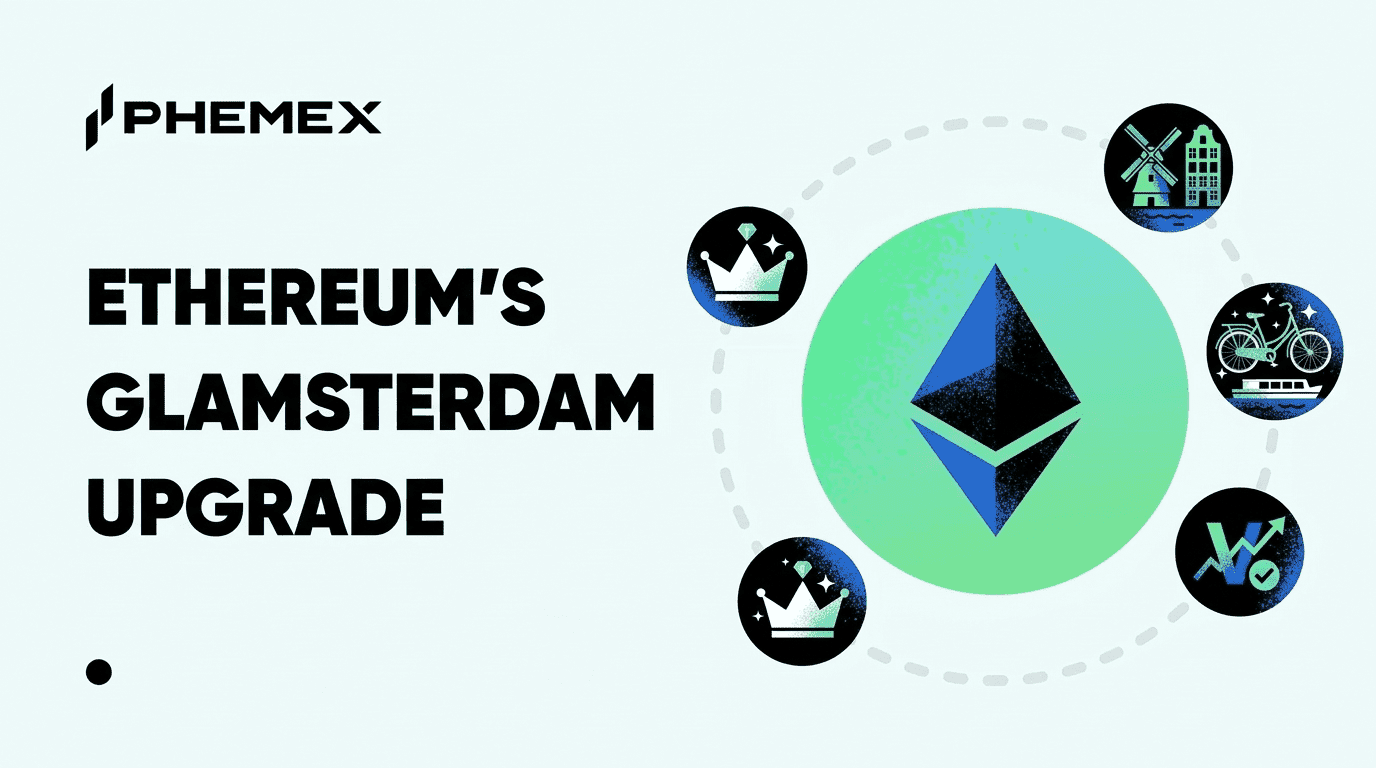
Ethereum is getting its most ambitious upgrade since The Merge, and almost nobody outside the developer community is talking about it yet. Glamsterdam, the next hard fork scheduled for H1 2026, introduces parallel transaction processing, on-chain block building, and a 78.6% reduction in gas fees across both simple transfers and complex smart contract calls. Vitalik Buterin outlined 8 Ethereum Improvement Proposals in late February that define the upgrade's scope, with the gas limit rising from 60 million to 200 million per block and throughput targeting 10,000 transactions per second, roughly 10 times what Ethereum handles today.
All of this is happening while ETH trades near $1,920, down over 45% from its October 2025 high above $3,600. Approximately 37 million ETH (30.6% of circulating supply) is now locked in staking, with over 3 million more waiting in the validator entry queue. BlackRock's existing Ethereum ETF (ETHA) holds roughly $11 billion in ETH, and the firm has filed for ETHB, a staked ETH ETF that would distribute yield to shareholders, with a final SEC decision expected by late March 2026. The disconnect between what Ethereum is building and where the price sits right now is exactly the kind of gap that traders should understand before the market reprices it.
What Is Glamsterdam?
Glamsterdam is Ethereum's next hard fork, following the successful rollouts of Pectra and Fusaka in 2025. It's scheduled for the first half of 2026, with a tentative target around June, though developers have stressed this remains dependent on testnet validation. The Ethereum Foundation's DevOps team has already tested three of the proposed EIPs on Devnet-4 and is currently transitioning to Devnet-5.
The upgrade is built around two "headliner" EIPs that received top priority: EIP-7732 (Enshrined Proposer-Builder Separation) on the consensus layer and EIP-7928 (Block-Level Access Lists) on the execution layer. Together with gas repricing and several smaller proposals, they represent the biggest changes to how Ethereum processes transactions since the chain moved to proof of stake. Here's what each one actually does, in terms that matter for traders rather than developers.
Enshrined Proposer-Builder Separation (ePBS)
Right now, Ethereum's block production relies on external relays operated by companies like Flashbots. Validators propose blocks, but the actual construction of those blocks (deciding which transactions to include and in what order) happens off-chain through third-party software. That arrangement works, but it concentrates power in a small number of relay operators and creates a dependency on trust in those intermediaries.
EIP-7732 moves this entire process on-chain. Under ePBS, the proposer and builder roles are formally separated at the protocol level, with the proposer committing to a block header and a separate builder constructing the execution payload. No external relay needed, no trust in third parties. The block-building logic becomes part of Ethereum itself.
For traders, the most tangible impact is on MEV (maximal extractable value), the profit that block builders extract by reordering, inserting, or front-running transactions within a block. If you've ever had a DEX trade execute at a worse price than expected, or watched a liquidation get front-run on Aave or Compound, you've experienced MEV firsthand. Researchers estimate that ePBS could reduce MEV extraction by up to 70%, which translates to fairer execution for anyone trading, borrowing, or providing liquidity on Ethereum's base layer.
The second-order effect matters even more for the long-term thesis. When block building is distributed across the protocol rather than concentrated in a few relay operators, it becomes significantly harder for any entity to censor specific transactions. That's a structural improvement to Ethereum's value proposition as neutral, permissionless infrastructure.
Parallel Transaction Processing (Block Access Lists)
This is the performance upgrade that puts Ethereum in direct competition with Solana and other high-throughput chains at the L1 level.
Today, Ethereum processes transactions sequentially, one after another, like a single-core computer working through a task list. EIP-7928 introduces Block-Level Access Lists (BALs), which pre-declare the accounts and smart contracts each block will interact with. When the network knows in advance that two transactions touch completely different parts of the state (say, one is a Uniswap swap and the other is an Aave deposit into a separate pool), it can process them simultaneously rather than waiting for one to finish before starting the other.
Think of it as Ethereum moving from a single-lane road to a multi-lane highway. The gas limit increase from 60 million to 200 million per block provides the raw capacity, while BALs provide the intelligence to use that capacity efficiently. Together, they target a throughput of approximately 10,000 TPS, up from the current effective rate of roughly 1,000 TPS on the base layer.
This is Phase 1 of parallel processing, not the final form. Future upgrades will expand the scope of parallelism as client implementations mature and the network accumulates operational data on how BALs perform under real-world load.
Gas Fees Drop 78.6%
Glamsterdam introduces gas repricing through EIP-7904, which realigns gas costs with the actual computational resources each operation consumes. Many current gas prices were set years ago and no longer reflect execution costs on modern hardware, so the recalibration results in a 78.6% reduction for both simple ETH transfers and complex smart contract interactions.
Combined with the tripled gas limit, this creates dramatically cheaper on-chain activity. A Uniswap trade that currently costs $3-8 in gas could drop below $1, and complex DeFi operations involving multiple contract calls would see proportionally larger savings.
The upgrade also decouples state creation from execution gas, a technical change with major practical consequences. Until now, deploying a new contract or opening a new storage slot consumed the same type of gas as running computations, which meant that scaling compute capacity inevitably bloated Ethereum's state. By separating these costs, the network can process more transactions without proportionally growing the state database, addressing one of its longest-running scalability constraints.
Why This Matters for ETH's Price
Ethereum upgrades have a well-documented relationship with price action. Before The Merge in September 2022, ETH rallied over 100% from its June lows before dropping 15% after activation in a classic "buy the rumor, sell the news" event. The Shapella upgrade in April 2023 defied that pattern entirely, rallying 10% post-activation as the market valued the de-risking of staking withdrawals over the feared $34 billion sell-side pressure. Dencun in early 2024 followed yet another path, with ETH gaining 60% in the months leading into the fork.
Glamsterdam's price thesis connects three mechanisms that reinforce each other.
The most direct channel runs through Ethereum's fee burn. Every transaction destroys a base fee via EIP-1559, but when gas is expensive, fewer transactions happen and the burn rate stays low. A 78.6% fee reduction should meaningfully increase on-chain activity as positions that were previously too expensive to manage (small DeFi allocations, frequent rebalancing, microtransactions) become viable again. More transactions at lower per-unit cost can actually generate more total burn than fewer transactions at higher cost, especially once throughput scales to 10,000 TPS. That dynamic strengthens the deflationary case for ETH.
The competitive narrative shifts as well. One of the dominant arguments driving capital away from ETH since mid-2025 has been that Solana offers comparable DeFi functionality with much higher speed and much lower cost. At 10,000 TPS with sub-dollar gas fees, that argument weakens considerably. Ethereum would retain its advantages in security ($70 billion+ in validator collateral with 30% of supply staked), decentralization (over 1 million validators), and ecosystem depth (the largest DeFi TVL by far) while closing the speed and cost gap that Solana bulls have exploited.
Then there's the L2-to-L1 migration potential. Chains like Arbitrum, Optimism, and Base captured users partly because L1 gas was too expensive and partly because MEV on L1 punished retail traders. If Glamsterdam cuts gas by 78% and MEV by up to 70%, some of that activity could flow back to Ethereum's base layer, which carries a higher security guarantee than any rollup. More base layer activity means more direct value accrual to ETH holders through fee burns and staking rewards.
The Risk Side
None of this is guaranteed to play out on schedule or as designed.
Ethereum has a history of delaying major upgrades, with The Merge itself pushed back multiple times over several years. The recent on-time delivery of Pectra and Fusaka suggests the foundation has improved its execution cadence, but Glamsterdam's scope is larger and the interplay between ePBS and BALs introduces complexity that hasn't been tested at mainnet scale. The tentative June 2026 target could realistically slip to Q3 or Q4.
Scope creep is a related concern. Over 25 non-headliner EIPs are under consideration for inclusion, and the Base engineering team has publicly warned that adding FOCIL (Fork-Choice Inclusion Lists) alongside ePBS could delay the upgrade beyond 2026. Keeping the scope focused on the two headliners is critical for timeline adherence, but the pull of additional features is constant in open-source development.
The "sell the news" risk is real and historically supported. Even if ETH rallies into the upgrade (as it has before previous forks), the activation itself could trigger profit-taking that pushes the price down 10-15% in the days following launch, based on the precedent from The Merge.
Finally, the broader macro environment overrides any single upgrade. ETH is trading at $1,920 in a bear market with oil above $90, a weakening labor market, and no Fed rate cuts in sight. A technical upgrade cannot single-handedly reverse a macro-driven drawdown. Glamsterdam strengthens the medium-to-long-term case for ETH, but it won't necessarily produce short-term price appreciation if the macro headwinds persist.
What Comes After Glamsterdam
The Ethereum Foundation has adopted a biannual upgrade cadence following the successful 2025 fork deliveries. Hegotá, tentatively scheduled for H2 2026, introduces Verkle Trees, which replace Ethereum's current data structure and cut node storage requirements by approximately 90%. That reduction would enable "stateless clients" where new nodes can join the network and begin validating without downloading the full state history, dramatically lowering the barrier to running a full node.
Glamsterdam and Hegotá are designed as complementary halves of the same vision. Glamsterdam handles execution (faster processing, cheaper gas, decentralized block building) while Hegotá addresses storage and state management. Together, they form Ethereum's most comprehensive year of infrastructure development since the transition from proof of work.
FAQ
When exactly does Glamsterdam launch?
The target is H1 2026, with June referenced as an aspirational date in community documentation. Devnet testing is underway and public testnets with dual audit phases are planned for spring. Developers have been clear that hitting the date is secondary to getting the upgrade right, so some delay into Q3 remains possible.
Will Glamsterdam make Ethereum faster than Solana?
At 10,000 TPS, Ethereum would match Solana's effective throughput in real-world usage, since Solana's theoretical maximum is much higher but actual sustained throughput under load typically falls in the 3,000-5,000 TPS range. The comparison is imperfect because the two chains make different architectural tradeoffs, but Glamsterdam closes the speed gap meaningfully while Ethereum retains its security and ecosystem advantages.
Should I buy ETH before the upgrade?
Historically, ETH has rallied in the 60 days leading into major hard forks, but the current bear market and macro headwinds complicate the pattern. The strongest risk-reward entry would come if ETH retests the $1,750-$1,800 support zone while upgrade testnet milestones keep hitting on schedule. A reclaim of $2,000 with sustained volume would be the first signal of a potential trend reversal.
What happens if Glamsterdam gets delayed?
A push to Q3 or Q4 2026 would likely trigger a short-term selloff as the market reprices the timeline. But the underlying improvements would still be coming, and any delay-driven dip could represent a buying opportunity for longer-term holders who care about the destination more than the departure time.
Bottom Line
Glamsterdam is the strongest technical argument for Ethereum in over a year, landing at a time when ETH sits at its most beaten-down level since early 2023. The upgrade addresses the network's three most persistent criticisms in one package: gas fees are too high (78.6% reduction), throughput is too slow (10x increase to 10,000 TPS), and block building is too centralized (ePBS moves it on-chain with up to 70% less MEV extraction).
The timing creates an interesting asymmetry. If the upgrade ships on schedule and the macro environment stabilizes, ETH has a credible path to repricing significantly higher as lower fees generate more activity, more EIP-1559 burns, and a stronger deflationary case. If the upgrade gets delayed or the macro worsens, ETH is already trading at historically oversold levels with 30% of supply locked in staking and BlackRock actively building yield-generating ETF infrastructure around it. The downside from here is painful but bounded by structural demand, while the upside, if Glamsterdam delivers on its promises, remains significantly larger than what the market is currently pricing in.
Disclaimer: This article is for informational purposes only and does not constitute financial advice. Cryptocurrency investments carry significant risk. Always conduct your own research before making investment decisions.