




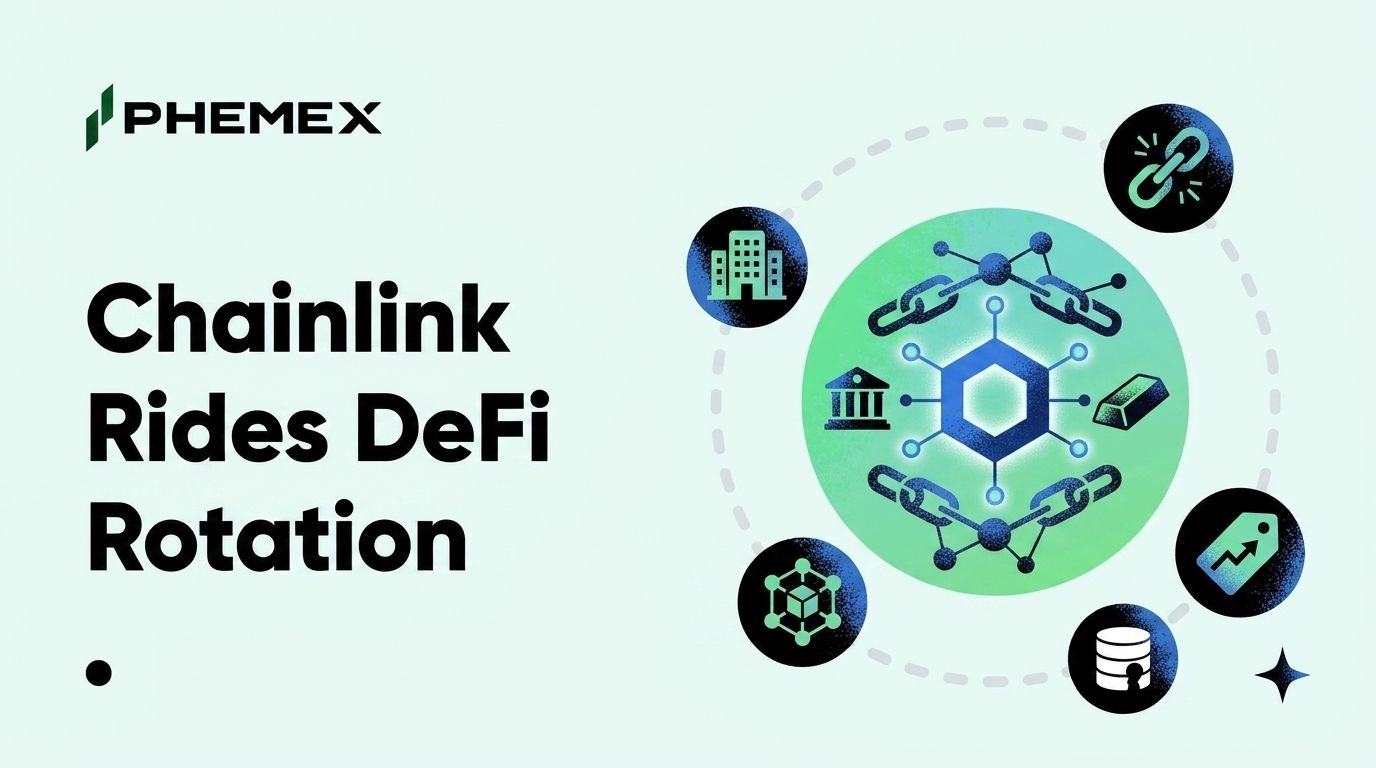
Chainlink trades at $8.34, up 2.03% on the day, and it is not moving on its own. The whole DeFi and real-world-asset complex caught a bid this week as a risk-on rally, fed by the Iran truce and record crypto sentiment, pushed capital back toward the lending and oracle protocols that anchor the sector. AAVE ran 5.15% into its V4 launch, and LINK is climbing alongside it as the infrastructure layer most of those protocols quietly depend on.
- LINK price: $8.34
- 24h change: +2.03%
- Catalyst: DeFi + RWA sector rotation (risk-on rally)
- Thesis: oracle + cross-chain infrastructure for tokenization
The move looks small on the surface, but the why behind it is the part worth understanding. Here is the breakdown.
Why LINK Is Moving Right Now
The rally is a sector rotation, not a Chainlink-specific catalyst. When risk appetite returns to crypto, capital tends to flow back into the assets that lead the previous cycle's narrative, and right now that narrative is DeFi infrastructure plus tokenization. The Iran truce removed a geopolitical overhang that had kept traders cautious, and overall crypto sentiment is sitting near record-high readings, the kind of backdrop where money stops hiding in stablecoins and starts hunting beta again.
AAVE is the cleanest tell. Up 5.15% into its V4 launch, it is dragging the entire DeFi lending complex higher, and Chainlink sits one layer beneath all of it. Aave, like most major lending protocols, relies on Chainlink price feeds to value collateral and trigger liquidations. When lending volume rises and new DeFi capital comes online, oracle usage rises with it. That is the mechanical link between an AAVE rally and a LINK bid, and it is why traders treat Chainlink as a way to express a broad DeFi recovery rather than a single-protocol bet.
The honest caveat is that rotations cut both ways. LINK is high-beta to sector sentiment, which means it leads on the way up and bleeds on the way down. A 2% green day inside a risk-on week is encouraging, but it is not a structural breakout, and the chart still has work to do before this becomes a trend rather than a bounce.
What Chainlink Actually Does
Chainlink is the dominant decentralized oracle network, and the simplest way to think about it is as the bridge between blockchains and the outside world. Smart contracts are powerful but blind. They cannot natively see the price of ETH, the outcome of a sports match, or the interest rate on a Treasury bond. Chainlink feeds them that verified data through a decentralized network of node operators, which removes the single-point-of-failure risk of trusting one source.
Three products carry most of the weight. Price feeds supply the market data that DeFi protocols use to value collateral, settle derivatives, and run liquidations, and they secure the largest share of any oracle provider tracked across the sector. CCIP, the Cross-Chain Interoperability Protocol, moves data and tokens between otherwise isolated blockchains, which matters more every quarter as liquidity fragments across dozens of chains and Layer-2 networks. Proof of Reserve lets a protocol cryptographically verify that a tokenized asset is actually backed by the reserves it claims, which is the trust mechanism behind a growing slice of on-chain finance.
Think of Chainlink as the plumbing and wiring of a building. Nobody tours an apartment to admire the pipes, but nothing works without them. That invisibility is both the strength and the curse here. The technology is genuinely critical, yet critical infrastructure does not always translate cleanly into token price, which is the tension at the center of the entire LINK thesis.
The RWA Tokenization Thesis
This is the real hook, and it is why LINK keeps getting framed as a long-term hold rather than a trade. The largest financial institutions on earth are moving real-world assets on-chain, and Chainlink is positioned as the connective tissue that makes those systems function.
BlackRock's BUIDL fund tokenized Treasuries on a public chain. Tokenized money-market funds, FX products, and even sports and entertainment integrations are landing on networks like Avalanche. As stablecoins and tokenized cash equivalents scale into the hundreds of billions, every one of these products needs the same things: verified off-chain data, proof that reserves exist, and a secure way to move value between chains. Those are exactly the three problems Chainlink built products to solve.
The framing traders use is "picks and shovels." You do not need to know which tokenized fund wins to bet on tokenization, the same way you did not need to pick the winning miner during a gold rush to profit from selling the shovels. If on-chain finance grows from a niche into a multi-trillion-dollar category, the infrastructure that every issuer plugs into captures usage regardless of which specific product succeeds. That is the bull case in one sentence, and it is a good one. The question is if usage actually reaches the token, which is where the thesis gets complicated.
LINK Tokenomics and the Value-Accrual Debate
Here is where you have to be honest with yourself before sizing a position. Chainlink's technology adoption is real and measurable. The single most debated question in the entire ecosystem is if that adoption actually flows into the LINK token, and it deserves a straight answer rather than a marketing one.
|
Factor
|
The bull case
|
The honest pushback
|
|
Staking
|
LINK staking secures the network and lets holders earn rewards for backing oracle reliability
|
Rewards are currently subsidized by emissions and fees, not pure organic demand
|
|
Network usage
|
More DeFi and RWA volume means more oracle calls and more fees
|
Many feeds were historically subsidized, so usage did not always require buying LINK
|
|
CCIP fees
|
Cross-chain transfers can be paid in LINK, creating direct token demand
|
Adoption is still early and fees can be paid in other assets too
|
|
Supply
|
Roughly 1 billion max supply with a large circulating float
|
Unlocks and team allocations remain a supply overhang traders watch closely
|
Chainlink's staking system is the mechanism meant to close this gap. Stakers lock LINK to back the network's reliability and earn rewards, and CCIP is designed so cross-chain activity routes fees toward the token. The direction is toward stronger value capture. But the gap between "Chainlink the network is winning" and "LINK the token is winning" has been the defining frustration of holders for years, and anyone telling you it is fully resolved is selling something. The thesis improves as staking matures and CCIP volume grows. It is not yet a closed case.
The Levels That Matter
Price action gives you a cleaner read than narrative, and the LINK chart has a tight, tradeable structure right now.
Support sits at $8.00. That is the line the current move needs to hold to keep the rotation thesis alive on the chart. Lose it on a daily close and the bid weakens.
Invalidation is $7.60. A break below that level says the sector rotation lost steam and LINK is back in the chop that defined its range before this week. If you are long for the rotation, this is where the trade is wrong.
Resistance runs $8.80 to $9.00. This is the first real test, and LINK has been rejected around here before, so reclaiming it on volume is what would turn a bounce into a trend. Above it, the next extension target is the psychological $10 level, which also lines up with where larger sellers have historically stepped in.
The setup is straightforward. Hold $8.00 and the path of least resistance is toward $9. Lose $7.60 and the rotation trade is done until conditions reset. Everything between those two levels is noise that traders overreact to in both directions.
How LINK Could Play Out From Here
The bull scenario needs the rotation to keep running. If risk-on sentiment holds, AAVE V4 lands well, and the broader DeFi complex sustains its bid, LINK reclaims $9 and the RWA narrative gives it a reason to extend toward $10. Institutional tokenization headlines, the kind that name BlackRock or a major tokenized fund, are the catalysts most likely to accelerate that move because they reinforce the picks-and-shovels framing directly.
The bear scenario is simpler. Sector rotations fade fast, and if crypto sentiment cools or macro turns risk-off again, the high-beta names give back gains first. LINK loses $7.60, the value-accrual skeptics get their talking point back, and the token drifts while the network keeps growing without the price following. That divergence has happened before, and it is the base-case risk for anyone treating this as a quick momentum trade rather than a multi-year hold.
The two timeframes matter here. As a trade, LINK lives and dies on the rotation and the $8.00 to $9.00 range. As an investment, it lives on if tokenization scales and if staking plus CCIP finally route that growth into the token. Those are different questions with different answers, and conflating them is how traders end up holding a long-term thesis through a short-term stop-out.
Frequently Asked Questions
Will Chainlink go up in 2026?
It depends almost entirely on two things. Short term, LINK tracks DeFi and RWA sector rotation, so it rises when risk appetite returns and falls when it leaves. Long term, the upside case rests on tokenization scaling and Chainlink's staking and CCIP systems routing that usage into the token. The network adoption story is strong, but the token-price story is more contested.
What is Chainlink used for?
Chainlink is a decentralized oracle network that feeds verified outside-world data to smart contracts. Its three main products are price feeds for DeFi protocols, CCIP for moving data and tokens across blockchains, and Proof of Reserve for verifying that tokenized assets are actually backed. Most major lending and derivatives protocols rely on it to value collateral and run liquidations.
Is LINK a good investment?
LINK is an infrastructure bet on the growth of DeFi and asset tokenization, which is a genuinely large addressable market. The risk is the long-running gap between network adoption and token value capture, which staking and CCIP are designed to close but have not fully closed. It fits the higher-risk, conviction portion of a portfolio for traders who believe tokenization scales, not the core.
Why is Chainlink moving with AAVE?
Because Chainlink sits underneath Aave and most other lending protocols as the price-feed layer. When DeFi lending volume rises and new capital enters the sector, oracle usage rises with it, so a rally in lending blue chips like AAVE tends to pull LINK along as a way to express the broader DeFi recovery.
Bottom Line
LINK at $8.34 is a high-beta read on if the DeFi and RWA rotation has legs, not a standalone breakout. Hold $8.00 and the path runs toward $9.00, then $10 if the risk-on backdrop and tokenization headlines cooperate. Lose $7.60 and the rotation trade is invalidated until sentiment resets. The longer-term case is the better one, that Chainlink is the connective tissue for a multi-trillion-dollar tokenization wave, but it only pays off if staking and CCIP finally route network usage into the token. Trade the levels in the short term, and size the thesis honestly in the long term, because those are two different bets wearing the same ticker.
Disclaimer: This article is for educational purposes only and does not constitute financial advice. Cryptocurrency and stock trading carries significant risk. Always do your own research and consult a qualified advisor.