


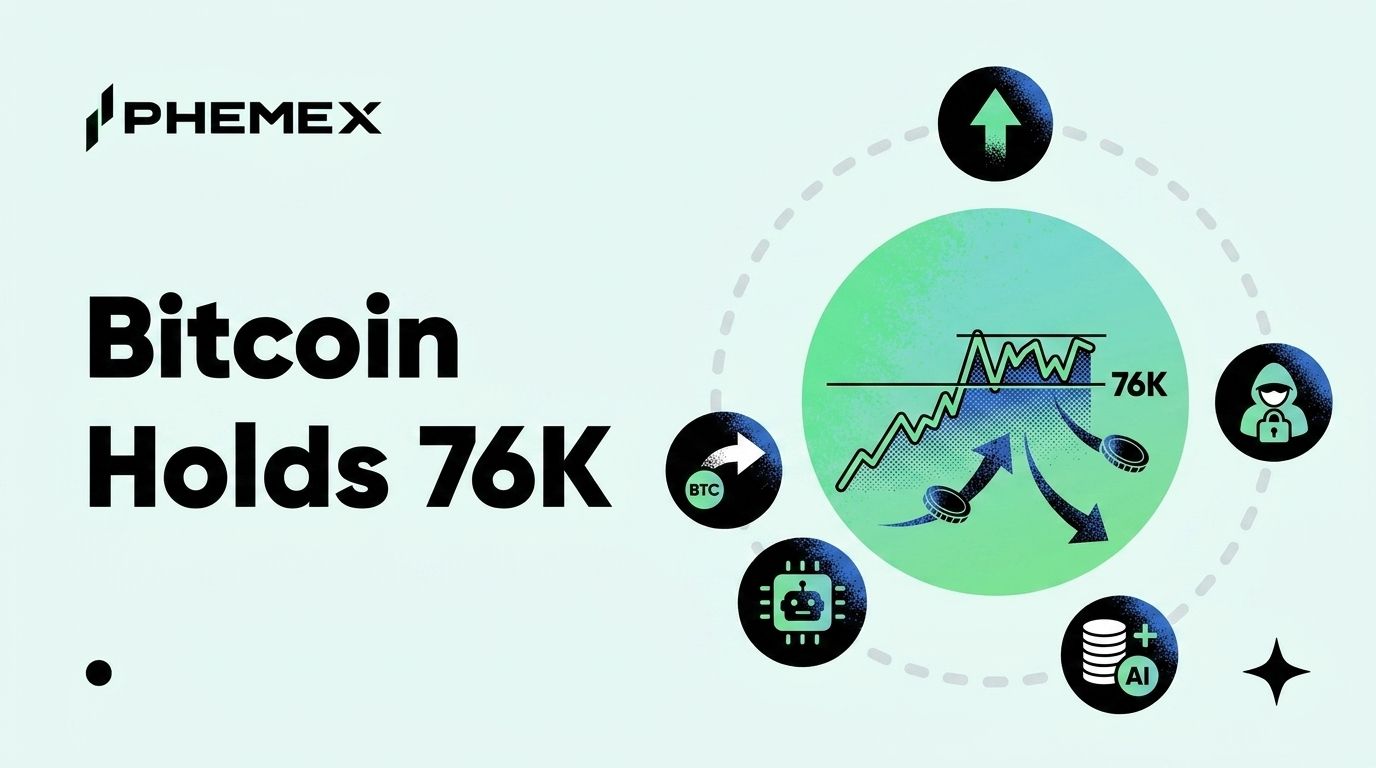
Bitcoin has spent the past week pinned between roughly $76,000 and $78,000, posting near-zero net change while the rest of the market sorts itself into clear winners. Privacy coins ZEC, XMR, and DASH ran double digits earlier in the week. AI tokens NEAR and FET took the baton on Friday with NEAR up roughly 28.5% and FET up 11.4% on the session, per CoinDesk reporting. Hyperliquid's HYPE hit a new all-time high after two U.S. ETFs tied to the token launched. None of this is happening because BTC is selling off. It's happening because BTC is doing nothing, and capital that needs to be deployed is finding the next move.
This is what a derivatives stagnation rotation looks like in real time. Below are the levels that pin BTC here, the sectors actually absorbing the flow, the dominance signal that decides if this is a real rotation or a head-fake, and what historically comes next.
What Is Actually Pinning Bitcoin Between $76K and $78K
BTC is range-bound by design right now, not by accident. Options positioning on Deribit shows put activity concentrated at the $71,000 to $77,000 strikes while traders are aggressively selling upside calls, which drags implied volatility lower with each passing session. When dealers are short downside puts and short upside calls, they hedge by buying weakness and selling strength, and that dealer gamma flow is the mechanical reason BTC keeps reverting to the middle of its range every time it tries to break out.
Spot volumes confirm the same picture from a different angle. Daily exchange turnover has compressed to multi-month lows, and the monthly average across the top 12 decentralized perpetual venues sits near $612 billion year-to-date in 2026 versus $532 billion across all of 2025. CME basis has flattened and funding rates across major venues have hovered near neutral all week. When neither bulls nor bears can force a move, capital looks elsewhere, and that is exactly what the altcoin tape is telling you.
The Sectors Absorbing the Flow: Privacy, AI, and HYPE
Three clusters have done the heavy lifting this week and each one tells a slightly different story about what the marginal buyer wants.
Privacy coins moved first. ZEC, XMR, and DASH all posted double-digit gains earlier in the week before giving back some of those moves into Friday's session. The macro driver is straightforward. Concerns about onchain surveillance, AI-powered chain analysis, and the longer-tail risk of quantum attacks on transparent ledgers have pushed allocators toward assets where the privacy guarantee is the product. Zcash specifically benefits from a shielded-pool narrative that has been compounding all year.
AI tokens caught the late-week bid. NEAR's roughly 28.5% Friday move and FET's 11.4% session were the clearest signal that speculative flows rotated out of the privacy trade and into the AI basket. AKT, TAO, and OCEAN moved alongside them but with smaller magnitudes. The thesis here is not new. What is new is that the capital is actually showing up, which it had not been doing during the April chop.
HYPE is its own category. Hyperliquid's token printed a new all-time high after two U.S. spot HYPE ETFs launched, and Bitwise published a note arguing it remains one of the most undervalued large-cap assets in the space. The structural pitch is that 99% of platform trading fees are used to buy back HYPE, so growth in the perp DEX directly tightens token supply, and that mechanic is why HYPE keeps separating from the rest of the alt complex even on mixed days.
The table below ranks the rotation by what each cluster is actually pricing in.
|
Cluster
|
Lead tokens
|
What the bid is pricing
|
Read-through for traders
|
|
Privacy
|
ZEC, XMR, DASH
|
Surveillance and quantum risk premium
|
Narrative-driven, gives back fast on profit-taking
|
|
AI
|
NEAR, FET, AKT, TAO
|
Compute demand and agent-economy thesis
|
Highest beta to a real BTC breakout
|
|
Perp DEX
|
HYPE
|
Buyback flywheel plus ETF demand
|
Structural rather than purely narrative
|
The Bitcoin Dominance Signal That Decides Everything
Bitcoin dominance is currently sitting near 57% to 58% after pulling back from the June 2025 peak of around 65%. That number alone does not mean altcoin season has started. The Altcoin Season Index has been hovering in the high 40s, which is still inside the transition zone, not above the 75 threshold that defines a confirmed rotation.
But the shape of the move matters more than the absolute number. When BTC dominance plateaus while alts run, you are watching the classic mid-cycle rotation signature, and that is exactly the tape this week. The ETH/BTC ratio is the cleaner confirmation candle on a rotation broadening. It has been sitting near 0.03 for most of the spring, well below the 0.07 level that historically marks the start of a broad altcoin run. The flow has skipped ETH entirely and gone directly into smaller, story-driven names with sharper catalysts, which tells you the current rotation is selective rather than broad.
The signal that flips this from a sector-specific rotation into a real altcoin season is BTC dominance breaking and holding below roughly 54% with ETH/BTC reclaiming the 0.035 to 0.04 zone. Until both happen, this is a rotation inside a Bitcoin-dominant regime, not a regime change.
The Levels That Decide the Next Leg for BTC and ETH
For BTC, the support and resistance map is unusually clean because the range has held for so long. The key zones to actually trade around are below.
$80,000 is the upside trigger. A clean reclaim and daily close above $80K opens the door back toward the $82,000 to $86,000 zone where the next layer of resistance lives. As long as BTC is below this level, the dealer-hedging gravity that has pinned the range stays in control.
$75,000 is first support. This is the bottom of the current week's range and the level that has absorbed every dip since the range formed. A break here is the first signal that the rotation thesis is breaking down and that BTC is rolling, which would drag the entire alt complex lower regardless of how strong individual sector narratives look.
$70,000 is the line that matters. Below $75K the next major shelf is the round $70,000 level, and a sustained break below it would put BTC back into a structurally lower range with a measured move toward the mid-$60Ks. That outcome ends the current rotation immediately.
For ETH, the corresponding levels are the $3,000 to $3,100 zone as overhead supply and the $2,700 area as the first meaningful support. ETH/BTC reclaiming 0.035 would be the cleanest read-through that the rotation has expanded beyond the privacy and AI clusters into the larger alt majors. Without that, ETH stays heavy and the rotation stays narrow.
Open interest trends and BTC dominance on TradingView are the two live charts to keep open this week. Both are where the next regime change will show up first.
The Historical Rotation Playbook and How This One Differs
Capital rotation while BTC ranges is not a new pattern. It happened in mid-2019, in the summer of 2021, and again in the Q1 2024 chop. The shared template is recognizable. BTC stops trending, dominance plateaus, capital that needs to be deployed finds the highest-conviction narrative, that narrative runs for two to six weeks, then either BTC breaks the range and the rotation reverses violently or BTC confirms a new leg up and the rotation broadens.
Three things make the May 2026 rotation different. The rotation is happening with macro positioning still defensive rather than after a clean BTC breakout, which makes it structurally more fragile than the post-ATH rotations of late 2021 or early 2024. ETF infrastructure now exists for a meaningful slice of the rotation basket, with HYPE already trading as a U.S. spot ETF and multiple AI tokens in the SEC pipeline, which tends to make the capital stickier on the way up and slower on the way out. And the privacy and AI clusters do not actually share a catalyst, so the fact that both ran in the same week says more about BTC's silence than about any unified thesis.
The honest read is this. Until BTC picks a direction, the rotation continues and the named winners keep grinding higher. The moment BTC breaks $80K or $75K with conviction the rotation either accelerates into a broader move or unwinds back into BTC, and being overexposed before BTC commits is how traders give back a month of gains in 48 hours.
Frequently Asked Questions
Why are privacy and AI tokens rallying while Bitcoin sits flat?
Because BTC's range has compressed implied volatility to multi-month lows and dealer hedging keeps pinning spot. Capital that needs to be deployed is hunting for the highest-conviction story rather than waiting for BTC to choose a direction. Privacy coins offer a surveillance-and-quantum hedge thesis, AI tokens offer beta to the broader tech narrative, and HYPE offers a structural buyback flywheel. All three have a reason to bid that does not require BTC to move first.
Is this the start of altcoin season?
Not yet, and the data is fairly clear on that point. The Altcoin Season Index is still below 75 and BTC dominance has not broken its support zone near 54%. What is happening is a selective sector rotation inside a Bitcoin-dominant regime. A real altcoin season requires BTC dominance to break and hold lower while ETH/BTC reclaims at least 0.035, and neither condition is in place yet.
What ends the current rotation?
Either BTC breaking out above $80,000 with conviction (which broadens the rotation into the larger alt majors) or breaking down below $75,000 (which unwinds the rotation back into BTC and stablecoins). The narrow trades work as long as BTC stays asleep, but the moment BTC commits to a direction the leadership of this market changes fast.
Should traders chase NEAR, FET, or HYPE here?
Chasing a 28% single-day move is statistically how most retail traders end up underwater on a rotation. The cleaner play is to wait for the first 5% to 10% pullback on the leaders and re-enter against a defined risk level. Position size matters more than entry price in narrow rotations because the giveback when BTC eventually moves is usually fast and broad.
Bottom Line
BTC is pinned between $76K and $78K because options dealers are short gamma on both sides of the range and spot volume has dried up. That stagnation is creating space for privacy coins, AI tokens, and HYPE to absorb the marginal capital, and the leaders have already moved double digits this week. The dominance signal is not yet confirming a full altcoin season. BTC dominance near 57% to 58% and ETH/BTC near 0.03 still mark a Bitcoin-dominant regime with a selective rotation inside it.
The decision points are clean. A daily close above $80,000 broadens the rotation and brings the alt majors into play. A break below $75,000 ends the rotation and drags the leaders down with BTC. ETH/BTC reclaiming 0.035 is the early signal that capital is spreading beyond the narrow sector trade. Until one of those happens, the rotation continues but it stays fragile, and the traders who keep the most of these gains are the ones who size positions for a giveback rather than for a continuation.
This article is for informational purposes only and does not constitute financial or investment advice. Cryptocurrency trading involves substantial risk. Always conduct your own research before making trading decisions.