









The Altcoin Season Index sits between 27 and 35 as of mid-March 2026, depending on the tracking platform, firmly in "Bitcoin Season" territory. A month ago it was approaching 50, and in early 2025 it briefly touched 70. The drop reflects the post-October 2025 market reset where capital fled higher-risk altcoins back into Bitcoin and stablecoins as BTC fell from $126,000 to the $67,000 range. Bitcoin dominance currently sits around 56-58%, and search interest in "when is altcoin season" has spiked to its highest level since late 2022.
Every altcoin trader wants to know the same thing: when does it turn? The index is the closest thing the market has to a daily answer, and understanding how to read it correctly separates traders who position early from those who chase rallies that are already half over.
How the Index Works
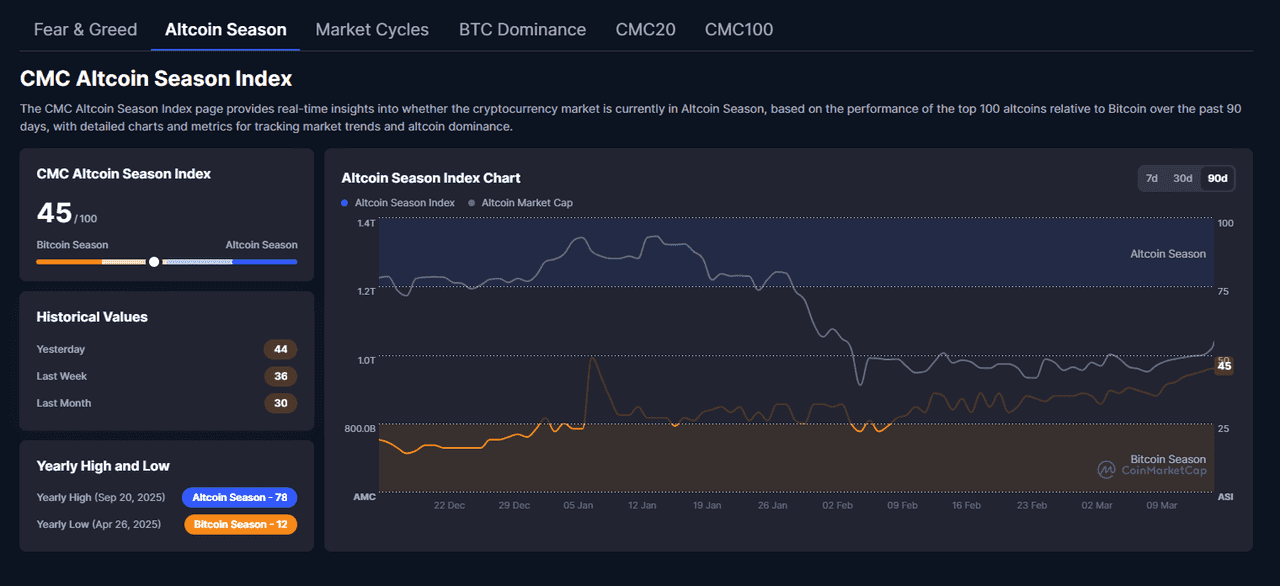
The Altcoin Season Index tracks what percentage of the top 100 altcoins have outperformed Bitcoin over the past 90 days. Stablecoins (USDT, USDC, DAI) and wrapped or asset-backed tokens (WBTC, stETH) are excluded from the calculation. The index is updated daily and produces a score from 0 to 100.
A score above 75 means altcoin season: at least 75% of the top 100 altcoins are outperforming BTC on a rolling 90-day basis. A score below 25 means Bitcoin season: BTC is outperforming the vast majority of alts. Anything between 25 and 75 is a transition zone where the market is mixed and capital is rotating without a clear leader.
The 90-day lookback window is important to understand because it means the index is a lagging indicator by design. It doesn't tell you altcoin season is about to start. It tells you altcoin season has already been underway for weeks by the time the score crosses 75. This lag is why using the index as a confirmation tool (entering when the trend is confirmed) works better than using it as a predictive signal (trying to front-run the move before it registers).
Where We Are Right Now
Around 40% of tracked altcoins are outperforming BTC over the trailing 60 days, which shows some rotation is happening beneath the surface, but it's nowhere near the 75% threshold that defines a full altcoin season.
BTC dominance at 56-58% reinforces this picture. Historically, dominance needs to fall and sustain below 52-54% before altcoin season is broadly confirmed. A brief dip below 55% followed by a recovery is not altcoin season. It's just normal fluctuation within a Bitcoin-dominant regime.
Stablecoin dominance near 10% adds another layer. That level of sidelined capital hasn't been seen since the FTX collapse era, and it represents a significant pool of money that could flow back into risk assets, including altcoins, when conditions improve. The capital is there. The confidence isn't, at least not yet.
How Previous Altcoin Seasons Played Out
The index has crossed 75 three times in the past decade. Each episode followed a recognizable pattern, but the duration, intensity, and catalyst were different every time.
|
Season
|
Duration
|
Index Peak
|
Primary Catalyst
|
How It Ended
|
|
Dec 2017 - Apr 2018
|
~5 months
|
~100
|
ICO frenzy, retail FOMO after BTC hit $20K ATH
|
90-99% drawdowns across most ICO tokens
|
|
Jan - Apr 2021
|
~3 months
|
95+
|
DeFi + NFT explosion, Grayscale institutional inflows
|
BTC correction from $64K dragged alts down harder
|
|
Oct - Dec 2021
|
~2 months
|
~90
|
L1 wars (SOL, AVAX, LUNA)
|
Terra/LUNA unwind, Fed hawkish pivot
|
The shared pattern is clear. BTC makes a new ATH, consolidates or dips slightly, profit-takers rotate capital into altcoins, and the rotation builds for weeks before the index confirms it. The actual season lasts 2-5 months before reversing hard, and the setup phase leading into it takes months of BTC strength to develop. Missing the entry by a few weeks means catching the tail end, which is where most retail traders buy and subsequently lose money.
The Four Conditions That Trigger Alt Season
Rather than trying to predict the exact date, watch for these four conditions to converge. When 3 or more are present simultaneously, alt season has historically followed within one quarter.
BTC makes a new ATH and consolidates. This is the classic trigger and the one that matters most. When Bitcoin hits new highs, early holders take profits and rotate that capital into altcoins looking for higher-percentage gains. BTC is currently at $67,000-$71,000, roughly 44% below its $126,000 ATH. This condition has not been met and is the single biggest reason the index remains in Bitcoin Season territory.
Rate cuts are confirmed and underway. Liquidity expansion benefits higher-beta assets disproportionately, and altcoins are the highest-beta assets in crypto. The Fed is expected to hold rates this week (March 18 FOMC), and the market is pricing in one to two cuts for the second half of 2026. If those cuts materialize, the liquidity environment improves for risk assets broadly and altcoins specifically.
Regulatory clarity expands beyond BTC and ETH. The CLARITY Act, if passed, could open the door to institutional allocations to altcoins by resolving the commodity-versus-security classification question for major tokens. Polymarket shows approximately 72% odds of the bill being signed into law in 2026. Each additional altcoin that receives clear regulatory status becomes investable for institutions that currently can only touch BTC and ETH.
ETF approvals for specific altcoins. SOL and ADA staking ETFs are in front of the SEC, and seven spot XRP ETFs are already live. Each approval acts as a catalyst for that specific token and signals to the broader market that the institutional window for altcoins is opening. If a major issuer like BlackRock files for a SOL or XRP ETF, the narrative impact alone could shift capital flows.
Why 2026 Could Look Different
Previous altcoin seasons were driven almost entirely by retail money rotating through exchanges. This cycle has a structural difference: institutional capital can now access specific altcoins through regulated ETF products for the first time.
When BlackRock, Fidelity, or Grayscale offers an XRP or SOL ETF, the capital that flows in comes from 401(k)s, wealth management platforms, and institutional allocators who would never have opened a crypto exchange account. That changes both the scale and the timing of future rotations. Previous cycles needed months of retail FOMO to build altcoin season momentum, but this cycle could see faster, more concentrated rotations driven by institutional allocation models that spread capital across digital asset baskets rather than going all-in on a single token.
The flip side is that institutional participation also makes altcoin season more selective. Money managers pick altcoins with clear fundamentals, regulatory status, and liquidity. Microcap tokens with no revenue, no product, and no regulatory clarity won't benefit from institutional rotation the way they did during the 2017 ICO frenzy. The sectors most likely to lead when rotation comes include L2 scaling (Arbitrum, Optimism, Base ecosystem tokens), real-world asset tokenization, AI blockchain infrastructure, and DeFi blue chips like AAVE and UNI. Meme coins typically peak last and crash hardest.
What NOT to Do Before the Index Confirms
The most expensive mistake in crypto is rotating 100% into altcoins before BTC confirms a new ATH. Every previous alt season was preceded by Bitcoin leading the way, and premature rotation means you're holding depreciating assets while BTC outperforms. The index at 27-35 is telling you explicitly that this is not altcoin season, and the traders who ignore that signal to "get in early" are the ones who end up holding bags when the rotation doesn't come or comes later than expected.
The disciplined approach is to keep BTC and ETH as 60-70% of your portfolio while the index is below 50, and only add selective altcoin exposure as it approaches the 40-50 range with sustained momentum. If the index crosses 50 and holds for several weeks, you can increase alt allocation to 40-50%. If it crosses 75, alt season is confirmed and you can be more aggressive, but even then, keep a BTC/ETH base because alt seasons end fast and violently.
FAQ
When will altcoin season start in 2026?
The honest answer is nobody knows, and anyone giving you a specific date is guessing. The conditions that historically precede alt season (BTC at new ATH, rate cuts underway, declining BTC dominance below 52%) are not yet present. If BTC recovers above $100,000 and consolidates while the Fed begins cutting rates, a rotation could develop as early as Q3 2026. If macro conditions stay difficult, altcoin season may not arrive this year at all.
Is the Altcoin Season Index reliable?
As a confirmation tool, yes. The index has accurately flagged every previous altcoin season after it began. As a predictive tool, no. The 90-day lookback means the index lags the actual rotation by weeks. Smart traders use it alongside BTC dominance, stablecoin dominance, and sector-specific ETF flow data rather than relying on any single metric.
Should I buy altcoins now while the index is low?
Buying altcoins during Bitcoin Season is high risk because most alts are underperforming BTC with no guarantee the rotation arrives on any specific timeline. If you want exposure now, focus on tokens with the strongest institutional interest (ETH, SOL, XRP based on ETF infrastructure) and keep position sizes small relative to your BTC/ETH base.
Bottom Line
The Altcoin Season Index at 27-35 is telling a clear story: this is Bitcoin's market. The conditions for altcoin season (BTC at new highs, rate cuts, declining dominance, ETF expansion) are building in the background but none have fully triggered. The setup phase takes months to develop, and trying to front-run it before the index confirms the rotation is how retail traders consistently lose money in the transition zone between cycles.
The practical approach is to track the index daily alongside BTC dominance, watch for the four trigger conditions to converge, and start adding selective altcoin exposure only when the index sustains above 40-50 with momentum. When alt season arrives, it moves fast and the window is typically 2-5 months. Being positioned before confirmation is less important than being positioned correctly when it starts.
Disclaimer: This article is for informational purposes only and does not constitute financial advice. Cryptocurrency investments carry significant risk. Always conduct your own research before making investment decisions.
