




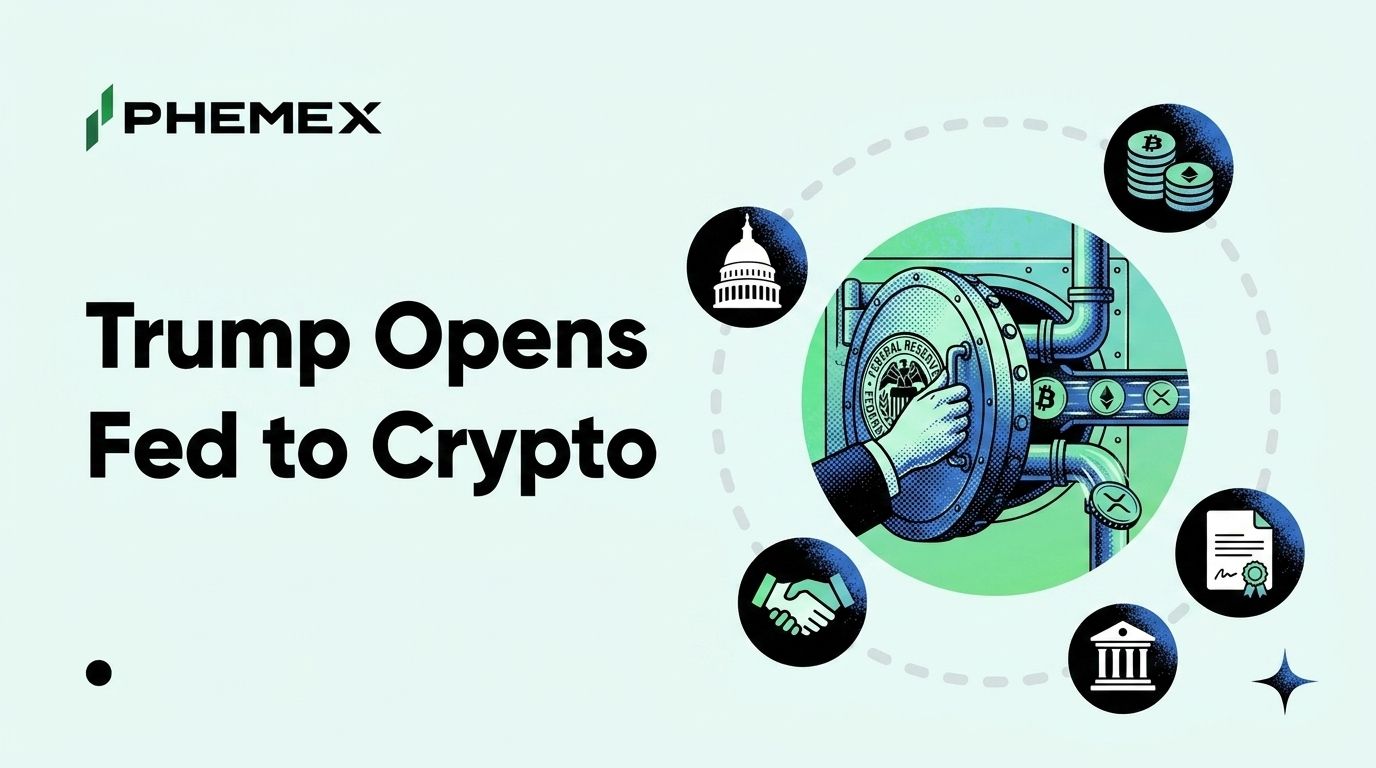
On May 19, 2026, President Trump signed an executive order directing the Federal Reserve and federal banking regulators to review the eligibility rules that have kept fintech and crypto firms out of Reserve Bank payment accounts. The order asks the Fed to "consider options for expanding such access" to uninsured depository institutions and non-bank financial companies dealing in digital assets, publish transparent application procedures, and rule on completed applications within 90 days. Ripple, Anchorage Digital, and Wise are the three firms most often named as front-runners. The same day, the Federal Trade Commission sent warning letters to PayPal, Visa, Mastercard, and Stripe about debanking compliant crypto businesses.
This is a review order, not a guarantee of access. The Fed has spent the last several years denying or sitting on master-account applications from crypto-adjacent applicants. What changes inside the next 90 days is the question that matters.
What the Executive Order Actually Orders
The text of the May 19 order is narrower than the headline framing suggests, and that is what makes it operationally interesting. It directs the Federal Reserve Board, the Federal Reserve Banks, the Office of the Comptroller of the Currency, and the FDIC to do three concrete things. The first is to review the current eligibility framework for Reserve Bank master accounts and payment services, with specific attention to uninsured depository institutions and non-bank firms handling digital assets. The second is to design a transparent application procedure with published criteria, written status updates, and a documented appeal path. The third is to rule on completed applications within 90 days of submission rather than letting them sit indefinitely.
It does not declare any firm eligible. It does not override the Federal Reserve's Account Access Guidelines published in August 2022. It does not amend the Federal Reserve Act. What it does is tell the Fed to apply its own existing tiered review framework on a clock and in public, which is a structural change because the absence of a clock is exactly how every applicant since Custodia Bank has been kept out.
The order also instructs the agencies to coordinate with Treasury on stablecoin issuer access, which is the link to the GENIUS Act framework that the White House has been pushing alongside the broader Strategic Bitcoin Reserve and CLARITY Act packages. The administration is treating payment-rail access as the third leg of a three-part regulatory build-out, after asset classification and stablecoin licensing.
What the Fed Has Historically Said About Master Accounts
The Federal Reserve has been the bottleneck for a decade. Custodia Bank, the Wyoming Special Purpose Depository Institution founded by Caitlin Long, applied for a master account in October 2020. The Kansas City Fed denied the application in January 2023, and a federal district court upheld the denial in March 2024. Reserve Trust, which briefly held a master account for crypto-related activity, had it revoked in 2023. Every crypto-native applicant since has been kept in the same indefinite review status.
The Fed's stated reason, codified in the 2022 Account Access Guidelines, is a tiered review system. Tier 1 applicants are federally insured depository institutions and get a streamlined review. Tier 2 covers federally supervised but uninsured institutions and gets a more detailed review. Tier 3 covers everything else, including state-chartered SPDIs and non-bank fintechs, and triggers what the Guidelines describe as a "strict" review with no published timeline. Crypto firms have lived in Tier 3, and Tier 3 has been a polite way of saying no.
The new EO does not collapse the tiers. It tells the Fed to publish procedures and run the clock. The honest read is that a 90-day clock on a Tier 3 review is a significant procedural change, but the Fed retains every substantive ground it has previously used to deny applications. Capital requirements, AML controls, operational risk, and counterparty exposure all remain in play. What changes is that a denial now has to come with a written rationale on a defined schedule, which is easier to challenge in court.
Who Is Applying and Who Stands to Benefit
Three firms are most often named in the May 19 reporting from Reuters and The Block.
Ripple. Holds a conditional OCC national trust bank charter granted in December 2025 and applied for a master account shortly after. RLUSD, its dollar-backed stablecoin, has roughly $1.6 billion in circulation and currently settles dollar legs through partner banks. A master account would let Ripple settle natively on Fed rails.
Anchorage Digital. OCC-chartered crypto bank that already handles institutional custody for several US Bitcoin and Ethereum ETF issuers. Has applied for direct Fed access to handle dollar movement for its custody clients rather than routing through correspondent banks.
Wise. UK-headquartered cross-border payments fintech that moves roughly $130 billion a year in consumer flows. Has been openly lobbying for direct Fed access since 2022 to cut the correspondent-banking layer out of US-bound transfers.
Beyond those three, the order applies to any Wyoming SPDI, OCC trust bank, or licensed fintech that submits a completed application. Custodia is the most prominent name in that group and has already signaled it will refile under the new procedures. Stablecoin issuers like Circle and Paxos benefit indirectly because the EO ties into the parallel GENIUS Act stablecoin framework that would route reserve-asset settlement through the Fed.
The named beneficiaries share one structural feature. All of them are already chartered or licensed under some federal or state banking regime. The EO does not crack the door for unregulated crypto exchanges or DeFi protocols. It widens access for entities that have already accepted bank-like supervision.
The FTC's Parallel Debanking Warning
The same day Trump signed the EO, the FTC sent warning letters to PayPal, Visa, Mastercard, and Stripe. The letters cite the agency's consumer-protection authority over unfair or deceptive practices in payment networks and put the four largest US payment processors on notice that ending services to compliant crypto firms without an articulable risk-based reason will be treated as a potential violation.
This piece is the closure of a loophole that has been more damaging than the master-account gap. Operation Chokepoint 2.0 was the informal label crypto-industry lawyers gave to the pattern starting in 2022 where major banks dropped crypto-firm clients under regulatory pressure that was never put in writing. The result was a system where a fully compliant firm could lose ACH access, wire transfers, or card processing with no documented reason and no appeals path. The Federal Reserve did not directly debank anyone. It applied pressure that propagated downstream through correspondent banks and payment networks.
The FTC letters target the propagation layer. PayPal, Visa, Mastercard, and Stripe collectively handle the vast majority of US consumer card and payment-app volume. If those four are now operating under a documented federal expectation that they treat compliant crypto businesses on the same risk-based terms as any other financial client, the practical effect is that the cheapest informal pressure mechanism stops working. A bank or processor cannot quietly cut a client without creating a record that the FTC can examine.
The next question is if the FTC actually enforces, because the agency has the authority and the letters establish the expectation but action has not arrived. Enforcement, if it comes, will land later in the year and probably target one mid-sized processor as an example rather than the four named giants.
What the 90-Day Window Actually Produces and What It Does Not
Below is the realistic catalyst map for the rest of the year, separating what the EO can deliver from what it cannot.
|
Window
|
What the EO can produce
|
What it cannot produce
|
|
Late May to June
|
Revised Fed application procedures, published criteria, written status framework
|
A reversal of the 2022 Account Access Guidelines
|
|
June to August
|
First procedural rulings on Ripple, Anchorage, Wise, and Custodia applications
|
Approvals that bypass capital, AML, or operational-risk review
|
|
Q3 2026
|
First conditional master-account approvals with documented compliance conditions
|
A blanket clearance for any crypto firm without bank-like supervision
|
|
Q4 2026
|
FTC enforcement signal against at least one debanking case
|
A statutory right of access for crypto firms
|
The conditional approval is the catalyst that matters in market terms. It is the moment when the legal pathway becomes real, with a documented set of conditions rather than an indefinite review. Most market reaction will land on that announcement rather than on the final activation several months later.
The bearish signal to watch for is the opposite. If the Fed deems applications "incomplete" and resets the 90-day clock on procedural grounds, the EO loses its bite. The Federal Reserve has done exactly that in past review cycles, and nothing in the May 19 order prevents it from doing so again. A future administration can also rescind the order on day one. The pieces that survive a change of administration are the application procedures themselves once they are published, because procedural rules require their own rulemaking process to undo.
The harder structural point is that this order does not change who the Fed answers to. The Federal Reserve Board is independent of the executive branch on monetary policy and on supervisory matters. Trump can direct the review process and require published procedures, but he cannot order the Fed to approve any individual application. If the Fed comes back in 90 days with revised procedures that look procedurally clean but functionally identical to the 2022 Guidelines, the EO produces headlines and not access.
Frequently Asked Questions
Does the executive order force the Fed to give crypto firms master accounts?
No. The order directs a review of the eligibility framework, the design of a transparent application process, and a 90-day decision window on completed applications. The Fed retains full authority to approve or deny on its existing supervisory and risk-based criteria.
How does this fit with the GENIUS Act and the CLARITY Act?
The EO is the third leg of a three-part federal build-out. The SEC-CFTC commodity ruling settled asset classification, the GENIUS Act framework addresses stablecoin licensing, and this order targets payment-rail access. The CLARITY Act would codify the market-structure piece into statute, which is what would make these changes permanent across administrations.
Why does the FTC matter here alongside the Fed?
The Fed controls master-account access at the top of the payment stack. The FTC controls unfair-practice enforcement at the consumer and processor layer. Together they close both the regulatory bottleneck and the informal debanking pressure that has substituted for it.
Can a future administration reverse the order?
Yes, an executive order can be rescinded by a future president on day one without congressional action. Application procedures and any approvals already granted are harder to undo because they require their own rulemaking process and create reliance interests that courts protect.
Bottom Line
The May 19 order converts an indefinite Fed review into a 90-day clock and pairs it with FTC pressure on the four largest US payment processors. The procedural change is real, and the substantive change depends on how the Fed writes its revised application criteria and if the first batch of decisions actually arrives inside the window. Watch for revised procedures in late June, the first procedural rulings on Ripple, Anchorage, Wise, and Custodia in July and August, and the first conditional approvals in Q3. If the Fed delivers conditional approvals on the clock, the structural read is correct and US crypto firms get the first credible path into regulated payment rails. If applications are deemed incomplete and the clock resets, the order is a headline rather than a real change in access. The market will know which one it is before the year ends.
This article is for informational purposes only and does not constitute financial or investment advice. Cryptocurrency trading involves substantial risk. Always conduct your own research before making trading decisions.