




SKYAI is up roughly 708% over the last 30 days and about 220% on the week, with price oscillating near $0.60 after tagging an all-time high of $0.82 on May 6 and then pulling back hard. Daily volume in recent sessions sat around $199 million, the kind of turnover that confirms the move is real and signals the crowd is fully aware. A token that goes parabolic, prints a new ATH, and then sheds more than 25% in a week is no longer a quiet setup. It is a chart where every level matters and chasing late is the most expensive mistake on the menu.
Here are the catalysts behind the run, the levels traders are actually watching, and how to size a position in a token that has already done most of its work without you.
The Recent Rally and What Fueled It
A 708% move in a month does not happen on charts alone. SKYAI sits in the AI-agent infrastructure category, building an MCP Hub routing layer on BNB Chain that lets large language model agents coordinate across multiple data and tool servers. Phemex already covers the project end-to-end in the SkyAI explainer, so this piece is the price-side companion rather than a rerun of the fundamentals.
The MCP narrative went mainstream in crypto media after a wave of agent-to-agent demos, and SKYAI was the cleanest mid-cap proxy for the trade. Trading volume climbed from a low-eight-figure baseline to roughly $199 million on peak days, signaling fresh capital rather than rotation between existing holders, and the token's relative scarcity on tier-one venues meant every new listing announcement compressed supply into a smaller order book. The honest read is that those catalysts support a rerating, though they do not support 708% in 30 days, and the $0.82 ATH on May 6 was where that gap got too wide to ignore.
The Chart, the Supports, and the Resistances Worth Watching
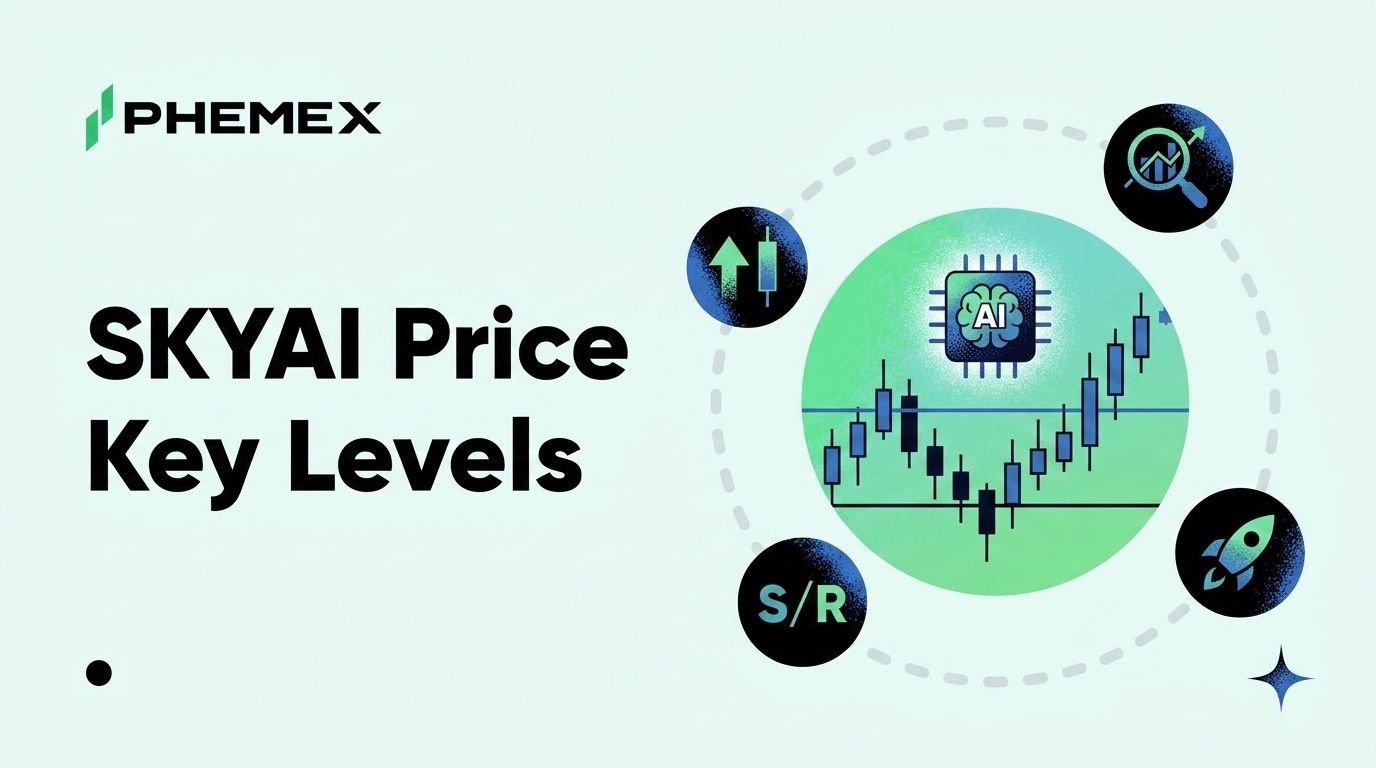
SKYAI moves too fast for exact figures to stay accurate for long, so think in zones the way any support and resistanceframework is meant to work. Four reference areas matter right now, and each one carries a different message about what the chart is doing.
The $0.82 all-time high is the obvious overhead resistance. Reclaiming it on real volume would tell you buyers are still willing to pay up after a hard pullback, which is the strongest possible signal a trend is intact. Repeated rejections there, each one weaker than the last, is the textbook exhaustion tell that ends most parabolic moves.
The mid-range pivot near $0.55 to $0.60. This is where price has spent most of its time during the cooldown and where buyers and sellers are currently fighting. Holding above it keeps the broader uptrend structure alive, and losing it cleanly opens the next leg toward deeper supports.
The breakout shelf near $0.44. This was the consolidation zone SKYAI traded inside before the vertical leg began. On the way up it acted as resistance, and on the way down it becomes the line that decides if the 708% run was the start of a sustained trend or a single liquidity event. A hold here on a retest, with volume cooling rather than spiking, is the bullish read. A clean break through it is the signal to step aside.
The pre-rally base near $0.37. Losing the $0.44 shelf points price toward this deeper level, where SKYAI would have given back roughly half of the monthly gain. Traders treating that as a buying opportunity are essentially saying the fundamentals support a 380% month even after the 708% one cools off, which is a real position but a different trade than catching the top.
None of these levels predict direction on their own, but together they give you a framework. Hold the mid-range and the trend thesis survives intact. A clean break of the $0.44 shelf invalidates it. Everything between those outcomes is noise that should not drive sized decisions.
The Parabolic Exhaustion Risk After a 708% Month
Here is where most retail traders get the setup wrong. They see a real catalyst stack, a real volume profile, and a real listing pipeline, and conclude the move has legs. More often, a 708% month is the move, and what follows is either a sharp pullback or a long sideways grind while the chart cools off.
SKYAI's relative strength index touched the high 90s near the ATH, the kind of reading that historically precedes either a sharp correction or weeks of sideways action. RSI does not call tops on its own, but a reading that extreme is the market telling you the buying side has spent most of its ammunition. Combined with a 26% pullback already in the books, the path of least resistance for the chart is testing how much demand actually sits below.
On-chain holder concentration adds the second risk layer. AI-narrative tokens that run this hard almost always have top-wallet clusters that benefit asymmetrically from the move, and when those wallets begin distributing into strength, the order book looks fine right up until it does not. The broader tape makes it worse. Bitcoin broke below $77K this week with roughly $657 million in liquidations, 89% of them longs, and tokens that pumped against the tape tend to give back the most when rotation reverses.
Breakout Versus Breakdown Scenarios From Here
The bull case starts with SKYAI holding the $0.55 to $0.60 pivot zone on declining volume, which would suggest the cooldown is mature and supply is drying up. From there, a push that reclaims $0.82 on volume matching or exceeding the original breakout would put the chart in trend-continuation mode, with the next leg targeting price discovery rather than fixed levels. The conditions are specific and they have to print, not be assumed.
The bear case is shorter and uglier. A clean daily close below the $0.44 shelf would invalidate the breakout structure entirely, and the $0.37 pre-rally base becomes the first line of meaningful demand. A token that ran 708% in 30 days can give back 60% to 70% from its peak without anything fundamentally changing about the underlying project, and most of the people who buy the local high learn that the hard way.
The middle scenario is the one most traders ignore and the most likely to play out. SKYAI grinds sideways between $0.44 and $0.70 for weeks while the chart works off its overbought condition, with no sharp pullback and no resumed rally, just chop that flushes leveraged positions on both sides. That outcome is the worst for impatient traders and the best for anyone who wanted to build a position at sensible levels without chasing.
Risk Management for a +708% 30 Day Token
A token that moved this much in this short a window belongs in the satellite sleeve of a portfolio rather than the core. The risk-reward ratio on chasing a vertical move late is structurally bad, with upside from local highs constrained by exhaustion and downside open all the way to the prior consolidation.
Three rules keep traders out of trouble here. First, size with a real position sizing framework rather than gut feel, predefining the maximum dollar loss per trade and working backward from stop distance. Second, put the stop where the chart actually invalidates rather than a round number that feels safe, because random noise on a token this volatile will take you out before the thesis gets a chance to play out. Third, scale in tranches across the mid-range pivot, the $0.44 shelf, and an ATH reclaim on volume, which is the structure that respects how trends actually develop and lets you keep your account if the bear scenario hits instead.
Frequently Asked Questions
Is SKYAI a good buy after the 708% rally?
The narrative is real and the project has a legitimate seat at the AI-agent infrastructure table, but a 708% month means most of the easy move is already priced in. A safer approach is waiting for the chart to retest the breakout shelf and prove it holds rather than chasing strength near the ATH. Treat any entry as a small speculative position rather than a core allocation.
What is the most important SKYAI level to watch?
The breakout shelf near $0.44. As long as SKYAI holds above it on a pullback, the bullish structure from the parabolic run stays intact. A decisive break below it signals the move was a liquidity spike rather than the start of a sustained trend, and price tends to retrace toward the pre-rally base near $0.37 from there.
Why did SKYAI rally so hard in May 2026?
The MCP narrative went mainstream in crypto media, SKYAI was the cleanest mid-cap proxy for the AI-agent infrastructure trade, and limited float on tier-one venues compressed every new listing into a smaller order book. The fundamentals support a rerating, but the speed and size of the move went well beyond what the underlying business changes alone would justify.
How much of a portfolio should SKYAI be?
A token this volatile belongs in the satellite sleeve, not the core. Many traders cap single speculative positions at 1% to 3% of total portfolio value, with a hard stop below the level that would invalidate the thesis. That sizing lets the upside compound if the trend continues without putting the account at risk if the parabolic exhaustion plays out.
Bottom Line
SKYAI sits in the awkward zone between a confirmed trend and an exhausted parabola, where the catalysts justify a rerating but the $0.82 ATH rejection and 26% weekly drawdown say the easy money was already made. The levels to watch are clean. Hold the $0.55 to $0.60 mid-range and the structure survives, while losing the $0.44 shelf puts $0.37 in play. The trade that actually pays here is patience, a defined stop, and position size that respects the fact that a 708% month is almost always followed by either a sharp pullback or a long sideways grind rather than another vertical leg.
This article is for informational purposes only and does not constitute financial or investment advice. Cryptocurrency trading involves substantial risk. Always conduct your own research before making trading decisions.