

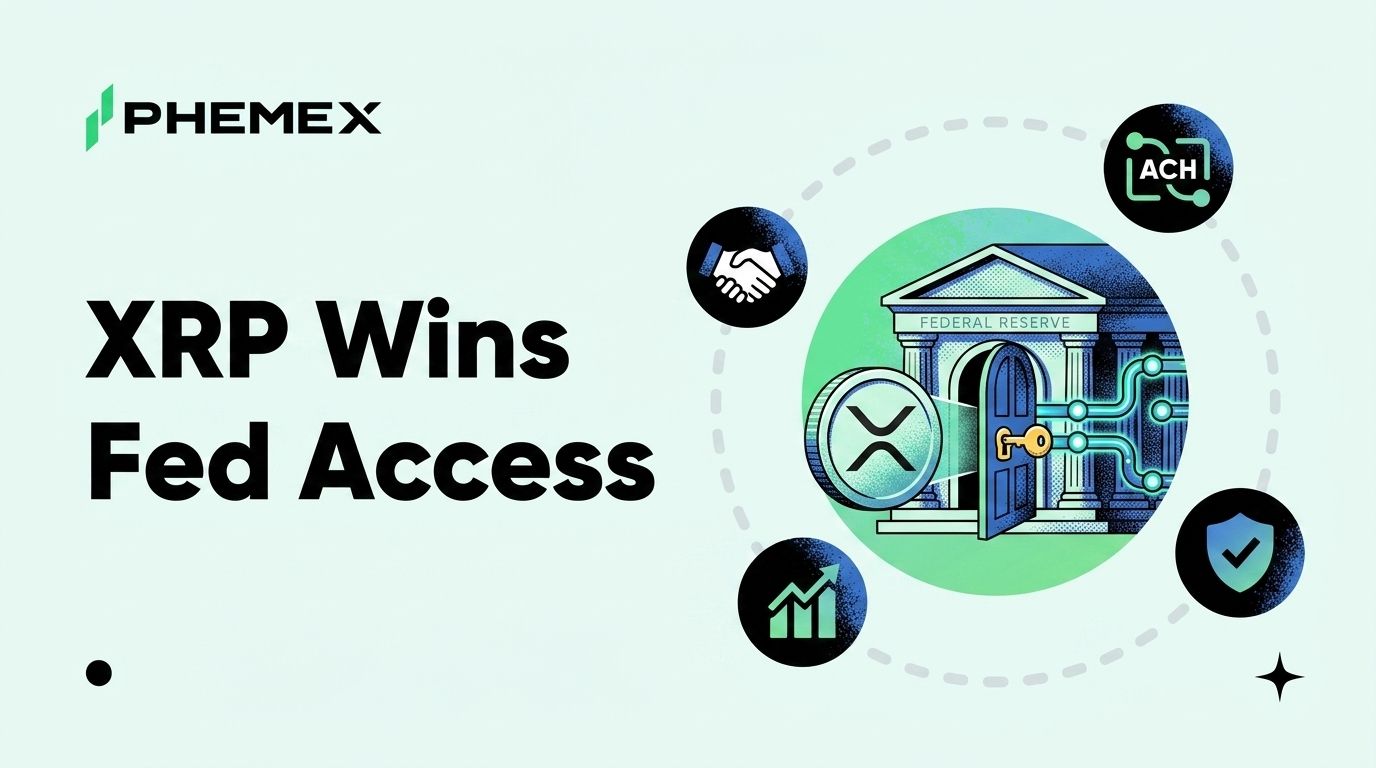
On May 19, 2026, President Trump signed an executive order directing the Federal Reserve and federal financial regulators to review the rules that keep fintech and crypto firms out of Reserve Bank payment accounts. The order tells the Fed to "consider options for expanding such access" to uninsured depository institutions and non-bank financial companies dealing in digital assets, set transparent application procedures, and decide on completed applications within 90 days. The three firms most directly named as likely beneficiaries are Ripple, Anchorage Digital, and Wise.
For XRP holders, this is a real institutional event with a clean 90-day window and a clear catalyst structure. The honest reading is that a Fed master account would be a meaningful opening for Ripple's enterprise payments business. The harder question of how much it lifts XRP-the-token in proportion is a separate one, and one this article does not dodge.
What the Executive Order Actually Says
The May 19 order is narrower and more procedural than the headlines suggest, and that is exactly what makes it credible. It does not declare crypto firms eligible for Fed accounts. It instructs the Fed and federal banking regulators to review the current eligibility criteria for payment account access, design a transparent application process, and rule on completed applications within 90 days of submission. Until now, master-account decisions have moved on an unwritten timeline that has stretched several years for some applicants.
The order applies to two categories that have been mostly locked out. The first is uninsured depository institutions, which is the bucket Wyoming Special Purpose Depository Institutions and OCC trust banks fall into. The second is non-bank financial companies dealing in digital assets, which is the bucket that captures stablecoin issuers, crypto-native banks, and fintechs running cross-border payment rails.
Alongside the EO, the Federal Trade Commission sent letters warning PayPal, Visa, Mastercard, and Stripe against debanking compliant crypto firms. The legal mechanism is consumer-protection authority over unfair or deceptive practices in payment networks. That FTC angle matters because it closes the obvious workaround. A bank that does not want to lose its Fed account by serving a crypto firm has historically just dropped the client. The FTC letters tell the largest US payment processors that doing the same thing at the network level is now on the agency's radar.
Ripple's Existing US Position and Why a Master Account Matters
Ripple has been building toward this for two years. The company received conditional approval from the Office of the Comptroller of the Currency for a national trust bank charter in December 2025. It applied for a Federal Reserve master account shortly after. Its dollar-backed stablecoin RLUSD has grown to roughly $1.6 billion in market cap, sitting alongside Ripple Payments and the XRP Ledger as the three legs of the company's US strategy.
A Fed master account is the piece that ties those legs together. Without one, Ripple has to settle dollar legs of cross-border payments through partner banks, which means an additional layer of fees, friction, and counterparty risk on every transaction. With direct Fed access, Ripple can hold dollar reserves at the central bank, settle dollar legs natively, and run RLUSD with the same plumbing that JPMorgan or Citibank uses for their own dollar settlement.
This is where the practical math changes. Cross-border payments is roughly a $190 trillion annual market, dominated today by correspondent banking and Swift messaging that takes 1-3 days end to end. Ripple Payments already settles in seconds across more than 90 corridors. The bottleneck has been the US dollar leg, where Ripple needs a domestic banking partner for every transaction. A master account removes that bottleneck. The Trump EO does not guarantee Ripple gets one, but it gives the company a defined process and a 90-day clock instead of an indefinite wait.
Anchorage Digital and Wise are the other names in the mix for slightly different reasons. Anchorage is the OCC-chartered crypto bank that already handles custody for several US asset managers' Bitcoin and Ethereum ETFs. Wise is a fintech moving roughly $130 billion a year in cross-border consumer payments and has been pushing for direct Fed access since 2022. All three benefit from the same procedural fix, which is one reason the order is being read as a structural change rather than a one-off political favor.
The Gap Between Ripple Wins and XRP Token Demand
This is the part most XRP coverage glosses over, and it is the most important section to read carefully. Ripple winning a Fed master account is bullish for Ripple the company. It is not automatically bullish for XRP the token in proportion.
Ripple's enterprise payment flows have historically used XRP as a bridge asset in specific corridors only. Most large US-to-Mexico, US-to-Philippines, and US-to-India flows that Ripple Payments handles settle in fiat on both ends, with XRP touched briefly for liquidity or not at all. The token demand created by Ripple's enterprise wins has been small relative to the size of the payment flows themselves, because XRP is held for seconds during a transaction, not accumulated as a balance sheet asset.
A master account could change that structure, but only if Ripple chooses to route new dollar-leg use cases through the XRP Ledger and on-ledger XRP liquidity. That is a corporate decision, not an automatic consequence of the EO. Ripple has said it intends to expand XRPL-based settlement, and the company holds roughly 40 billion XRP in escrow that it releases on a fixed monthly schedule. If new institutional settlement use cases land on XRPL, the float dynamics tighten meaningfully. If Ripple Payments keeps running mostly on fiat rails with RLUSD as the new dollar leg, XRP captures a smaller share of the upside than the headlines imply.
XRP trades around $2.10 as of May 20, up about 6% on the EO news but well below the $3.65 all-time high from July 2025. The token has been sitting in the range where every named regulatory catalyst since the March 2026 SEC-CFTC joint commodity rule has produced a brief rally followed by a drift back to range. That is the pattern to keep in mind before assuming this time is different.
What the FTC Debanking Warning Actually Adds
The FTC piece of the announcement got less coverage than the Fed piece, but it closes a loophole that has quietly choked the US crypto industry for the better part of two years. Operation Chokepoint 2.0 was the informal name for the pattern where major banks dropped crypto-firm clients under regulatory pressure without ever putting that pressure in writing. The result was a system where a compliant crypto firm could lose access to ACH, wire transfers, and card processing with no clear reason and no appeals process.
The FTC letters to PayPal, Visa, Mastercard, and Stripe say that ending services to a compliant crypto firm without an articulable risk-based reason will be treated as a potentially unfair or deceptive practice. The four companies named handle the vast majority of US consumer card and payment-app volume between them. For Ripple specifically, this matters because RLUSD distribution and Ripple's enterprise customers both rely on those networks at multiple points in the flow.
This does not mean every crypto firm gets a Visa partnership tomorrow. It means the largest payment networks now have a documented federal expectation that they treat compliant crypto clients the same way they treat any other regulated financial business. Combined with the Fed access piece, the two policies together create the first credible US framework for crypto firms to operate inside the regulated payment system rather than alongside it.
What XRP Holders Should Watch Over the 90-Day Window
The 90-day Fed application clock starts running on each completed application individually, not on the EO itself. That makes the calendar fragmented but trackable. Below is the realistic catalyst map for the rest of the year.
|
Window
|
Catalyst
|
What it would confirm
|
|
Late May to June
|
Fed publishes revised application procedures
|
The EO is being implemented operationally, not only signed for headlines
|
|
June to July
|
First procedural rulings on existing applications (Ripple, Anchorage, others)
|
If the 90-day clock is being enforced or quietly extended
|
|
Q3 2026
|
First conditional master-account approvals
|
Real institutional access begins
|
|
Ongoing
|
Ripple announcements on XRPL-based US settlement
|
If master-account access actually drives XRP token demand
|
The conditional approvals are the catalyst that matters. A conditional approval lands with a specific list of compliance, capital, and reporting requirements the firm has to meet before the account goes live. The market will treat the conditional approval as the news event, not the final activation, because the conditional approval is when the legal pathway becomes real.
On the bearish side, the catalyst to watch is the first firm whose application is denied or sent back for an indefinite extension past the 90-day window. If the Fed slow-walks the process by deeming applications "incomplete" and resetting the clock, the EO loses its teeth and the structural read above gets weaker.
Frequently Asked Questions
Does Trump's executive order guarantee Ripple gets a Fed master account?
No. The EO sets a 90-day decision window and a transparent application process, but the Fed makes the final eligibility determination on each application. Ripple is one of three firms most likely to win access based on charter status and application timing, but approval is not automatic and could come with conditions.
How is this different from the March 2026 SEC-CFTC commodity ruling for XRP?
The commodity ruling settled the legal classification of XRP as a digital commodity and removed the threat of future SEC enforcement. The Trump EO addresses a different bottleneck, which is the question of Ripple the company plugging directly into US payment rails. Both matter, and they stack rather than overlap.
Will XRP price move if Ripple gets approved for a master account?
Likely yes on the announcement, with size depending on how the approval is framed. The harder question is what happens over the following months. If Ripple routes meaningful new settlement volume through the XRP Ledger, the token captures real demand. If it routes the same volume through RLUSD on private rails, XRP captures less.
What happens to the EO if a future administration wants to reverse it?
An executive order can be rescinded by a future president the day they take office. The 90-day clock and the application procedures are administrative, not legislative. The CLARITY Act, currently in Senate process, would codify some of the structural pieces into permanent law, which is why the bill's progress remains the larger regulatory catalyst for the year.
Bottom Line
The May 19 EO converts an indefinite wait into a 90-day clock for Ripple, Anchorage, and Wise. The conditional approval is the real event to track, not the order itself. Watch for the Fed's revised application procedures by late June, the first procedural rulings shortly after, and the first conditional approvals in Q3. If Ripple lands one, the next question becomes how much new US settlement volume actually routes through XRPL. The structural opening here is real, and the XRP token upside is conditional on the specific corporate choices Ripple makes inside that opening over the next several quarters.
This article is for informational purposes only and does not constitute financial or investment advice. Cryptocurrency trading involves substantial risk. Always conduct your own research before making trading decisions.