









Key Takeaways
PAAL AI is an AI platform that combines blockchain and machine learning to power bots, agents, research tools, and custom AI services across Telegram, Discord, web, and API interfaces.
The project’s ecosystem includes products such as an AI Web Widget, Ask.Paal crypto research engine, and MyPaalBot/AutoPaal research and analysis tools.
PAAL is the native token and is used for premium AI services, staking, rewards, and ecosystem utility.
PAAL’s official staking system says token holders can earn both PAAL and ETH, while its revenue-sharing docs link rewards to the project’s AI-solution revenue, advertising, and trading-tax flows.
As of today, PAAL AI is best understood as a multi-product AI ecosystem for crypto users, not merely a single-token narrative. That is an inference based on PAAL’s official site and documentation structure.
Artificial intelligence projects in crypto often promise smarter tools, better automation, or autonomous agents, but many of them are still difficult to separate from hype. PAAL AI is one of the longer-running projects trying to turn that promise into a fuller product ecosystem. Its official website says PAAL is a “powerful ecosystem” that combines advanced bots, intelligent agents, immersive visual content, and other utilities to enhance knowledge, creativity, and community engagement across industries. Its docs describe PAAL AI as a platform merging machine learning and blockchain technology to build intelligent agents, autonomous trading tools, and custom AI services across Telegram, Discord, web, and API interfaces.
That positioning matters because PAAL AI is not just one chatbot or one token. It is trying to build a broader stack of AI-driven products for crypto and Web3 users, including assistants, research tools, widgets, agent-creation surfaces, and staking-linked token utility. PAAL’s documentation repeatedly describes the ecosystem as a place where AI and decentralization meet to simplify complexity and provide practical tools for users and businesses.
At the center of the ecosystem is $PAAL, the project’s native token. PAAL’s token-information page says the token is used for exclusive AI services and broader platform utility, while its staking documentation says holders can stake PAAL to earn additional PAAL and ETH. The revenue-sharing page adds that PAAL’s ecosystem includes revenue streams from proprietary AI solutions, advertising and cross-promotion, and a trading tax that affects staking rewards.
What Is PAAL AI?
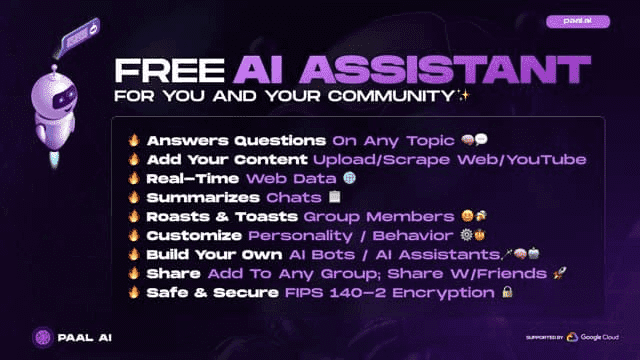
PAAL AI is a blockchain-AI platform designed to provide AI-powered tools for crypto users, communities, and businesses. The official documentation says PAAL AI merges machine learning and blockchain technology to build intelligent agents, autonomous trading tools, and custom AI services across several interfaces. Its website describes the ecosystem as one that enhances investor knowledge, supports creativity, and empowers communities with advanced utilities.
This means PAAL AI is not easiest to define as just a meme token with an AI label. It is better described as an AI product ecosystem with multiple user-facing surfaces. The docs say PAAL aims to simplify complex crypto and blockchain information and help users make more informed decisions. The broader “vision and mission” page says the project’s goal is to revolutionize how people access and navigate cryptocurrencies and blockchain through AI-powered tools.
That broader product identity matters because many crypto-AI projects are still thin on live utilities. PAAL, by contrast, has an official docs hub that catalogs a set of concrete tools and services rather than only a roadmap promise. Even if some features are more mature than others, the current public materials show a real product architecture.
What Problem Is PAAL AI Trying to Solve?
Crypto is information-dense, fragmented, and difficult for many users to navigate. Traders and community members often need to track fast-moving news, analyze tokens, compare narratives, and make sense of technical material across platforms such as Telegram, Discord, X, websites, and market dashboards. PAAL’s official vision page says the platform exists to help users access and navigate crypto and blockchain information more effectively with AI.
PAAL AI is described as a platform for intelligent agents, autonomous trading tools, and custom AI services across multiple interfaces. That suggests the project is trying to reduce the friction between crypto complexity and user action by giving people AI-native tools that are already embedded in the communication channels and environments they use.
Its product pages reinforce this. The Ask.Paal research engine is positioned as a real-time crypto research and analytics tool, while the AI Web Widget is designed to integrate AI and cryptocurrency services into websites or portals. Together, these products point to a core thesis: crypto users and crypto businesses both need AI layers that can deliver research, support, and actionable insight more directly than static dashboards or manual searching.
How PAAL AI Works
The easiest way to understand PAAL AI is to break it into four layers: the platform layer, the product layer, the agent/bot layer, and the token layer. This structure is not explicitly presented in one sentence by PAAL, but it is the clearest way to organize what the official site and docs currently show.
The Platform Layer
At the highest level, PAAL presents itself as a platform where AI and blockchain intersect. The docs describe PAAL as a dynamic ecosystem rather than a single app, and the “How We Work Together” page says the platform supports intelligent agents, autonomous trading tools, and custom AI services across multiple interfaces.
This matters because it means PAAL is not only building one “assistant.” It is building a reusable infrastructure and product environment where different AI services can be exposed across different channels. That multi-interface design is visible throughout the docs.
The Product Layer
The AI Web Widget page says the widget integrates artificial intelligence with cryptocurrency services and can be embedded on websites or used in a dedicated portal. It is intended to improve user interaction through AI-driven commands and crypto-related queries.
The Crypto Research Engine page describes Ask.Paal as a research engine built to provide real-time crypto insights, analytics, and AI-powered research solutions. That makes it one of the clearest examples of PAAL targeting actual user workflows rather than abstract AI branding.
The MyPaalBot documentation also highlights AutoPaal, which is described as advanced AI for in-depth research and analysis, with access to various knowledge bases, market data, and news. It also explicitly mentions revenue-sharing opportunities through staking PAAL.
Taken together, these product pages suggest PAAL is trying to build a suite of AI services that can support both individual crypto users and embedded business use cases.
The Agent and Bot Layer
PAAL’s current positioning leans strongly into the agent narrative. The official docs say the platform builds intelligent agents and autonomous trading tools, and recent ecosystem descriptions emphasize bots, intelligent agents, and advanced utilities as core parts of the offering.
This is strategically important because the market in 2026 increasingly values AI agents over simpler chatbot experiences. PAAL appears to be aligning with that narrative by framing its services not just as assistants, but as more active systems that can support research, trading-related workflows, and custom business integrations. That interpretation is grounded in PAAL’s own language about autonomous trading tools and intelligent agents.
The Token Layer
The final layer is $PAAL, which the official token-information page describes as the asset used to unlock exclusive AI services and utility across the ecosystem. The staking docs show that PAAL can also be staked to earn rewards, while the revenue-sharing page links the token to broader ecosystem monetization.
That means PAAL is not only a speculative token attached to the brand. It is being positioned as the economic layer around AI service access, staking incentives, and platform participation.
What Is the PAAL Token?
PAAL is the native token of the PAAL AI ecosystem. The official token-information page describes one clear function: using PAAL to unlock exclusive AI services and advanced tools in the ecosystem. That is one of the most direct official statements about token utility.
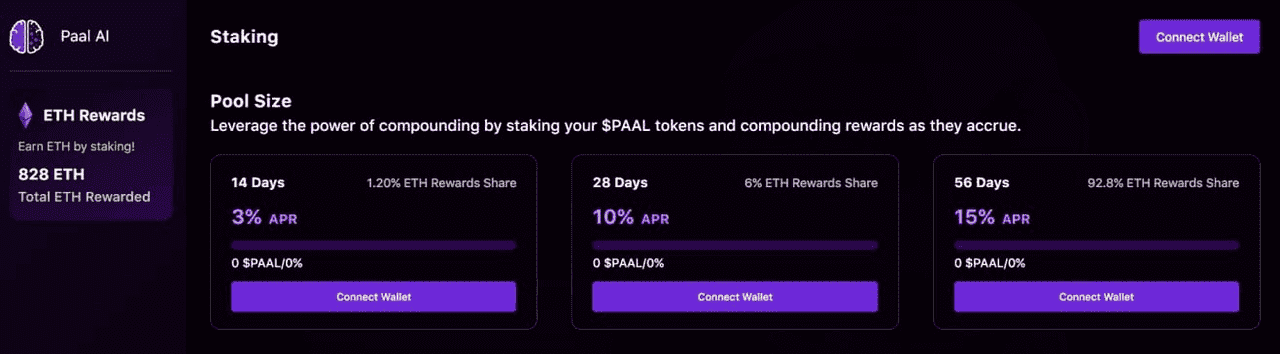
The staking documentation expands this further. It says the Staking DApp allows PAAL holders to stake their tokens and earn additional PAAL tokens and ETH. This suggests the token is designed not just for payment access, but also for long-term participation in the ecosystem’s reward mechanics. The same page says the pool had already distributed a substantial amount of ETH to stakers by the time of that documentation snapshot.
The revenue-sharing page adds another layer. It says PAAL AI’s revenue-sharing model is integrated with platform revenue generation from a proprietary AI solution, advertising and cross-promotion, and a 1% trading tax. That means the token is tied not just to staking, but to a broader narrative around ecosystem-level monetization and reward flows.
PAAL is the utility and staking token of the PAAL AI ecosystem, used for premium access, staking rewards, and participation in a revenue-linked reward structure.
What Does PAAL Do?
Based on PAAL’s current official materials, the token has several important functions.
Unlocking Premium AI Services
The token-information page explicitly says PAAL is used to unlock exclusive AI services and advanced tools. This is one of the strongest official utility statements available today.
Staking for Rewards
The staking documentation says users can stake PAAL to earn both additional PAAL and ETH. That gives the token a clear participation and yield role in the ecosystem.
Revenue-Sharing Exposure
PAAL’s revenue-sharing page says the ecosystem’s revenue comes from AI solutions, advertising and cross-promotion, and trading taxes. While the exact economic distribution mechanics are product-specific, the page clearly links staking and token participation to these broader revenue streams.
Ecosystem Utility
The broader docs and website present PAAL as the token powering a large ecosystem of bots, agents, and utilities. That means the token’s role is not limited to one app or one service. It is intended to sit across the wider PAAL environment.
PAAL AI’s Product Ecosystem
One of PAAL AI’s most notable strengths is that it presents a multi-product ecosystem rather than a one-tool pitch.
The AI Web Widget suggests a B2B or embedded-use strategy, allowing websites or portals to integrate AI-driven crypto assistance.
The Ask.Paal Crypto Research Engine targets traders and researchers who want real-time crypto analysis and AI-powered research workflows.
MyPaalBot/AutoPaal appears aimed at deeper autonomous or research-oriented usage, combining broader data access with AI analysis and staking-linked revenue-sharing incentives.
Taken together, these products show that PAAL AI is not just a community bot project. It is trying to build an AI service stack that covers:
user support,
crypto research,
embedded website AI,
and increasingly agent-style automation.
Why PAAL AI Matters in the AI-Agent Sector
PAAL AI matters because it sits in an increasingly important part of the crypto market: AI tools that are actually embedded in crypto workflows.
A lot of AI-agent projects focus heavily on narratives about autonomy, but have relatively thin product surfaces. PAAL’s documentation, by contrast, shows an ecosystem with multiple named products and user-facing utilities. That does not automatically make it superior to every competitor, but it does make it more concrete than many AI-token projects that remain mostly conceptual.
It also matters because PAAL appears to bridge both retail and platform use cases. The research engine targets individual users, while the web widget and custom AI-service positioning suggest B2B and community-integration ambitions. That broader footprint may help explain why the project keeps emphasizing an ecosystem rather than a single flagship app.
Finally, PAAL AI matters because it connects the AI-agent narrative to revenue-generating utilities and tokenized incentive design. Its staking and revenue-sharing pages show an explicit effort to tie ecosystem usage to token-holder incentives.
Current Direction as of Today
Based on PAAL’s current official site and documentation, the project’s present direction appears to center on three themes:
First, expanding AI product utility across web, research, bots, and agent-based services. That is supported by the ecosystem docs and the breadth of listed product pages.
Second, strengthening token utility through staking and premium service access. That is directly supported by the token-information and staking pages.
Third, positioning PAAL as an agent platform, not only a chatbot suite. The “How We Work Together” page’s language around intelligent agents and autonomous trading tools is especially important here.
So as of today, PAAL AI is best understood as a multi-surface crypto-AI platform with growing agent branding, rather than only a legacy bot product. That is an inference based on the current official materials.
Risks and Limitations
PAAL AI is interesting, but it comes with important risks.
The first is execution risk. PAAL’s ecosystem is broad, spanning research tools, widgets, bots, agents, custom services, and staking economics. A broad ecosystem creates more upside, but it also means the project must execute well across many surfaces at once. This is an inference based on the scope shown in its docs and website.
The second is token value-capture risk. PAAL has clearer utility than many AI tokens, but investors still need to ask how much product usage translates into durable token demand over time. Utility alone does not guarantee sustained token value. This is a general inference based on token-economics reality, though PAAL’s own docs do support genuine staking and service-access use cases.
The third is competitive risk. The AI-agent and crypto-AI sector is now crowded with research engines, trading assistants, custom agents, and multi-agent platforms. PAAL has real products, but it is competing in a rapidly evolving field where product differentiation can erode quickly. This is an inference based on broader market conditions.
The fourth is volatility risk. PAAL is still a crypto asset in a narrative-heavy sector. Public market pages show that PAAL has experienced severe drawdowns from past highs, which is common in AI-related tokens and should not be ignored.
Conclusion
PAAL AI is one of the more developed crypto-AI ecosystems because it is trying to offer more than one product and more than one narrative. Its official materials show a platform built around bots, research tools, intelligent agents, embedded AI widgets, and a token economy designed for service access and staking.
PAAL AI is a multi-product AI platform for crypto users and communities, and PAAL is the native token used for premium access, staking rewards, and participation in the ecosystem’s broader utility layer.
As AI agents, crypto research tools, and embedded AI services continue to evolve, projects like PAAL AI show how blockchain tokens can be used to coordinate access, incentives, and platform participation around AI ecosystems. For traders looking to stay ahead of emerging narratives—from AI agents and autonomous tools to RWAs, PayFi, and chain abstraction—Phemex offers a secure and user-friendly platform to explore the market, monitor new opportunities, and sharpen your trading edge.
