








Key Takeaways
Olas is a platform for co-owned AI, aiming to let users and businesses participate in AI agent economies rather than simply renting closed AI services.
Pearl is Olas’ consumer-facing app, described as an “AI Agent App Store” where users can run agents on a device they control and stake OLAS for potential rewards.
Mech Marketplace is Olas’ business-facing “AI Agent Bazaar,” where agents can buy and sell services via agent-to-agent, or A2A, interactions.
OLAS is the utility token that gives access to core functions of the network and coordinates incentives across builders, operators, bonders, and governors.
Olas uses a protocol design with registries, staking, bonding, builder rewards, and governance, making it closer to an AI-agent operating economy than a single app token.
As of April 2026, Olas has been pushing Pearl, Mech Marketplace, x402 support, ERC-8004-related agent standards, and newer consumer agent products like Polystrat.
Artificial intelligence and crypto have become one of the market’s most crowded narrative intersections. But most “AI tokens” are still little more than speculative wrappers around a vague promise: maybe an AI product will appear later, maybe the token will somehow capture value, maybe a community will form around it. Olas is trying to take a more concrete path. The project frames itself as a platform for “true co-ownership of AI”, where users can run AI agents they control, businesses can monetize AI agent services, and the OLAS token coordinates the entire system.
At a high level, Olas has three core layers. First is Pearl, which Olas describes as the “AI Agent App Store” for users. Second is the Mech Marketplace, which it calls the “AI Agent Bazaar,” where agents can hire other agents’ services or offer their own services. Third is the OLAS token, which provides access to core network functions and helps bootstrap what Olas calls agent economies.
That makes Olas more than just an AI-themed token. It is an attempt to build a coordinated, tokenized economy of autonomous agents—one where agents can be owned, operated, rewarded, and composed into larger systems. For readers trying to understand where the “AI agent” narrative might go beyond memes, Olas is one of the more infrastructure-heavy projects in the sector.
What Is Olas?
Olas is a crypto-AI platform built around the idea that people should be able to own and benefit from AI agents, not just pay for access to centralized AI tools. Olas’ official docs define it as “the platform that enables true co-ownership of AI,” while its About page says the mission is to coordinate the growth of autonomous AI agents that trade, influence, and predict on behalf of their owners.
That phrase—co-owned AI—is central to the project’s branding. Olas argues that crypto solved ownership for money and digital assets, but AI still largely follows a rental model where users rely on centralized providers. Its answer is to create an open ecosystem where users can run agents, businesses can build and list them, and the protocol can reward the different contributors needed to grow that ecosystem.
The project is also unusually early in the AI-agent category. Olas’ February 2025 announcement described it as “the original AI agent project,” stating that it has enabled AI agents in crypto since 2021. While “original” is partly marketing language, the broader point is clear: Olas is not a new narrative-chasing launch. It has been building toward agent coordination, autonomous services, and protocol incentives for several years.
How Olas Works
To understand Olas, it helps to separate the ecosystem into products and protocol.
Pearl: The AI Agent App Store
Pearl is the user-facing layer. In Olas’ docs, Pearl is described as an app where users can run agents on a device they control, stake OLAS for potential rewards, and benefit from those agents. Olas’ roadmap says Pearl is meant to offer simplified onboarding, a more Web2-like experience, fiat on-ramping, no-code usability, and a growing catalog of specialized agents.
This is important because many AI-agent projects remain developer-first or wallet-native. Pearl is clearly trying to lower the barrier for normal users. Instead of requiring someone to assemble infrastructure, configure APIs, and self-host everything from scratch, Olas wants users to access agent functionality through an app-store-style experience.
An earlier Pearl blog post also emphasizes accessibility, open-source transparency, and recovery options, framing Pearl as a way to enter autonomous AI without advanced skills or hardware. That reinforces the idea that Olas is trying to build consumer AI-agent distribution, not just protocol tooling.
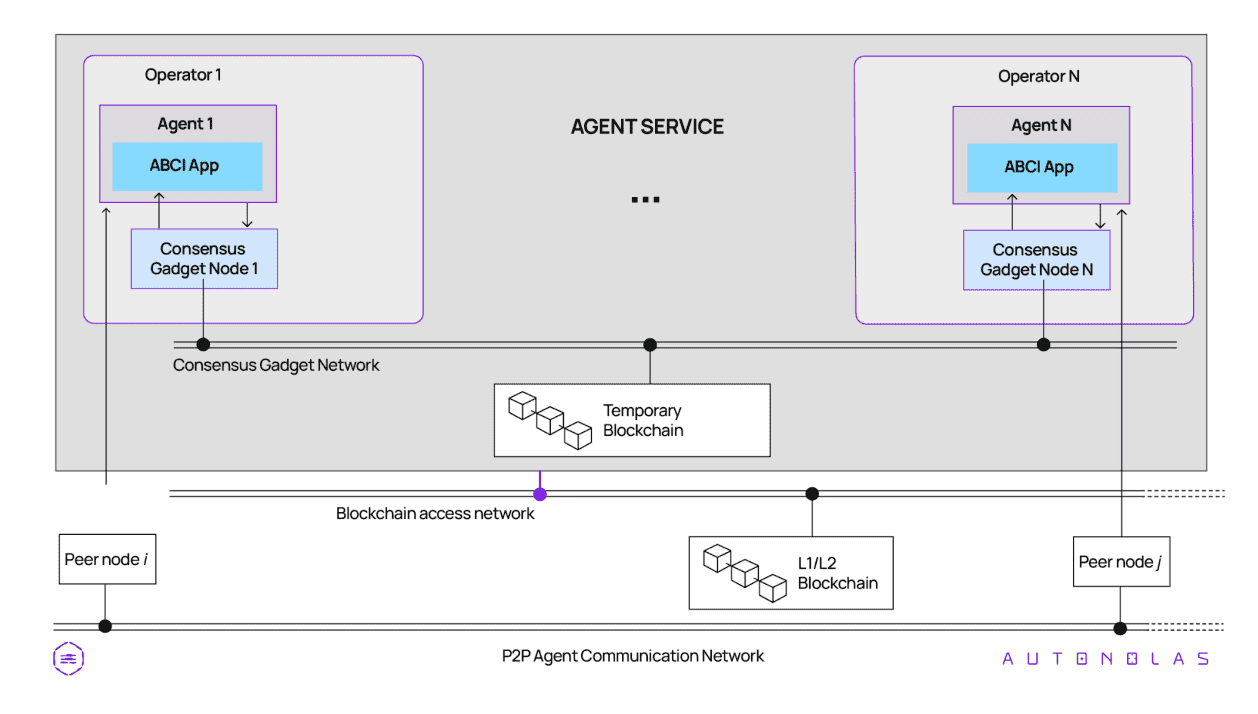
Agent Service (source)
Mech Marketplace: The AI Agent Bazaar
On the business and infrastructure side, Olas operates the Mech Marketplace, which it describes as a decentralized marketplace where AI agents can hire the services of other AI agents or list their own services to earn crypto. The official marketplace page calls it the “ultimate bazaar for AI agents” and highlights A2A collaboration, meaning agent-to-agent interactions.
This matters because one of the main bottlenecks in AI agents is capability fragmentation. An agent might be able to make trading decisions but not generate images, access a particular tool, or run a specialized prediction model. Olas’ answer is not to stuff every capability into one monolithic agent. Instead, agents can outsource tasks to other specialized agents via the marketplace.
The Mech Marketplace page says this allows businesses to hire or offer AI-agent services with “no API keys” and using cryptographic signatures instead. The Mechs page further explains that a Mech agent can handle tasks like LLM requests, automation, or data access: a requesting application or agent sends an on-chain request, pays a fee in crypto, the Mech executes the request off-chain, and then records the response on-chain.
In other words, Olas is trying to make AI services composable in the same way DeFi made financial primitives composable. Rather than building one AI app that does everything, it wants to create a marketplace where autonomous services can be bought, sold, combined, and reused.
The Protocol Layer
Underneath Pearl and the marketplace sits the Olas Protocol. The OLAS token page says the protocol is centered around on-chain registries that track AI agents and the open-source code they are composed of. These include software registries for components and agent blueprints, registered as ERC-721 NFTs, and an AI Agent Registry that maintains sovereign and decentralized agents and coordinates their operators.
That structure makes Olas more protocolized than many AI projects. Rather than simply launching an app with a token, it uses registries to identify code, agent blueprints, and running agents on-chain. This is part of why Olas talks about an ecosystem and not just a product suite.
What Makes Olas Agents Different?
Olas’ agents are not just chatbots with a token attached. The official agents page says Olas agents have several distinguishing features: they self-custody resources via a wallet, they can earn rewards via Olas staking, they can be listed on the Mech Marketplace, and they can optionally be made accessible to end users through Pearl.
The same page distinguishes between sovereign agents and decentralized agents. Sovereign agents are run by a single operator on a machine they control, while decentralized agents are run by multiple operators and synchronized through shared state and consensus, which is intended for use cases where an agent should not be controlled by one party alone.
That distinction is useful because it shows Olas is not forcing one model on every agent. Some use cases need simplicity and a single operator. Others may benefit from fault tolerance, multi-operator coordination, or minimized dependence on one machine. Olas has been exploring this architecture for years, as earlier work such as its Autonomous Keeper Service described cooperative multi-agent systems with configurable fault tolerance and transparent public code.
What Is the OLAS Token?
The OLAS token is the utility token that coordinates the Olas ecosystem. The official token page says OLAS “provides access to the core functions of the network,” while the docs say it coordinates agent interactions in entire AI-agent economies.
Crucially, OLAS is not just there for trading. The protocol uses it in a structured incentive model across several roles:
Builders are incentivized through builder rewards for code and agent contributions.
Operators can stake and earn rewards for running active agents in agent economies.
Bonders provide liquidity and receive discounted OLAS through the bonding mechanism, helping the protocol acquire protocol-owned liquidity.
Governors lock OLAS into veOLAS, the vote-escrow version used for governance.
This makes OLAS closer to a coordination asset than a simple payment token. It helps allocate incentives to the different participants required to grow an agent economy: developers, operators, liquidity providers, and token governors.
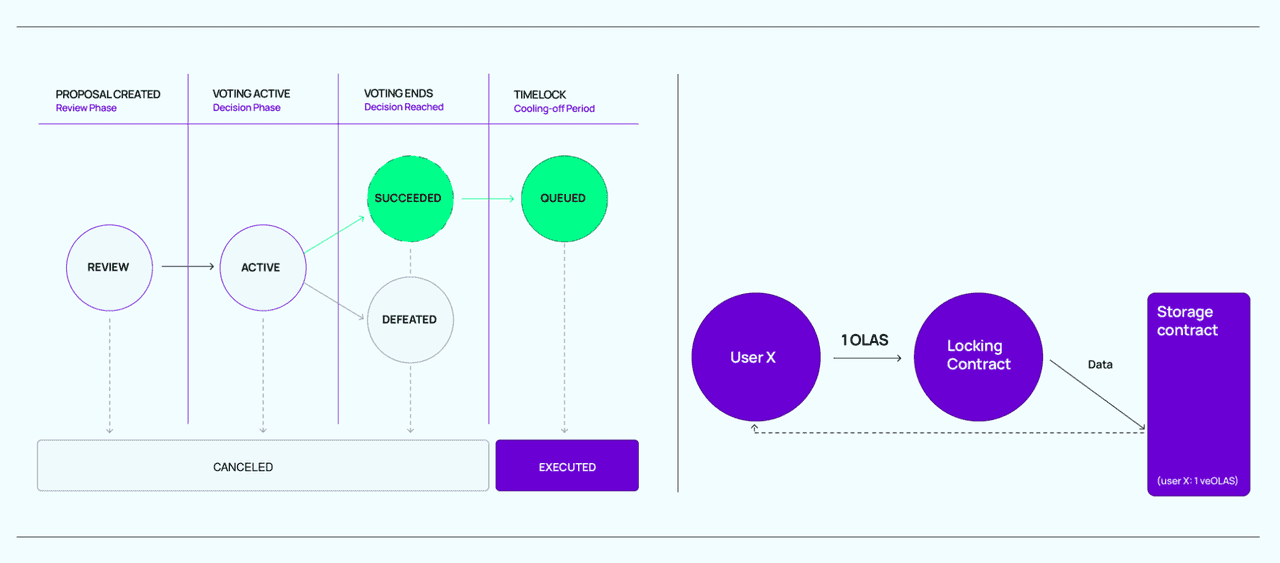
Protocol Governance (source)
OLAS Tokenomics
According to the official token page, a maximum of 1 billion OLAS tokens can be minted in the protocol’s first 10 years, and after year nine, an additional 2% can be minted each year, with the DAO able to reduce that inflation rate. The same page says newly minted tokens are currently distributed to builders, operators, and bonders on epochs that run roughly once a month, and DAO members can vote to update how emissions are allocated.
That tokenomics model tells you a lot about how Olas thinks. Rather than emphasizing fixed scarcity above all else, it emphasizes programmable emissions to bootstrap ecosystem growth. This is somewhat similar to how some DeFi protocols used inflation to fund liquidity, development, and participation—except here the target is an economy of AI agents and services.
The token page also shows OLAS deployed across multiple chains, including Ethereum, Gnosis, Polygon PoS, Arbitrum, Solana, Optimism, Base, Celo, and Mode, with chain-specific token addresses and bridges referenced directly on the site. That multi-chain presence fits Olas’ ambition to be infrastructure rather than a single-chain niche product.
The Olas Flywheel
Olas repeatedly describes its ecosystem in terms of a flywheel between Pearl and Mech Marketplace. Its roadmap says OLAS bootstraps this flywheel, and the About page explains the logic clearly: users adopt agents via Pearl, those agents need services from the marketplace, businesses create and list agents to serve that demand, and both sides require OLAS to access benefits in the system.
In plain English, the theory is this:
More users on Pearl means more demand for useful AI agents.
More agent usage means more demand for specialized agent services on Mech Marketplace.
That demand attracts more builders and businesses.
More useful agents improve Pearl, attracting more users.
OLAS coordinates access, incentives, staking, and participation across the whole loop.
This is one of the more coherent token-value narratives in the AI-agent sector. Whether it works at scale is another question, but at least the project has a defined theory of how product adoption and token utility are supposed to reinforce each other.
Why Olas Matters in the AI-Agent Sector
The AI-agent category is full of buzzwords, but Olas matters because it tackles several real problems at once.
First, it addresses ownership. Many AI products are effectively rented interfaces to centralized models. Olas is trying to shift the experience toward user-controlled agents running with self-custodied wallets and explicit permissions.
Second, it addresses distribution. Even useful agents need a way to reach users. Pearl is Olas’ attempt to solve that through an app-store-like interface.
Third, it addresses composability. A single AI agent rarely has every capability required for real work. The Mech Marketplace lets agents outsource tasks to other agents rather than reinvent everything internally.
Fourth, it addresses incentives. Most AI ecosystems still struggle to align developers, operators, liquidity providers, and users. Olas explicitly uses OLAS emissions, staking, bonding, and governance to coordinate those roles.
That does not guarantee success, but it does mean Olas is solving a more comprehensive problem than many tokens in the sector.
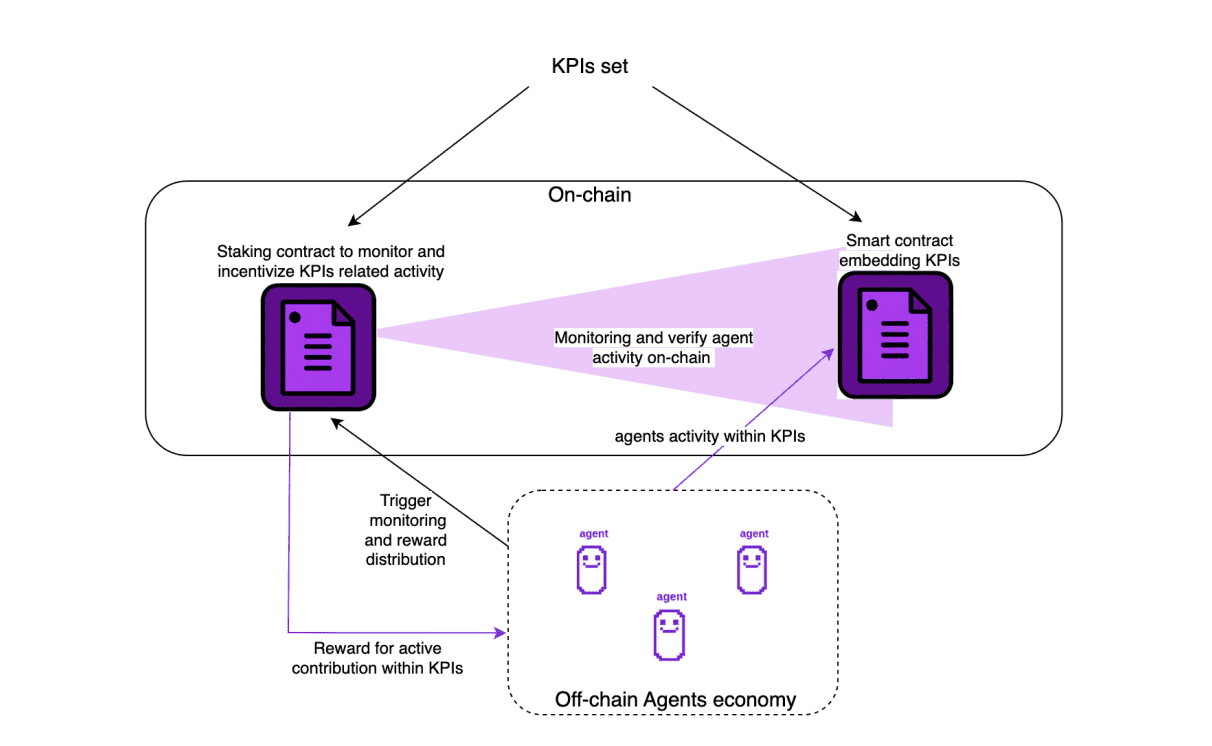
Olas Network Process (source)
Risks and Limitations
Olas has an interesting model, but it is not risk-free.
The first risk is adoption risk. The flywheel only works if enough users actually want to run agents through Pearl and enough businesses want to monetize services through the marketplace. Product theory is not the same as market traction. This is an inference from Olas’ own flywheel model and ecosystem design.
The second is execution complexity. Olas is not building one app. It is building a consumer layer, a business marketplace, registries, staking systems, token incentives, and governance. That breadth is powerful, but it also increases the chance of delays, fragmented priorities, or underperforming individual components.
The third is token design complexity. OLAS emissions support growth, but emissions can also create sell pressure if ecosystem participants treat rewards as income to be realized rather than long-term alignment. As with many incentive systems, the balance between bootstrapping growth and protecting token value is difficult. This is an inference based on the official emissions model.
The fourth is technical and security risk. Olas publishes audit references and has an Immunefi bug bounty with rewards up to $50,000, which is a positive signal, but no protocol is risk-free—especially one coordinating smart contracts, registries, marketplaces, agents, and cross-chain deployments.
Finally, there is narrative risk. AI-agent tokens can move dramatically on sentiment. Even if Olas continues building, market pricing can diverge significantly from fundamentals for long periods.
Final Thoughts
Olas is one of the more ambitious projects in the crypto-AI sector because it is not just asking traders to buy into an “AI” story. It is trying to build the rails for AI-agent economies: user-owned agents through Pearl, service marketplaces through Mech Marketplace, and protocol incentives through OLAS.
That makes Olas particularly interesting for readers who think the next phase of crypto AI will not be about chatbot branding or meme speculation, but about autonomous software that can transact, outsource work, coordinate with other agents, and remain economically linked to an open network. Olas’ own language around co-owned AI, A2A collaboration, and protocolized incentives points directly in that direction.
The simplest way to understand the project is this: Olas is trying to do for AI agents what app stores did for apps and what DeFi did for financial primitives—make them easier to access, compose, monetize, and own. Whether it becomes a category leader will depend on adoption, execution, and how much real usage its agent economies can sustain. But as of April 1, 2026, it is one of the clearest examples of a crypto-native attempt to turn AI agents into an open economic system rather than a closed product.
As AI-agent ecosystems continue to evolve, projects like Olas show how crypto can add ownership, coordination, and open-market incentives to the AI stack. For traders looking to stay ahead of emerging narratives—from AI agents and AgentFi to RWA and TradFi—Phemex offers a secure and user-friendly platform to explore the market, monitor new opportunities, and sharpen your trading edge.
