









Key Takeaways
A tokenized ETF is a blockchain-based representation of an exchange-traded fund, where ownership or economic exposure is recorded as digital tokens rather than only through traditional brokerage and transfer-agent systems.
Tokenized ETFs generally fall into two broad models: issuer-sponsored tokenized securities and third-party tokenized securities. Third-party versions can be either custodial or synthetic, which means not every tokenized ETF gives the same rights or legal claim on the underlying ETF shares.
The main appeal is operational: tokenized ETFs may enable 24/7 access, faster settlement, fractional ownership, and DeFi interoperability compared with traditional ETF rails.
The main risks are structural: regulatory uncertainty, liquidity fragmentation, smart-contract risk, and differences between direct ownership and synthetic exposure (no relevant link).
Tokenized ETFs are still early, but the broader direction of travel is clear: regulators, market infrastructure firms, and crypto-native platforms are increasingly treating tokenized securities as a serious part of future capital markets.
The ETF was already one of the most important financial inventions of the modern market era. It made diversified exposure easier, cheaper, and more tradable. Now tokenization is pushing that idea one step further. Instead of holding ETF ownership only inside traditional brokerage and post-trade systems, tokenization puts a representation of that ownership — or in some cases a representation of the ETF’s price exposure — onto blockchain rails.
That does not mean every tokenized ETF is the same thing. Some are structured as regulated tokenized securities where the token represents legal ownership or beneficial interest in real ETF shares. Others are created by third parties and may only track the value of an ETF through collateral or derivatives, without giving the holder the same legal rights as a direct fund investor. This distinction is one of the most important things beginners miss.
What an ETF Is in the First Place
Before getting into tokenization, it helps to remember what a regular ETF actually is. An exchange-traded fund is an investment vehicle that holds a basket of assets — such as stocks, bonds, commodities, or other instruments — and trades on an exchange like a stock. Investors buy and sell ETF shares through brokerage accounts during market hours. This structure made portfolio diversification much more accessible than buying every underlying asset individually.
A tokenized ETF does not change the basic economic idea of the ETF. What changes is the recordkeeping, transfer, and settlement layer. Instead of existing only as positions recorded within legacy securities infrastructure, the ETF exposure is represented through tokens on a blockchain.
What Makes an ETF Tokenized
A tokenized ETF is created when ETF ownership or ETF-linked exposure is formatted as a crypto asset on a blockchain. Chainlink’s overview says a tokenized ETF is a digital representation of an ETF where shares are issued and traded as tokens on a blockchain. The SEC’s January 2026 statement on tokenized securities fits this broader idea by defining tokenized securities as securities represented by crypto assets where the record of ownership is maintained in whole or in part on one or more crypto networks.
That means tokenization is not necessarily a new asset class. It is often a new wrapper or operating rail for an existing financial instrument. The ETF is still the underlying investment idea. The blockchain changes how access, transfer, compliance, and settlement can work.
The Two Main Types of Tokenized ETFs
The most useful way to understand tokenized ETFs is to separate them into two categories.
Issuer-sponsored tokenized ETFs
These are tokenized securities created by or on behalf of the issuer of the underlying security. In the SEC’s January 2026 taxonomy, issuer-sponsored tokenized securities are those where the issuer itself integrates distributed ledger technology into how ownership is recorded and maintained. In this kind of structure, the tokenized version is tied more directly to the legal ownership record of the security.
This is the cleaner and more institutionally robust model because the token is closer to the actual security itself, rather than just an outside wrapper tracking it. In theory, this model is more likely to preserve the legal and economic rights of the traditional ETF share while adding blockchain-based transfer and settlement benefits.
Third-party tokenized ETFs
The SEC also says tokenized securities can be created by third parties unaffiliated with the issuer of the underlying security. These can take different forms, including custodial tokenized securities and synthetic tokenized securities.
In a custodial model, a third party holds the real ETF shares with a custodian and issues tokens against them. In a synthetic model, the token may simply mirror the ETF’s price exposure through collateral, swaps, or other mechanisms, without the holder owning the actual ETF shares. This distinction matters because rights, redemption mechanisms, counterparty exposure, and regulatory treatment can differ significantly across models.
How a Tokenized ETF Works
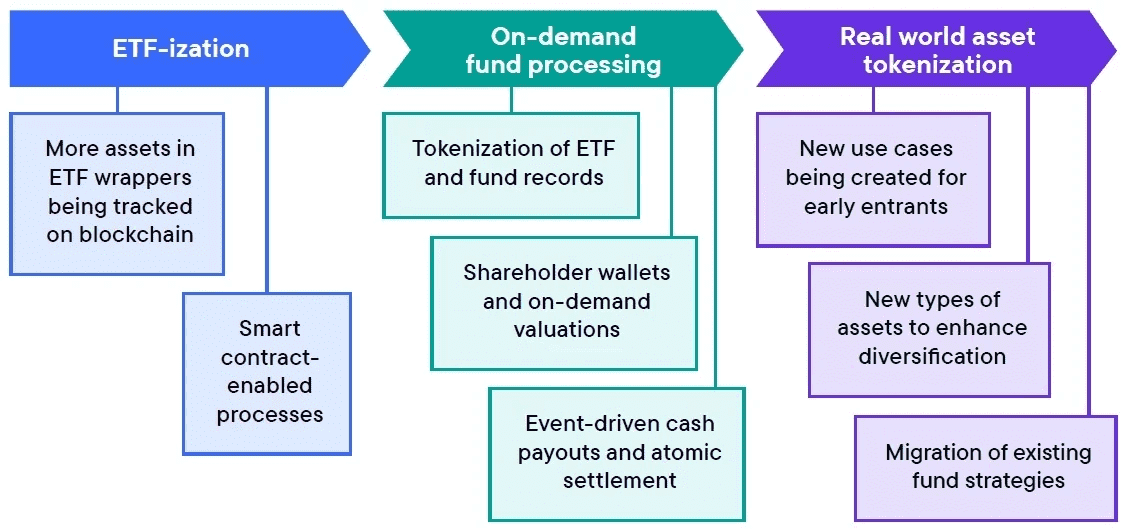
The mechanics vary, but the broad lifecycle is fairly intuitive. First, an issuer or third party creates the ETF-linked structure. If the model is asset-backed, the real ETF shares are held with a qualified custodian or similar entity. Then tokens are minted on a blockchain to represent those shares or that economic exposure. Smart contracts can govern transfers, compliance checks, and in some cases redemptions.
One major difference from traditional ETF infrastructure is settlement. In legacy securities markets, trade settlement has historically taken one or more days because intermediaries need to reconcile ledgers and clear the trade. In a tokenized system, settlement can happen much faster and potentially atomically, meaning the asset transfer and payment occur together or not at all. Chainlink highlights this as one of the core operational advantages of tokenized ETFs.
Why People Are Excited About Tokenized ETFs
The excitement comes from a combination of market access and market infrastructure. The first benefit is 24/7 or near-continuous access. Traditional ETF trading generally follows exchange hours. Tokenized representations can, depending on the platform and regulatory model, move on blockchain rails outside traditional market windows. Reuters reported in early 2026 that Intercontinental Exchange was developing infrastructure for 24/7 trading and on-chain settlement of tokenized securities, which shows how seriously mainstream market operators are taking this direction.
The second benefit is faster settlement. Tokenized rails can reduce the time between trade execution and final ownership transfer. That improves capital efficiency and can lower counterparty settlement risk. This is one of the most consistently cited structural advantages of tokenized securities.
The third benefit is fractionalization. A tokenized ETF can be divided into smaller units more naturally, which may make certain products more accessible and portfolio allocations more precise. Chainlink’s explanation emphasizes this as a native feature of tokenization.
The fourth benefit is DeFi composability. Once ETF exposure exists as an onchain asset, it can potentially be used in new ways — for example as collateral, inside structured products, or as part of automated portfolio systems — assuming the legal and technical design allows it. This is one of the biggest reasons tokenization is so attractive to crypto-native builders.
How Tokenized ETFs Differ From Traditional ETFs
The easiest mistake is to think tokenized ETFs are just regular ETFs with a cooler interface. The differences are more meaningful than that.
Traditional ETFs are bought through brokerages and live inside the conventional securities system. Ownership records, settlement, and corporate actions flow through central securities depositories, custodians, transfer agents, and brokers. Tokenized ETFs, by contrast, aim to move some or all of that ownership and transfer logic onto blockchain rails.
That can create new advantages, but it also creates new questions. A regular ETF share has well-understood legal and market infrastructure behind it. A tokenized ETF may introduce additional variables: smart contract code, blockchain choice, wallet risk, token redemption mechanics, and differences between direct ownership and synthetic exposure. So tokenization may improve usability in some ways while increasing complexity in others.
Tokenized ETFs vs. Tokenized Funds
A tokenized fund is a broader category. It can include money market funds, Treasury funds, private funds, mutual funds, or other pooled investment vehicles represented onchain. A tokenized ETF is a narrower subset where the underlying vehicle is specifically an exchange-traded fund.
This distinction matters because much of the real-world adoption so far has been in tokenized money market and Treasury products rather than fully tokenized ETFs. The broader tokenized securities movement is clearly accelerating, but the ETF-specific part of that market is still emerging.
The Main Risks of Tokenized ETFs
Tokenized ETFs sound efficient, but investors should stay realistic about the risks. The first risk is regulatory complexity. Securities law still applies. The SEC’s January 2026 statement makes clear that tokenized securities remain securities under federal law; tokenization changes the format, not the legal status. That means issuers and platforms still need to handle disclosure, registration, custody, transfer restrictions, and investor protections appropriately.
The second risk is structural ambiguity. Not every tokenized ETF gives the same rights. Some may give direct beneficial ownership. Others may only offer contractual or synthetic exposure. Investors need to know which model they are buying.
The third risk is liquidity fragmentation. Chainlink points out that if tokenized products live on many disconnected blockchains or platforms, markets can become siloed rather than more efficient. A tokenized ETF is only as useful as the ecosystem around it.
The fourth risk is smart contract and wallet risk. Traditional ETF investors usually do not need to think about contract exploits or self-custody mistakes. Tokenized products can introduce those risks if the design relies heavily on blockchain-native infrastructure.
The fifth risk is legal and operational mismatch. Faster onchain transfer is useful only if the legal record, custodian, and issuer framework all recognize and support that transfer in a clean way. This is why tokenized securities infrastructure is advancing carefully and often under regulated pilot structures.
Why Tokenized ETFs Matter for Crypto
Tokenized ETFs matter because they could bring one of traditional finance’s most successful wrappers directly into the onchain economy.
If tokenized ETFs gain traction, they could expand the menu of investable assets available to crypto-native portfolios without requiring investors to leave blockchain rails. They could also deepen the overlap between crypto markets and traditional securities markets, especially if tokenized ETFs become usable in lending, collateral, and structured-product ecosystems.
This is also part of a broader shift. Reuters reported in 2026 that U.S. banking regulators said tokenized securities would not face extra capital charges simply because they are tokenized, reinforcing the view that the financial system is increasingly treating tokenization as a change in infrastructure rather than a separate asset category.
The Bigger Picture
The deeper significance of tokenized ETFs is not only about convenience. It is about market architecture. Traditional finance and crypto finance have spent years developing in parallel. ETFs belong to one system. DeFi and tokenized assets belong mostly to another. Tokenized ETFs could help connect those systems by bringing diversified traditional exposures into programmable onchain environments.
That does not mean the transition will be smooth or immediate. Legal rights, transfer controls, settlement rules, and investor access all need to be worked out carefully. But the fact that the SEC is now explicitly classifying tokenized securities, and that major institutions are building tokenized-securities infrastructure, shows the market is moving beyond theory.
Conclusion
A tokenized ETF is a blockchain-based representation of an ETF, designed to bring ETF ownership or ETF-linked exposure onto digital rails. Depending on the structure, it may represent direct ownership of real ETF shares or synthetic exposure created by a third party. That distinction is crucial, because not all tokenized ETFs offer the same rights or risk profile.
The reason tokenized ETFs matter is that they combine the familiar appeal of ETFs — diversified, efficient market exposure — with the potential advantages of blockchain infrastructure, including faster settlement, programmability, fractionalization, and interoperability with onchain markets.
But they are still early. Regulatory structure, liquidity, legal design, and technical security all matter. So the right way to think about tokenized ETFs is not as a guaranteed upgrade to every ETF. It is as an emerging model that could become a major part of the next generation of financial infrastructure if it proves trustworthy and useful at scale.
