










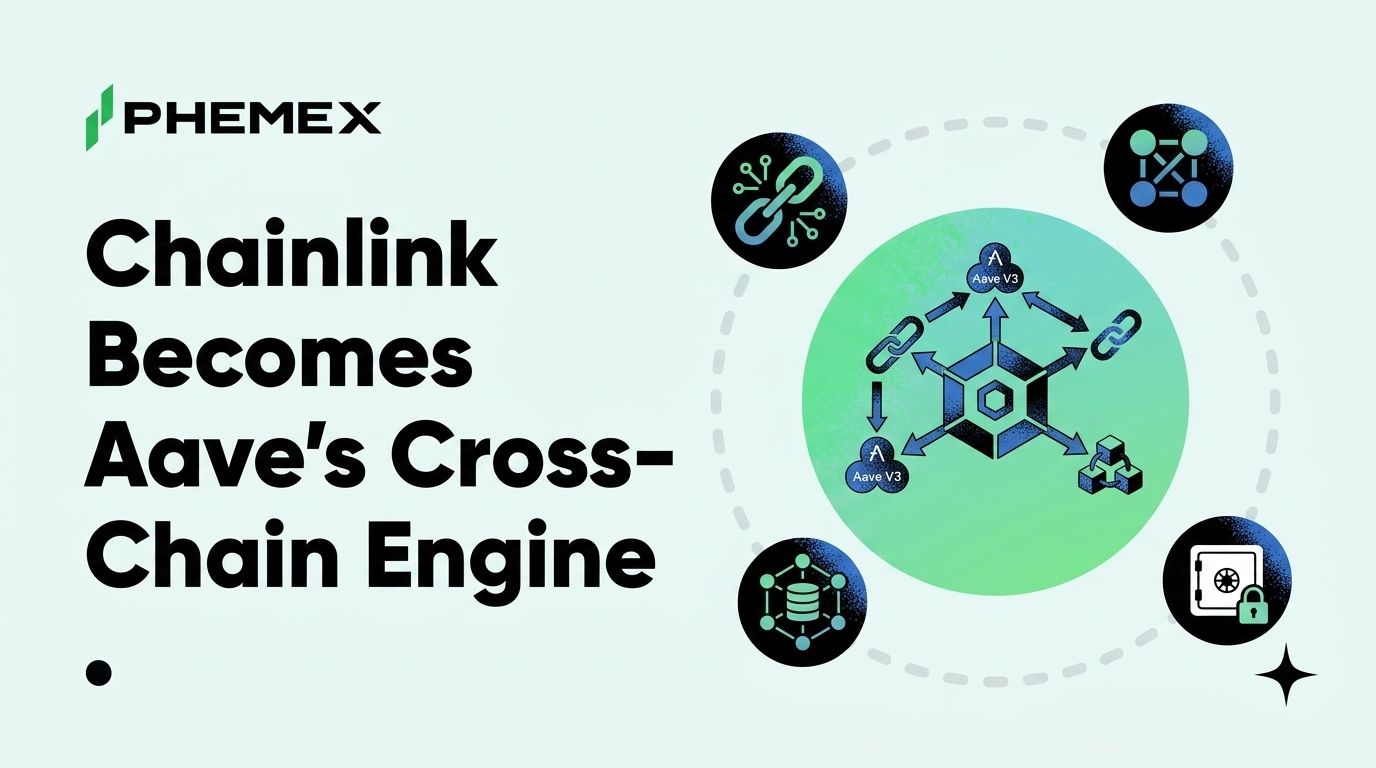
Chainlink is trading around $8.51, up about 3.13% on the day, and that modest move is the whole story in miniature. On July 13-14, 2026, Aave, the largest lending protocol in decentralized finance, named Chainlink CCIP its default cross-chain engine. That single decision now routes deposits, withdrawals, its Stable Vaults, GHO stablecoin transfers, and governance messaging across Ethereum, Base, and Arbitrum through Chainlink's rails.
A catalyst that big should, in theory, move a token more than 3%. It did not, and being honest about that gap is the point of this piece. This is a fundamentals and adoption story, not a price breakout. Chainlink is quietly becoming the trusted plumbing between blockchains, the same way it became the trusted plumbing for price data years ago. The open question underneath the headline is if the LINK token ever fully prices that role.
LINK price: $8.51, up 3.13% on the day
AAVE price: $96.57
BTC price: $64,568
ETH price: $1,923
Catalyst: Aave named Chainlink CCIP its default cross-chain engine, July 13-14, 2026
Here is what Aave actually chose, what CCIP does, and why the token has lagged its own adoption for years.
Where Chainlink Trades After the Aave Decision
LINK changed hands near $8.51 this morning, a gain a little over 3% on a broadly risk-on tape that lifted most of the market after this week's soft CPI and PPI prints. Bitcoin sits around $64,568 and Ethereum near $1,923, so LINK is moving with the crowd rather than pulling away from it on the back of its own news. That is worth sitting with for a second, because the Aave decision is arguably the most significant infrastructure win Chainlink has landed all year.
Do not expect this section to hand you invented support and resistance numbers. The honest read on the chart is simple, and you can confirm the live figure on Chainlink's CoinGecko page. LINK is up modestly, in line with a market that caught a relief bid, and there is no visible re-rating that says traders have decided this integration changes the token's trajectory. The reference point that matters is the muted reaction itself. A protocol handling billions in deposits just made Chainlink its default cross-chain layer, and the token barely flinched. That disconnect is the trade to think about, not a Fibonacci level.
What Aave Actually Chose and Why It Matters
Aave did not add Chainlink as one option among several. It made CCIP the default. Deposits and withdrawals that hop between chains, the new Stable Vaults, transfers of the GHO stablecoin, and the governance messages that let token holders vote across networks now move through Chainlink's cross-chain protocol by design rather than by exception. That covers Aave's presence on Ethereum, Base, and Arbitrum, three of the most active venues in decentralized finance.
The reason this is a real vote of confidence comes down to where crypto has historically bled. Cross-chain bridges have been the single most exploited part of the industry, with billions of dollars drained through bridge hacks over the years. When the largest lending protocol chooses a security-first standard as its default plumbing, it is making a statement that the old approach of bolting on whatever bridge was cheapest is over. You can see why that matters in the pattern of 2026 bridge exploits, where the attack surface was almost always the connective tissue between chains rather than the applications themselves.
What CCIP Is in Plain English
CCIP stands for Cross-Chain Interoperability Protocol, and the plain-English version is that it lets tokens and messages move securely between blockchains that otherwise cannot talk to each other. Think of blockchains as separate countries with their own currencies and no shared postal service. CCIP is the courier that carries a package from one to another, verifies it was not tampered with in transit, and delivers it intact.
The security-first framing is the part that earns the trust. Instead of a single bridge operator holding the keys, CCIP layers independent verification on top of the transfer, which is exactly the design lesson the industry learned the hard way after years of bridge disasters. Chainlink already won this argument once with oracles, becoming the default way protocols pull reliable price data on-chain. It is now running the same playbook for the movement of value between chains. Aave choosing it as a default is the clearest sign yet that the playbook is working a second time.
The Adoption Is Everywhere Except the Price
Aave is not an isolated win. In the same window, Mantle migrated its $2.5 billion Super Portal bridge over to CCIP, part of more than $7.2 billion in recent migrations onto the protocol. CCIP also underpins Robinhood's tokenized-stock offering, which pushes Chainlink beyond native crypto and into the institutional tokenization stack. Stack those up and the direction is obvious.
|
Integration
|
What moved to CCIP
|
Scale
|
|
Aave
|
Default cross-chain engine for deposits, GHO, governance
|
Largest DeFi lending protocol
|
|
Mantle
|
Super Portal bridge migration
|
$2.5 billion
|
|
Recent migrations (total)
|
Bridges and messaging rerouted
|
Over $7.2 billion
|
|
Robinhood
|
Tokenized-stock infrastructure
|
Institutional tokenization
|
And that is before you add the institutional plumbing work with SWIFT and DTCC that has been building for a while. Every one of these deepens Chainlink's moat as critical infrastructure. None of them automatically flows to LINK holders one-for-one. That is the tension the whole thesis turns on.
The Value Accrual Question Nobody Can Ignore
Here is the honest core of the Chainlink debate. The network is indispensable, but the token's capture of all that usage has been indirect and slow. Chainlink secures an enormous share of DeFi and, increasingly, tokenized real-world assets, yet the LINK token does not mechanically collect a slice of every transaction the way a simple fee model would. The muted price reaction to the Aave news is that gap in action, live on the tape.
The bull case is straightforward and patient. As CCIP usage compounds and the staking and fee mechanisms mature, the argument goes, the token eventually starts to capture the network's importance, and a re-rating follows. More chains, more transfers, more fees routed through a system that stakers help secure and get paid for. If that machinery tightens, adoption and token value converge.
The bear case is just as real and has years of evidence behind it. Indispensable infrastructure and a valuable token are not the same thing. LINK has underperformed its own adoption for a long time, and pointing to a bigger moat has not reliably moved the price. A skeptic can look at the Aave headline, look at a 3% candle, and conclude that the market has already decided how much token value these integrations are worth, which is not much. Both readings are defensible right now, and anyone selling you certainty on either side is guessing.
Why the Gap Is Worth Watching
For a trader, Chainlink is one of the cleaner tests in the market of a single question. Does fundamental adoption eventually win, or can a protocol be everywhere and still leave its token behind. Chainlink sits under a huge slice of DeFi and a growing slice of institutional tokenization, so the sample size is real and the stakes are visible.
Watching if LINK finally starts to price its adoption, versus continuing to lag it, tells you something bigger than one token's chart. It tells you if the market is willing to reward infrastructure that wins on trust rather than hype. The Aave decision just raised the stakes on that question. The token's answer, so far, is a shrug, and that shrug is exactly what makes it interesting.
Frequently Asked Questions
What did Aave announce about Chainlink CCIP?
On July 13-14, 2026, Aave named Chainlink CCIP its default cross-chain engine, routing deposits, withdrawals, its Stable Vaults, GHO stablecoin transfers, and governance messaging across Ethereum, Base, and Arbitrum through the protocol. It is a default choice, not an optional add-on, which is what makes it a strong endorsement of Chainlink's security-first design.
Why did the LINK price barely move on such big news?
Because Chainlink's challenge has always been that the network can be indispensable while the token captures that value slowly and indirectly. The 3% move on a major integration is the value-accrual gap showing up in real time. Adoption is compounding faster than the token has historically priced it.
What is Chainlink CCIP in simple terms?
CCIP is a protocol that lets tokens and messages move securely between different blockchains, with independent verification layered on top of each transfer. Cross-chain bridges have been the most exploited part of crypto, so a security-first standard becoming a default for a major lending protocol is a meaningful trust signal.
Is Chainlink a good long-term hold?
That depends on if you believe the token eventually captures the network's importance as staking and fee mechanisms mature, which is the bull case, or that indispensable infrastructure and a valuable token stay separate, which is the bear case backed by years of underperformance. The honest answer is that both remain open, and the coming quarters of CCIP usage are the test.
The Bottom Line
Chainlink just became default plumbing for the largest lending protocol in DeFi, and the token responded with a 3% shrug. That is the entire thesis in one sentence. The catalyst is real, the adoption is stacking with Aave, Mantle, and Robinhood, and the value-accrual question is still unresolved. Watch two things from here. Watch if CCIP volume and the staking and fee mechanics keep tightening, and watch if LINK ever starts to trade like the infrastructure it has become. If adoption eventually wins, the gap between how important Chainlink is and how the token trades closes fast. If it does not, this stays the market's most patient waiting game.
This article is for informational purposes only and does not constitute financial or investment advice. Cryptocurrency trading involves substantial risk. Always conduct your own research before making trading decisions.
