


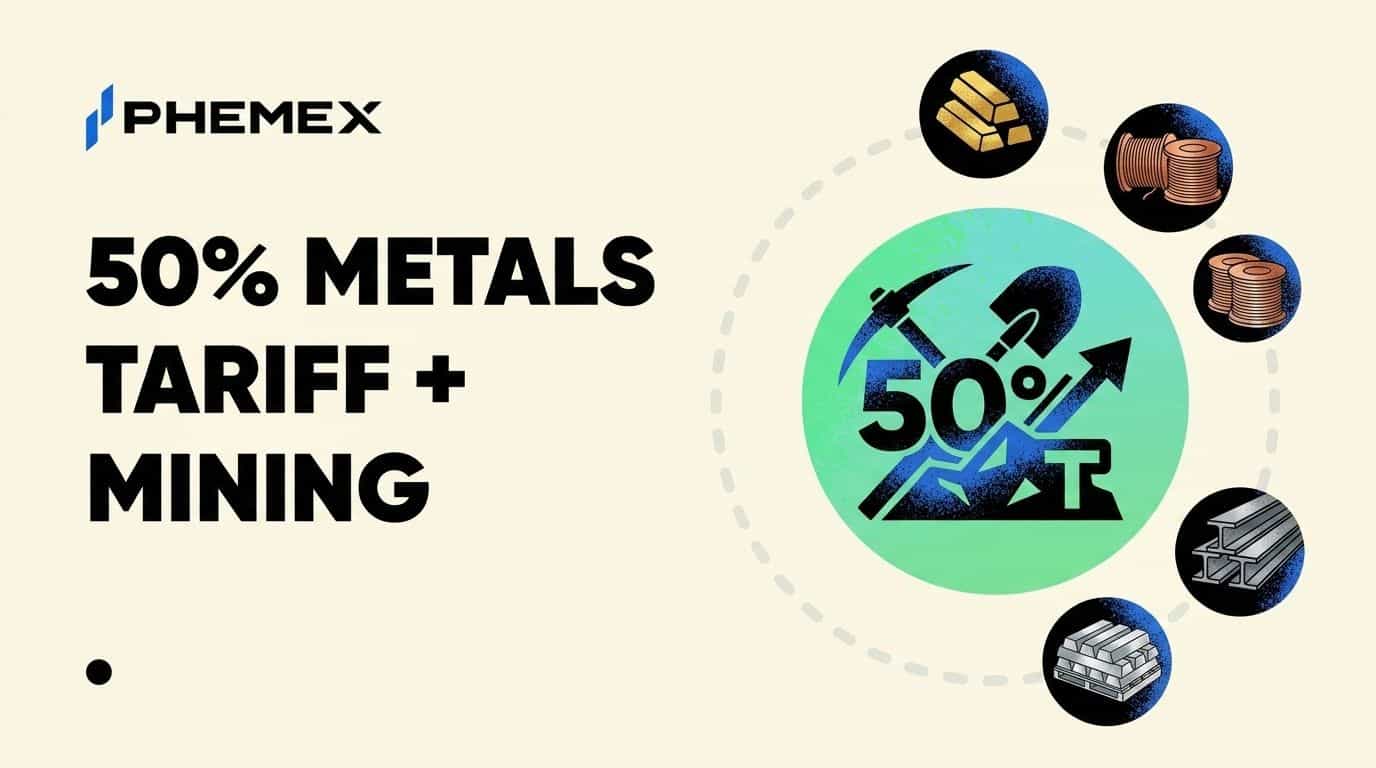
President Trump signed a Section 232 proclamation on April 2, 2026, restructuring tariffs on steel, aluminum, and copper imports with rates reaching 50% on articles made entirely of these metals and 25% on derivative products that contain substantial amounts of them. The new rates took effect April 6. Bitcoin mining hardware is built from all three of these metals, with aluminum forming the chassis and heatsink assemblies, copper winding through the wiring harnesses and printed circuit boards, and steel reinforcing the structural frames of large-scale mining containers and rack systems.
BTC is trading around $72,200 as of April 10, and the network hash rate sits near 870 EH/s. Mining margins are already compressed after the April 2024 halving, and now the raw materials that go into every mining rig just got significantly more expensive to import. The question is how much of that cost actually reaches miners, and who benefits from the disruption.
What the April 2 Proclamation Actually Changes
The April 2 proclamation creates a tiered system that applies differently depending on how much metal a product contains. Articles made entirely or almost entirely of aluminum, steel, or copper pay 50% on their full customs value. Derivative products that are substantially made of these metals pay 25% on the full value of the finished good rather than only the metal content. That second part is the change that matters most for electronics manufacturers, because the tariff now applies to the entire product value instead of the metal portion alone.
Products containing 15% or less metal by weight are exempt entirely, and certain electrical grid equipment gets a reduced 15% rate through 2027. Mining hardware does not qualify for either carveout.
How Much Aluminum and Copper Is Actually in a Mining Rig
An Antminer S21 XP, the current flagship ASIC from Bitmain, weighs approximately 14.6 kg. The aluminum heatsinks alone account for 30-40% of the total mass in high-performance ASIC designs, and they are the primary thermal management system that keeps hash boards running at rated efficiency.
Copper shows up in three places. The internal wiring harness uses copper conductors, the printed circuit boards contain multiple copper layers for power distribution and signal routing, and the integrated power supply unit contains copper transformer windings and bus bars.
The total metal content of a typical ASIC miner puts it squarely in the derivative product category at minimum, meaning it faces the 25% tariff rate on its full customs value. A $6,400 Antminer S21 XP would incur roughly $1,600 in Section 232 metals tariffs on top of the existing 21.6% reciprocal tariff on ASIC miners from Southeast Asia. That layers to a combined tariff burden approaching 47% before any other import duties.
But the cost pressure runs deeper than individual machines. Mining containers, the standardized units that house dozens of ASICs for industrial deployments, are steel structures with copper wiring and aluminum ventilation. A container costs $30,000-$80,000 depending on configuration, and at 50% on the steel frame plus 25% on derivative components, that price just jumped $10,000-$25,000.
The Squeeze on Mining Economics
US miners were already operating on thin margins before April 2. All-in production costs for publicly listed American miners averaged roughly $74,600 per Bitcoin in late March 2026, factoring in depreciation, electricity, and overhead. With BTC at $72,200, that math was already uncomfortable. Adding 25-50% metals tariffs on top of the existing 21.6% ASIC import levy pushes the cost of deploying new mining capacity significantly higher.
The compounding effect is what separates this from a one-time cost hit. ASIC generations turn over every 12-18 months as efficiency improvements make older machines obsolete, and every refresh cycle forces miners to buy new equipment at tariff-inflated prices. A US miner replacing an S19 fleet with S21 XPs now pays roughly 47% more than a competitor in Kazakhstan or Russia buying the same machines with zero tariff exposure.
|
Cost Component
|
Pre-April 2
|
Post-April 2
|
|
Antminer S21 XP base price
|
$6,400
|
$6,400
|
|
Reciprocal tariff (21.6%)
|
$1,382
|
$1,382
|
|
Section 232 metals tariff (25%)
|
$0
|
$1,600
|
|
Landed cost per unit
|
$7,782
|
$9,382
|
|
Cost increase per unit
|
|
+$1,600 (+20.6%)
|
Hashprice, the daily revenue per terahash, is already sitting near historical lows. Miners cannot absorb another 20% hardware cost increase without either raising capital, cutting expansion plans, or waiting for BTC to move higher. For the marginal miner operating near breakeven, this is the difference between staying online and shutting down.
Who Wins From the Metals Tariff
The winners fall into three categories, and none of them are small US miners trying to scale up.
Large miners with pre-tariff hardware inventories. Marathon Digital, Riot Platforms, and CleanSpark placed massive equipment orders throughout 2024 and early 2025, locking in prices before both the reciprocal tariffs and the metals tariffs took effect. American Bitcoin, backed by the Trump family, purchased 11,298 ASIC miners at pre-tariff pricing. These companies now hold a structural cost advantage over any competitor still buying hardware at current prices.
Non-US mining operations. Russia controls approximately 17% of global hash rate with zero US tariff overhead on equipment imports, and Kazakhstan, parts of Africa, and several Latin American jurisdictions offer the same cost advantage. Every tariff escalation makes these regions relatively more competitive, accelerating hash rate migration away from American soil.
Domestic mining hardware manufacturers. Auradine, the US-based ASIC developer backed by over $300 million in funding, benefits from anything that raises the cost of importing Chinese alternatives. The Mined in America Act introduced by Senators Cassidy and Lummis on March 30 would extend CHIPS Act-style industrial policy to mining hardware and create tax incentives for certified domestic operations. If passed, tariff-protected domestic manufacturing becomes a genuine competitive moat.
What This Means for Hash Rate Distribution and Network Security
Bitcoin's security model depends on hash rate being geographically distributed. The US currently contributes the largest single-country share of the global network at roughly 38%, or about 330 EH/s of the approximately 870 EH/s total. When tariffs make it progressively more expensive to deploy new mining capacity in the US, hash rate does not vanish. It relocates to wherever the economics work better.
The installed base of pre-tariff hardware will run for years, so the risk is gradual rather than immediate. But if every new generation of ASICs costs 20% more to deploy in Texas than in Russia, and the mining containers housing them cost 30% more, the rational economic response is to build new capacity where the costs are lower.
And the tariffs are landing on top of commodity prices that were already elevated. Copper surged past $12,000 per tonne on the LME amid supply concerns and tariff-driven stockpiling, with a June 30 refined-copper review deadline sustaining uncertainty through mid-2026. Aluminum opened the year above $3,000 per tonne after an 18.5% gain in 2025. Rising commodity prices plus rising tariff rates amplifies the cost pressure on anyone building metal-intensive infrastructure like mining facilities.
Frequently Asked Questions
Do the new 50% metals tariffs apply directly to ASIC miners?
ASIC miners are derivative products containing aluminum and copper, so they fall under the 25% derivative tariff rate rather than the full 50%. The 50% rate applies to articles made entirely of steel, aluminum, or copper, like raw aluminum sheet or copper wire. Mining containers with steel frames could face the higher rate on their structural components.
How do metals tariffs stack with the existing ASIC import tariffs?
They stack on top. US miners already pay a 21.6% reciprocal tariff on ASIC miners from Southeast Asian factories. The new 25% Section 232 metals tariff applies separately to the full customs value. Combined, a miner importing an Antminer S21 XP now faces roughly 47% in total tariff burden before any other duties apply.
Will these tariffs push Bitcoin mining out of the United States?
Not immediately, because existing hardware continues to run regardless of new tariff rates. The risk is gradual. Each hardware upgrade cycle becomes relatively more expensive for US miners compared to competitors in tariff-free jurisdictions like Russia and Kazakhstan. Over 2-3 upgrade cycles, that cumulative cost disadvantage could shift meaningful hash rate share away from the US.
Could the Mined in America Act offset the tariff damage?
If passed, it would create federal subsidies, tax incentives, and a Treasury procurement channel for certified domestic miners, offsetting some of the tariff burden. But the bill is still in committee, and crypto legislation historically moves slowly through Congress. Miners need to plan around current tariff reality, not future legislative possibilities.
Bottom Line
The April 2 metals tariff adds a new cost layer on top of an already expensive import regime for US crypto miners, pushing total tariff burden near 47% for machines shipped from Southeast Asia. Large miners with pre-tariff inventories are insulated for now, but the next equipment cycle will hit harder.
Watch the June 30 refined-copper review deadline for signals on future tariff direction, and track the Mined in America Act for potential offsetting incentives. If commodity prices stay elevated while BTC trades in the low $70,000s, the marginal US miner's breakeven math breaks down entirely. The capital that flows out of uneconomic US operations does not leave Bitcoin. It flows to miners in jurisdictions where the same hardware costs 30-47% less, and those miners will absorb the hash rate that American operators can no longer afford to maintain.
This article is for informational purposes only and does not constitute financial or investment advice. Cryptocurrency trading involves substantial risk. Always conduct your own research before making trading decisions.