



The cryptocurrency market is currently experiencing a period of heightened scrutiny. As of today, Meteora (MET) is trading at $0.1699, marking a significant 24.03% decline over the past week. Notably, its 24-hour trading volume has surged by over 102%, reaching $19.83M, signaling an intense sell-off and high-velocity capital movement as the market reacts to upcoming external reports.
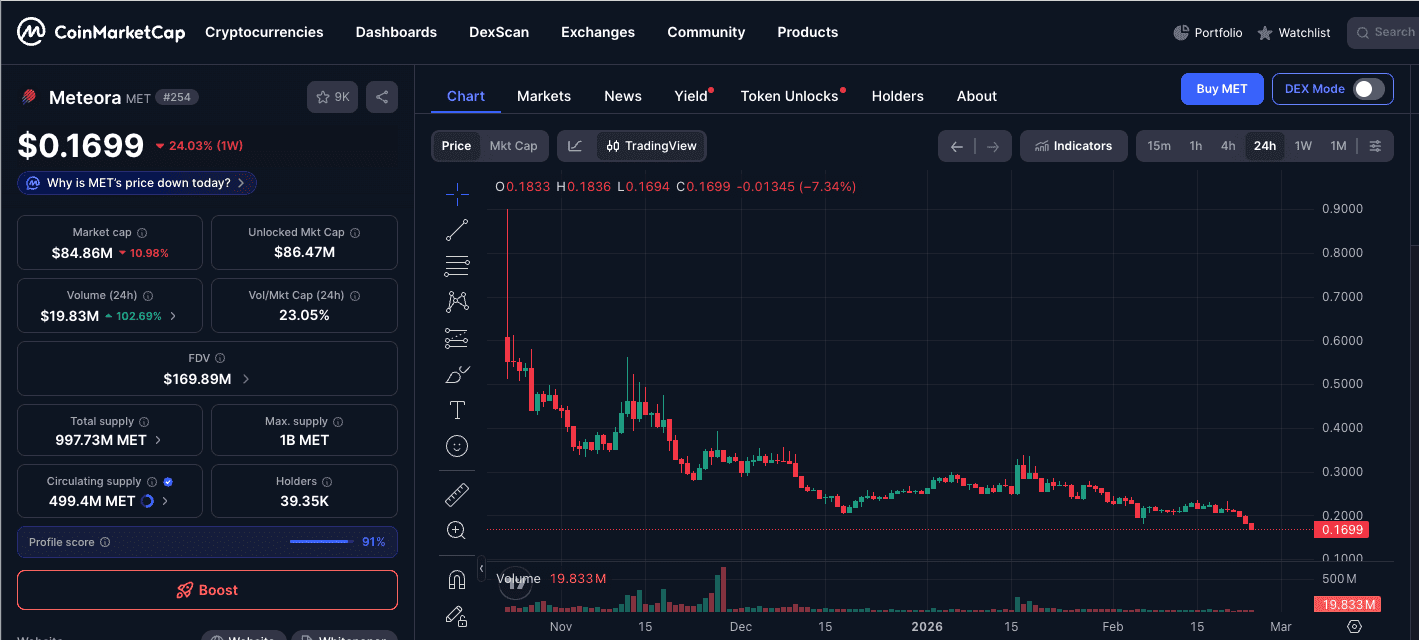
Source:CoinMarketCap
The primary catalyst for this turbulence is the scheduled release from independent on-chain researcher ZachXBT on February 26, 2026. Known for a multi-year track record of identifying systemic risks, ZachXBT’s investigation into alleged "insider trading" has led to significant market discussions regarding institutional integrity. While no official target has been confirmed, the "wisdom of the crowd" on decentralized prediction markets has placed Meteora at the center of this speculative storm.
As traders move from observation to defensive positioning, the Solana ecosystem is bracing for potential liquidity shifts. This deep dive examines the data driving current sentiment, the on-chain evidence of professional hedging, and how users can utilize Phemex’s robust toolkit to manage risk during this period of high-impact volatility.
The Sentiment Indicator: Polymarket Data and Meteora
In the absence of verified information, the digital asset industry often turns to decentralized information markets to gauge collective probability. Polymarket has emerged as a key dashboard for tracking sentiment surrounding the "ZachXBT Event."
The specific prediction contract, titled "Which crypto company will ZachXBT expose?", has recorded substantial volume over the last 12-hour window. While initial speculation was broad, liquidity has recently converged around a few specific projects.
Data Distribution and Probability
As of February 24, 2026, the probability distribution reflects significant market concern for specific infrastructure providers:
Meteora (MET): Reached a peak of 48% probability earlier today; currently oscillating between 35-38%.
Pump.fun: Maintains a secondary position at approximately 21%.
Secondary Suspects: Various Tier-1 exchanges and DeFi protocols represent the remaining fragmented percentages.
It is critical to note that prediction market odds reflect sentiment and speculative positioning, not factual guilt or verified evidence.
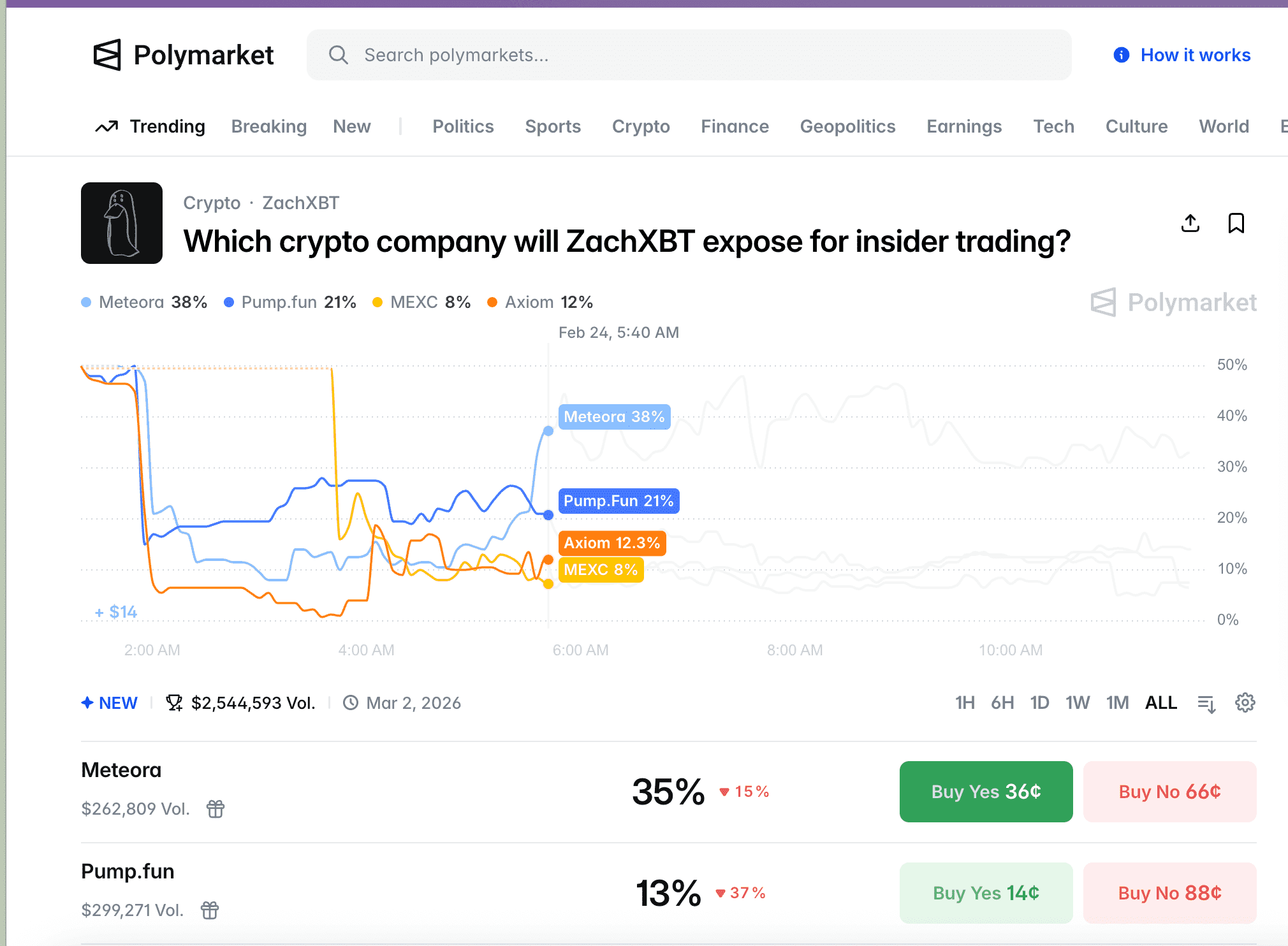
Source:Polymarket
Contextualizing the Speculation Around Meteora
To understand why the market is focusing on Meteora, one must look at its role within the Solana Dynamic Liquidity Market Maker (DLMM) infrastructure. While the protocol has been a cornerstone of the 2025-2026 Solana resurgence, it has recently faced unverified allegations regarding its interaction with high-profile token launches.
The current market anxiety stems from perceived links between liquidity initialization and "celebrity" tokens, such as those associated with high-profile political figures. On-chain observers have pointed to specific wallet clusters that acquired significant percentages of token supplies immediately following pool creation on Meteora.
While these movements were previously attributed to external "mev-bots" or "snipers," the prevailing theory on social platforms—now reflected in Polymarket odds—is that the upcoming investigation may explore whether internal entities had prior knowledge of these events. Until the report is released, these remain unverified rumors; however, the market is already "pricing in" the risk of such a revelation, as evidenced by MET's current price testing lower support levels.
Analyzing On-Chain Positioning: Professional Hedging Activity
While sentiment provides context, capital flow provides evidence of how market participants are preparing for a potential "black swan" event. Data monitored by analytics platforms like Lookonchain indicates that large-scale holders are engaging in complex hedging strategies.
Case Study: The Synthetic Hedge Strategy
Earlier today, Lookonchain flagged a sophisticated wallet address executing what appears to be a delta-neutral or speculative hedge. This behavior involves balancing a prediction market position with a directional trade on perpetual contracts.
The Contingency Position: The entity allocated approximately $5,891 to "Yes" shares on the Meteora contract via Polymarket. This serves as a financial hedge that gains value only if the specific protocol is named.
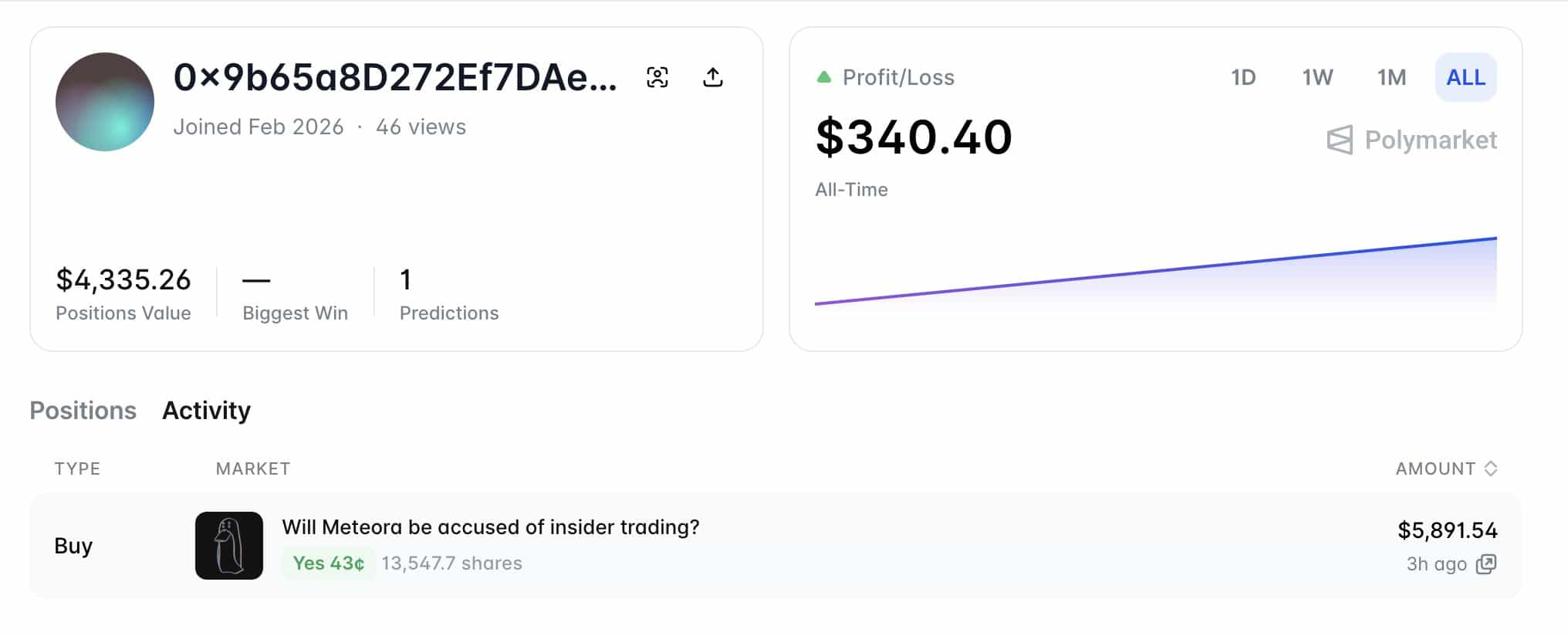
Source:Lookonchain
The Perpetual Position: Concurrently, the same entity utilized a decentralized perpetual exchange to open a 3x Short Position on the MET token, involving approximately 186,435 MET.
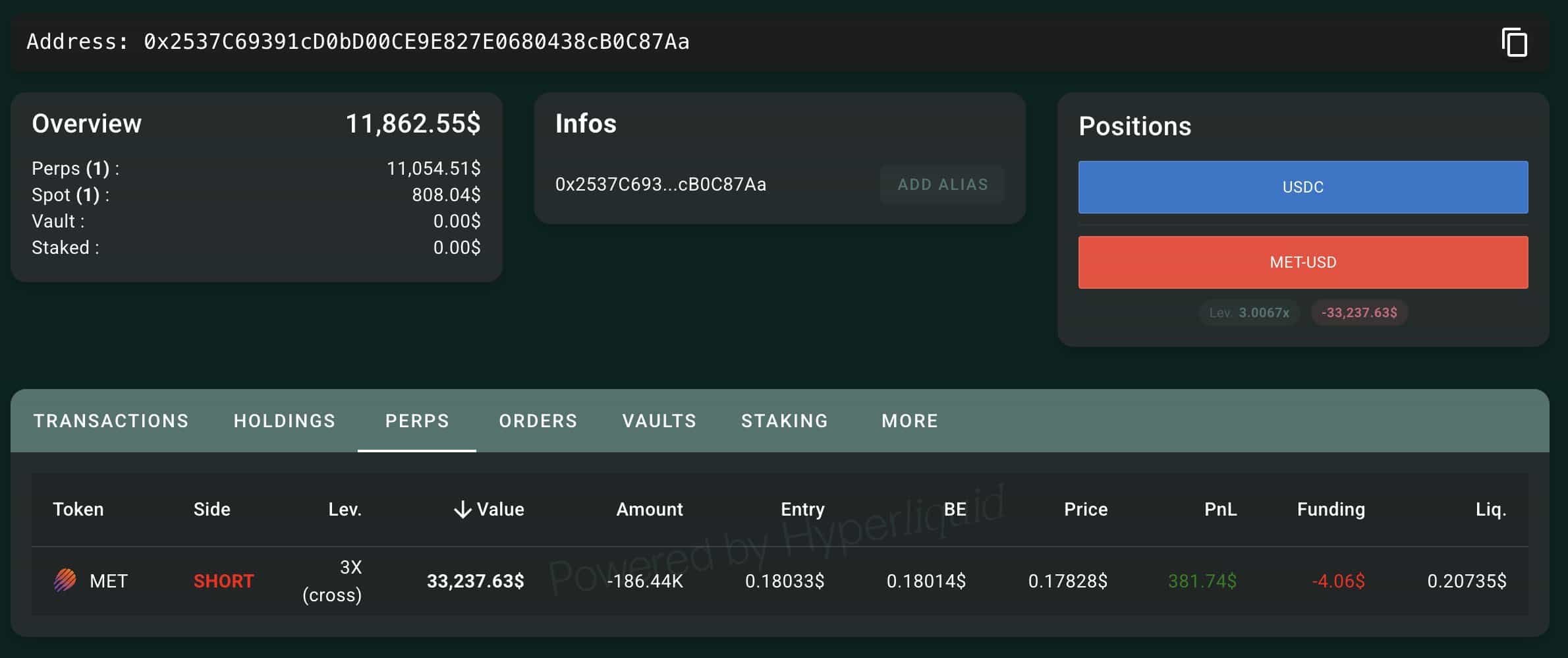
Source:Lookonchain
Interpreting Large-Scale Intent
This behavior demonstrates "high-conviction" risk management. By splitting capital between a binary option (prediction market) and a perpetual contract, the participant attempts to create a protected payoff profile. If the news is negative for the protocol, the decline in token price is offset (or amplified) by the short position and the prediction market win. Conversely, if the news is unrelated to the protocol, the trader must manage the potential "relief rally" that often follows a period of intense FUD (Fear, Uncertainty, and Doubt).
Such on-chain movements often trigger "copy-trading" cascades, which may explain the 24% weekly drawdown MET is currently experiencing.
Ecosystem Implications: The Solana Liquidity Layer
A critical risk factor in this developing situation is the potential for "contagion." Meteora functions as a vital liquidity layer within the Solana DeFi stack. If a foundational liquidity protocol faces reputational or regulatory challenges, the impact may extend to the broader ecosystem:
Slippage Volatility: A withdrawal of liquidity from DLMM pools could lead to higher slippage for various Solana-based assets.
TVL Fluctuations: Risk-averse yield farmers often move capital into stablecoins or Layer 1 assets during periods of uncertainty.
Solana (SOL) Proxy Risk: As users de-risk their ecosystem holdings, the Layer 1 token often serves as the primary exit vehicle, leading to broader price volatility.
Risk Management Strategies on Phemex
Volatility represents both risk and opportunity. For traders on Phemex, the next 48 hours require a disciplined approach to risk management. Below are the methodologies market participants use to navigate event-driven volatility.
1. Utilizing Ecosystem Proxies for Hedging (SOL/USDT)
If a specific protocol faces extreme volatility, direct trading can be hampered by low liquidity. Many traders utilize Solana (SOL) as a proxy for ecosystem health.
Market Observation: Participants often monitor if Polymarket odds cross a "consensus threshold" (e.g., >50%).
Tactical Positioning: Utilizing Phemex's SOL/USDT Linear Perpetual Contracts allows traders to hedge their overall Solana portfolio against systemic "flight to safety" moves.
2. Delta-Neutral Hedging for Long-Term Holders
For investors who hold spot Solana or ecosystem tokens (such as JUP or RAY) and do not wish to liquidate their long-term positions, a delta-neutral hedge can mitigate temporary drawdowns.
The Mechanism: An investor holding a specific value in spot assets can open an equal-sized Short position using 1x leverage on Phemex.
The Objective: This "locks in" the USD value of the portfolio. If the market declines, the gains in the short position offset the losses in the spot bag, allowing the investor to navigate the volatility without exiting their core positions.
3. Monitoring for the "Relief Rally" (Short Squeeze Potential)
Crowded trades—where a majority of the market expects the same outcome—carry the risk of a short squeeze. If the investigation reveals a target different from Meteora, the market may experience a violent reversal.
Psychological Shift: Short sellers may be forced to buy back positions simultaneously, leading to a rapid price increase.
Preparation: Traders often set price alerts on Phemex and monitor ZachXBT’s official channels for the exact moment of disclosure to react to "mispriced" market reactions.
The Historical Impact of Independent Audits
The "ZachXBT Effect" is a documented phenomenon in the crypto markets. As an independent auditor, his findings have historically led to immediate market re-evaluations:
Historical Precedent: Past investigations into influencer-led schemes or protocol vulnerabilities have seen affected assets undergo 50% to 90% adjustments as the market recalibrates for newly discovered risks.
Data-Driven Respect: The market prioritizes his data because it is verified on-chain, making the February 26 reveal a high-certainty event for volatility, regardless of the specific outcome.
Conclusion: Strategic Preparation for the Disclosure
The countdown to February 26 continues. With Meteora currently down over 24% in 7 days, the market is clearly reacting to the high probability suggested by prediction markets. Sophisticated market participants are currently voting with their capital, signaling a bearish outlook for specific Solana liquidity layers through hedging and short positioning.
However, in the digital asset space, consensus can often lead to over-extension. The significant portion of the market not betting on a single outcome serves as a reminder that uncertainty remains high.
Professional Action Plan:
Maintain Objectivity: Avoid emotional reactions to unverified social media rumors.
Monitor Intelligence: Use tools like Lookonchain for real-time whale movements and Phemex’s live order books to gauge liquidity depth.
Implement Risk Controls: Ensure that all positions have predefined stop-loss orders and that leverage is used conservatively during this high-volatility window.
Whether the upcoming report confirms current speculation or identifies a new area of risk, market volatility is guaranteed. Ensure your portfolio is positioned to withstand significant price fluctuations.
Disclaimer: This article reports on market speculation, prediction market data, and on-chain analysis. It is provided for informational purposes only and does not constitute financial, investment, or legal advice. Trading cryptocurrencies, particularly with leverage and based on speculative news, involves a high degree of risk. Always perform your own due diligence.