

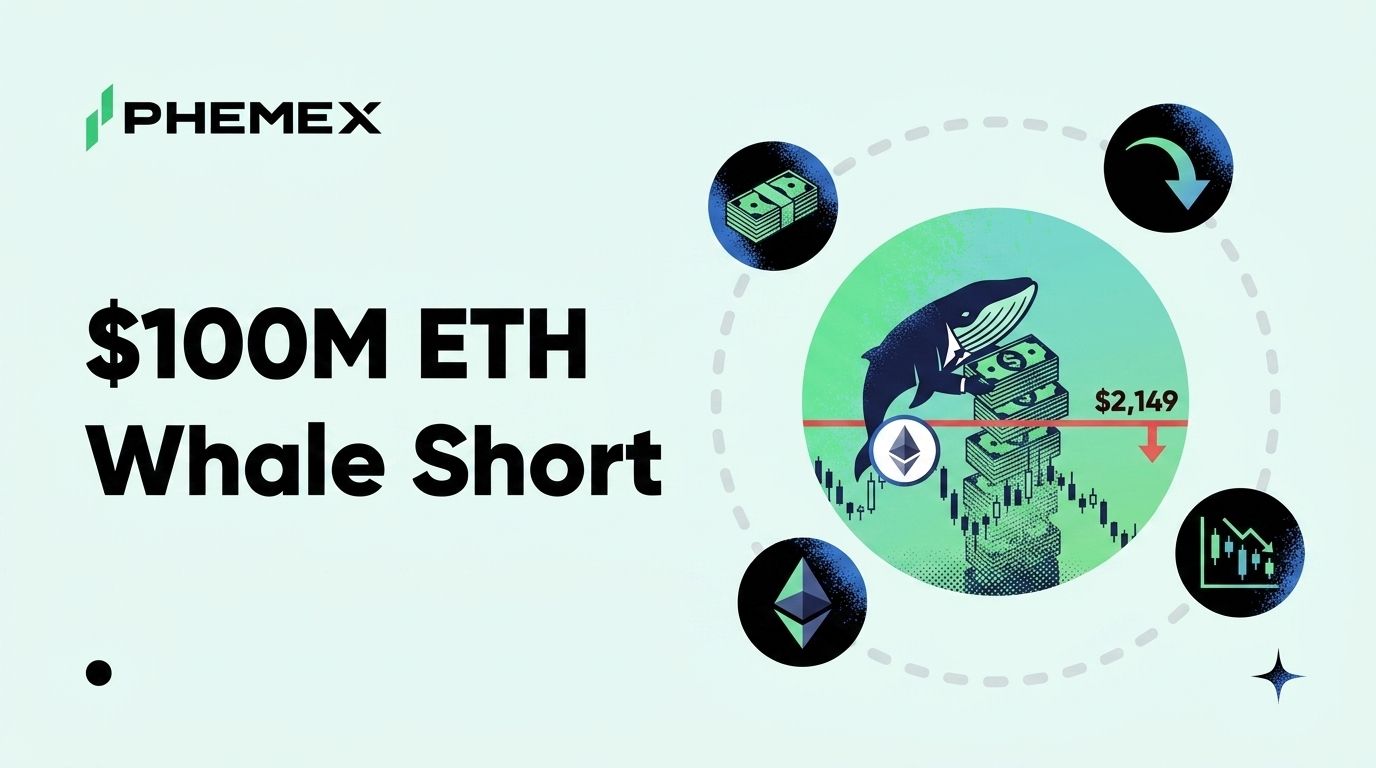
A single wallet opened a $100 million notional Ethereum short at 23x leverage in the early hours of June 2, 2026, with a stated liquidation price of $2,149.84. ETH was trading at $2,006 when the position printed, meaning the whale is sitting on a 7% buffer between current spot and the level that would wipe the position out. The trade was visible onchain within minutes of execution.
Positions of this size and visibility do not stay private. They become both a thesis statement and a target.
The Mechanics of a 23x Short of This Size
Source: X
A 23x short with $100 million notional exposure means the trader posted roughly $4.35 million in margin to control 49,850 ETH worth of downside exposure. Every 1% move against the position costs $1 million. Every 4.35% move would wipe the margin entirely, but the position is structured with a liquidation buffer above that math because the venue's maintenance margin requirement sits at roughly 0.5% for size that large.
The structure tells you two things. First, the trader is highly conviction on a near-term ETH decline. You do not put on 23x leverage on a position this size to express a slow grind lower. Second, the trader is willing to accept the visibility cost. Onchain bookmaking platforms surface positions like this within minutes, and a public 23x short of this size is a magnet for traders who specialize in coordinated buying at the liquidation level.
What the $2,149 Liquidation Price Reveals
The single number that matters in any whale trade is the liquidation price. The reason is that the liquidation price reveals two things the position size and entry price do not. It tells you exactly how much pain the trader is willing to accept, and it tells you the level where the market will get a forced buyer regardless of fundamentals.
The $2,149.84 mark sits roughly 7.1% above current spot. That is a tight stop for a position this size, especially given that one-week realized vol on ETH is sitting at 52. ETH has produced multiple 7% intraday moves in 2026 alone. The whale either has a very specific catalyst in mind (likely a macro print or a corridor-specific risk event) or is structuring the trade as a sacrificial wedge to push price lower into a larger book.
The other tell is the round-number proximity. $2,150 is a clean psychological level that retail traders will defend with buy orders, and any liquidation cascade that triggers near it will be partially absorbed by that latent demand. A more sophisticated whale would have placed the liquidation just above a resistance shelf rather than just below one.
How the Market Typically Reacts to Publicly-Visible Large Shorts
There is a well-documented market behavior called the liquidation hunt, and it activates whenever a whale short or long becomes onchain-visible. The mechanics are simple. A coordinated cohort of opposing traders accumulates spot exposure in the direction that would liquidate the whale, slowly pushes price into the liquidation zone, and lets the forced unwind do the rest. The forced buyer (in this case the venue's liquidation engine) becomes the exit liquidity for the coordinated long position.
This pattern has played out multiple times in 2025 and 2026. The most prominent case was the $30 million BTC short on a different perpetual venue in February 2026 that was liquidated within 18 hours after a coordinated buying campaign pushed BTC into the trader's pain point. The whale's loss became the bookmaking platform's most-cited educational example of why size-plus-visibility-plus-leverage is a structurally fragile combination.
The $100 million ETH short is roughly three times the size of that case, and the leverage is higher. The position is either a deliberate bait to attract the hunt and then reverse on macro confirmation, or a genuine high-conviction directional trade that the whale has accepted will be public.
What On-Chain Bookmaking Platforms Surface in Real Time
The reason this trade is being discussed at all is that onchain transparency platforms now surface large perpetual positions within minutes of execution, complete with liquidation price, leverage, and unrealized PnL. Traders can subscribe to alerts that fire whenever a position above a certain size threshold appears, and the data feeds into copy-trading bots that scale the trade up or down based on the subscriber's risk profile.
Polymarket-style transparency and the broader prediction-market infrastructure has trained an entire generation of traders to expect this level of visibility into other people's positions. The 2023 era of opaque CEX positioning is over. Every large trade is now an information event, and the trader has to factor that information leakage into the trade's expected value.
What the Whale Might Actually Be Trading
The macro setup that would justify a $100 million 23x ETH short over the next 72 hours has three plausible interpretations. The first is a play on the Iran conflict escalation, with the whale expecting another leg lower in risk assets if the IRGC follow-up on Kuwait expands. The second is an ETH ETF flow trade, with the whale anticipating a redemption wave from the spot ETH ETFs that have been losing assets since late May. The third is a pure technical short into the $2,149 wall, where the trader expects retail to defend the level and then capitulate.
None of those interpretations require the position to actually reach liquidation. A 4% move lower in ETH would put the whale's unrealized PnL at roughly $40 million, which is a clean exit even if the original thesis only partly plays out.
What to Watch
Three things will define how this position resolves. The first is the question of ETH holding $1,980 on a closing basis, because a break of that level opens a clean technical path to $1,920 and would deliver the whale a 4% to 5% return without any liquidation drama. The second is the onchain hunt itself, which would show up as coordinated buying volume in the $2,080 to $2,120 zone over the next 24 to 36 hours. The third is the whale's next move, since adding to or trimming the position before any catalyst will reveal if the trade was bait or conviction.
Frequently Asked Questions
How visible is a large perpetual short really?
Very. Onchain analytics platforms surface positions above $10 million notional within minutes, including the wallet address, entry price, liquidation price, and current unrealized PnL. The data is free, the alerts are automated, and the resulting trades are increasingly coordinated rather than independent.
Can a single whale actually move ETH by 7% to defend or attack a position?
Not alone, but a single whale's position can become a coordination point for many smaller traders who collectively can. The $100 million notional is enough to attract the kind of liquidation-hunt campaign that historically resolves within 24 to 72 hours of the position appearing.
What happens if the liquidation actually triggers at $2,149?
The venue's liquidation engine becomes a forced buyer of 49,850 ETH at market, which would print as roughly $107 million in market-buy volume over a window of 5 to 15 minutes depending on order-book depth. That forced bid is precisely what the coordinated long cohort is positioning to sell into.
Is there a defensive reason to short ETH at 23x rather than 10x?
Not really. Higher leverage on a directional perpetual short does not improve the trade's expected value, it only reduces the margin requirement. The choice to run 23x signals either capital efficiency optimization (the whale wants to deploy the freed margin elsewhere) or genuine conviction that ETH falls fast enough that the leverage does not matter.
Bottom Line
A $100 million 23x short with a $2,149 liquidation price is a public-information event as much as it is a trade. The whale is either expressing genuine high-conviction downside (likely tied to Iran-escalation risk or an ETH ETF redemption wave) or deliberately baiting a liquidation hunt to then reverse on macro confirmation. The next 72 hours will resolve which. If ETH closes below $1,980 in the next two sessions, the whale wins clean. If a coordinated bid materializes in the $2,080 to $2,120 zone and pushes price toward $2,149, the trade becomes a textbook hunt setup and the visibility cost was the whole story.
This article is for informational purposes only and does not constitute financial or investment advice. Cryptocurrency trading involves substantial risk. Always conduct your own research before making trading decisions.