

Aave is the largest DeFi lending protocol, and it ships Aave V4 on June 30, 2026, the most significant rewrite of its architecture in years. The token has front-run the news. AAVE trades near $93.99 and is up sharply on the weekeven as the broader market fell, which is the kind of relative strength that signals traders are positioning for a real catalyst rather than another roadmap slide.
The upgrade is not a cosmetic version bump. V4 reorganizes how liquidity is held, priced, and borrowed across the whole protocol, and it leans harder on GHO, Aave's own stablecoin. Here is what V4 actually changes, why it counts as a generational upgrade, what it means for AAVE the token, and what a trader watches when the contracts go live.
What Aave V4 Actually Changes
The headline change in V4 is a move toward a unified liquidity layer, often described with a "Hub and Spoke" design. Today, liquidity in Aave is fragmented across separate markets and separate deployments on each chain. Capital sitting in one isolated pool cannot be used by another, which leaves a lot of idle supply earning nothing and forces borrowers to hunt for the specific pool that holds what they need.
The Hub and Spoke model flips that. A central liquidity Hub holds the supplied assets, and individual Spokes connect to it to serve specific use cases, risk profiles, or asset types. Think of it as the difference between every branch of a bank keeping its own vault of cash versus all branches drawing from one shared reserve. The shared reserve is more efficient because money is never stranded in the wrong place.
Aave's team has published the high-level architecture in the Aave V4 technical paper and docs, but several mechanics are still being finalized in the run-up to launch, so the details below are described in terms of intent rather than exact parameters. The core pieces Aave has outlined for V4 include the following:
|
V4 feature
|
What it is meant to do
|
|
Unified liquidity layer (Hub and Spoke)
|
Pool supply in one Hub so capital is shared across markets instead of stranded in isolated pools
|
|
Dynamic risk and premium model
|
Price borrowing risk per position and per asset rather than applying one blunt rate to a whole pool
|
|
Improved capital efficiency
|
Let the same supplied liquidity back more borrowing demand, lifting utilization and supplier yield
|
|
GHO at the center
|
Route more borrowing demand and protocol revenue through Aave's native stablecoin
|
|
Cross-chain liquidity
|
Move toward liquidity that is accessible across chains rather than siloed per deployment
|
The risk model is the part that matters most for active borrowers. Instead of one pooled interest rate that every borrower of an asset pays, V4 aims to price risk more granularly, so a conservative position and an aggressive one are not charged the same premium. That is a meaningful shift in how DeFi lending has worked for most of its history.
Why This Is the Biggest Aave Upgrade in Years
Aave has shipped major versions before, and each one moved the protocol forward. V1 proved the model. V2 made collateral and debt management usable. V3 introduced isolation mode, efficiency mode, and portals that pushed the protocol multichain. V4 is bigger than any of those because it does not just add features on top of the existing pool design. It rethinks the base layer that everything else sits on.
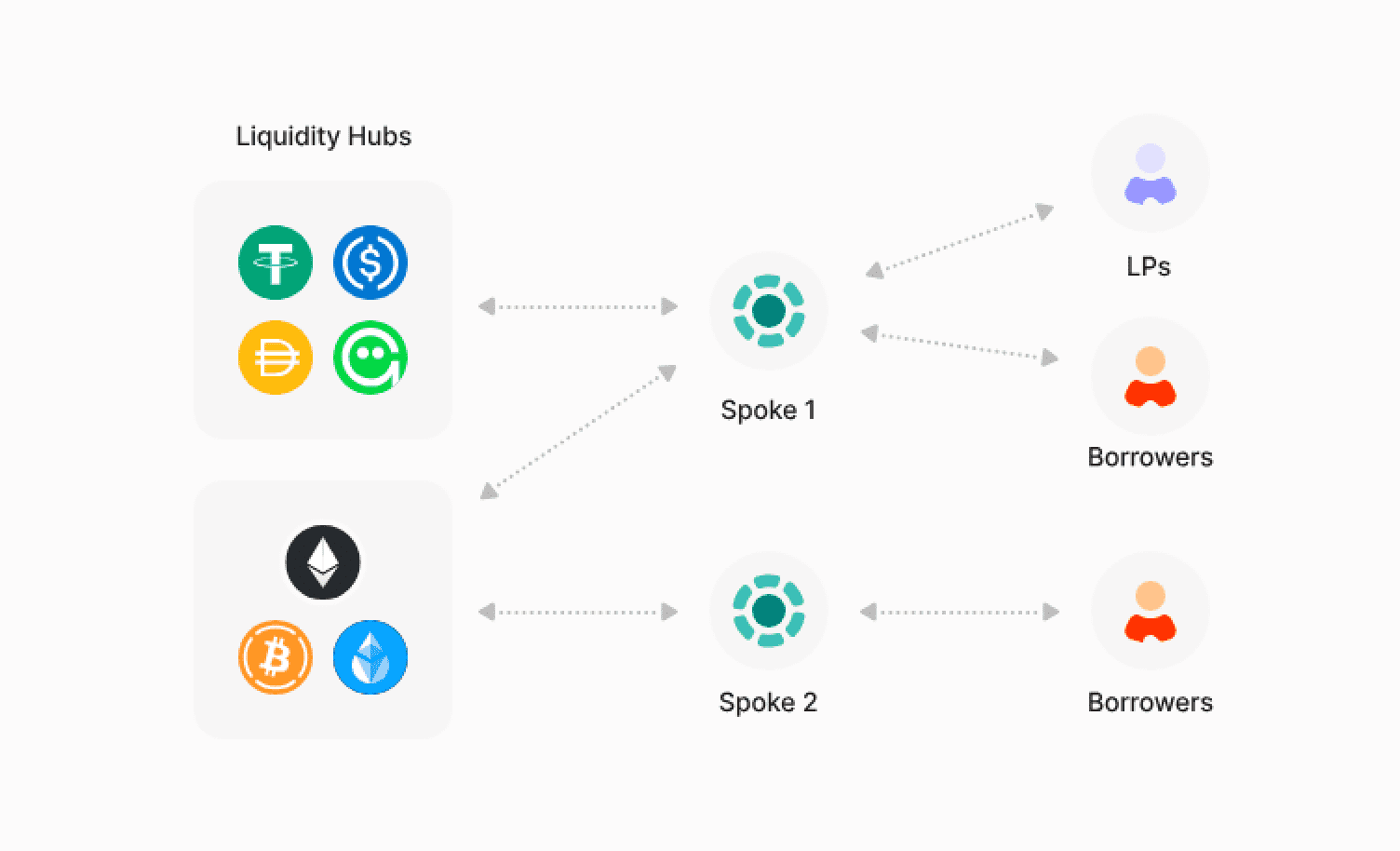
Source: AAve
The reason that is hard, and the reason it took years, is that Aave is not a small experiment. It is the anchor of the entire onchain crypto lending market, with billions in deposits trusting the existing contracts. Rewriting the core while protecting that capital is closer to replacing an aircraft engine mid-flight than patching an app.
There is also a competitive reason the timing matters. Lending is one of the few DeFi categories with durable, real demand, and newer rivals have chipped at Aave's lead with fresh designs. V4 is Aave's answer. If the unified liquidity layer delivers the efficiency it promises, it widens the moat. If it stumbles, it hands rivals an opening. That binary outcome is exactly why traders are paying attention to a protocol upgrade the way they normally pay attention to a token supply release or an ETF decision.
What Aave V4 Means for AAVE the Token
A protocol upgrade and a token are not the same thing, and traders sometimes conflate the two. AAVE is a governance and safety-module token. It does not automatically capture every dollar of protocol revenue. So the honest question is how V4 actually reaches the token, and the answer runs through two channels.
The first is fees and the buyback program. Aave governance has been steering protocol revenue toward buying AAVE from the open market, which turns real lending activity into steady, mechanical demand for the token. If V4 lifts capital efficiency and pulls more borrowing volume through the protocol, it lifts the revenue that feeds that buyback. More usage means more fees, and more fees means more buying pressure that does not depend on speculation.
The second channel is GHO. Aave's native stablecoin earns the protocol interest when users borrow it, and V4 is built to push more borrowing demand through GHO. Every GHO loan is revenue Aave keeps rather than shares, so a V4 design that grows GHO is directly accretive to the value that flows back to the token.
The Risks Traders Should Not Ignore
The bull case assumes V4 works as designed on day one, and that is the assumption to interrogate. The first risk is migration. Moving billions in deposits from V3 to V4 is not instant, and it is not free. Users have to opt in, liquidity has to move, and any friction in that process can leave the new system thin while the old one drains. A half-migrated protocol is less efficient than either version run on its own.
The second risk is smart-contract risk, and it is sharpest exactly when code is new. A ground-up rewrite means fresh contracts holding large sums, and fresh code is where exploits live. Aave runs audits and a safety module precisely for this reason, but no audit is a guarantee. The history of DeFi is full of upgrades that passed review and still got drained. If you want a primer on how these failures happen, Phemex's writeup on DeFi hacks and bridge exploits lays out the common patterns.
There is a market risk too. AAVE has already rallied hard into the launch, which means a chunk of the good news may be priced in. "Buy the rumor, sell the news" is a cliché because it keeps happening, and a token that ran up before a known date is a classic setup for a post-launch flush even if the upgrade itself is flawless.
What a Trader Watches at Launch
The launch itself is a date on the calendar. What confirms or breaks the thesis is the data in the days after. The cleanest signal is total value locked, which anyone can track on the DefiLlama Aave dashboard. If TVL holds and migrates cleanly into V4, the market is voting that the new design is trusted. If deposits leak out or migration stalls, that is the early warning, regardless of what the price does in the first hours.
Watch GHO next. Growth in GHO borrowing is the most direct read on how well the V4 design is doing what it was built to do, because that is where the protocol's own economics live. Then watch the spread between supplier yields and borrow rates, which is the real-world test of how much the unified liquidity layer improved capital efficiency rather than just reshuffling it.
For the token specifically, the question is how clearly buyback-driven demand shows up in the price structure once the launch noise fades. A token underpinned by mechanical revenue-funded buying should behave differently on pullbacks than one running purely on hype. The first few weeks of post-launch price action are where that difference becomes visible.
Frequently Asked Questions
When does Aave V4 launch?
Aave V4 goes live on June 30, 2026. The token has rallied into the date, with AAVE trading near $93.99 and up sharply on the week, which is why the launch is being treated as a genuine catalyst rather than a routine update.
What is new in Aave V4?
The central change is a unified liquidity layer built on a Hub and Spoke design, which pools supplied capital centrally so it is no longer stranded in isolated markets. V4 also introduces a more granular risk and premium model, targets better capital efficiency, leans harder on the GHO stablecoin, and moves toward cross-chain liquidity. Some exact parameters are still being finalized into launch.
Is AAVE a good investment?
AAVE is the governance token of the largest DeFi lending protocol, and V4 plus the revenue-funded buyback program give it real, usage-driven demand drivers rather than pure speculation. That said, the token has already run hard into the launch, smart-contract and migration risk are real, and nothing here is advice. Size any position to the risk and do your own research.
Does Aave V4 affect the GHO stablecoin?
Yes. GHO is central to the V4 design, which is built to route more borrowing demand through Aave's own stablecoin. More GHO borrowing means more interest the protocol keeps, which is one of the cleaner ways V4 activity can flow back to AAVE holders.
Bottom Line
The thesis is simple. If V4's unified liquidity layer migrates cleanly and TVL holds, Aave widens its lead in the one DeFi category with durable demand, and the buyback program turns that activity into steady token demand. The signals to track in the first weeks are migration health, GHO borrowing growth, and how the supplier-to-borrow spread tightens the way better capital efficiency should make it. The risk that breaks the setup is a stalled migration or a contract exploit in fresh code, and the market risk is that a token already up sharply into a known date gives some of it back on the news. Watch the June 30, 2026 launch for the headline, but watch the TVL and GHO data for the truth. The chart built on Ethereum DeFi rarely lies for long.
This article is for informational purposes only and does not constitute financial or investment advice. Cryptocurrency trading involves substantial risk. Always conduct your own research before making trading decisions.