









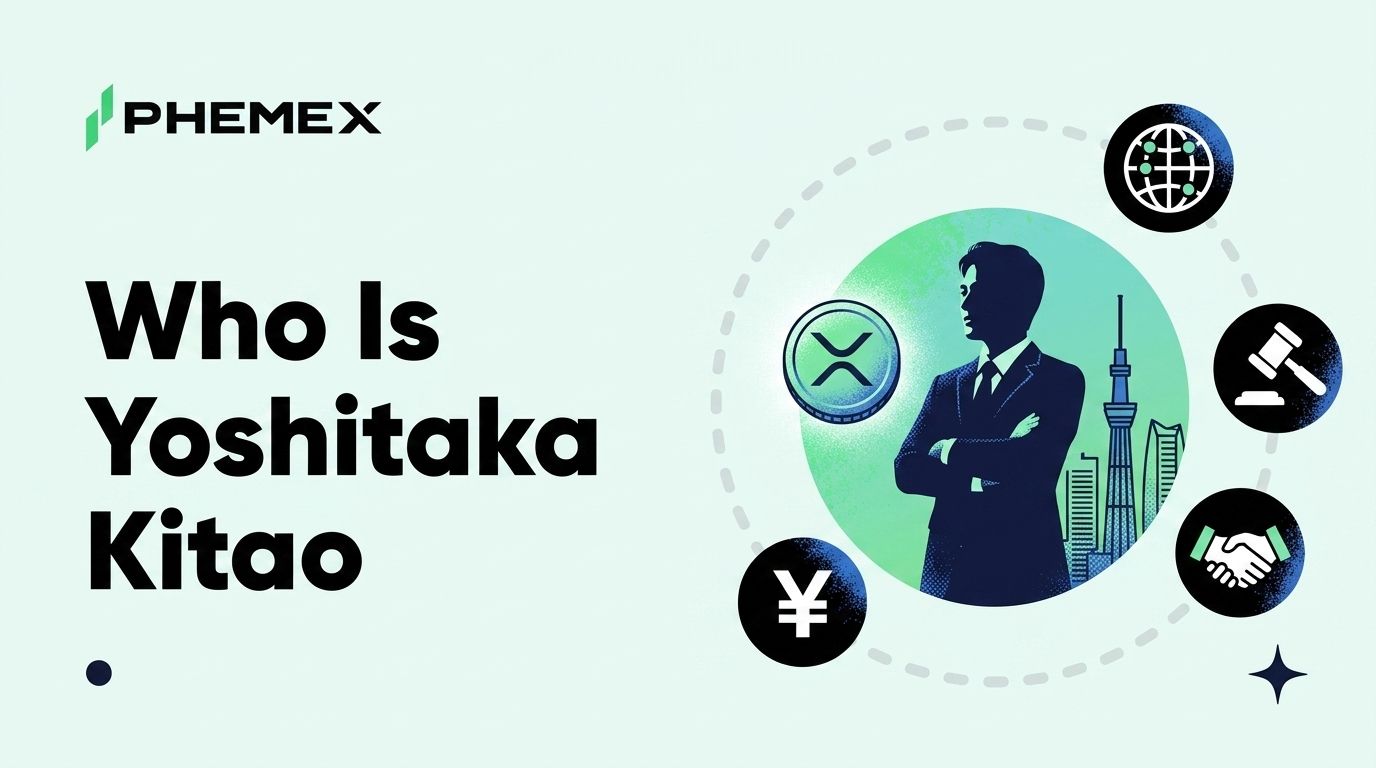
Yoshitaka Kitao runs one of Japan's largest financial groups, and he has spent close to a decade telling anyone who will listen that XRP belongs at the center of cross-border payments. He is the CEO and founder of SBI Holdings, one of Ripple's largest outside shareholders, and the most senior long-standing corporate evangelist the token has. He held that conviction through the 2018 collapse and again through the 2022 bear market, when most institutional backers went quiet.
That conviction is paying off in hard numbers now. SBI's crypto arm, SBI VC Trade, passed 2 million registered accounts on July 6, 2026, roughly double its 2025 count, as Japanese corporate demand for XRP and Bitcoin climbs against a weak yen. Here is who Kitao is, how SBI got so big, why he bet early and heavily on Ripple, and why the man behind that bet still matters for anyone holding XRP today.
Who Yoshitaka Kitao Is and How He Built SBI
Kitao is a career financier who cut his teeth at Nomura Securities before joining SoftBank in the mid-1990s as its chief financial officer. In 1999 he spun out SoftBank's finance operations into a standalone company, which grew into SBI Holdings. The name once stood for SoftBank Investment. Today the group runs online brokerage, banking, insurance, asset management, and venture capital across dozens of markets.
The scale is easy to underestimate from outside Japan. SBI operates the country's largest online securities brokerage by account count, a digital bank, and a sprawling investment arm that has seeded hundreds of financial-technology startups. According to SBI's corporate profile, the group frames itself around financial innovation rather than any single product line, which is the lens Kitao uses when he talks about crypto.
That background matters because Kitao does not come to XRP as a retail speculator. He comes to it as a payments executive who runs settlement rails for a living. When he argues that XRP solves a real cost problem in moving money between currencies, he is describing a business he actually operates. SBI VC Trade lets Japanese users trade XRP, Bitcoin, and other assets directly, and that retail arm is now one of the fastest-growing parts of the group.
How Kitao Made the Early Bet on Ripple and XRP
SBI took its stake in Ripple back in 2016, well before institutional money treated crypto as a serious asset class. Kitao did not treat it as a passive investment. Within months he had formed a joint venture and started building products around the technology, positioning SBI as Ripple's primary partner across Asia.
The bet looked painful for long stretches. XRP fell more than 90% from its early-2018 peak, and it spent years trading sideways while regulatory pressure in the United States hung over the token. Plenty of early corporate supporters walked away during that period. Kitao did the opposite. He kept adding products, kept distributing XRP to SBI shareholders, and kept naming XRP as the settlement asset SBI would standardize around.
There is a useful parallel here with Michael Saylor's Bitcoin buying, where a single executive tied his company's public identity to one crypto asset and refused to blink through drawdowns. Kitao plays that role for XRP in Asia. The difference is that Kitao is not merely accumulating the token. He is wiring it into a live financial group with millions of customers, which gives his conviction a distribution channel most individual backers never have.
Inside the SBI-Ripple Partnership and SBI's XRP Programs
The center of the relationship is SBI Ripple Asia, the joint venture Kitao formed to bring Ripple's payment technology to Japan and neighboring markets. It has since registered as a prepaid-payment-instrument issuer, a licensing step that lets it build consumer-facing apps on top of the XRP Ledger. That registration turns XRP from a trading instrument into something SBI can embed inside everyday payment products.
SBI has also pushed XRP directly at its own investor base. The group distributes XRP to qualifying shareholders as a formal shareholder benefit, a program it renewed for 2026 with distributions running from May 1, 2026. On the trading side, SBI VC Trade cut XRP trading fees by roughly 78% to court leverage demand, a move aimed squarely at the active traders who drive volume. For readers newer to how payment tokens differ from stablecoins, the short version is that XRP settles the transfer while a stablecoin holds the value, and SBI's design uses XRP as the bridge asset.
The milestones below track how the partnership moved from a single investment to an operating layer inside SBI.
|
Year
|
SBI and XRP milestone
|
|
2016
|
SBI invests in Ripple and forms SBI Ripple Asia as its regional joint venture
|
|
2018
|
SBI expands XRP-based remittance and payment pilots across Asia
|
|
2019
|
SBI VC Trade opens XRP trading to Japanese retail customers
|
|
2020
|
SBI begins distributing XRP to qualifying shareholders as a benefit
|
|
2026
|
SBI VC Trade passes 2 million accounts, cuts XRP fees ~78%, renews the shareholder benefit from May 1
|
Why Kitao Still Matters for XRP in 2026
The honest picture is mixed, and it is worth stating plainly. Japan-XRP adoption is real and still growing, yet the XRP price has lagged what that adoption might suggest. XRP trades around $1.083 today, far below where holders hoped a decade of institutional integration would carry it. Kitao's importance is not that he moves the chart. It is that he keeps building the demand base that a real re-rating would eventually need.
The 2026 account surge is the clearest evidence. SBI VC Trade doubling to 2 million accounts in a year, driven partly by Japanese companies parking treasury into XRP and Bitcoin as the yen weakens, shows the pipeline Kitao spent years building is now filling fast. Anyone weighing why the XRP price has stayed soft through 2026 should read that adoption data alongside the chart, because the two are diverging.
For traders, Kitao is a signal rather than a catalyst. He represents patient, operator-level corporate demand that does not flinch on red candles, and that kind of holder tends to compress future supply rather than sell into strength. According to SBI's investor relations, crypto has moved from a side project to a named growth line inside the group. When the man running a top Japanese financial group treats XRP as core infrastructure, that is a durable bid, even in a year the price refuses to cooperate.
Frequently Asked Questions
Why does SBI support XRP?
SBI uses XRP as a settlement asset for cross-border payments, a business its CEO Yoshitaka Kitao has run for years through SBI Ripple Asia. The support is commercial rather than speculative, since XRP plugs directly into the payment and remittance products SBI operates across Asia.
Who is Yoshitaka Kitao?
He is the founder and CEO of SBI Holdings, one of Japan's largest financial groups, which he spun out of SoftBank in 1999. He is also one of Ripple's largest outside shareholders and the most prominent long-term corporate backer of XRP.
How many accounts does SBI VC Trade have?
SBI VC Trade passed 2 million registered accounts on July 6, 2026, roughly double its 2025 total. The growth has been driven by Japanese retail and corporate demand for XRP and Bitcoin as the yen weakens.
Does SBI give XRP to shareholders?
Yes, SBI distributes XRP to qualifying shareholders as a formal shareholder benefit, and it renewed the program for 2026 with distributions running from May 1. The perk is part of how Kitao has widened XRP ownership across SBI's investor base.
The Bottom Line
Kitao matters because he is the rare corporate leader who tied a real, operating financial group to XRP and held that line through two bear markets. The 2 million accounts at SBI VC Trade, the renewed shareholder distributions from May 1, and the 78% fee cut are all evidence that the demand engine he built is running at full speed in 2026. The gap to watch is the one between that adoption and the soft $1.083 price. If Japanese corporate treasuries keep rotating into XRP against a weak yen, the holder base Kitao spent a decade assembling is exactly the kind that closes gaps like that when sentiment finally turns.
This article is for informational purposes only and does not constitute financial or investment advice. Cryptocurrency trading involves substantial risk. Always conduct your own research before making trading decisions.
