










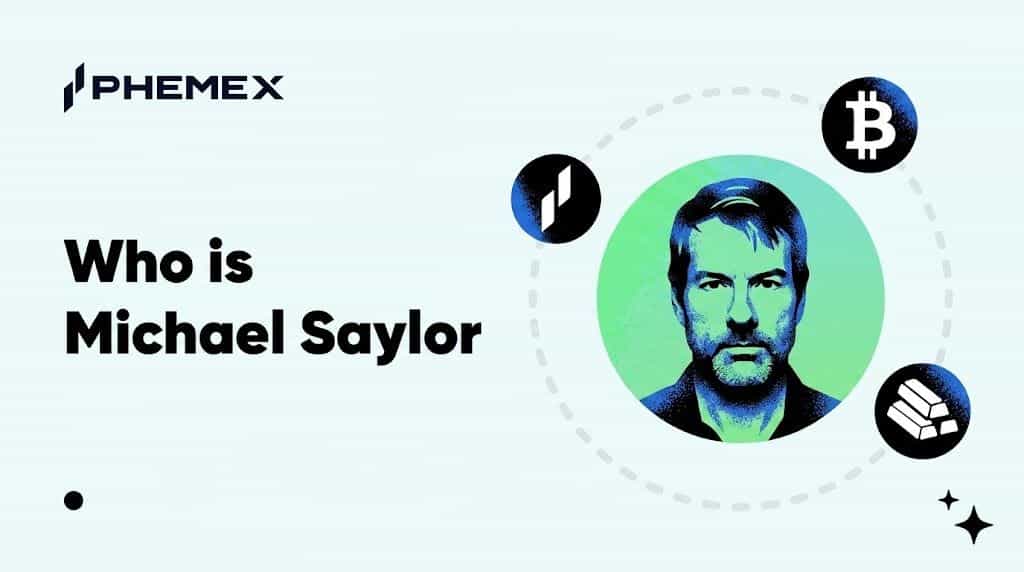
Michael Saylor runs the largest corporate Bitcoin treasury on the planet, and on April 14, 2026, his company Strategy (formerly MicroStrategy) added another $1 billion in BTC at an average price of $71,902. That purchase pushed Strategy's stack past 600,000 coins, worth roughly $43 billion at current prices, and extended a buying streak that has continued across every kind of market condition since August 2020. Saylor himself has become one of the most recognizable faces in crypto, a MIT-trained engineer who pivoted a dying enterprise software company into a Bitcoin proxy stock that now sits in the Nasdaq 100.
The interesting part is not the size of the stack. It is that Saylor keeps buying at $20,000, at $48,000, at $71,000, and he would almost certainly keep buying at $150,000. Understanding why he does that requires going back further than 2020. His story covers an MIT aerospace degree, a billion-dollar personal wipeout in the 2000 dot-com crash, an SEC fraud settlement the same year, two decades of wandering in the enterprise software wilderness, and finally a single earnings call in 2020 that rewired his entire worldview.
From MIT Aerospace to Enterprise Software
Michael J. Saylor was born in 1965 on an Air Force base in Lincoln, Nebraska, and grew up moving between military postings before his family settled in Fairborn, Ohio. He won an Air Force ROTC scholarship to the Massachusetts Institute of Technology, where he studied aeronautics and astronautics alongside a second major in the history of science. He graduated in 1987 with the intent of becoming a pilot, but a medical condition disqualified him from flight duty, which rerouted him toward consulting and eventually software. You can read the outline of that early path in his MIT alumni profile and in later interviews.
In 1989 Saylor co-founded MicroStrategy with his MIT fraternity brother Sanju Bansal, initially as a consulting firm for DuPont. The company pivoted into business intelligence software, riding the corporate data-warehousing wave through the 1990s. MicroStrategy went public in June 1998 at $12 per share and became one of the loudest dot-com era success stories, with Saylor briefly holding a paper net worth reported at around $7 billion in early 2000.
The $6 Billion Day and the SEC Settlement
On March 20, 2000, Saylor lost roughly $6 billion of paper wealth in a single trading session after MicroStrategy disclosed it would restate two years of financial results. The SEC followed with civil fraud charges alleging the company had overstated revenue and earnings to meet analyst expectations. Saylor and two other executives settled with the SEC in December 2000 without admitting or denying the allegations, paying a combined $11 million in disgorgement plus $350,000 in personal penalties each. The full filing still lives on the SEC litigation release page for anyone who wants to read the original complaint.
That episode matters because it shaped how Saylor talks about money now. He has said in multiple interviews that watching $6 billion of paper wealth evaporate in hours taught him that most financial assets are claims on someone else's promises, and promises can be broken overnight. The experience pushed him toward thinking about monetary energy as something that needs a non-dilutable container. He did not find that container for another 20 years.
The Wilderness Years and the 2020 Pivot
Between 2000 and 2020, MicroStrategy quietly ground out a profitable but unexciting existence as a mid-cap enterprise software firm. The stock spent most of the decade between $100 and $200. Revenue flatlined around $500 million annually. Cash piled up on the balance sheet because the business threw off more than the company needed to operate, and Saylor began to see that cash as a slow-motion problem rather than an asset. Inflation, near-zero interest rates, and dollar debasement concerns during the 2020 COVID response made the problem acute.
In a now-famous July 2020 earnings call, Saylor told analysts that holding $500 million of cash was equivalent to standing on a melting ice cube. A few weeks later, on August 11, 2020, MicroStrategy announced it had purchased 21,454 BTC for $250 million at an average price of around $11,653. That was the first institutional Bitcoin treasury purchase of meaningful size, and it set the template every other corporate buyer has followed since.
Saylor often points to his conversion reading list from the spring of 2020, which included the Bitcoin whitepaper, The Bitcoin Standard by Saifedean Ammous, and roughly 70 hours of podcast content. He described the outcome in a widely circulated What Bitcoin Did interview as "finally finding a place to store my wealth that cannot be debased."
The Thesis in One Paragraph
Saylor's core argument is that Bitcoin is the first engineered scarcity in human history, a monetary network with a fixed supply cap of 21 million units and no central authority capable of inflating it. In his framing, every other store of value leaks in some mechanical way. Gold gets mined out of the ground at roughly 1.5% per year, real estate gets taxed and maintained at a steady drag on yield, equities get diluted by stock issuance whenever management wants a bonus, and bonds get inflated away by the same central banks that issue them. Bitcoin is the only asset where the supply schedule is enforced by math and cannot be changed by a committee, a government, or a corporate board. He calls it digital property, digital energy, and digital gold interchangeably depending on the audience, but the underlying claim is identical. If you believe fiat currencies will continue losing purchasing power to monetary expansion, then the rational move is to convert as much of your balance sheet as possible into the only asset that cannot follow them down.
The Buying Playbook: Never Sell, Always Add
What separates Saylor from every other institutional Bitcoin buyer is the mechanical consistency of his accumulation strategy. Strategy has acquired BTC through at least four distinct funding channels since 2020, and the pattern has held through a 77% drawdown, a regulatory crackdown, two SEC inquiries, and multiple accounting rule changes.
|
Funding source
|
Approximate BTC added
|
How it works
|
|
Operating cash flow
|
Roughly 30,000 BTC
|
Quarterly software profits converted directly into Bitcoin
|
|
Senior secured notes
|
Roughly 80,000 BTC
|
Corporate bonds issued to institutional buyers, proceeds into BTC
|
|
Convertible notes
|
Roughly 180,000 BTC
|
Low-coupon convertibles that flip into equity at a premium strike
|
|
At-the-market equity offerings
|
Roughly 310,000 BTC
|
Direct share issuance used to accumulate at market prices
|
The April 14, 2026, purchase of $1 billion at $71,902 came from the latest tranche of an at-the-market equity program announced earlier in the quarter, according to Strategy's investor relations page. Saylor has publicly committed to never selling any of the stack, a position he has repeated across CNBC, Bloomberg, and his own quarterly shareholder letters.
The playbook is circular by design. Strategy issues equity or debt when its stock trades at a premium to its underlying BTC net asset value. It uses the proceeds to buy more BTC. That buying pushes BTC higher, which pushes the stock higher, which allows the next issuance to happen at an even larger premium. Critics call it a reflexive bubble. Saylor calls it a Bitcoin standard applied to corporate finance. Both descriptions are technically accurate.
Why He Keeps Buying Regardless of Price
The question traders ask most often is what would make Saylor ever stop buying. The public record suggests nothing would, and the reasoning is baked into his framework. If Bitcoin is going to $1 million per coin over a decade, as Saylor has stated repeatedly on Bloomberg and in his Saylor Series interviews, then any price under that target is a discount. An entry at $20,000 versus $80,000 becomes a rounding error across a ten-year horizon.
There is a second layer to it. Saylor argues that fiat-denominated time is the real scarcity, and the longer an investor waits to accumulate, the more purchasing power they lose to monetary expansion. In that framework, dollar cost averaging is not a risk management tool. It is a time compression strategy. Every day spent holding cash is a day of lost optionality.
And there is a third layer that traders tend to miss. Strategy's corporate structure creates an institutional feedback loop that a normal treasury cannot replicate. The company does not have to answer to quarterly Bitcoin performance the way a hedge fund does. It has a captive software business generating cash, a shareholder base that has self-selected for the Bitcoin thesis, and a CEO who owns enough voting stock to override any boardroom revolt. That structural setup lets Saylor ignore short-term price action in a way almost no other public company can.
Current Holdings and Net Worth Snapshot
As of the April 14, 2026, filing, Strategy holds approximately 601,000 BTC acquired for a cumulative $27.3 billion, at an average cost basis of around $45,400 per coin. At current spot prices near $71,900, that position is worth roughly $43.2 billion, giving the company an unrealized gain of approximately $15.9 billion on its Bitcoin book. Saylor personally owns approximately 17,700 BTC acquired in his own name before the corporate program began, which puts his personal holdings at around $1.27 billion at current prices, separate from his stake in Strategy equity.
The company's market capitalization trades at a persistent premium to its underlying BTC net asset value, historically ranging between 1.5x and 3.0x depending on sentiment. That premium is what funds the next purchase.
Frequently Asked Questions
How much Bitcoin does Michael Saylor personally own?
Saylor has publicly disclosed owning approximately 17,732 BTC personally, acquired before MicroStrategy began its corporate treasury program in August 2020. At current prices near $71,900, that personal stack is worth roughly $1.27 billion. His stake in Strategy equity is a separate and much larger exposure.
Why did MicroStrategy change its name to Strategy?
The company rebranded to Strategy in early 2025 to reflect that Bitcoin had become its primary corporate identity rather than a sideline to the business intelligence software division. The software unit still operates and generates cash, but the rebrand was an explicit signal to investors that the company should be valued primarily as a Bitcoin holding vehicle.
Has Saylor ever sold any Bitcoin?
Strategy has never sold a single coin from its treasury program. Saylor has stated on multiple occasions that the company will never sell and instead plans to use its BTC as collateral for future financing. The one nuance is that the company has occasionally rebalanced between different custodians, which is not a sale.
Is buying Strategy stock the same as buying Bitcoin?
Not exactly. Strategy stock trades at a premium to its underlying Bitcoin net asset value, which means investors pay more than $1 of BTC exposure for every $1 of stock. Buying spot BTC directly gives cleaner exposure without the premium, the corporate overhead, or the software business drag. Strategy is a leveraged Bitcoin play, not a one-to-one proxy.
Bottom Line
Michael Saylor's buying behavior is the clearest real-world application of a long-duration Bitcoin thesis that the public markets have ever seen. Watch his purchase cadence as a proxy for institutional conviction during drawdowns. The signal worth tracking is not the dollar size of each buy but the average purchase price relative to spot. When Strategy adds at prices above its blended cost basis, it means the company is so confident in the long-term path that it is willing to raise its own book value ceiling on every new tranche. That is what happened on April 14 at $71,902, and it will happen again at higher levels if the thesis stays intact. The moment to pay attention is not when Saylor buys. It is the first day he stops, and there is no indication that day is anywhere on the horizon.
This article is for informational purposes only and does not constitute financial or investment advice. Cryptocurrency trading involves substantial risk. Always conduct your own research before making trading decisions.
