









Key Takeaways
Virtuals Protocol describes itself as a society of AI agents, an onchain ecosystem where autonomous agents can generate services or products and engage in commerce with humans and other agents.
The protocol’s core idea is not just launching AI-themed tokens, but building an economy where agents can be tokenized, coordinated, funded, and paid onchain.
The VIRTUAL token functions as the base liquidity pair and transactional currency across agent interactions, and the protocol is governed by onchain governance holders through onchain governance.
Official tokenomics state that VIRTUAL has a total supply of 1 billion tokens with no future inflation, with 60% in public circulation, 5% for the liquidity pool, and 35% for the ecosystem treasury.
As of late May 2026, VIRTUAL hovers around $0.71, with a market cap near $468 million, roughly 660 million circulating tokens, and an all-time high of $5.07.
Virtuals Protocol is one of the more distinctive projects to emerge from the intersection of crypto, AI agents, and tokenized internet economies. At first glance, it can look like another AI-crypto narrative token. But its official materials frame it in a much more ambitious way: not simply as a coin, but as infrastructure for an agent-native economy where autonomous software entities can produce value, coordinate with each other, and transact onchain.
That framing matters because the crypto market is increasingly moving beyond the old question of “which AI coin will pump next?” toward a more fundamental one: which protocols are actually building usable rails for AI agents to operate economically? Virtuals Protocol is trying to be one of those rails. Its whitepaper says agents can act as economic actors, produce output, earn revenue, coordinate tasks, and manage resources autonomously.
So if you are asking “What is Virtuals Protocol?”, the best answer is this: it is a protocol designed to let AI agents become funded, tokenized, and economically active participants on blockchain rails, with VIRTUAL serving as the monetary layer that ties that ecosystem together.
What Virtuals Protocol Actually Is
Virtuals Protocol brands itself as a society of AI agents, meaning a coordinated onchain ecosystem where autonomous agents generate services or products and engage in commerce with both humans and other agents. The protocol argues that blockchain is the infrastructure needed for autonomous economic coordination, because agents need a permissionless and composable medium to coordinate work, transact value, and settle outcomes.
In practical terms, the project is trying to solve two related problems. The first is coordination. If AI agents are going to become economically useful, they need a way to discover one another, hire one another, exchange services, and settle payments. The second is capital formation. If agents are dynamic entities that improve over time, then the old startup model of raising money once to build a static product may not be enough. Virtuals argues that token-based coordination allows incentives and capital formation to align more directly with an agent’s output and usage.
Virtuals is not just an AI launchpad in the narrow sense. It is trying to build the economic and token infrastructure around AI agents as ongoing productive assets.
How the Virtuals Ecosystem Is Structured
The official whitepaper says the Virtuals ecosystem is built around four interdependent pillars.
The first is the Agent Commerce Protocol (ACP), described as a standardized coordination and settlement layer that enables agents to discover, hire, and pay one another autonomously onchain. This is the core commerce layer of the system.
The second is Butler, which the whitepaper describes as a human-facing interface agent that connects users to the agentic supply chain by translating human intent into coordinated agent execution across the ecosystem. In simple terms, Butler is meant to help humans interact more naturally with the agent economy.
The third is the Agent Tokenization Platform, which is where capital formation and ownership mechanics come in. The whitepaper says this pillar provides tokenized mechanisms that enable ownership, capital formation, and incentive alignment around productive AI agents.
The fourth is Agent Robotics, which extends agents into the physical world and aims to anchor agentic output beyond purely digital labor. This is the most forward-looking part of the stack and suggests the protocol wants to extend beyond chatbots, creators, or trading agents into real-world machine coordination.
Taken together, these four pillars show that Virtuals is aiming for something much broader than speculation around agent tokens. It wants a full economic stack for AI-native entities.
What the VIRTUAL Token Does
The VIRTUAL token is central to the ecosystem. The official whitepaper states that VIRTUAL functions as the base liquidity pair and transactional currency across agent interactions, calling it the monetary backbone of the ecosystem.
That means VIRTUAL is not positioned merely as a governance token with vague utility. It is supposed to sit at the center of the protocol’s economic activity, particularly in agent creation, tokenization, and interaction.
The governance layer reinforces that importance. The governance page states that Virtuals Protocol is governed by veVIRTUAL holders, and that strategic direction, capital allocation, and protocol upgrades evolve through onchain governance rather than being set solely by a core team.
Further governance rules are as follows:
wallets holding at least 0.10% of total veVIRTUAL supply can submit proposals,
proposals enter a 72-hour comment window,
voting then opens for 72 hours,
and proposals require 25% quorum of total veVIRTUAL supply plus a simple majority to pass.
So VIRTUAL plays two major roles at once: it is both the economic settlement layer of the ecosystem and the base asset around which governance power is organized.
Virtuals Tokenomics
Virtuals’ official token distribution page says the total supply is 1,000,000,000 VIRTUAL, minted without future inflation. It also states that all tokens are fully unlocked and vested.
The official breakdown is:
60% public distribution, or 600,000,000 tokens in public circulation,
5% for the liquidity pool, or 50,000,000 tokens,
35% for the ecosystem treasury, or 350,000,000 tokens, held in a DAO-controlled multisig wallet with an emission cap of no more than 10% per year for the next 3 years, subject to governance approval.
That structure is notable for two reasons.
First, the token supply model is relatively clean compared with some AI-agent projects that rely on complex inflation schedules or heavily locked insider allocations.
Second, the ecosystem treasury is still very significant. That means governance and treasury deployment matter a lot for how the protocol evolves, because a large share of long-term ecosystem growth capital sits under DAO-linked control.
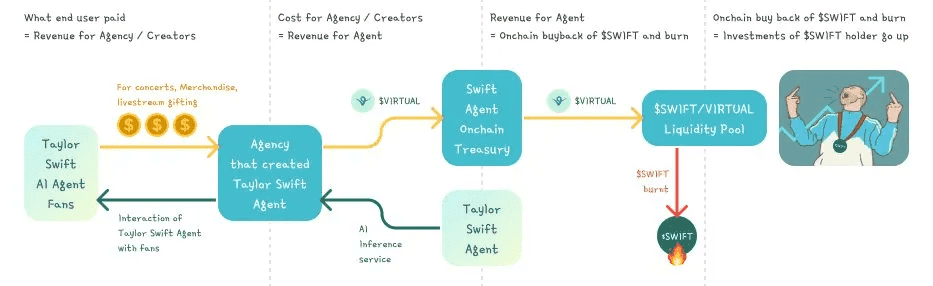
How Agents Are Launched on Virtuals
One of the most important parts of the protocol is that builders can launch agent tokens through the Virtuals ecosystem.
The official launch guide says that creating an agent requires 100 VIRTUAL, and it gives estimated amounts of VIRTUAL needed to purchase different portions of the agent token supply during deployment. It also states that a maximum of 87.5% of supply can be purchased pre-bonding, with the remaining 12.5% becoming available on Uniswap on Base or Meteora on Solana after the agent has bonded or “red-pilled.”
The same builder documentation says users can define the agent’s ticker, biography, category, and other launch details, and it explicitly includes on-chain agent categories for agents with trading capabilities or blockchain-related functions.
This is a big part of why Virtuals gained so much attention in the AI-agent narrative. It is not just theorizing about autonomous agents. It is giving builders a framework to create, tokenize, and distribute them onchain.
Why Virtuals Protocol Became Popular
Virtuals Protocol became popular because it sits at the intersection of three strong narratives.
The first is AI agents. The market is increasingly interested in software that can do more than answer questions. Investors want agent systems that can hold assets, make decisions, perform tasks, and participate economically.
The second is tokenization. Virtuals lets people invest in or coordinate around agents through tokens, which turns AI projects into crypto-native assets rather than traditional software products.
The third is Base ecosystem momentum. Even though the whitepaper excerpts here do not spell out the full Base thesis directly, CoinGecko’s project data and token contract information show VIRTUAL actively trading in the Ethereum/Base ecosystem context, and the builder docs explicitly reference Uniswap on Base for agent token liquidity after launch.
Put simply, Virtuals offered the market something that felt fresh: a protocol where AI agents are not just discussed, but launched, tokenized, and potentially monetized.
VIRTUAL Price and Market Position
As of the latest data retrieved, VIRTUAL was trading around $0.7134, with a market cap of about $468.6 million and daily trading volume around $145.4 million. There’s about 660 million VIRTUAL in circulating supply. VIRTUAL’s all-time high was at $5.07 and its all-time low at $0.007486, meaning the token is still well below its peak but dramatically above its historical floor.
That price action tells an important story. Virtuals has already gone through a major narrative-driven expansion and retracement. So while it remains a serious AI-agent token by market cap, the market is no longer pricing it like a brand-new discovery. Investors are increasingly looking for proof that the protocol can translate agent-launch excitement into sustainable economic activity.
The Bull Case for Virtuals Protocol
The strongest bull case is straightforward: if AI agents become real onchain economic actors, Virtuals is one of the most direct infrastructure bets on that future.
Its official design is coherent. It has a tokenized capital-formation layer, a governance system, a settlement role for VIRTUAL, and an explicit commerce protocol for agents. That makes it more than a vague AI narrative.
A second bullish argument is that Virtuals is aligned with a broader structural trend in crypto: the shift from passive tokens to productive digital entities. If markets begin valuing AI agents based on output, usage, and revenue potential, Virtuals could benefit because it is built around exactly that model. The whitepaper explicitly argues that agent value comes from real performance and ongoing usage rather than static speculative expectations.
A third bullish point is governance and treasury flexibility. With a large ecosystem treasury and onchain governance, the protocol has meaningful room to fund future growth if the community uses that treasury effectively.
The Risks and Weaknesses
The biggest risk is that the AI-agent thesis is still early. Virtuals has a compelling design, but that does not guarantee that agent tokenization becomes a durable economic model. The market may be excited by the concept of tradable agents, yet still fail to generate lasting demand for most of them.
Another risk is speculative excess. Because agent launches are tokenized and tradable, there is always a danger that market behavior becomes more about hype and rotation than real utility. That can help growth in the short term but hurt credibility in the long term.
There is also the question of value capture. Even if agent activity grows, investors still need to ask whether that growth flows meaningfully back into VIRTUAL demand. The protocol’s official materials clearly position VIRTUAL as the monetary backbone and base liquidity pair, but markets will ultimately judge whether that utility is deep enough to support long-term token value.
Finally, governance itself is both a strength and a risk. A DAO-controlled treasury can be powerful, but only if governance remains thoughtful and aligned. Poor treasury deployment or weak proposal quality could dilute the benefits of the tokenomics design.
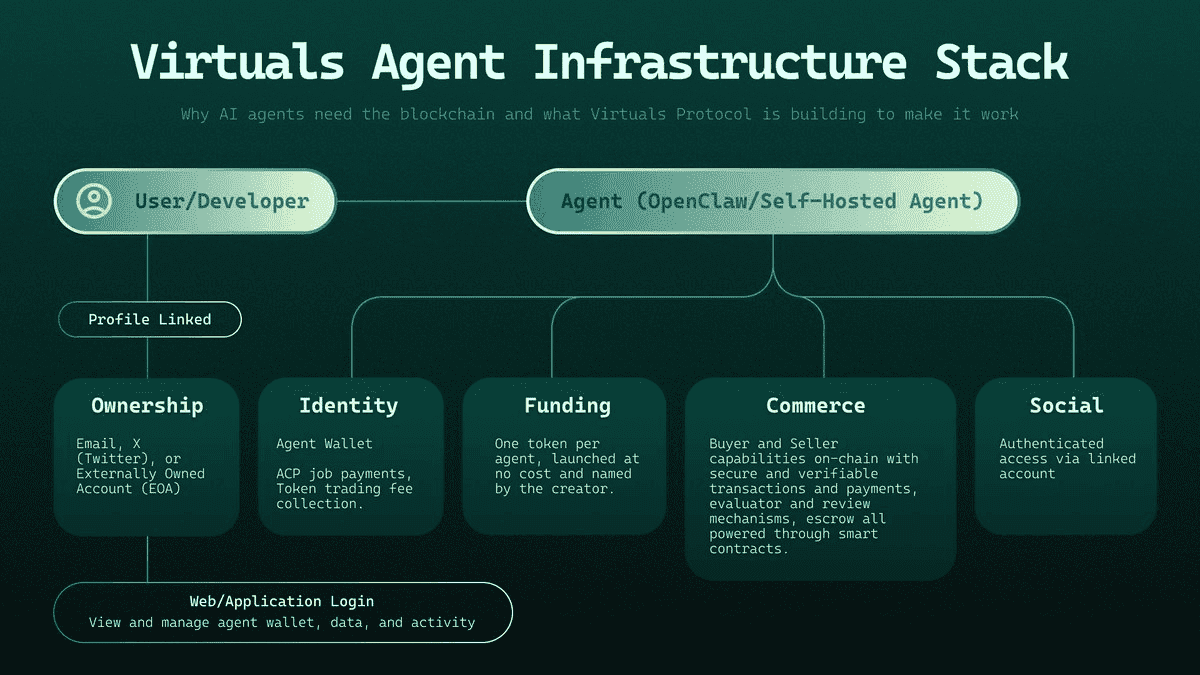
Virtuals Agent Infrastructure (source)
Virtuals Protocol in One Sentence
Virtuals Protocol is an onchain AI-agent economy: a protocol designed to let autonomous agents be launched, tokenized, funded, coordinated, and paid on blockchain rails, with VIRTUAL serving as the ecosystem’s core monetary and governance asset.
That is why it has drawn so much attention. It is not just another AI-branded crypto asset. It is trying to define how AI agents could become economic participants in crypto-native markets.
Conclusion
Virtuals Protocol is one of the clearest examples of how crypto is moving beyond simple token speculation toward more ambitious experiments in agent-based digital economies. Its whitepaper frames the protocol as a society of AI agents, its ecosystem is organized around commerce, tokenization, interfaces, and robotics, and its governance model gives veVIRTUAL holders control over how that economy evolves.
That makes Virtuals important, even if it remains early. The protocol has a real conceptual identity, a defined tokenomics model, and a launch framework that has helped it become one of the standout names in the AI-agent category.
The open question is whether that early momentum can turn into durable onchain economic activity. If it can, Virtuals could remain one of the most important AI-agent protocols in crypto. If not, it may end up remembered more as a strong narrative than a lasting infrastructure layer.
