








Key Takeaways
Swarms is an official multi-agent framework built for creating and orchestrating AI agents at scale, with production-oriented features such as tool integration, memory systems, logging, and concurrent execution.
The live Swarms Marketplace is designed for discovering, distributing, and monetizing agents, prompts, and tools.
The project frames itself as infrastructure for the agentic economy, meaning a world where AI agents become economic actors and software products in their own right.
$SWARMS is used in the ecosystem for governance participation, staking rewards, early access, exclusive feature access, and protocol revenue share, according to official DAO and investor pages.
As of April 2026, Swarms appears to be best understood as a combined framework + marketplace + token ecosystem, rather than only a token or only an open-source library.
Artificial intelligence is moving from single chatbots toward multi-agent systems: collections of specialized AI agents that can coordinate, delegate tasks, use tools, and solve more complex problems together. That shift matters because many real-world workflows are too large, too structured, or too dynamic for one model prompt to handle cleanly. Swarms is a project built around that exact idea. In its official documentation, Swarms describes itself as a production-grade multi-agent framework designed to orchestrate intelligent AI agents at scale, with enterprise-ready infrastructure, tool integration, memory systems, and multiple swarm architectures.
At the same time, Swarms is no longer just a developer framework. Its live platform also presents Swarms Marketplace, where users can “monetize and distribute” agents, prompts, and tools, while the broader platform messaging says it is building the infrastructure for the agentic economy. In other words, Swarms is trying to connect the developer layer, the marketplace layer, and a tokenized ecosystem into one stack.
The ecosystem token is $SWARMS, which current official investor and DAO pages tie to governance, staking rewards, exclusive feature access, protocol revenue share, and early product access. Those same official pages also identify the token contract on Solana and describe DAO participation through staking or treasury participation mechanics.
What Is Swarms?
Swarms is an AI project centered on the idea that useful AI systems increasingly need to be multi-agent, not single-agent. The official documentation says Swarms is a “production-grade framework” for orchestrating intelligent AI agents at scale and emphasizes that it was built for enterprise applications, not just demos or research prototypes. The docs list features such as hierarchical swarms, parallel processing, dynamic task distribution, multiple memory systems, custom agent creation, and production-focused monitoring and error handling.
That positioning matters because many AI projects use “agent” language loosely. Swarms, by contrast, is explicit that it is trying to provide an operational framework for building systems where multiple agents collaborate on complex work. The docs also say it supports real-world use cases across finance, healthcare, manufacturing, and other domains, which reinforces its attempt to be seen as serious infrastructure rather than just an AI meme narrative.
The project’s public-facing web properties show that this framework is now part of a larger platform. The marketplace site lets users browse categories such as agents, prompts, and tools, while the footer and related pages position the whole network as infrastructure for the “agentic economy.” That means Swarms is increasingly trying to become not just a coding framework, but also a distribution and monetization layer for AI-native products.
What Problem Is Swarms Trying to Solve?
Most DeFi tools today still assume one model handles one conversation or one task at a time. That works for simple interactions, but it breaks down as workflows become more specialized. A serious financial-analysis system might need one agent for data collection, one for modeling, one for risk analysis, one for drafting output, and another for review. A medical or research workflow might need similar specialization. Swarms is trying to solve that orchestration problem by giving developers a structured way to create coordinated systems of agents rather than isolated prompts. This is directly supported by the docs’ focus on multi-agent orchestration, hierarchical swarms, parallel processing, and intelligent task distribution.
There is also a commercialization problem in AI. Even if developers build useful agents, they still need a place to distribute and monetize them. Swarms Marketplace addresses that side of the equation by offering a place to discover and list agents, prompts, and tools, while its vendor messaging says creators can publish quickly, earn revenue, and reach a global audience.
So the core Swarms thesis is broader than “agents are cool.” It is closer to this: the future of AI will involve many specialized agents working together, and those agents will need both a technical coordination layer and an economic distribution layer. That framing is partly inference, but it is strongly supported by the official docs, marketplace positioning, and investor portal language about decentralized AI infrastructure.
How Swarms Works
The easiest way to understand Swarms is to break it into three layers: the framework, the platform/marketplace, and the token/DAO layer.
The Swarms Framework
At the framework level, Swarms provides the tooling for building agents and multi-agent systems. The docs describe the core Agent class as a system that combines a language model with tools, long-term memory, loop logic, document ingestion, and structured execution. The documentation highlights support for PDFs, text, Markdown, JSON, tool integration, retry logic, conversational loops, asynchronous execution, and various swarm architectures.
That matters because orchestration is not just about running two bots side by side. It usually requires task routing, state handling, model selection, memory, tool calling, and workflow control. Swarms’ docs show that the framework is trying to package those operational concerns into a unified developer toolkit.
The docs also show newer integrations such as MCP support and model-routing examples. MCP integration allows Swarms agents to connect dynamically to external tools and services via a standardized protocol, while the ModelRouter example describes automatic task analysis and model selection across providers. These features suggest that Swarms is trying to position itself as a broad agent-operating framework rather than just a prompt wrapper.
The Marketplace and Platform Layer
The live Swarms Marketplace is where the ecosystem becomes commercial. The homepage says users can “trade and discover tools, agents, and prompts,” and the vendor section emphasizes fast publishing, revenue generation, and discoverability. Product categories include agents, prompts, and tools, and the broader platform navigation also references dashboard, apps, chat, bookmarks, playground, and resources such as “Agent Economy” and “Foundry.”
This is a notable design choice. Instead of treating AI agents only as software components used behind the scenes, Swarms is treating them as marketplace-native products that can be listed, discovered, and monetized. That makes Swarms feel less like a pure framework and more like an app-store or platform economy for AI agents.
The marketplace examples help make that concrete. Public pages show specialized agents such as causal-reasoning systems, medical orchestrators, and market-intelligence tools. The content on these pages shows that Swarms wants the ecosystem to support both consumer-facing and professional/enterprise-grade agent products.
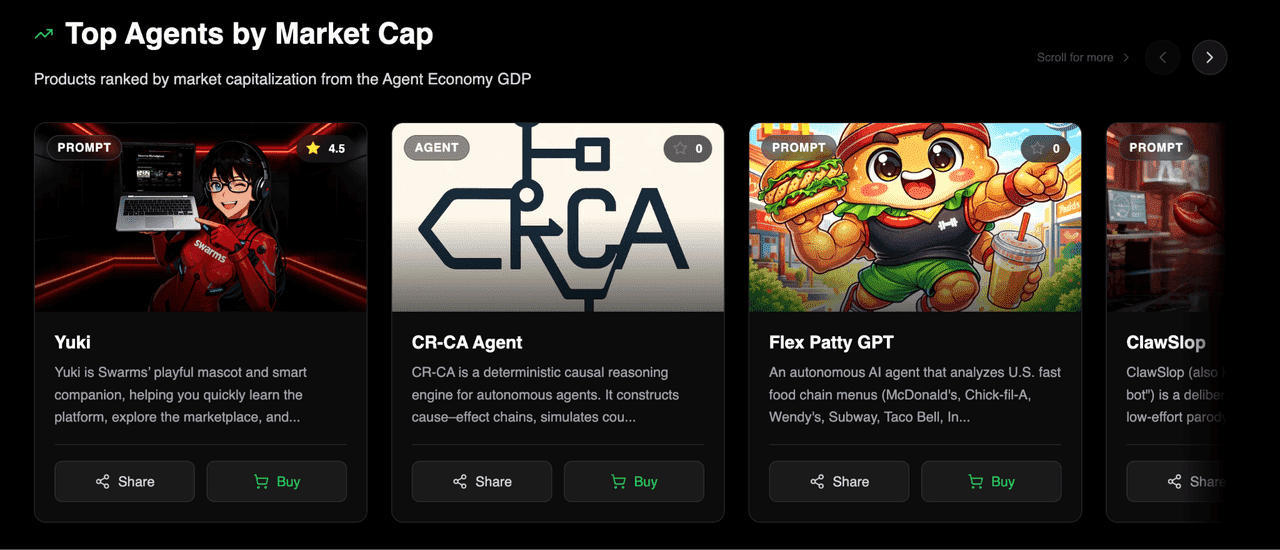
Swarms Marketplace (source)
The Agentic Economy Layer
Swarms uses the phrase “building the infrastructure for the agentic economy” on its site, and its investor portal describes the mission as “automating the world economy with multi-agent collaboration.” Those are bold phrases, but they reveal the project’s ambition: AI agents should not just be tools; they should become participants in software markets, payment flows, and decentralized economic systems.
The roadmap language on the investor portal pushes this even further. It references marketplace payments, an agent token exchange, infrastructure expansion, and extremely aggressive growth targets for active agents. Readers should treat those roadmap milestones as aspirational rather than guaranteed, but they do show that the project is thinking in ecosystem and network terms, not only in product terms.
What Is $SWARMS?
$SWARMS is the ecosystem token used across the project’s DAO and investor-facing ecosystem. The investor portal lists the token contract address on Solana, while the DAO portal says users can participate in governance and ecosystem growth with$SWARMS and SOL. Both pages make clear that the token is central to governance, staking, and ecosystem participation.
That means $SWARMS is not presented as a passive branding token. It is positioned as the economic and governance layer around the Swarms ecosystem. The investor portal lists governance voting rights, exclusive feature access, protocol revenue share, and early product access as token-linked benefits, while the DAO page highlights governance rights and staking rewards of up to 20% APY.
The same official pages also indicate that DAO participation requires meaningful token commitment. The investor portal lists a 1,000 $SWARMS minimum, active participation, governance commitment, and a 30-day minimum stake. Meanwhile, the DAO page refers to treasury participation and staking-based governance.
What Does $SWARMS Do?
Governance
The clearest role is governance. Both the DAO and investor pages say token holders can participate in governance, and the investor page explicitly lists governance voting rights among the benefits. The DAO site also shows active proposal counts and describes community-driven development as a core part of the platform’s identity.
This matters because Swarms is presenting itself as an ecosystem rather than a single app. Governance gives token holders a way to influence how the framework, grants, token distribution, and broader infrastructure evolve.
Staking and Rewards
The DAO page says users can earn up to 20% APY through staking, while the investor page also refers to governance participation through token commitment. That makes staking one of the project’s most visible economic hooks.
For a platform like Swarms, staking also serves a signaling function. It identifies committed ecosystem participants and aligns long-term token holders with the growth of the framework and marketplace. That alignment is an inference, but it follows naturally from the governance-and-rewards design described on the official pages.
Exclusive Access and Early Access
The investor portal says token participation can unlock exclusive feature access and early product access. That is important because it suggests the token is not only a governance asset but also a product-access asset.
This kind of utility can be meaningful in AI ecosystems, where new tools, agent launches, premium products, or enterprise features may be gated or prioritized for more engaged community members.
Protocol Revenue Share
One of the more notable token-linked claims on the investor portal is protocol revenue share. That is a meaningful positioning choice because it ties the token to the marketplace and infrastructure economy, not just to community symbolism.
Readers should still be careful to distinguish product marketing from realized economics, but the official positioning is clear: the token is meant to participate in the economic upside of the platform if the marketplace and infrastructure layers grow.
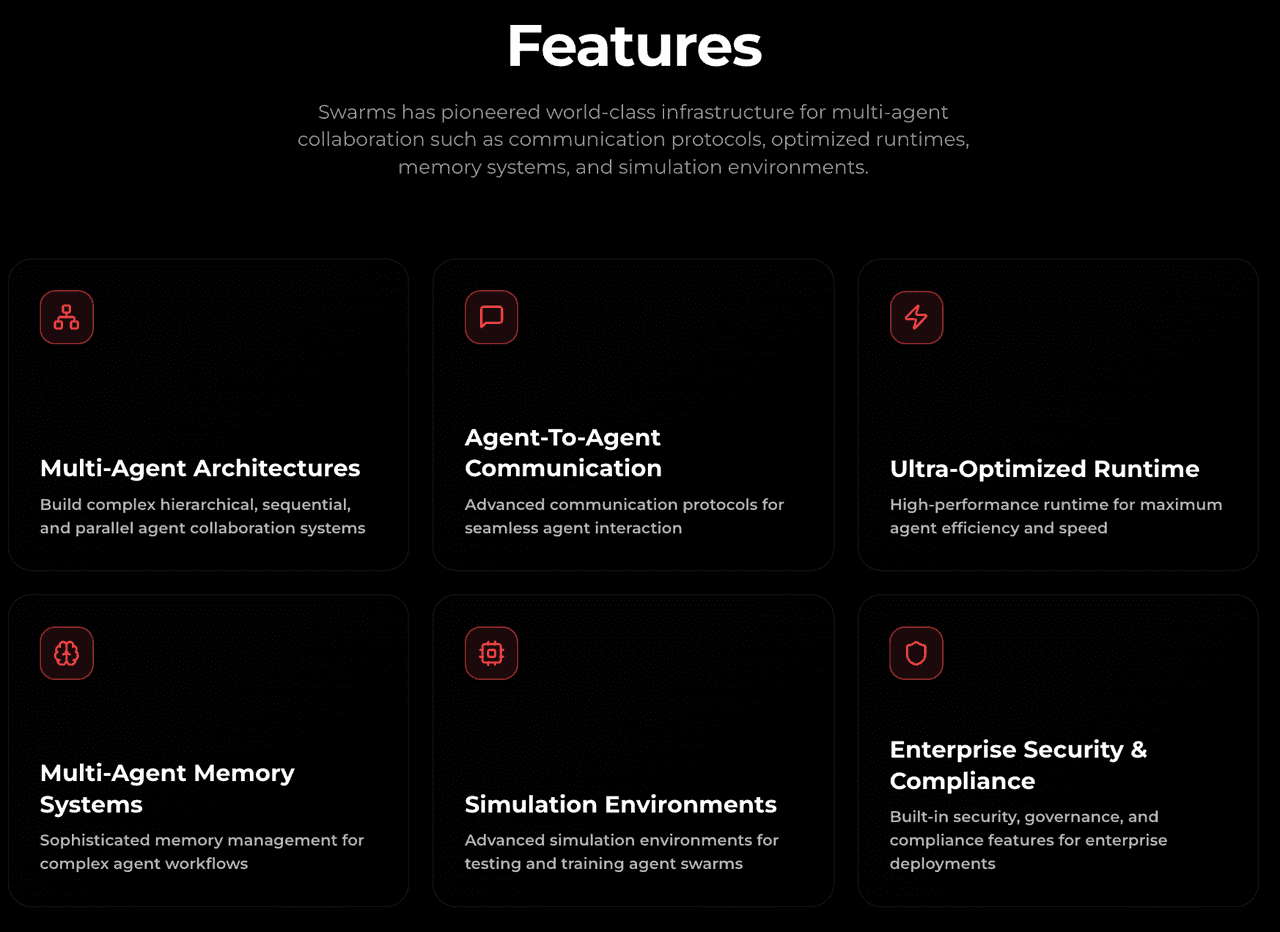
Swarms AI Features (source)
The DAO and Token Distribution Debate
One of the most interesting official disclosures on the DAO page is the project’s own discussion of token distribution. The team says that when the token launched, they took only 2% of total supply for the team, which they describe as one of the smallest allocations in DAO history. The page then says this extreme distribution led to problems such as instability and exposure to manipulation by large holders and exchange-linked actors.
The DAO page proposes increasing team allocation to 10% through governance, alongside growing grants, combating manipulation, and strengthening community-driven development. That is important because it shows the project is actively grappling with token-economy design rather than pretending the initial structure was perfect.
For investors and researchers, this is a double-edged signal. On one hand, it shows transparency about the tradeoffs of decentralization and token distribution. On the other, it also highlights that the tokenomics and governance structure are still evolving in meaningful ways. That is an inference based directly on the DAO proposal language.
Why Swarms Matters in the AI-Agent Sector
Swarms matters because it sits at the intersection of three strong narratives in 2026:
multi-agent AI frameworks,
agent marketplaces,
and tokenized agent economies.
A lot of AI-crypto projects talk about agents abstractly. Swarms is trying to provide the operational and economic structure around them. The documentation focuses on production readiness and orchestration. The marketplace focuses on monetization and discovery. The token/DAO ecosystem focuses on governance, incentives, and revenue participation. Taken together, that makes Swarms more like an ecosystem platform than a single AI application.
It is also notable that the live marketplace already shows specialized use cases across finance, healthcare, reasoning, and x402-related services. That gives the project a more concrete “agent economy” feel than ecosystems that only have token branding but little visible product surface.
Real Use Cases and Ecosystem Direction
The Swarms docs and marketplace show that the project is aimed at more than generic chatbots. Examples in the public docs and listings include structured causal reasoning, medical diagnostic orchestration, model routing, financial-analysis agents, and integrations with tools and APIs. The docs also include sections for x402, memory systems, tool integrations, API usage, and examples spanning many sectors.
This breadth is strategically useful. It means Swarms can pitch itself to:
developers building agent systems,
enterprises needing orchestration infrastructure,
creators monetizing prompts or agents,
and token holders participating in the ecosystem economy.
The risk, of course, is that broad ecosystems can lose focus. But the upside is that Swarms is not dependent on one narrow AI use case.
Risks and Limitations
Swarms is ambitious, but it comes with important risks.
The first is execution risk. The project is simultaneously trying to be a serious open-source framework, a marketplace for agents/prompts/tools, and a DAO/token ecosystem. Each of those is hard on its own. Doing all three well is harder. This is an inference based on the scope of the official docs, marketplace, and investor/DAO pages.
The second is tokenomics and governance risk. The DAO’s own message about the original 2% team allocation and the need to rebalance distribution shows that the project is still working through governance and incentive design. That transparency is helpful, but it also means the token structure is not static.
The third is adoption risk. Swarms can have strong docs and platform ambition, but the long-term value of the ecosystem depends on whether developers actually build on the framework, whether creators use the marketplace, and whether the token-linked economy generates durable activity. This is an inference from the ecosystem design rather than a direct project claim.
The fourth is competitive risk. Multi-agent frameworks and agent marketplaces are increasingly crowded. Swarms is competing against other orchestration frameworks, agent platforms, and AI-crypto ecosystems. Its differentiation appears to be the combination of framework maturity, visible marketplace surface, and tokenized ecosystem design. That is a reasoned inference from the product stack.
Conclusion
Swarms is one of the clearer examples of how the AI-agent sector is evolving beyond simple chatbot narratives. The project shows a real attempt to connect agent creation, agent orchestration, agent distribution, and tokenized ecosystem incentives into one platform.
The framework side gives developers a production-oriented toolkit for building multi-agent systems. The marketplace side gives those systems a place to be listed, discovered, and monetized. The DAO and token side give the ecosystem a governance and participation layer through $SWARMS.
As AI agents continue to move from experiments to products, projects like Swarms show how crypto can be used to coordinate ownership, incentives, and distribution around intelligent software. For traders looking to stay ahead of emerging narratives—from AI agents and chain abstraction to RWAs and PayFi—Phemex offers a secure and user-friendly platform to explore the market, monitor new opportunities, and sharpen your trading edge.
