








RAIN is the governance token of Rain Protocol, a decentralized prediction market infrastructure platform built on Arbitrum.
Rain is designed not only as a consumer prediction market, but as AI-ready infrastructure that lets builders launch their own forecasting platforms.
The protocol supports both private and public markets, uses an AMM pricing system, and can resolve outcomes through market creators, AI-assisted oracle systems, and dispute escalation to human oracles.
RAIN is currently positioned mainly as a governance token. According to the project’s white paper, it does not grant ownership, profit rights, redemption rights, or required access to core platform usage.
A share of protocol trading fees is used to buy back and burn RAIN, while limited new issuance may support ecosystem growth and development.
Rain’s broader thesis is that prediction markets can become a programmable information layer for communities, builders, and AI-powered forecasting platforms.
RAIN is the native governance token of Rain Protocol, a project focused on decentralized prediction markets. At first glance, that may sound similar to other on-chain forecasting platforms, but Rain is trying to do something a little broader. Instead of positioning itself only as a place where users speculate on event outcomes, the protocol is also presenting itself as infrastructure for builders.
Many crypto prediction markets are mostly consumer-facing. Rain’s current materials emphasize that the protocol provides AI-ready infrastructure for people and teams who want to launch their own forecasting platforms. In other words, Rain is not only a market destination. It is also a toolkit for creating new market experiences on top of a shared protocol. That makes the project easier to understand in two layers as a decentralized prediction market and as infrastructure for launching decentralized forecasting products.
What Rain Protocol Actually Is
Rain Protocol is a decentralized protocol for creating and participating in prediction markets. The core product idea is fairly straightforward: users define outcomes tied to real-world or digital events, provide liquidity, and trade positions based on how likely they think those outcomes are.
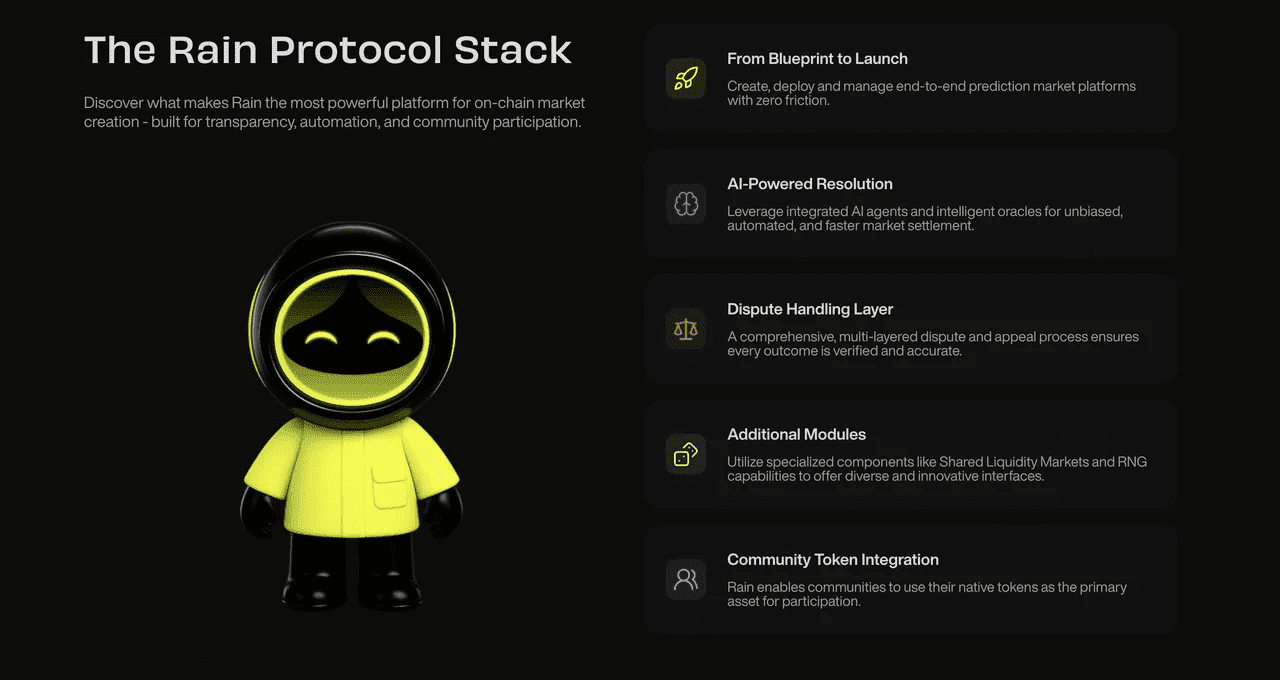
But Rain is not stopping there. The protocol also provides the infrastructure for builders to launch their own forecasting platforms. That means Rain is trying to sit one layer below the finished application. Rather than assuming everyone will use one front end forever, it wants to become the backend logic that different products and communities can build on.
This is one of the key reasons the project describes itself as AI-ready infrastructure. The aim is not just to host markets, but to help power a broader forecasting ecosystem. Rain combines market creation, liquidity provision, outcome trading, oracle-assisted resolution, and eventually DAO-based governance. That makes it more of a prediction-market protocol than just a token tied to one app.
Why Prediction Markets Matter
Prediction markets have always had a strong intellectual appeal in crypto because they turn belief into price. Instead of asking users only to vote, comment, or guess, prediction markets let them take positions backed by capital. This can make the market price a useful signal about what participants collectively think is likely to happen. That is why prediction markets are often described not just as gambling systems, but as information markets. They can aggregate opinion, conviction, and incentives into a single tradable mechanism.
Rain is clearly leaning into this broader use case. Its website emphasizes communities, private and public markets, and forecasting infrastructure. Its white paper goes further and presents Rain as a protocol where markets can be tied to real-world or digital events, with built-in infrastructure for market creation and resolution. So the project’s deeper bet is that prediction markets are not just niche betting products. They can also become a programmable layer for collective forecasting.
How Rain Protocol Works
Rain’s white paper gives a fairly clear picture of the basic system design. The protocol runs on Arbitrum, which means it benefits from Ethereum-linked security while using a Layer 2 environment designed for lower fees and better scalability. Users can create markets, define outcomes, provide liquidity, and trade positions.
Pricing is determined through an automated market maker (AMM) mechanism. In simple terms, that means prices move based on how liquidity is allocated across different outcomes. If capital shifts strongly toward one result, the implied probability of that result rises.
This structure makes Rain feel familiar to DeFi users. It is not using a traditional centralized sportsbook model. It is using on-chain liquidity and market mechanics to generate prices dynamically.
That also means liquidity is important. A prediction market is only as useful as the depth and efficiency of the market around it. Rain’s infrastructure design tries to make that process more scalable and builder-friendly.
Public and Private Markets
One of the project’s more interesting design choices is that it supports both private and public markets. A public market is what most users expect from prediction-market crypto: anyone can see the market, trade on it, and participate in forecasting a public question. A private market is different. It can be used by a smaller group, community, or organization that wants to forecast outcomes internally or in a more restricted environment.
That makes Rain more flexible than a protocol focused only on public speculation. Communities, DAOs, teams, and niche ecosystems may want internal or semi-private forecasting markets that are still on-chain and transparent within a defined context. This public/private split fits well with Rain’s positioning as infrastructure rather than just a one-size-fits-all product.
AI-Powered Resolution and the Oracle Layer
One of the most important parts of any prediction-market protocol is resolution. Markets are only useful if participants trust that outcomes will be resolved fairly and clearly.
Rain’s official materials say outcomes may be resolved in different ways:
by the market creator,
by an AI-based oracle system in certain public markets,
and through a dispute mechanism that can escalate to human oracles.
The project’s white paper refers to this oracle framework as Olympus AI.
This hybrid model is notable because it tries to balance automation with human oversight. Purely automated resolution can be fast, but it also creates risk if the oracle misreads an outcome or handles ambiguous information poorly. Purely manual resolution can be slower and more centralized. Rain appears to be aiming for a system that uses AI for efficiency but still preserves a path to dispute resolution.
Rain as Builder Infrastructure
The white paper explicitly says Rain protocol provides infrastructure for builders to launch their own forecasting platforms. The official website also frames Rain as more than just a single market venue. This matters for two reasons.
First, it gives Rain a broader market than a consumer-only app. If developers and communities use Rain as the backend for their own products, then the protocol becomes infrastructure rather than only destination traffic.Second, it fits the wider crypto trend toward modular systems. Increasingly, successful protocols are not always the ones with the flashiest consumer brand. Sometimes they are the ones that other builders choose to use underneath the surface.
So Rain’s long-term upside is not only tied to how many individual traders visit one interface. It is also tied to whether builders see Rain as a useful foundation for launching forecasting products.
What the RAIN Token Does
According to the project’s white paper, RAIN is currently a governance token. That point is extremely important, because many users will assume the token must be required for trading or market participation. According to the white paper, that is not the case. RAIN does not currently grant access to the protocol’s core prediction-market functions, and users do not need it to create markets, trade, or deposit.
The token is instead intended for future DAO-based governance, ecosystem coordination, and alignment around protocol development. Governance rights are planned for a later stage of development and are not yet active at the time of the current white paper. That means RAIN is a governance token in design intent, but the full governance functionality is still future-facing rather than fully live.
This is a crucial distinction for investors. RAIN is not best understood as a utility token for day-to-day protocol access. It is best understood as a governance and ecosystem token with a future DAO role.
RAIN Tokenomics
There is a total token supply of 1.15 trillion RAIN. The token is freely transferable on Arbitrum once in circulation, though certain internal allocations such as team, strategic partner, and presale allocations are subject to vesting schedules.
CoinGecko currently shows a slightly different live tokenomics snapshot based on circulating and unlocked supply, which is normal for market-data sites reflecting real-time release schedules. The broader takeaway is that the token has a very large max supply, a substantial circulating base already, and additional locked supply that can enter the market over time. In other words, the token story is not only about protocol adoption. It is also about how unlocks, vesting, and long-term emissions affect market perception and price.
Buyback and Burn Mechanism
One of the more supportive tokenomic features in Rain’s current design is that a share of trading fees is used to buy back and destroy RAIN. That is an important point because it gives the token some connection to protocol activity, even if the token is not required to use the platform directly.
If market usage grows, trading fees can help support token buybacks. That does not create a guaranteed value floor, and the white paper itself makes clear that the mechanism is subject to protocol parameters and governance decisions. But it does provide a clearer value-accrual narrative than a governance token with no fee linkage at all. At the same time, the white paper also warns that limited new token issuance may be used to support development and community rewards. So the buyback-and-burn story has to be evaluated together with future supply management.
The Bull Case for RAIN
The strongest bull case for RAIN is that it is not just building another prediction market front end. It is trying to build forecasting infrastructure. That matters because infrastructure plays often have broader upside if they become the layer that many products and communities use underneath the surface.
A second bullish point is that prediction markets are a strong crypto-native use case. They combine liquidity, incentives, and information aggregation in a way that is much more native to blockchain finance than many other “Web3 social” experiments.
A third bullish point is the builder thesis. If Rain succeeds in making it easier for communities and third parties to launch their own markets, then the protocol could grow as an ecosystem rather than just as one app.
A fourth bullish point is that tokenomics at least attempt a feedback loop through trading-fee buybacks and burns, which gives the token a stronger story than governance alone.
The Risks and Weaknesses
The biggest risk is that prediction markets remain a specialized category. Even though they are intellectually attractive, prediction markets have historically struggled to become mainstream consumer products. Rain may have strong infrastructure, but it still needs real and sustained user demand.
A second risk is resolution complexity. AI-based oracle systems can improve efficiency, but they also introduce risk if outcomes are ambiguous or contested. Rain’s human dispute path helps, but it does not eliminate this challenge.
A third risk is token utility timing. Since governance is still planned for a later stage, some of RAIN’s intended value proposition remains future-facing rather than fully active today.
A fourth risk is supply. The total supply is extremely large, and vesting/unlock schedules matter. Even with buybacks and burns, tokenomics can become a headwind if market growth does not keep pace.
A fifth risk is competition. Prediction markets are still a small enough sector that a few strong protocols can shape the entire category. Rain needs to prove not only that its infrastructure is useful, but that it is differentiated enough to win meaningful builder and user adoption.
What Is RAIN in One Sentence?
RAIN is the governance token of Rain Protocol, a decentralized prediction-market infrastructure platform on Arbitrum that helps users and builders create, trade, and resolve outcome-based markets.
Conclusion
Rain Protocol is trying to push prediction markets beyond simple speculation and into infrastructure. Its core design supports market creation, liquidity provision, AMM-based pricing, AI-assisted resolution, and a future DAO governance model. More importantly, it positions itself as a platform builders can use to launch their own forecasting products.
That makes RAIN more interesting than a generic market token. It sits on top of a protocol with a real infrastructure thesis.
The opportunity is that prediction markets could become a useful information and coordination layer for communities, apps, and on-chain ecosystems. The challenge is that this category is still relatively early, resolution remains a hard problem, and the token’s governance utility is still partially future-facing.
So the best way to think about RAIN is that it’s a bet on decentralized forecasting infrastructure, not just on one prediction-market app.
Register](https://phemex.com/register?group=7916&referralCode=CUFKP8">Register) on Phemex Now
