









Key Takeaways
Golem is a decentralized marketplace for computing power, where users can either rent compute resources or share idle hardware with the network.
The network is built around two core roles: requestors, who need computing power, and providers, who supply it in exchange for GLM tokens.
GLM is the network’s ERC-20 utility token and is used as the payment currency for renting resources on Golem.
Golem started as one of the earliest decentralized computing visions in crypto and has expanded from general-purpose compute into newer AI- and GPU-focused use cases.
The project now supports tools and integrations such as JavaScript and Python SDKs, Ray on Golem, and newer offerings like Golem-Workers for high-level access to CPU and GPU resources.
Golem’s long-term thesis is that computing should be more open, modular, and marketplace-driven rather than dominated only by large centralized cloud providers.
Golem is one of the oldest and most recognizable projects in decentralized computing. Long before crypto markets became crowded with DePIN, GPU tokens, and AI infrastructure plays, Golem was already trying to answer a very simple but powerful question: what if computing power could be bought and sold through an open marketplace instead of only through centralized cloud companies? That idea still defines the project today.
At its core, Golem is a decentralized platform where anyone can contribute spare computing resources and anyone else can rent those resources when they need extra compute. In practice, that means developers, researchers, startups, or companies can tap into distributed hardware for workloads like rendering, data processing, simulations, or AI tasks. On the other side of the market, providers can monetize idle CPUs or GPUs that would otherwise sit unused.
What Golem Actually Is
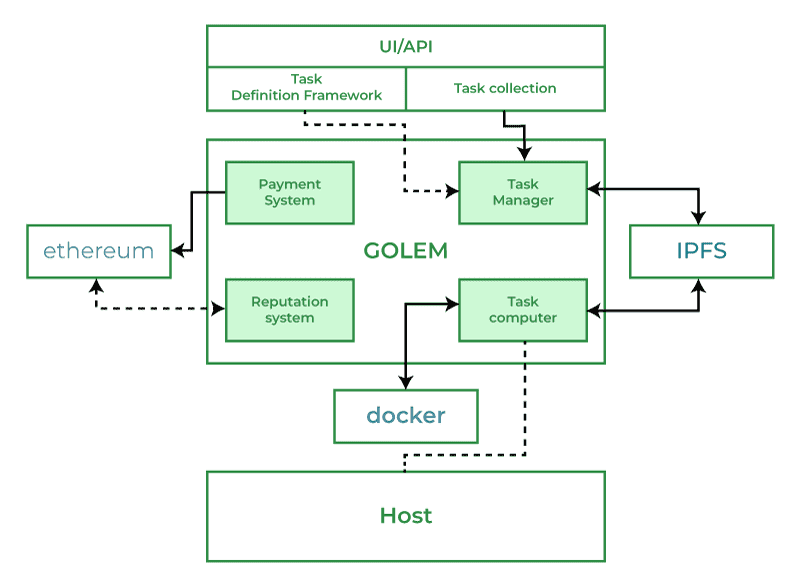
Golem is not a Layer 1 blockchain, a DeFi protocol, or a general smart contract platform in the usual sense. Instead, it is a peer-to-peer protocol for digital resource rental. The official site describes Golem as an open-source and decentralized platform where everyone can use and share each other’s computing power without relying on centralized cloud corporations. That framing is important. Golem is trying to serve as an alternative infrastructure layer for computation, not as just another token ecosystem.
The simplest mental model is if you need computing power, you join Golem as a requestor, if you have idle computing power, you join Golem as a provider, and GLM is the token used for payment between them. That sounds straightforward, but it is a meaningful concept. Instead of building giant data centers and renting them out from one central company, Golem tries to coordinate a distributed pool of machines across many independent participants.
The Two Sides of the Network: Requestors and Providers
Understanding Golem starts with understanding its two main roles.
Requestors
A requestor is someone who wants to use computing resources from the network. This could be a developer, startup, scientist, or company that needs extra processing power. Requestors use hardware shared by providers and can even use resources from many providers at the same time to run tasks in parallel. This is one of the main advantages of the model: a requestor does not need to own all the hardware it needs in advance. It can tap into a broader distributed market when demand appears.
Golem’s official platform pages and developer docs highlight use cases such as machine learning, data analytics, rendering, video transcoding, CAD simulations, chemistry simulations, and more recently AI inference and scaling Python workloads.
Providers
A provider is someone who contributes hardware resources to the network. According to the docs, almost any internet-connected computer can potentially act as a provider, including laptops, desktops, and servers, depending on configuration and supported workloads. Providers make their compute available and earn GLM in exchange when requestors rent their resources. This is the demand side and supply side of the Golem marketplace working together.
That two-sided market structure is the heart of Golem. It is not just decentralized storage of files or simple task outsourcing. It is a live compute market.
What the GLM Token Does
GLM is the native utility token of the Golem Network. The platform describes GLM as an ERC-20 utility token used as the currency for renting resources from providers. The payments documentation makes the same thing clear: providers offer resources for a price, requestors rent those resources, and payment happens in GLM. This means GLM is not mainly a governance token in the way many DeFi projects use tokens. Its primary purpose is transactional. It is the economic medium of the compute marketplace.
That gives GLM a relatively straightforward utility story:
requestors need GLM to pay for compute
providers receive GLM for supplying compute
the token functions as the medium of exchange across the network
From an investment perspective, that means GLM’s long-term value proposition depends heavily on whether the network can attract more useful workloads and more demand for decentralized computing.
Golem’s Original Vision
Golem is one of the earlier crypto projects in this category. Its whitepaper was first introduced in 2016, and the project’s official history notes that Golem became one of the earlier crowdfunded projects focused on decentralized computing. That matters because Golem did not appear during the recent AI or DePIN narrative wave. It was working on decentralized compute before those categories were fashionable.
This gives Golem two interesting qualities. First, it has survived long enough to show that it is more than a short-term trend token. Second, it has also had to evolve. The project’s own history page says the whitepaper still reflects its mission, but its current technology and priorities have adapted over time, especially in response to AI and decentralized infrastructure demand.
So while Golem is an old project by crypto standards, it is not static. It is better understood as an early decentralized-computing project that is now trying to stay relevant in a more AI-driven market.
What Can Be Built on Golem?
One of Golem’s strongest features is flexibility. The platform page says developers can build “anything you want” in the network, and the official examples include machine learning, data analytics, image and video rendering, simulations, scientific workloads, and AI inference. That breadth is important because Golem is not limited to one narrow vertical. It is not just a rendering network, not just an AI marketplace, and not just a scientific-computing grid. It is trying to remain a general-purpose decentralized compute layer.
The developer docs also reinforce this by offering multiple paths into the network:
JavaScript support
Python tooling
Ray integration
Job APIs
and other developer-focused resources
This makes Golem more of a programmable infrastructure layer than a single-purpose consumer product.
Golem and AI
This is where the story gets more current. Golem’s recent website and blog materials show a stronger push into AI infrastructure and GPU infrastructure. The dedicated AI page says Golem offers more affordable GPU computing power using consumer-grade cards, while newer roadmap and product materials make it clear that the project is trying to capture part of the growing demand for AI computation.
The broader cloud market has become increasingly expensive for smaller AI teams, especially those that need bursts of GPU access without committing to long enterprise contracts. Golem is trying to position itself as a decentralized alternative for some of that demand.
Of course, Golem is not claiming to replace every hyperscale AI cloud. But it is clearly trying to offer a more open and cost-effective layer for many workloads that do not require the largest centralized infrastructure providers. That gives the project renewed relevance in the current crypto market, where decentralized AI infrastructure has become a major theme.
Ray on Golem
One of the clearest examples of Golem’s AI and developer positioning is Ray on Golem. Ray is a widely used open-source framework for scaling Python applications, especially in AI and machine learning. Golem’s docs explicitly say Ray on Golem makes it easy to run Ray applications on Golem’s decentralized compute marketplace.
This matters because it lowers the barrier for developers who already use familiar tools. Instead of learning an entirely new environment from scratch, they can plug a known scaling framework into decentralized infrastructure. That is exactly the kind of bridge Golem needs. Strong infrastructure alone is not enough. Developers need practical integration paths, and Ray is one of the most credible examples of that strategy.
Golem-Workers and Higher-Level Access
Another important part of the recent Golem direction is Golem-Workers. This is an API that gives direct and high-level access to GPU and CPU resources on the network. The post says it is meant for developers, startups, and companies that need compute power for tasks ranging from AI model fine-tuning to data processing. This is important because it suggests Golem is moving beyond the earlier “build everything from low-level components” approach. Higher-level APIs can make the network easier to adopt for real businesses. That may not sound exciting compared with token price action, but it is exactly the kind of product evolution a compute marketplace needs if it wants broader demand.
Golem’s Role in the DePIN Sector
Today, Golem is often grouped with DePIN projects, even though it predates that label. That fit makes sense. DePIN usually refers to decentralized networks where people contribute physical or digital infrastructure resources — such as compute, storage, bandwidth, or wireless coverage — and are rewarded through tokens. Golem clearly fits the compute side of that idea.
But Golem is also slightly different from some newer DePIN tokens because it has had more time to evolve and because its core market is explicitly transactional. The requestor/provider model is not just a speculative staking system. It is an attempt to create a functioning compute economy. That makes Golem a useful reference point in the DePIN space: one of the earlier and more mature attempts to build a tokenized infrastructure marketplace.
The Golem Ecosystem Fund
Golem is also trying to support growth around the network, not only inside it. The Golem Ecosystem Fund was launched to support developers, researchers, and entrepreneurs building projects that contribute to Golem or its broader decentralized-computing vision. The site says the initiative began by staking 40,000 ETH, with most rewards directed toward beneficiaries and ecosystem support.
This matters because network growth does not happen automatically. Golem appears to understand that compute demand, tools, and community use cases need active cultivation. For investors, this is also meaningful because it shows the project has some capital and institutional ability to support ecosystem development rather than relying purely on token speculation.
The Bull Case for Golem
The strongest bull case for Golem is that decentralized computing is still a very large and still unsolved category. Cloud infrastructure remains expensive and concentrated. If even a modest part of AI inference, rendering, simulation, or general compute shifts toward marketplace-based alternatives, Golem could benefit.
A second bullish point is that Golem already has real technical infrastructure and a long operating history. It is not a brand-new project promising future decentralization. It has been building this category for years. A third bullish factor is the AI pivot. By expanding into GPU and AI-related tooling, Golem is trying to align itself with one of the strongest market narratives while still staying close to its original mission. A fourth bullish point is that GLM utility is easy to understand. It is the payment token of the compute market, which is simpler than many vague token-economy stories.
The Risks and Weaknesses
The biggest risk is competition. Golem is no longer one of the only names in decentralized compute. It now competes with newer DePIN projects, AI infrastructure tokens, and still with the giant centralized clouds that dominate the market.
A second risk is demand generation. Having providers is not enough. The network needs requestors with real workloads and recurring spend. A third risk is developer adoption. Golem’s tools are increasingly practical, but developers still need strong reasons to move workloads away from familiar centralized systems. A fourth risk is token-value capture. Even if Golem usage grows, investors still need to ask how much of that activity translates into durable demand for GLM rather than temporary transactional flow.
What Is Golem in One Sentence?
Golem is a decentralized marketplace for computing power where requestors rent CPU and GPU resources from providers and pay for them in GLM.
Conclusion
Golem remains one of the clearest and most established examples of decentralized computing in crypto. Its basic model is simple but powerful: let anyone rent computing power when they need it, and let anyone earn from hardware when it would otherwise sit idle.
What makes the project interesting today is that this old vision now overlaps with new demand. AI, GPU workloads, and flexible developer infrastructure have made decentralized compute relevant again. Golem is trying to use that moment to expand from its original marketplace model into a broader ecosystem of AI-friendly tools and APIs.
That does not guarantee success. The project still faces serious competition and the usual challenge of turning infrastructure into large-scale demand. But if decentralized computing continues to matter, Golem is still one of the key names worth understanding.
Register](https://phemex.com/register?group=7916&referralCode=CUFKP8%22>Register) on Phemex Now
